Telehandler (Rough Terrain Forklift) Safety
Updated 2026-10-12
In this bundle Vehicle Safety
Working in California? See the Cal/OSHA edition → California (Cal/OSHA)Working in Washington? See the WA DOSH edition → Washington (WA DOSH)
Print-ready PDF
Download this talk as a print-ready PDF, available in 4 languages.
A telehandler is the most useful machine on a jobsite and the one that gets treated most like a pickup truck. It unloads the flatbed, carries the pallet across the mud, and puts the trusses on the second floor, and the same driver who did all three this morning was running a warehouse forklift last year. This Telehandler (Rough Terrain Forklift) Safety Toolbox Talk (Safety Talk / Tailgate Talk) is about the one thing a telehandler has that a forklift does not: a boom. The boom is why the machine is on the site, and the boom is what tips it over, drops the load, and turns a forklift into a crane without anyone deciding it should be.
Where the boundary of this talk sits#
The forklift talk owns the powered industrial truck as a machine — the capacity plate, the stability triangle, "keep the load low," "stay in the seat," and the training and evaluation OSHA requires before anyone operates one. The cranes talk owns rigging, signals, and suspended loads once a machine is a crane. The overhead power lines talk owns clearance distances. The backing-up talk owns the spotter. The aerial lift talks own machines built to lift people. All are linked. This talk owns what the boom changes: a capacity chart with two axes instead of one, a frame that has to be level before the boom goes up, a load that has to be secured before it leaves the ground, attachments that change the machine and sometimes the rules, and the moment a telehandler stops being a forklift. It is written for construction, where 1926.602 brings in the forklift rules.
The anchor#
Here is the distinction that carries this whole talk: a forklift's capacity drops along one line — how far forward the load sits — but a telehandler's capacity drops along two, boom angle and boom extension, so every foot of boom you run out and every degree you lower it takes capacity away, and the same load that was within the chart at the truck can be over it at the second-floor deck; which is why the chart is read before the boom goes out, the frame is leveled before the load goes up, the load is secured before it leaves the ground, and the boom comes in and down before the machine moves — because the reach that makes a telehandler useful is the reach that tips it, and the machine does not know which one you are using.
The chart has two axes#
Open the cab of any telehandler and you will find a load chart: a grid of boom angles and extensions with capacity zones drawn across it. That chart is the machine. A counterbalanced forklift's plate gives one number at one load center; a telehandler's chart gives a different number for every combination of how high the boom is and how far it is out, and the numbers fall fast as the boom extends. A machine rated for several thousand pounds at the carriage can be rated for a fraction of that at full reach. The zones also change with the machine's setup — which attachment is on, whether the stabilizers are down, which tires and pressures it carries — and the manufacturer publishes a chart for each, which is why 1910.178 requires the capacity marking to match the truck as configured and forbids attachments or modifications without the manufacturer's written approval.
The crew-level rule: the chart is read before the boom goes out, not after the alarm sounds. The load moment indicator or overload alarm on newer machines is a warning that you are already at the edge; it is not a substitute for knowing where the edge is. Find the load's weight — from the ticket, the bundle tag, or the supplier — find the boom angle and extension the placement will need, and check that the chart allows it with the attachment you have on. If the number is not on the chart, the lift does not happen that way: bring the machine closer, break the load down, or get a crane. "It picked it up fine" at the truck tells you nothing about what happens when the boom is twenty feet out over a deck.
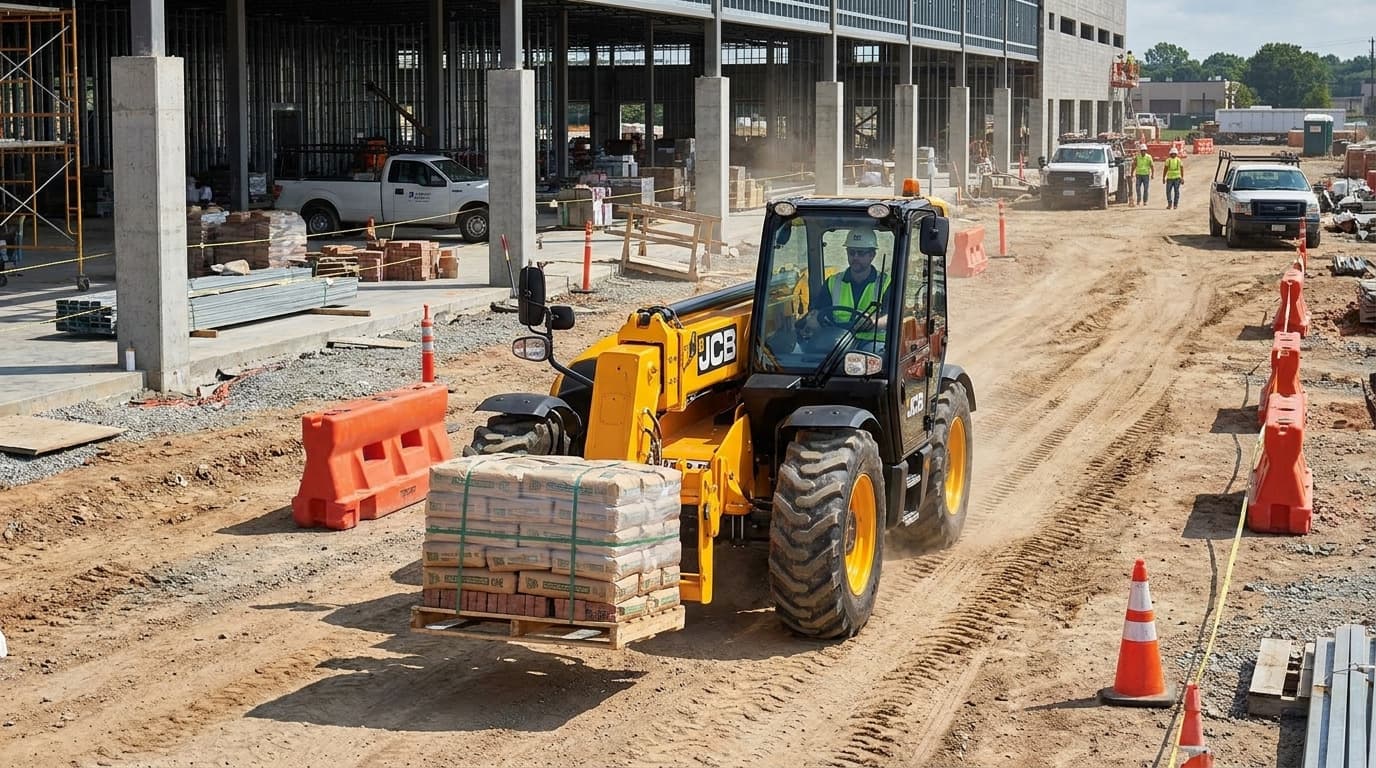
Level first, then lift#
A telehandler on a jobsite is almost never on flat ground, and its stability depends on the frame being level before the boom is raised. Every machine has a frame-level indicator in the cab; the operator levels the frame — with the frame-sway or leveling function, or by repositioning the machine — while the boom is still down. The manufacturer's manual sets a boom height above which the frame must not be leveled, because leveling with a raised, loaded boom shifts the load sideways at exactly the moment the machine has the least margin; know that height for your machine and treat it as a wall. Where the chart requires stabilizers for the lift, they go down on firm ground, with cribbing or pads where the ground will not hold them, before the boom moves.
The ground itself is a decision. OSHA's own description of this class of machine says "rough terrain" does not mean it is suitable for every conceivable type of terrain. Soft fill, a trench backfill, a slope that looked flat, a tire sinking on one side — each one tilts the frame after you leveled it. Walk the path and the set-up spot before the first lift of the day, and again after rain.
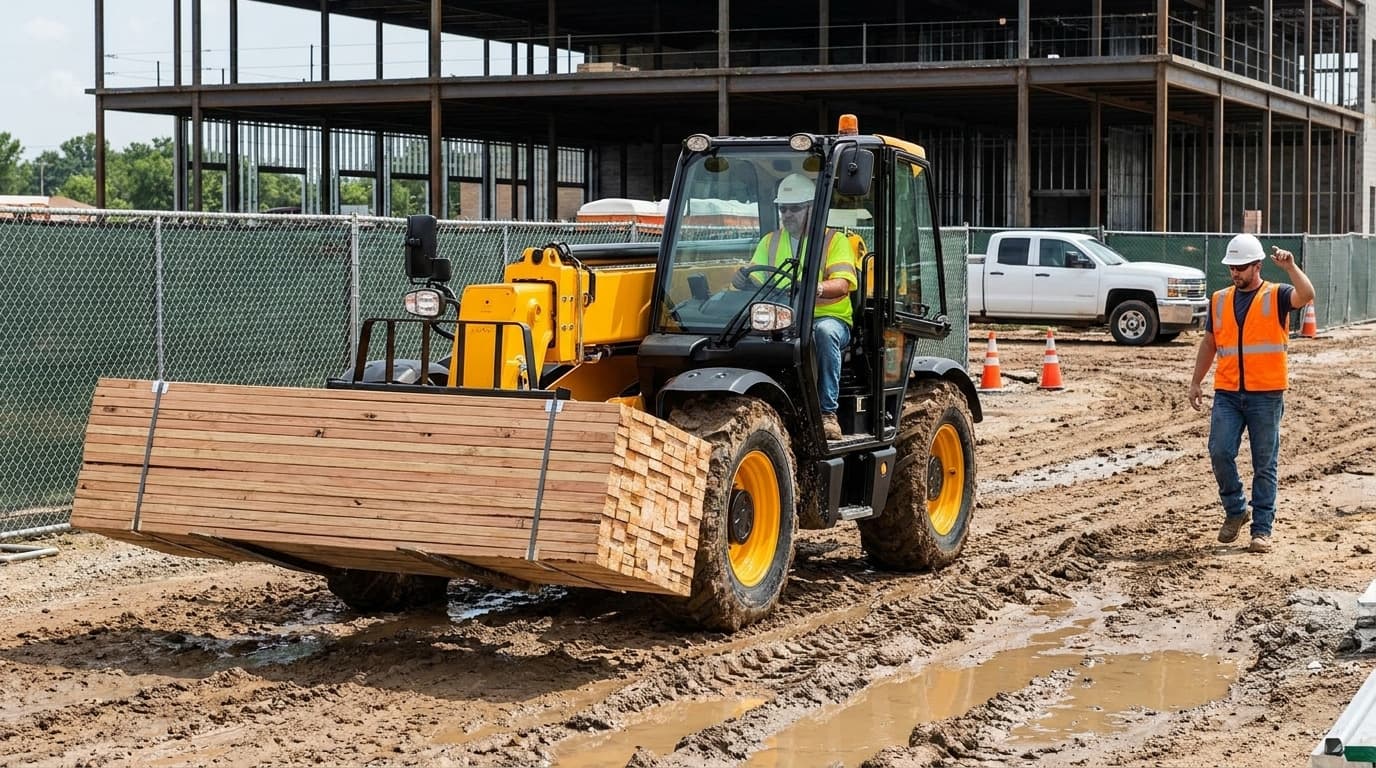
Travel has its own rules, and they are the forklift rules made stricter by the boom. The boom comes in and down before the machine moves — never travel with a raised or extended boom. On grades over 10 percent, a loaded truck is driven with the load upgrade: forward going up, in reverse coming down, with the load tilted back and raised only enough to clear the surface. Where the load blocks the view ahead, travel with the load trailing or use a spotter. Speed on rough ground is set by what the machine can stop on, not by the schedule. And if the machine starts to go over, the forklift talk's rule holds: belt on, stay in the seat, brace, lean away — OSHA enforces the use of installed operator restraints on powered industrial trucks under the General Duty Clause because tip-over is a recognized hazard and jumping is what kills.
Secure the load before it leaves the ground#
The second thing a boom changes is what the load does on the forks. A pallet on a warehouse floor sits still; a bundle of lumber going up to a deck on a boom twenty feet out is being tilted, swung, and set down at the far end of a lever, in wind. OSHA's forklift rules are written for this: only stable or safely arranged loads are handled, with extra caution for off-center loads that cannot be centered; long or high loads that affect capacity are adjusted; the forks go under the load as far as possible and the carriage is tilted back to stabilize it; and tilting forward with the load elevated is prohibited except to set the load down.
On a jobsite that means four habits. Center and spread. The load sits centered on the carriage with the forks spread as wide as the load allows, and the forks go all the way in — a bundle balanced on the fork tips is a bundle that slides off when the boom tilts. Band and strap. Trusses, lumber, pipe, and sheet goods are banded or strapped as a unit, and long loads that can slide forward on tilt-back or forward tilt are secured to the carriage. Loose or broken banding is fixed on the ground, not at height. Nothing loose on bare forks. Blocks, bricks, tools, buckets, and scrap go in a cage, a bin, or a bucket attachment the manufacturer approved — not piled on the forks. Nothing hanging from the forks. A load slung from the forks with chains or straps is a swinging pendulum on a lever arm, and it is also the first step toward the crane question in the next section; it does not happen without the manufacturer's say-so and a site decision.
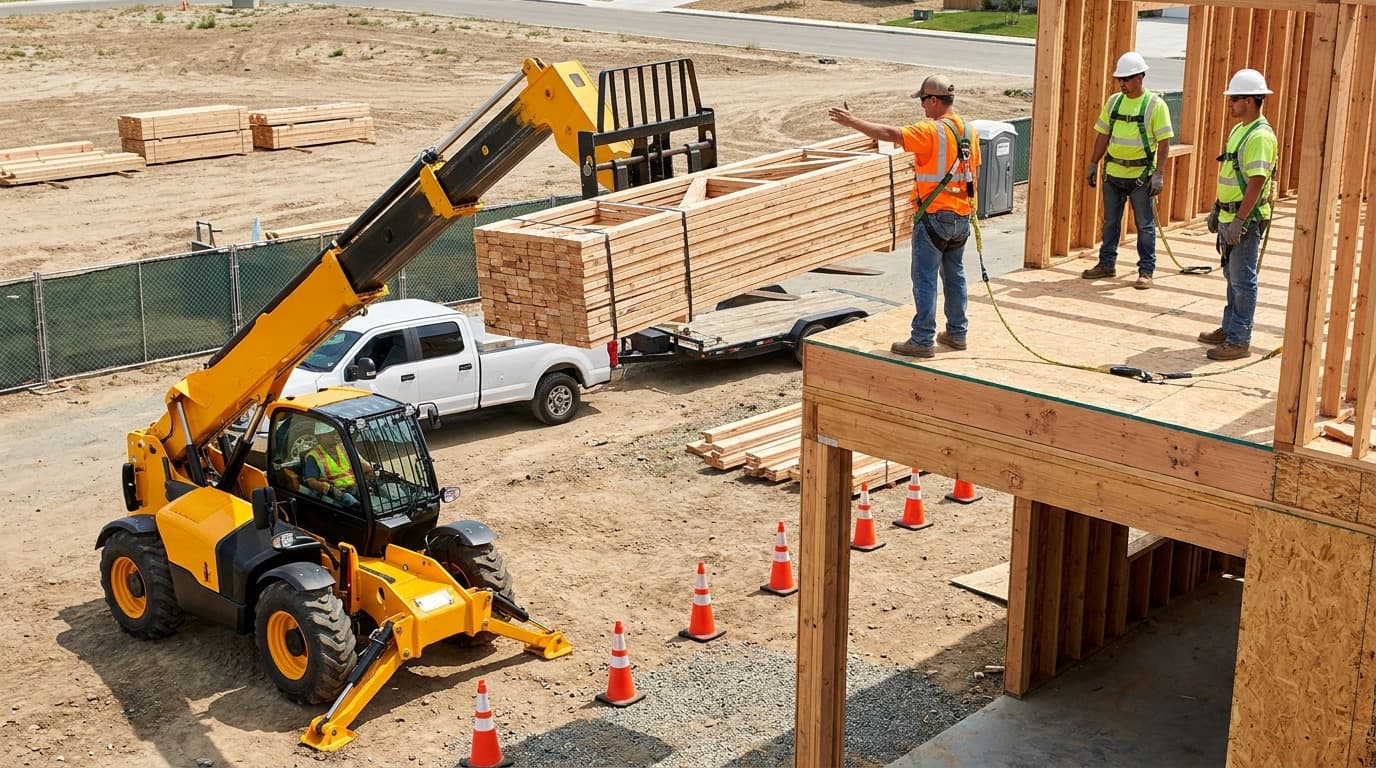
The landing is where this all pays off. When the load reaches the deck the boom is at its longest, the capacity is at its lowest, and the people receiving it are standing at an edge. Nobody stands under the elevated load or the boom at any point — OSHA's rule is that no one passes or stands under the elevated portion of any truck, loaded or empty. The receivers are tied off, the load is set down fully before anyone touches it, the forks are withdrawn clear before the boom swings or retracts, and the operator does not take direction from three people at once; one signal person, in view.
Attachments change the machine, and some change the rules#
Forks, buckets, jibs, hooks, truss booms, work platforms — a telehandler takes them all, and each one is a different machine with a different chart. The rule from 1910.178 is plain: attachments and modifications that affect capacity or safe operation need the manufacturer's prior written approval, and the capacity marking must be updated to match. A truck with an attachment is operated as a partially loaded truck even when it is empty.
Two attachments change the rules, not just the chart.
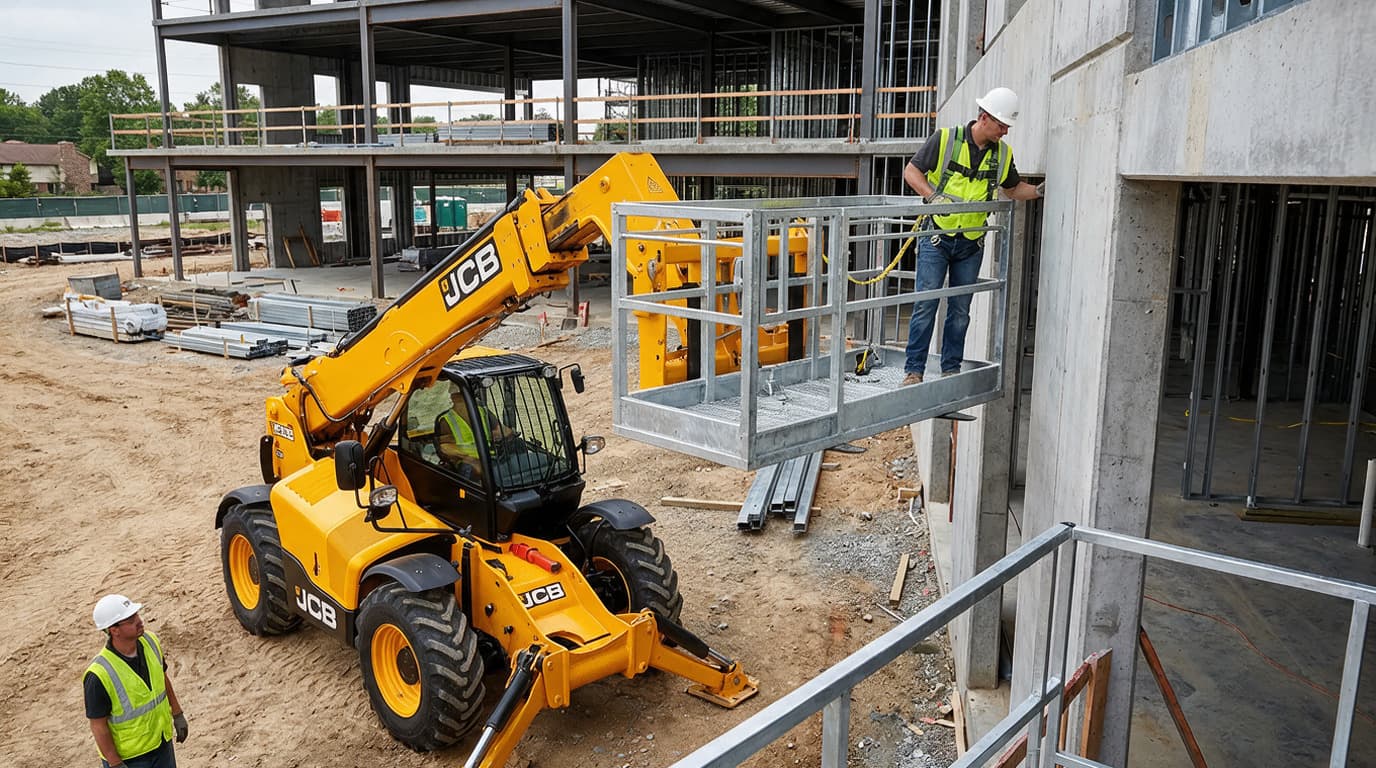
A platform for people. Under 1926.602(c)(1)(viii), lifting personnel on a powered industrial truck requires a safety platform firmly secured to the carriage or forks, a way for the people on the platform to shut off power to the truck, and protection from falling objects where conditions call for it. OSHA has gone further in writing, three times: a rough terrain forklift may lift people only if the machine was designed for it — if the manual prohibits it, it is prohibited; if the manual is silent, the employer confirms with the manufacturer or gets a registered professional engineer's certification. The platform and the machine then fall under the scaffold rules: capacity of at least four times the intended load, a platform designed by a qualified person, and no horizontal travel with the platform occupied. And OSHA has quoted the industry standard back to employers: rough terrain forklifts shall not be used to lift personnel unless there is no other practical option. Scissor lifts, boom lifts, and scaffolds come first.
A hook or a winch. OSHA's cranes standard excludes forklifts "except when configured to hoist and lower (by means of a winch or hook) and horizontally move a suspended load." OSHA's own guidance says equipment designed to work as both a crane and a forklift is multi-purpose equipment covered by the cranes standard when configured, and operated as, a crane. Put a hook or winch attachment on the boom and swing a suspended load and you may have a crane on site, with the crane rules — ground conditions, power-line clearances, qualified rigger and signal person, inspections — and, for rated hoisting capacity of 2,000 pounds or less, the lighter set in 1926.1441 with a trained operator. A load slung from the bare forks of a vertical-mast forklift was ruled not a crane in 2012, but the telehandler's boom moves a load in ways a mast cannot, so the question is settled before the attachment goes on — by the manufacturer's guidance and the site's crane rules — not after. The cranes talk owns what happens once the answer is yes.
Near overhead lines the clearance rules apply whichever machine you are: the boom reaches, and the power-lines talk owns the distances.
Where the duty sits#
In construction the telehandler is a powered industrial truck under 1926.602(c): rated capacity posted and never exceeded (c)(1)(i), design, stability, inspection, and operation to the ANSI B56 standard (c)(1)(vi), no unauthorized riders (c)(1)(vii), and the personnel-platform precautions (c)(1)(viii). 1926.602(d) makes the 1910.178(l) training rule apply — formal and practical training plus an evaluation, on this type of truck and this site, with a new evaluation at least every three years and refresher training when the operator is assigned a different type. Through the same standard: (a)(4) manufacturer approval for attachments and updated capacity markings; (m)(2) no one under the elevated portion; (m)(5) the unattended-truck rule at 25 feet or out of view; (n)(7) grades; (o) stable loads, within capacity, forks fully under, tilt back; (p)(1) out of service when unsafe; (q)(7) examined before each shift. The rough-terrain consensus standard is ANSI/ITSDF B56.6; OSHA's rule still points at B56.1-1969 and its 2022 proposal to adopt B56.6-2021 is not final, so the manufacturer's chart and manual are where B56.6 reaches the crew. 1926.1400(c)(8) and 1926.1441 decide when the machine is a crane. Section 5(a)(1) carries the seat belt, per OSHA's 1996 enforcement memo.
What can go wrong?#
- A bundle of trusses that was well within capacity at the flatbed goes over the chart when the boom reaches the second-floor deck; the machine tips forward with the load over the receivers.
- The operator levels the frame with the boom raised and loaded to "fix" a tilt; the load swings sideways and the machine goes over.
- Stabilizers are set on backfill over a trench; one sinks during the lift.
- The machine travels across the site with the boom extended and a pallet in the air, hits a rut, and the pallet comes off the tips.
- A loose bundle of lumber with broken banding is picked up anyway; the top layer slides off the forks onto a worker at the landing.
- Blocks are piled loose on bare forks to save a trip; half of them come off when the operator tilts forward to set down.
- A worker stands under the raised boom to guide the load by hand.
- A hook attachment goes on the boom and a suspended load is swung onto the roof with no rigger, no signal person, and nobody having asked whether the machine is now a crane.
- A warehouse-certified operator runs the telehandler for the first time with no training on the boom, the chart, or the site.
- The operator runs without the seat belt "because it's just across the yard" and jumps when the machine tips.
How do we manage this properly?#
- Read the chart first — load weight, boom angle and extension for the placement, attachment on the machine; if the number is not on the chart, the lift changes.
- Level before you lift — frame level on the indicator with the boom down; stabilizers down on firm ground with pads where the chart requires; never level above the manual's boom-height limit.
- Walk the ground — set-up spots and travel paths checked for soft fill, trench backfill, and slope before the first lift and after rain.
- Boom in and low to travel — load tilted back and low, load upgrade on grades over 10 percent, load trailing or a spotter when the view is blocked, speed set by stopping distance.
- Secure the load on the ground — centered, forks spread and fully under, carriage tilted back, bundles banded and strapped, loose material in an approved cage or bucket, nothing hung from the forks.
- Keep the landing clean — nobody under the load or boom, receivers tied off, one signal person, load set down fully and forks clear before the boom moves.
- Attachments by approval — manufacturer's written approval and updated capacity marking; platforms only on machines designed for them under the scaffold rules; hooks and winches decided as a crane question before they go on.
- Trained on this machine, belted in — formal, practical, and evaluated on the telehandler and this site, refresher on a new type; seat belt on every move, stay in the seat if it tips.
Before you start#
Walk around the machine and do the pre-shift examination — tires and pressure, stabilizers, boom, forks and carriage, attachment pins, the chart and the frame-level indicator, the seat belt. Confirm which attachment is on and that the chart in the cab is the chart for it. Know the weight of every load you will lift today and where each one is going, and find those placements on the chart before the first one. Walk the travel path and the set-up spots. If a platform or a hook is planned, stop and confirm the manufacturer's approval and whether the lift has become a crane lift with crane rules. Name the signal person and the spotter.
Talk it over#
- What is the heaviest load on today's list, and where on the chart is the placement for it?
- Where did you last see somebody level the frame with the boom up?
- What loose material do we carry on bare forks, and what should it go in instead?
- Who on this crew has been evaluated on this telehandler — not a warehouse forklift, this machine?
- When was the last time a hook went on the boom, and who decided whether that was a crane lift?
The bottom line#
A telehandler's capacity falls along two axes, boom angle and extension, so the load that was fine at the truck can be over the chart at the deck — read the chart before the boom goes out. Level the frame before the load goes up, never above the manual's limit, with stabilizers on firm ground where the chart calls for them, and walk the ground first, because rough terrain is not any terrain. Secure the load before it leaves the ground: centered, forks fully under, tilted back, banded, loose material in a cage, nothing hung from the forks, nobody under the boom. Bring the boom in and low before the machine moves, belt on, stay in the seat if it tips. Attachments need the manufacturer's approval; a platform needs a machine designed for it; a hook or winch may make the machine a crane, and that is decided before it goes on. The reach that makes it useful is the reach that tips it.
Frequently asked questions about telehandler safety#
Why does capacity drop so much when I extend the boom?
Because the load moves away from the machine's tipping point while the counterweight stays where it is. On a counterbalanced forklift the plate gives one capacity at one load center; on a telehandler the manufacturer's chart gives a different capacity for every combination of boom angle and extension, and the numbers fall as the boom goes out and down. A machine rated for several thousand pounds at the carriage can be rated for a fraction of that at full reach. The chart also changes with the attachment, the stabilizers, and the tires, which is why OSHA requires the capacity marking to match the truck as configured. The chart is read before the boom goes out; the overload alarm is a warning that you are already at the edge, not a way to find it.
Can I level the frame with the boom raised?
Not above the limit in your machine's manual. Frame leveling is done with the boom down, before the lift, so the machine starts level and the chart means what it says. Leveling with a raised, loaded boom shifts the load sideways at the moment the machine has the least margin, and every manufacturer sets a boom height above which the frame-sway function must not be used. Know that height for your machine. If the frame is not level with the boom down — soft ground, a slope you did not see — reposition the machine or set the stabilizers on firm ground with pads; do not fix it in the air.
Can we use the telehandler to lift people?
Only on a machine designed for it, on a platform built for it, and only when there is no practical alternative. The construction standard requires a safety platform firmly secured to the carriage or forks, a way for the people on it to shut off the truck's power, and falling-object protection where needed. OSHA has said in writing that if the manufacturer's manual prohibits lifting personnel, it is prohibited; if the manual is silent, the employer must confirm with the manufacturer or obtain a registered professional engineer's certification; the platform and machine must meet the scaffold rules, including capacity of at least four times the intended load, and the machine must not travel horizontally while the platform is occupied. OSHA has also quoted the industry standard that rough terrain forklifts shall not lift personnel unless there is no other practical option — scissor lifts, boom lifts, and scaffolds come first.
When does a telehandler become a crane?
When it is configured to hoist and lower a suspended load by a winch or hook and move it horizontally — that is the exact wording of the forklift exclusion in OSHA's cranes standard, and OSHA's guidance says multi-purpose equipment is covered by the crane rules when configured and operated as a crane. A load slung from the bare forks of a vertical-mast forklift was ruled not a crane in 2012 because a mast cannot move a load the way a boom does; a telehandler with a hook or winch attachment on a telescoping boom is a much closer call, and the answer is settled before the attachment goes on — by the manufacturer's guidance and the site's crane procedures. Once it is a crane, the crane rules apply: ground conditions, power-line clearances, qualified rigger and signal person, inspections, and for rated hoisting capacity of 2,000 pounds or less the lighter requirements of 1926.1441 with a trained operator. The cranes talk owns the rest.
Can I carry loose material on the forks if I go slow?
No. OSHA's forklift rules allow only stable or safely arranged loads, with the forks fully under the load and the carriage tilted back to stabilize it, and they prohibit tilting forward with the load elevated except to set it down. Loose blocks, bricks, tools, or scrap on bare forks are none of those things — the first forward tilt at height sends them off the tips onto whoever is below. Loose material goes in a cage, a bin, or a bucket attachment the manufacturer approved for the machine; bundles are banded and strapped as a unit before they are picked, with long loads secured against sliding; and nothing is slung from the forks, which is both a stability problem and the first step toward the crane question.
I am certified on a warehouse forklift. Can I run the telehandler?
Not until you have been trained and evaluated on the telehandler. OSHA's training rule, which applies to construction through 1926.602(d), requires formal and practical training plus an evaluation on the type of truck and the conditions of the workplace, and it specifically requires refresher training and a new evaluation when an operator is assigned a different type of truck. A telehandler has a boom, a two-axis load chart, frame leveling, stabilizers, and rough-ground behavior that a counterbalanced forklift does not, and it is used in a workplace of mud, slopes, trenches, and decks. The forklift certificate is a start, not a license for the boom.
Do I have to wear the seat belt on a telehandler?
Yes. The machine comes with an operator restraint, and OSHA's enforcement position since 1996 is that employers must require operators to use the restraints installed on powered industrial trucks, cited under the General Duty Clause because tip-over is a recognized hazard. The reason is the same as on any forklift: an operator who stays belted in and braces rides the tip-over inside the protected zone of the cab; an operator who jumps is crushed under the overhead guard or the boom. On a telehandler, with a boom that can take the machine over sideways on a slope you did not see, the belt goes on before the machine moves, every time.
Download the telehandler safety toolbox talk PDF#
Download this Telehandler (Rough Terrain Forklift) Safety Toolbox Talk (Safety Talk / Tailgate Talk) as a printable PDF in English, Spanish, Portuguese, and Turkish for your next tailgate meeting, and read it in the cab with the load chart open.
Related toolbox talks#
- Forklift / Powered Industrial Truck Safety
- Cranes and Suspended Loads
- Working Near Overhead Power Lines
- Backing Up and Spotters
Sources#
- OSHA, 29 CFR 1926.602 — Material handling equipment ((c)(1)(i) rated capacity posted and not exceeded; (c)(1)(vi) industrial trucks meet ANSI B56.1-1969 for design, construction, stability, inspection, testing, maintenance and operation; (c)(1)(vii) no unauthorized riders; (c)(1)(viii) personnel platforms secured to the carriage or forks, power shut-off at the platform, falling-object protection; (d) operator training identical to 1910.178(l)): https://www.osha.gov/laws-regs/regulations/standardnumber/1926/1926.602
- OSHA, 29 CFR 1910.178 — Powered industrial trucks ((a)(4) no modifications or attachments affecting capacity without the manufacturer's prior written approval, capacity markings updated; (l) training, evaluation, refresher on a different type, evaluation at least every three years; (m)(2) no one under the elevated portion; (m)(5) unattended at 25 feet or out of view; (n)(7) loads upgrade on grades over 10 percent, tilted back and raised only to clear the surface; (o)(1)–(6) stable loads, within capacity, forks fully under, tilt back, no forward tilt elevated except to deposit; (p)(1) out of service when unsafe; (q)(7) examined before each shift): https://www.osha.gov/laws-regs/regulations/standardnumber/1910/1910.178
- OSHA Standard Interpretations on personnel platforms on rough terrain forklifts — September 30, 1999 (manual prohibits → prohibited; silent → manufacturer or PE; alternatives first; training under 1910.178(l) via 1926.602(d)), November 27, 2001 (1926.602(c)(1)(viii) and the scaffold standard: four-times capacity, qualified-person design, no horizontal movement while occupied), and August 15, 2013 (platforms are attachments; "rough terrain forklifts shall not be used to lift personnel unless there is no other practical option"; ANSI/ITSDF B56.6-2011 section 5.15): https://www.osha.gov/laws-regs/standardinterpretations/2001-11-27
- OSHA, 29 CFR 1926.1400(c)(8) (forklifts excluded "except when configured to hoist and lower (by means of a winch or hook) and horizontally move a suspended load"), Cranes and Derricks in Construction FAQ (multi-purpose equipment covered when configured and operated as a crane), OSHA Standard Interpretation, June 21, 2012 (a vertical-mast forklift with a boom attachment using slings is not covered), and 29 CFR 1926.1441 (equipment with rated hoisting/lifting capacity of 2,000 pounds or less; operator training under (e)): https://www.osha.gov/cranes-derricks-construction/faq
- OSHA memorandum, October 9, 1996 — Enforcement of the Use of Seat Belts on Powered Industrial Trucks (use of installed operator restraints enforced under Section 5(a)(1); tip-over a recognized hazard): https://www.osha.gov/laws-regs/standardinterpretations/1996-10-09
- OSHA, Powered Industrial Trucks eTool — Class VII rough terrain forklift trucks ("rough terrain" does not mean suitable for every conceivable type of terrain; variable-reach type with telescoping boom) and Federal Register, February 16, 2022, Powered Industrial Trucks Design Standard Update (proposed rule to incorporate ANSI/ITSDF B56.6-2021; not final): https://www.osha.gov/etools/powered-industrial-trucks/types-fundamentals/types/classes
Written by FieldSafetyTalk's safety professional — a CSP, ASP, CHST and OSHA Authorized Outreach Trainer with 14+ years of international construction safety experience across federal, heavy civil, and industrial projects.