Ergonomics
Updated 2026-07-28
In this bundle Health & Environmental Exposure
Print-ready PDF
Download this talk as a print-ready PDF, available in 4 languages.
Ergonomics has an image problem in construction. It sounds like office furniture, and it arrives as a lecture about lifting with your legs delivered to people who have been lifting for twenty years. Meanwhile strains, sprains and musculoskeletal disorders remain the most common injuries resulting in days away from work. The mismatch is not because the crew won't listen — it is because the wrong thing is being addressed. This Ergonomics Toolbox Talk (Safety Talk / Tailgate Talk) is about the part that actually works.
Here is the distinction that carries this whole talk: ergonomics fits the job to the person, not the person to the job. Technique training asks a worker to compensate, with their body, for a task that was badly set up. A tool change, a work-height change or a different piece of equipment removes the demand entirely — and it keeps working on the day someone is tired, rushed or new. That is why the standard reference on this subject, NIOSH's Simple Solutions: Ergonomics for Construction Workers (DHHS (NIOSH) Publication No. 2007-122), is essentially a catalogue of tools and equipment rather than a list of postures.
The five risk factors#
NIOSH describes injuries that arise when job demands push the human body beyond its natural limits, and the recognised risk factors in construction work are these five:
Repetition — doing the same task over and over, using the same muscles.
High force — using major muscle power for heavy lifting, pushing, pulling or gripping tools.
Awkward posture — holding the body in a poor position for a long time: stooping, kneeling, twisting, stretching, reaching overhead.
Contact stress — pressure from an object pushing into soft tissue, most often a tool handle in the palm, or a knee, forearm or shoulder pressed against a hard edge.
Hand-arm vibration — vibration entering the body from power tools and equipment.
The outcomes NIOSH lists are specific rather than vague: back problems, carpal tunnel syndrome, tendinitis, rotator cuff tears, sprains and strains.
And here is the point most talks miss: the factors combine. Any one of them, sustained over time, can cause a problem — and a task carrying more than one risk factor increases the strain further. Grinding overhead is not simply "awkward posture." It is awkward posture plus high force plus vibration plus duration, arriving together. That is why the tasks that hurt people are rarely the ones that look heaviest.
The rules that fix most of it#
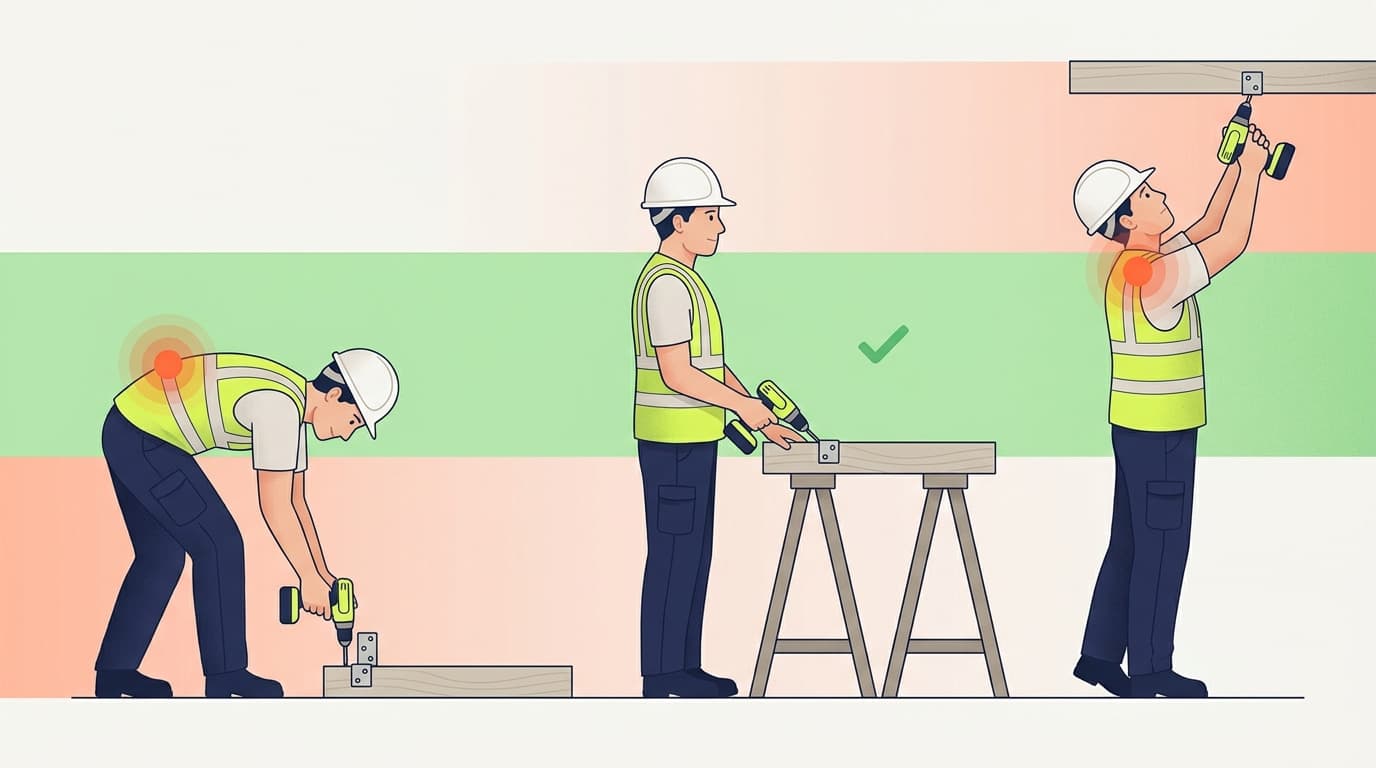
Work height is the biggest single lever. Work performed between roughly knuckle height and shoulder height keeps the back and shoulders in a neutral position. Anything below it means stooping or kneeling; anything above it loads the shoulder and neck. Raising the work — trestles, stands, adjustable benches, bench blocks — or lowering yourself properly to it fixes more posture problems than any amount of instruction on how to bend.
Bring the work to the worker. Rotating a component, using a turntable, tipping a panel, or repositioning material so nobody has to reach into it.
Extend the reach instead of the person. Long-handled tools, extension poles, standing-height drills and screw guns, and pole-mounted attachments remove the stoop or the overhead reach altogether.
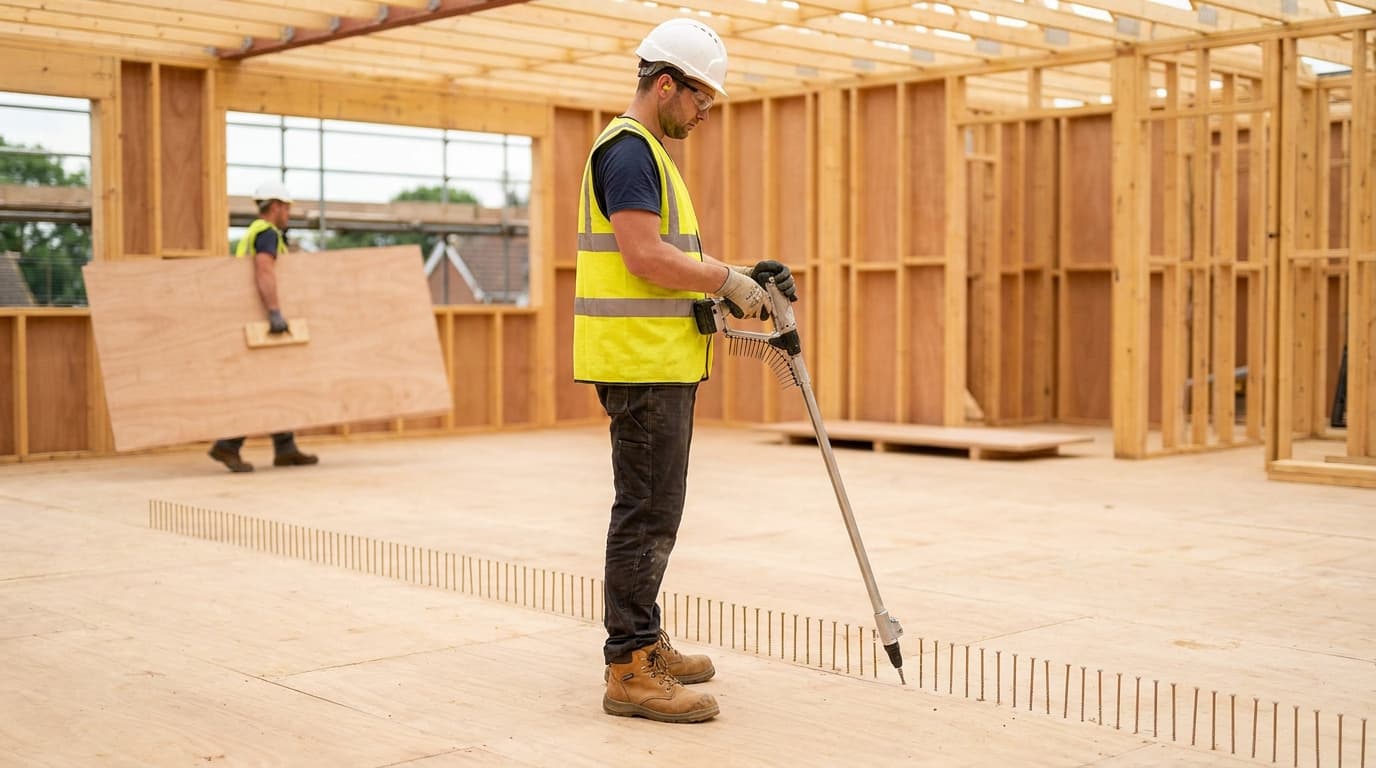
Change the grip, not the wrist. A tool that forces the wrist to bend is producing the injury. Angled handles, pistol grips for horizontal work and inline grips for vertical work keep the wrist straight — the principle behind NIOSH's guide to selecting non-powered hand tools (Publication 2004-164).
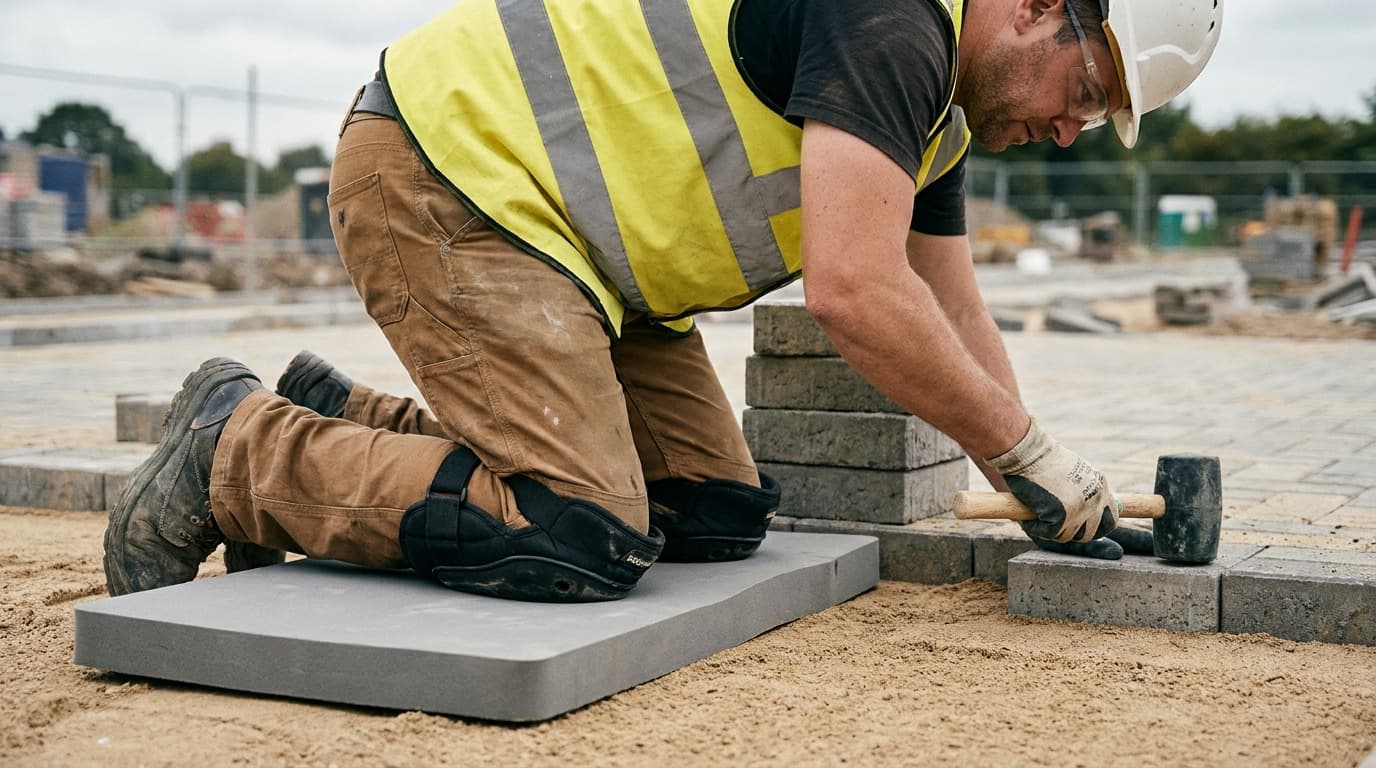
Pad the pressure points. Contact stress is the cheapest of all these to fix: knee pads, handle cushioning, shoulder pads on carried loads, and edge protection where forearms rest.
Cut vibration exposure at the source. Better-maintained tools, anti-vibration handles and gloves where appropriate, and — most effectively — limiting how long any one person stays on a vibrating tool.
Rotate tasks meaningfully. Rotation only works if the next task uses different muscles in a different posture. Swapping one overhead task for another overhead task is not rotation.
Let people who do the job choose the tool. The most reliable route to a workable solution is the crew that performs the task daily — they already know which part hurts.
What the regulation says — and does not#
There is no OSHA ergonomics standard. The obligation runs through Section 5(a)(1), the General Duty Clause, requiring a workplace free from recognised hazards likely to cause death or serious physical harm, together with 1926.21(b)(2), requiring employees to be instructed in the recognition and avoidance of unsafe conditions.
The absence of a standard means there is no threshold, no measurement you are required to take and nothing that automatically triggers action. In practice, that makes the reporting culture the whole control: discomfort reported early is a design problem; discomfort reported late is a diagnosis.
The recognised guidance fills the gap — principally NIOSH 2007-122, along with NIOSH 2004-164 on selecting non-powered hand tools. Manual material handling and lifting assessment are covered in the lifting techniques talk, and back injury specifically in its own.
What can go wrong?#
The task is designed at ground level. Cutting, fixing and assembling done on the deck because that is where the material landed.
Overhead work continues without a break. Shoulders fail faster than almost anything else, and the fatigue arrives before the pain.
Tools that force the wrist to bend. Wrong grip orientation for the plane of work, held for hours.
Vibrating tools all shift. No rotation, no limit, and often the newest person given the breaker because it needs no skill.
Contact stress ignored. Kneeling on concrete, tool handles pressed into the palm, edges against forearms — the cheapest thing to fix and the least often fixed.
Rotation that isn't rotation. Four different tasks, all overhead.
Symptoms hidden. Tingling, numbness, night pain and morning stiffness carried quietly because reporting looks like weakness.
"Just lift properly." Technique advice offered instead of changing a task that no technique makes safe.
Before you start#
- Confirm the work height for this task, and whether it can be raised or lowered into the neutral range.
- Confirm nobody has to reach overhead or stoop for a sustained period.
- Confirm the tool suits the plane of work and keeps the wrist straight.
- Confirm how long anyone will be on a vibrating tool, and who takes over.
- Confirm knees, palms, forearms and shoulders are not pressed against hard surfaces or edges.
- Confirm how many risk factors this task combines — one is manageable, three is a problem.
- Confirm rotation actually changes the muscles and posture being used.
- Confirm anyone with tingling, numbness or persistent ache knows where to report it.
Talk it over#
- Which task on this job leaves you aching at the end of the day?
- If you could change one tool here, which would it be — and what would you change it to?
- What are you doing at ground level that could be done at bench height?
- Who has been on the breaker longest today?
The bottom line#
Ergonomics fits the job to the person. The recognised risk factors in construction are repetition, high force, awkward posture, contact stress and hand-arm vibration — and they combine, so a task carrying several is far worse than the sum of its parts. NIOSH describes the resulting disorders concretely: back problems, carpal tunnel syndrome, tendinitis, rotator cuff tears, sprains and strains, arising when job demands push the human body beyond its natural limits. There is no OSHA ergonomics standard, so the duty runs through Section 5(a)(1) and 1926.21(b)(2) and the practice comes from NIOSH Publication 2007-122, Simple Solutions: Ergonomics for Construction Workers. The controls that work are physical, not verbal: work between knuckle and shoulder height, extend the tool rather than the person, keep the wrist straight, pad the pressure points, limit time on vibrating tools, and rotate to genuinely different demands. And report discomfort early, because early it is a design problem.
Frequently asked questions about ergonomics in construction#
Does OSHA have an ergonomics standard?
No. Ergonomic hazards are addressed through Section 5(a)(1), the General Duty Clause, which requires a workplace free from recognised hazards likely to cause death or serious physical harm, and through 1926.21(b)(2), which requires employees to be instructed in recognising and avoiding unsafe conditions. The recognised practice comes from NIOSH guidance rather than from a construction standard.
What are the ergonomic risk factors in construction?
Five: repetition, high force, awkward posture, contact stress and hand-arm vibration. NIOSH frames the resulting injuries as arising when job demands push the body beyond its natural limits — including back problems, carpal tunnel syndrome, tendinitis, rotator cuff tears, sprains and strains.
Is one risk factor as bad as several?
No — they combine. Any single factor sustained over time can cause a problem, and a task carrying more than one risk factor increases the physical strain further. Overhead grinding, for example, brings awkward posture, high force, vibration and duration together, which is why tasks that do not look heavy still cause injury.
What is the single most useful change?
Work height. Keeping the work roughly between knuckle and shoulder height keeps the back and shoulders neutral, and it removes both stooping and overhead reaching. Raising the work on trestles or stands, or bringing it to bench height, fixes more posture problems than any amount of technique training.
Are anti-vibration gloves the answer to vibration?
They are part of an answer, not the answer. The most effective control is reducing how long any one person spends on a vibrating tool — through rotation and planning — supported by well-maintained tools and anti-vibration handles where they suit the tool. Gloves alone do not solve a full-shift exposure.
Why is technique training not enough?
Because it asks the worker's body to compensate for a task that was set up badly, and it stops working the moment someone is tired, rushed or unfamiliar with the job. Changing the tool, the height or the equipment removes the demand itself — which is why NIOSH's construction ergonomics guidance is largely a catalogue of tools and equipment rather than a list of postures.
What should someone do about tingling or numbness in their hands?
Report it and get it assessed. Tingling, numbness, night pain and morning stiffness are early signs of musculoskeletal disorders including carpal tunnel syndrome, and they are far more treatable early than late. Reported early, they also identify the task that needs redesigning before it affects anyone else.
Download the ergonomics toolbox talk PDF#
Get this ergonomics toolbox talk as a print-ready PDF — available in English, Spanish, Portuguese, and Turkish. Print it, hand it to the crew, and collect signatures on the included attendance sheet.
Download the PDF — free account required. New members get 3 free downloads.
Related toolbox talks#
Sources#
- NIOSH, Simple Solutions: Ergonomics for Construction Workers, DHHS (NIOSH) Publication No. 2007-122: https://www.cdc.gov/niosh/docs/2007-122/default.html
- NIOSH, Easy Ergonomics: A Guide to Selecting Non-Powered Hand Tools, DHHS (NIOSH) Publication No. 2004-164: https://www.cdc.gov/niosh/publications/numbered/2004-164.html
- OSHA, Ergonomics — Solutions to Control Hazards: https://www.osha.gov/ergonomics/control-hazards
This talk summarises published health and regulatory guidance. It is not medical advice. Persistent pain, tingling, numbness or loss of grip strength should be assessed by a physician or other licensed health care professional — musculoskeletal disorders respond far better to early treatment.
Written by FieldSafetyTalk's safety professional — a CSP, ASP, CHST and OSHA Authorized Outreach Trainer with 14+ years of international construction safety experience across federal, heavy civil, and industrial projects.