Asphalt Paving
Updated 2026-08-05
In this bundle Health & Environmental Exposure
Print-ready PDF
Download this talk as a print-ready PDF, available in 4 languages.
A paving crew works fast, in a line, with a truck reversing into the hopper every few minutes and rollers moving in both directions behind them. It looks like a well-drilled operation, and usually it is. But two of the things that hurt people on a paving job behave in ways that are not obvious, and both of them reward knowing the mechanism rather than the rule. This Asphalt Paving Toolbox Talk (Safety Talk / Tailgate Talk) is about those two.
Here is the distinction that carries this whole talk: hot asphalt does not burn you and then stop — it sticks, and it keeps burning until somebody cools it. Hot mix arrives on site at around 275 to 325 °F (135 to 163 °C), and NIOSH gives general asphalt application temperatures as 250 to 400 °F (120 to 205 °C). On contact it adheres to skin and clothing, and it cools by putting its heat into you. Because it sticks, the heat source stays on the wound. A flame burn ends when you move away from the flame. An asphalt burn does not end until the material is cooled.
Where the boundary of this talk sits#
Heat illness — the physiology, the acclimatisation schedule and the water-rest-shade framework — belongs to the heat stress talk. Respirable crystalline silica, the exposure limits and Table 1 belong to the dust and silica talk. Struck-by mechanics in general belong to the struck-by talk, and traffic control plans and night work zone lighting to those talks. Skin disorders generally belong to the skin hazards talk. This talk owns the paving operation: the hot material, the fume, and the paving train itself.
What to do when it lands on somebody#
The mechanism decides the first aid, and the instinct is wrong.
Cool it immediately with cool running water for at least 20 minutes. That is what stops the injury developing, because until the material is cooled it is still transferring heat.
Do not peel or pull the asphalt off. It has bonded to the skin, and pulling takes the skin with it. Removal is a hospital job, done with the appropriate agents. The material can stay on the wound while it is being cooled — cooling works through it.
Cool running water, not ice. You will hear crews recommend plunging a burned arm into the ice bucket, and it is well meant because it kills the pain. Ice on a burn causes further tissue damage on top of the thermal injury. Cool running water, and time.
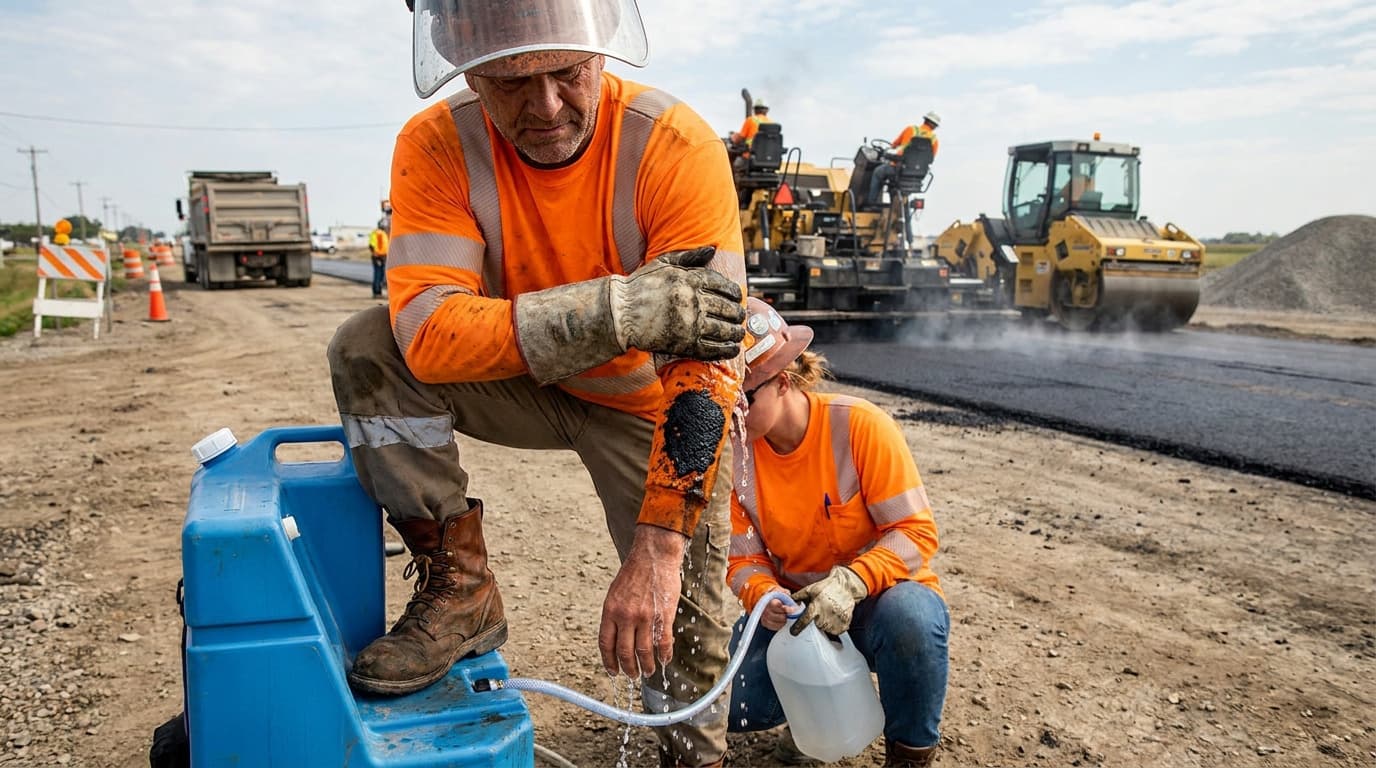
Then get medical care — for any blistering burn, any large burn, and any burn to the face or hands, which is where splashes land.
And remember what it will be wearing. Hot mix goes through clothing. Boots without high tops, trousers with cuffs, and open collars are how the material gets against skin and stays there. Cuffs in particular catch and hold a splash against the ankle.
The fume nobody has a limit for#
Asphalt fume is the exposure that accumulates over a career rather than a shift, and it sits in a regulatory gap.
OSHA states that over half a million workers are exposed to fumes from asphalt across paving, roofing, siding and concrete work, and lists the health effects as headache, skin rash, sensitisation, fatigue, reduced appetite, throat and eye irritation, cough, and skin cancer.
Note the last item on that list, and note that the exposure is both inhalational and dermal — published research has documented paving workers' exposure to polycyclic aromatic compounds by both routes.
There is no OSHA permissible exposure limit specific to asphalt fumes. Some state plans set their own figure, and NIOSH has published extensively on control — check the number that actually applies where you are working rather than assuming one exists federally.
Controls, in order: warm mix where the specification allows it, since it runs materially cooler and cuts fume generation at source; engineering controls on the equipment, including paver fume extraction; working upwind of the screed and the truck; and respiratory protection where those do not control it. Note that rapid-cure asphalts contain solvents which raise both the vapour and the fire risk — slower-cure, lower-temperature products reduce both.
And do not put your head over an open tank or kettle. Beyond the fume and the burn risk, hot asphalt in enclosed storage can release hydrogen sulfide, which is a different and more immediate problem.
The paving train hurts more people than the traffic does#
This is the part crews get backwards, and it is worth saying plainly at the tailgate.
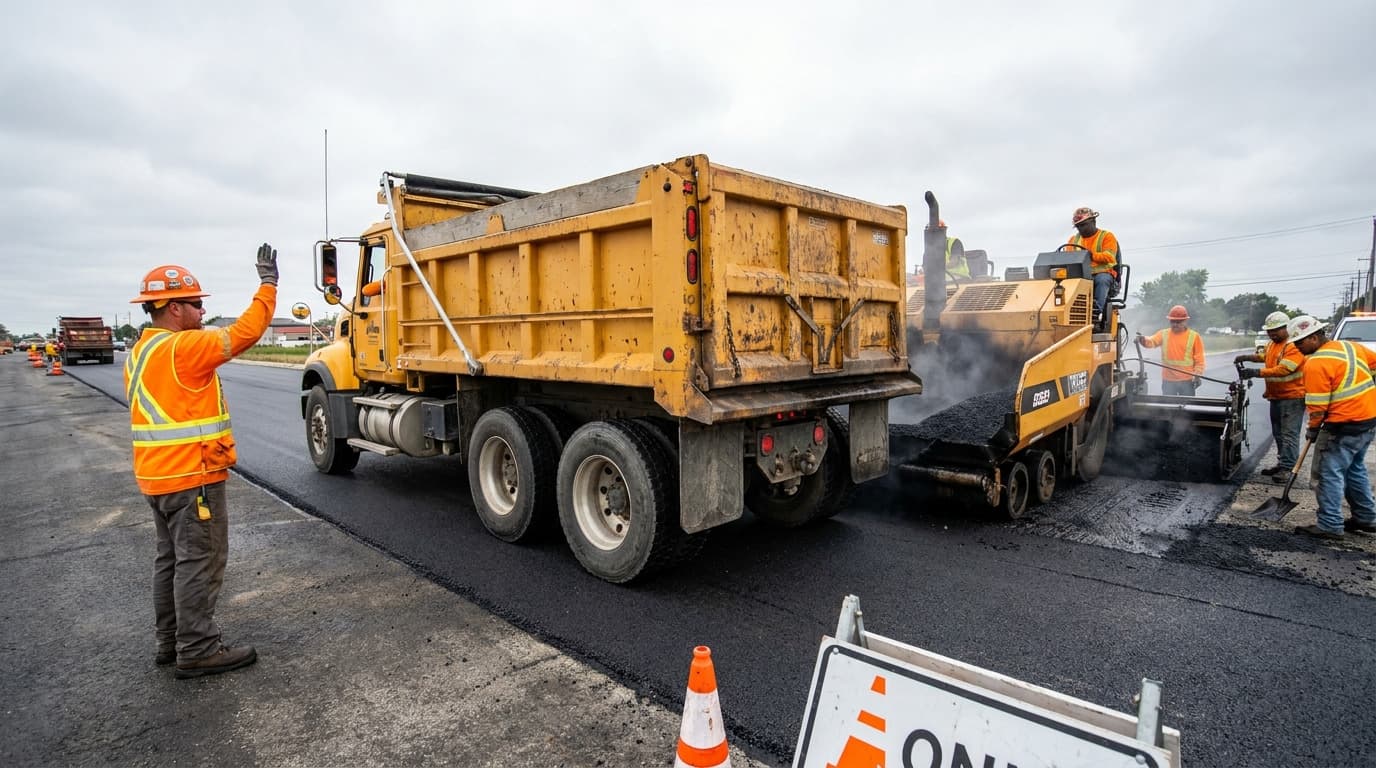
The instinct on a road job is that the danger is out there — the public, coming past at speed. That risk is real and the traffic control plan exists for it. But on an active paving operation, a large share of the injuries come from inside the work zone: dump trucks reversing into the hopper, rollers changing direction, workers stepping into an equipment path. The machines are close together, they move in both directions, and the noise makes verbal warning useless.
Three specific things:
The truck backing into the paver. This is the highest-frequency interaction on the job, it happens every few minutes, and the driver cannot see the ground immediately behind. The paver operator and the screed crew are in that space.
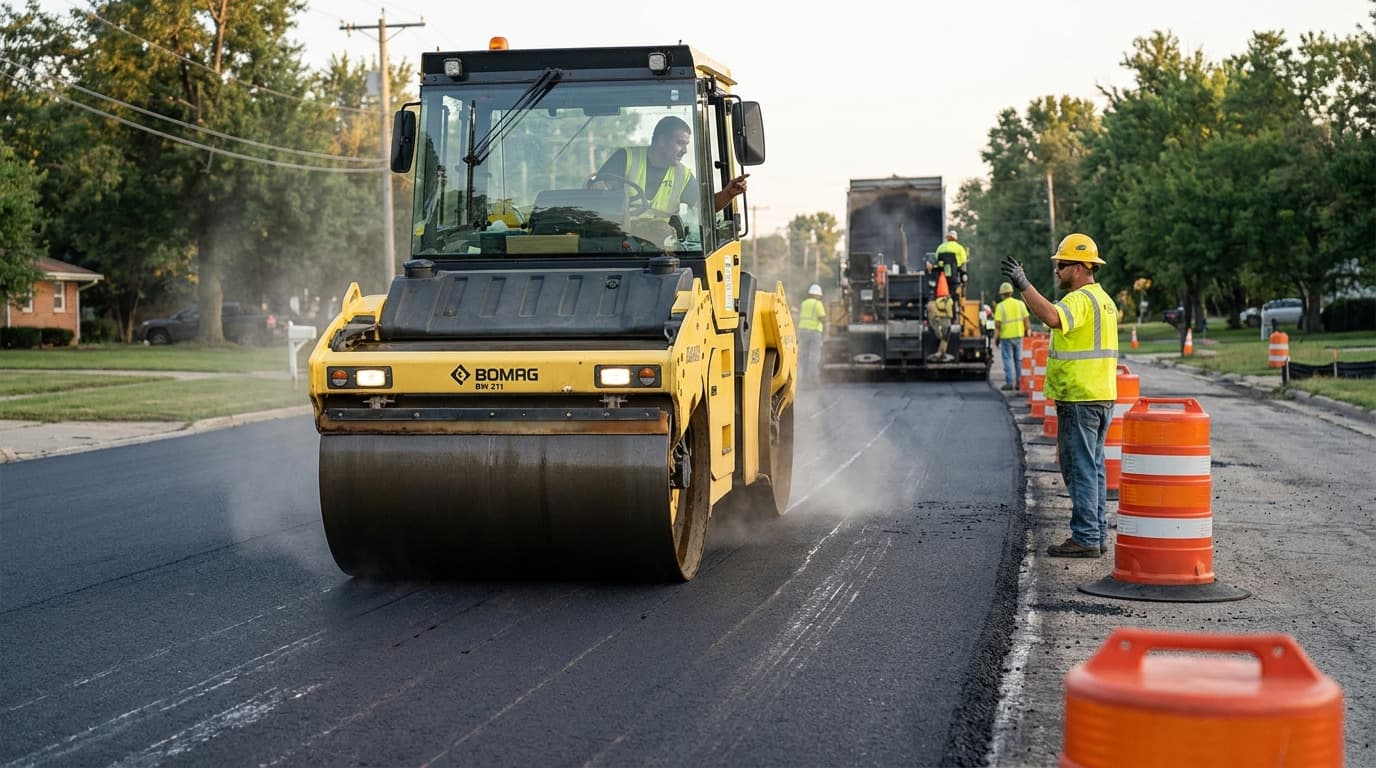
Rollers reversing. A roller changing direction is a machine with poor rear visibility, an operator focused on the mat and joint, and a crew member who assumed it was continuing forward.
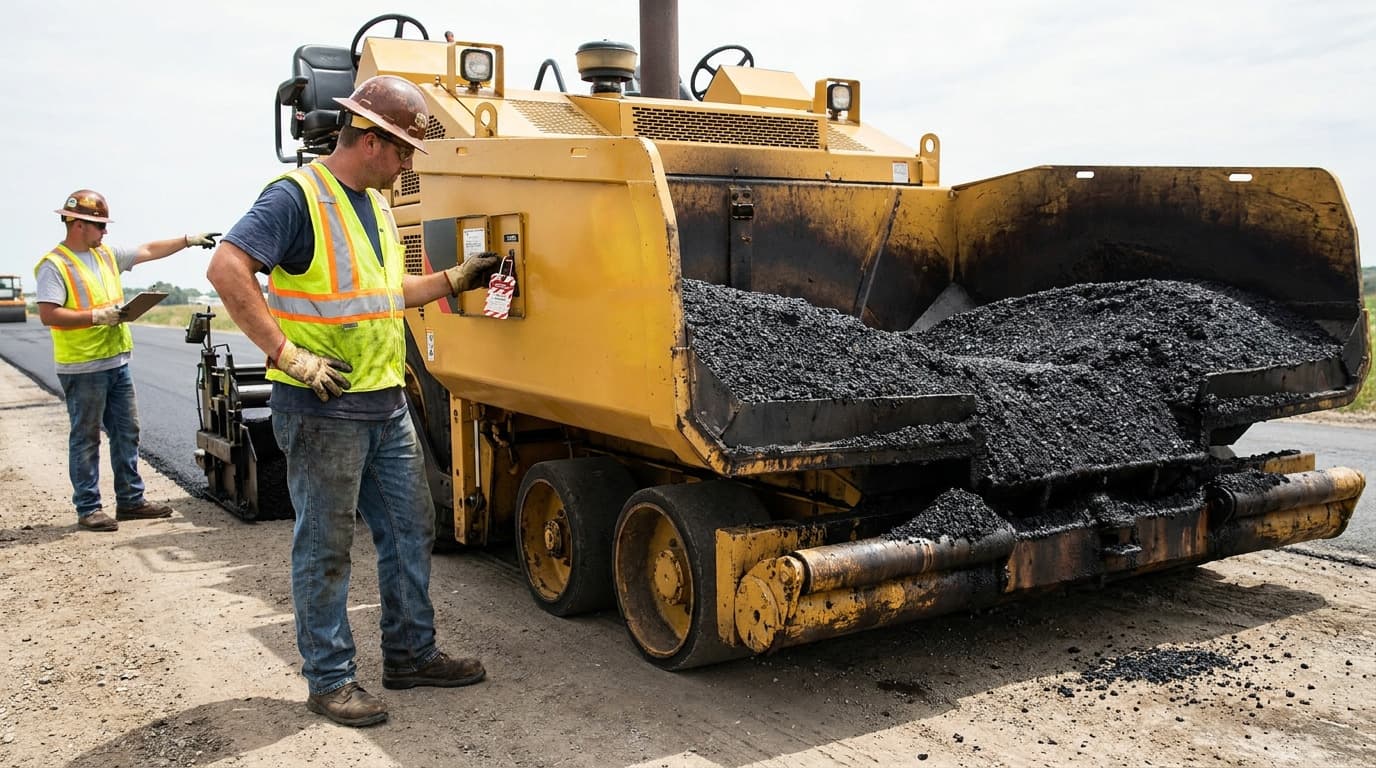
Reaching into the auger or the hopper. The paver auger has caused fatalities where workers reached in to clear a jam. Clearing a jam is a shutdown-and-isolate task, not something done with the machine running because the mat is going cold.
The controls are ordinary and they work: a defined internal traffic pattern, a spotter for reversing with an agreed signal, eye contact before entering any machine's path, high-visibility apparel, and nobody on foot between two machines.
The rest of the job#
Milling generates silica. Asphalt milling machines are covered by 1926.1153 and its Table 1 entries, with the associated water or extraction controls. That standard and the exposure limits are covered in the dust and silica talk; what belongs here is that milling is not a dusty nuisance, it is a regulated respirable crystalline silica task.
Heat illness stacks on top. A paving crew works in the sun, next to a 300 °F mat, in long sleeves and boots. The radiant load from the mat is real and it is additional to the air temperature. The heat stress talk owns the physiology and the controls.
Tack coat is the sleeper burn. It is sprayed, it is hot, it goes where the wind puts it, and crews treat it more casually than the mix because there is less of it.
Noise. Pavers, rollers and milling machines run continuously and the crew works alongside them all shift. It is also why the verbal warning fails.
Where the duty sits#
There is no OSHA asphalt paving standard, and no federal PEL for asphalt fumes. The duties are assembled.
1926.95 and 1926.28(a) cover PPE — for this work, insulated gauntlet gloves, face shield, long sleeves and trousers without cuffs, and high-top boots. 1926.102 covers eye and face protection. 1926.1153 covers respirable crystalline silica in milling. 1926.50 covers medical services and first aid, which for a paving crew means burn care available and a route to hospital. 1926.21(b)(2) requires instruction in recognising and avoiding the hazards. Where the work is on a road, 1926.200 to 1926.203 and the agency's traffic control plan govern the work zone. And Section 5(a)(1) applies to recognised hazards without a specific standard — which is where asphalt fume sits federally.
What can go wrong?#
Pulling stuck asphalt off a burn, taking the skin with it.
Using ice instead of cool running water on a burn.
Wearing trousers with cuffs or low boots, so a splash lodges against skin and stays there.
Standing behind a truck reversing into the hopper, where the driver cannot see.
Reaching into the auger or hopper to clear a jam with the machine running.
Assuming a roller will keep going forward.
Relying on a shout in an environment where nobody can hear it.
Treating milling as ordinary dust rather than a regulated silica task.
Standing downwind of the screed for a whole shift.
How do we manage this properly?#
Brief the burn response before the first load arrives — cool running water for at least 20 minutes, do not peel, no ice, then medical care.
Have cool running water available on the job, not just drinking water in a cooler.
Issue and enforce the right PPE: insulated gauntlet gloves, face shield, long sleeves, trousers without cuffs, high-top boots.
Agree an internal traffic pattern before paving starts — where trucks queue, where they reverse, where people on foot may and may not be.
Use a spotter for every reverse into the hopper, with an agreed signal, and stop the reverse when the spotter is not visible.
Make eye contact with an operator before entering their path, every time.
Shut down and isolate before clearing any jam, and treat schedule pressure on a cooling mat as the reason the rule exists rather than a reason to break it.
Specify warm mix where the job allows it, which reduces fume at source rather than downstream.
Work upwind of the screed and the tack coat, and rotate positions so the same person is not downwind all day.
Set up water or extraction for milling before the machine starts.
Before you start#
- Confirm cool running water is available for burn first aid, and everybody knows where.
- Confirm the crew knows not to peel asphalt off and not to use ice.
- Confirm PPE: gauntlet gloves, face shield, long sleeves, cuffless trousers, high-top boots.
- Confirm the internal traffic pattern and where people on foot are excluded.
- Confirm who is spotting reverses into the hopper and what the signal is.
- Confirm the jam-clearing procedure and who is authorised to do it.
- Confirm dust control is set up if milling is part of today's work.
- Confirm the route to medical care and the expected time.
Talk it over#
- If somebody took a splash of hot mix on the forearm right now, what would we do first?
- Where is it acceptable to stand while a truck is backing into the hopper?
- Who has cuffs on their trousers today?
- What happens if the auger jams and the mat is going cold?
The bottom line#
Hot asphalt does not burn you and then stop — it sticks, and it keeps burning until somebody cools it. Hot mix arrives at around 275 to 325 °F (135 to 163 °C), with NIOSH giving general application temperatures of 250 to 400 °F (120 to 205 °C), and on contact it adheres to skin and clothing and cools by putting its heat into you — so the heat source stays on the wound. A flame burn ends when you move away; an asphalt burn does not end until the material is cooled. Therefore: cool immediately with cool running water for at least 20 minutes; do not peel or pull the asphalt off, because it has bonded and pulling takes the skin — removal is a hospital job and cooling works through the material; use cool running water, not ice, which adds tissue damage to the thermal injury; then get medical care for any blistering burn, any large burn, and any burn to the face or hands. Dress for it: hot mix goes through clothing, and trousers with cuffs catch and hold a splash against the ankle. On fume, OSHA states over half a million workers are exposed to asphalt fumes, with effects listed as headache, skin rash, sensitisation, fatigue, reduced appetite, throat and eye irritation, cough, and skin cancer — exposure being both inhalational and dermal, with documented paving-worker exposure to polycyclic aromatic compounds. There is no federal OSHA PEL specific to asphalt fumes, so check what applies where you work; control with warm mix where specified, equipment fume extraction, working upwind, then respiratory protection, noting that rapid-cure asphalts contain solvents raising vapour and fire risk, and that hot asphalt in enclosed storage can release hydrogen sulfide. On the machines: the instinct is that the danger is the passing public, but a large share of paving injuries come from inside the work zone — trucks reversing into the hopper, rollers changing direction, and reaching into the auger or hopper to clear a jam, which has caused fatalities and is a shutdown-and-isolate task. Noise makes verbal warning useless, so the controls are a defined internal traffic pattern, a spotter with an agreed signal for every reverse, eye contact before entering a machine's path, and nobody on foot between two machines. Around all of it: milling is a regulated respirable crystalline silica task under 1926.1153, heat illness stacks on top of the radiant load from the mat, and tack coat is the sleeper burn. There is no OSHA asphalt paving standard — duties run through 1926.95/1926.28(a) and 1926.102 for PPE, 1926.1153 for silica, 1926.50 for medical services and first aid, 1926.21(b)(2) for instruction, 1926.200–203 and the agency traffic control plan on the road, and Section 5(a)(1) behind them.
Frequently asked questions about asphalt paving#
Why is an asphalt burn worse than it looks?
Because it does not stop. Hot mix arrives at around 275 to 325 °F (135 to 163 °C) and adheres to skin and clothing on contact, cooling by transferring its heat into the person. Because it sticks, the heat source stays on the wound, so the injury keeps developing after contact ends — unlike a flame burn, which stops when you move away. That is why cooling is the treatment and why speed matters more than anything else you could do.
Should we pull the asphalt off the skin?
No. It has bonded to the skin and pulling it off takes the skin with it. Removal is a hospital job, done with appropriate agents. Leave the material in place and cool it with cool running water for at least 20 minutes — cooling works through the asphalt. Then get the person to medical care, particularly for any blistering burn, any large burn, or any burn to the face or hands.
Is ice better than water for a hot asphalt burn?
No, and this one circulates on site because ice kills the pain fast. Ice on a burn causes further tissue damage on top of the thermal injury. The correct first aid is cool running water for at least 20 minutes — long enough that it feels excessive — followed by medical care. Pain relief is not the objective in the first twenty minutes; stopping the burn from getting deeper is.
What are the health effects of asphalt fume?
OSHA states that over half a million workers are exposed to asphalt fumes and lists the effects as headache, skin rash, sensitisation, fatigue, reduced appetite, throat and eye irritation, cough, and skin cancer. Exposure is both inhalational and dermal, and published research has documented paving workers' exposure to polycyclic aromatic compounds by both routes. There is no federal OSHA PEL specific to asphalt fumes, so check what applies in your jurisdiction.
How do we reduce fume exposure?
At source first. Warm mix runs materially cooler than hot mix and cuts fume generation where the specification allows it. Then engineering controls on the equipment, including paver fume extraction. Then position — work upwind of the screed and the tack coat, and rotate so the same person is not downwind all shift. Respiratory protection fills what those cannot. Note that rapid-cure asphalts contain solvents, raising both vapour and fire risk.
What is the biggest struck-by risk on a paving job?
Not the passing traffic — the paving train itself. Dump trucks reversing into the hopper is the highest-frequency interaction on the job and the driver cannot see the ground immediately behind. Rollers changing direction have poor rear visibility and an operator focused on the mat. And reaching into the auger or hopper to clear a jam has caused fatalities. Noise makes verbal warning useless, so the controls are a defined internal traffic pattern, a spotter with an agreed signal, and eye contact before entering any machine's path.
Does milling count as silica work?
Yes. Asphalt milling machines are covered by 1926.1153, the respirable crystalline silica standard, with corresponding Table 1 entries and the water or extraction controls that go with them. Treating milling as ordinary construction dust is a compliance failure as well as a health one. The exposure limits and the detail of Table 1 sit in the dust and silica talk; what matters here is that the control has to be set up before the machine starts, not after the dust appears.
Download the asphalt paving toolbox talk PDF#
Get this asphalt paving toolbox talk as a print-ready PDF — available in English, Spanish, Portuguese, and Turkish. Print it, hand it to the crew, and collect signatures on the included attendance sheet.
Download the PDF — free account required. New members get 3 free downloads.
Related toolbox talks#
Sources#
- OSHA, Asphalt (Bitumen) Fumes — Overview: https://www.osha.gov/asphalt-fumes
- NIOSH, Asphalt Fume Exposures During the Manufacture of Asphalt Roofing Products (Publication 2000-102): https://archive.cdc.gov/www_cdc_gov/niosh/docs/2000-102/default.html
- OSHA, 29 CFR 1926.1153 — Respirable crystalline silica: https://www.osha.gov/laws-regs/regulations/standardnumber/1926/1926.1153
This talk is general awareness guidance for training purposes. It is not medical advice and nothing in it is a diagnosis. Anyone burned by hot asphalt should be cooled with cool running water and assessed by a qualified medical professional; removal of adhered material is a clinical procedure and should not be attempted on site.
Written by FieldSafetyTalk's safety professional — a CSP, ASP, CHST and OSHA Authorized Outreach Trainer with 14+ years of international construction safety experience across federal, heavy civil, and industrial projects.