Excavation and Trenching
Updated 2026-07-23
In this bundle Jobsite Fundamentals & Compliance
Working in California? See the Cal/OSHA edition → California (Cal/OSHA)Working in Washington? See the WA DOSH edition → Washington (WA DOSH)
Print-ready PDF
Download this talk as a print-ready PDF, available in 4 languages.
A trench wall gives no warning. It does not crack, groan, or lean before it goes. One moment you are standing in a straight-sided cut that has held for three days, and the next you are under a cubic metre of soil that weighs about as much as a small car. This Excavation and Trenching Toolbox Talk (Safety Talk / Tailgate Talk) is about the hazard that looks most stable right before it kills you.
Here is the distinction that carries this whole talk: most hazards on this site announce themselves through deterioration you can observe. Equipment gets noisier, cables fray, guardrails loosen. Soil does the opposite — it fails suddenly and completely, with the failure surface hidden inside the ground where nobody can see it developing. A trench that stood open through a weekend is not proving it is safe; it is accumulating the moisture, vibration, and stress relief that will bring it down. Which is why the standard requires an inspection before every shift rather than once at the start, and why "it held yesterday" is the most dangerous sentence on an excavation site.
How dangerous is trenching work?#
Trenching is a low-frequency, high-lethality hazard, and the enforcement data shows it is also one of the most persistently non-compliant.
According to CPWR, the Center for Construction Research and Training, analyzing BLS data:
- The construction industry accounted for 85 percent of all fatal trenching injuries from 2011 to 2021, and 90 percent of nonfatal trenching injuries from 2011 to 2022 (CPWR Data Bulletin, May 2024).
- 39 workers across all industries died performing trench or excavation work in 2022, compared with 15 in 2021 — a sharp rise that prompted OSHA to announce enhanced nationwide enforcement (OSHA, cited in CPWR, May 2024).
- Over a third of fatal trenching injuries in 2022 occurred among Hispanic workers — 35 percent, against a much lower share of the overall workforce (CPWR, May 2024).
- The largest single year for construction trenching fatalities in the period was 33 deaths in 2016 (CPWR, May 2024).
The enforcement picture tells you exactly which requirement gets skipped:
- Citations for Protection of Employees in Excavations — 1926.652(a) — accounted for 34.5 percent of all trenching citations from 2011 to 2023. More than a third. The single most-cited failure is not having a protective system at all (CPWR, May 2024, from OSHA Enforcement Data).
- The average penalty for a trenching violation in 2023 was $5,800, against $2,500 for all construction citations — more than double (CPWR, May 2024).
- From 2011 to 2023, 51.6 percent of trenching citations went to Heavy and Civil Engineering Construction, a subsector that received only 8.1 percent of all construction citations (CPWR, May 2024).
OSHA excavation requirements (29 CFR 1926 Subpart P)#
Excavations are governed by 29 CFR 1926 Subpart P, sections 1926.650 through 1926.652.
- Protective systems — 1926.652(a)(1). Each employee in an excavation must be protected from cave-ins by an adequate protective system. The exceptions are narrow: excavations made entirely in stable rock, or less than 5 feet deep where a competent person has examined the ground and found no indication of a potential cave-in.
- Engineered design over 20 feet — 1926.652(b). Protective systems for excavations more than 20 feet deep must be designed by a registered professional engineer, or based on tabulated data prepared or approved by one.
- Daily inspection — 1926.651(k). A competent person must inspect excavations, adjacent areas, and protective systems before the start of each shift and as needed throughout the shift, and after every rainstorm or other hazard-increasing occurrence. Where evidence of a possible cave-in is found, exposed employees must be removed from the hazardous area until corrections are made.
- Access and egress — 1926.651(c). Trenches 4 feet or more deep must have a ladder, ramp, or other safe means of egress located so no employee travels more than 25 feet laterally to reach it.
- Spoil placement — 1926.651(j). Excavated material and equipment must be kept at least 2 feet from the edge, or retained by devices sufficient to prevent them falling in.
- Underground installations — 1926.651(b). The location of utility installations must be determined before opening the excavation, and utilities protected, supported, or removed as work proceeds.
- Hazardous atmospheres — 1926.651(g). Atmospheres in excavations more than 4 feet deep where hazardous conditions could exist must be tested before employees enter.
- Water accumulation — 1926.651(h). Employees must not work in excavations where water has accumulated or is accumulating unless adequate precautions are taken.
The three most-cited provisions after 1926.652(a) are 1926.651(k) inspections (17.1 percent), 1926.651(c) access and egress (16.8 percent), and 1926.651(j) protection from loose rock or soil (13.7 percent) — which means inspection, ladders, and spoil placement account for nearly half of trenching citations between them.
On USACE and NAVFAC projects, EM 385-1-1 applies and is more prescriptive in several places.
What can go wrong in an excavation?#
Cave-in, which is a physics problem rather than a judgement problem. A cubic metre of soil weighs roughly 1,200 to 1,400 kilograms. A worker buried to the waist cannot be pulled out by hand — the friction of the soil against the body exceeds what any number of people can overcome. Burial above the chest prevents breathing within minutes, long before rescue crews can dig safely.
The conditions that cause it are predictable:
- No protective system, because the trench was "only going to be open for an hour"
- Spoil piled at the edge, adding surcharge that pushes the wall inward
- Vibration from equipment, traffic, or nearby piling
- Water accumulation from rain, a broken service, or groundwater
- Previously disturbed ground — a backfilled trench has no cohesion
- A trench left open through weather, which changes the soil without changing its appearance
Falls into the excavation. Workers and members of the public falling into an unguarded, unbarricaded trench, particularly at shift end and in poor light.
Struck-by from above. Spoil, tools, and material falling from the edge onto workers below, and equipment operating close to the lip.
Hazardous atmospheres. Excavations more than 4 feet deep can accumulate heavier-than-air gases, and adjacent sewers, fuel lines, or contaminated ground can introduce them. This is an excavation that has become a confined space.
Utility strikes. Buried electrical, gas, water, and communications lines struck because they were never located, or located inaccurately, or the locate was old.
Equipment at the edge. Excavators and trucks working close to the lip, adding load, transmitting vibration, and creating a struck-by and crush hazard for anyone in the trench.
And then the enforcement pattern, which is a hazard pattern. More than a third of trenching citations are for having no protective system at all. Not an inadequate one — none. That is a decision, made by someone, before anyone climbed in.
How do we prevent trench collapses?#
Never enter an unprotected trench. This is the one rule that prevents most excavation deaths, and the one most frequently broken. Any excavation 5 feet or deeper requires sloping, benching, shoring, or shielding unless it is entirely in stable rock. Below 5 feet, a competent person decides — and that decision belongs to them, not to you and not to assumption.
Get the competent person inspection before entry, every shift. Not once when the trench was dug. Before each shift, throughout the shift as conditions change, and after any rainstorm, vibration event, or equipment loading near the edge. Under 1926.651(k), evidence of a possible cave-in means workers come out until it is corrected.
Locate utilities before you break ground. Under 1926.651(b), utility locations are determined before opening the excavation. Locates go stale, marks get washed away, and drawings are frequently wrong — verify rather than assume.
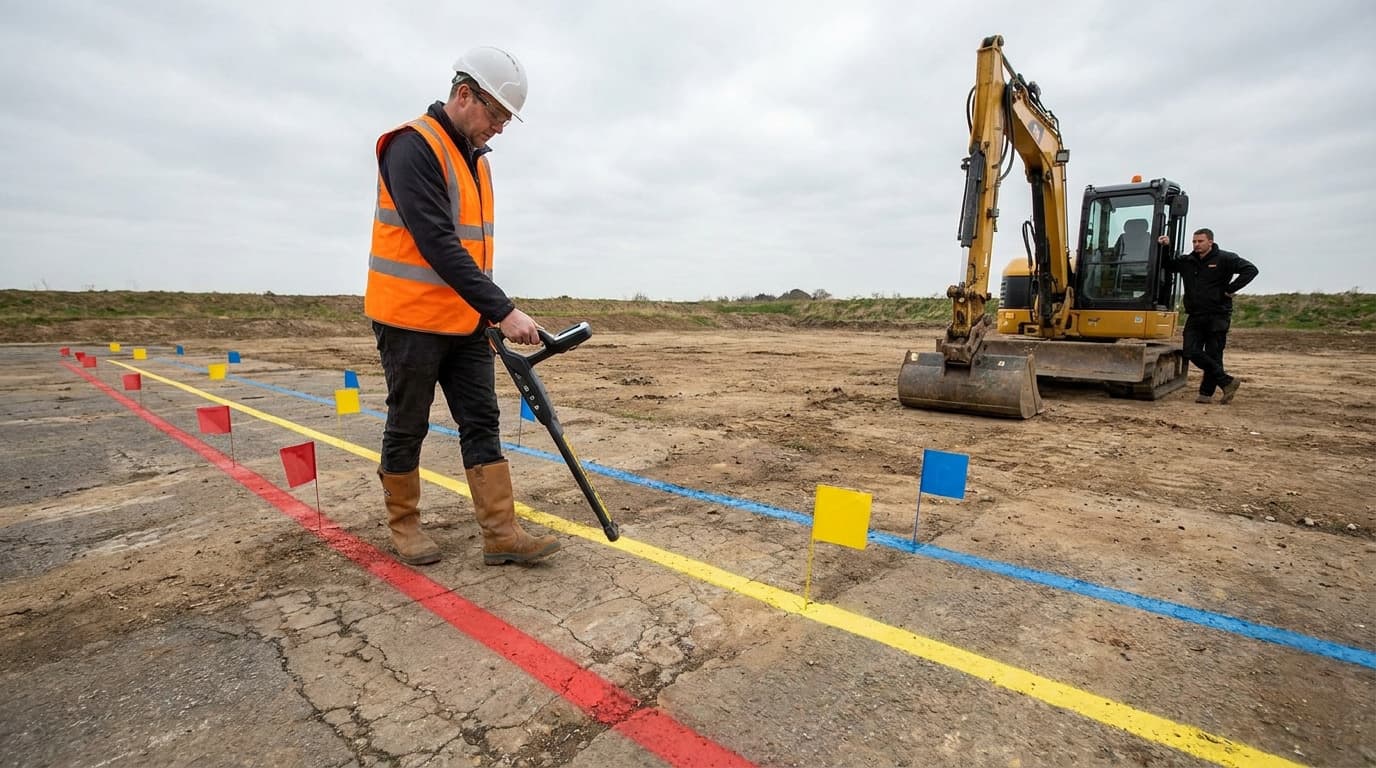
Keep the edge clear. Spoil and equipment at least 2 feet back, and further where the ground is questionable. Material at the edge does double damage: it adds surcharge pushing the wall inward, and it becomes a struck-by hazard for anyone below.
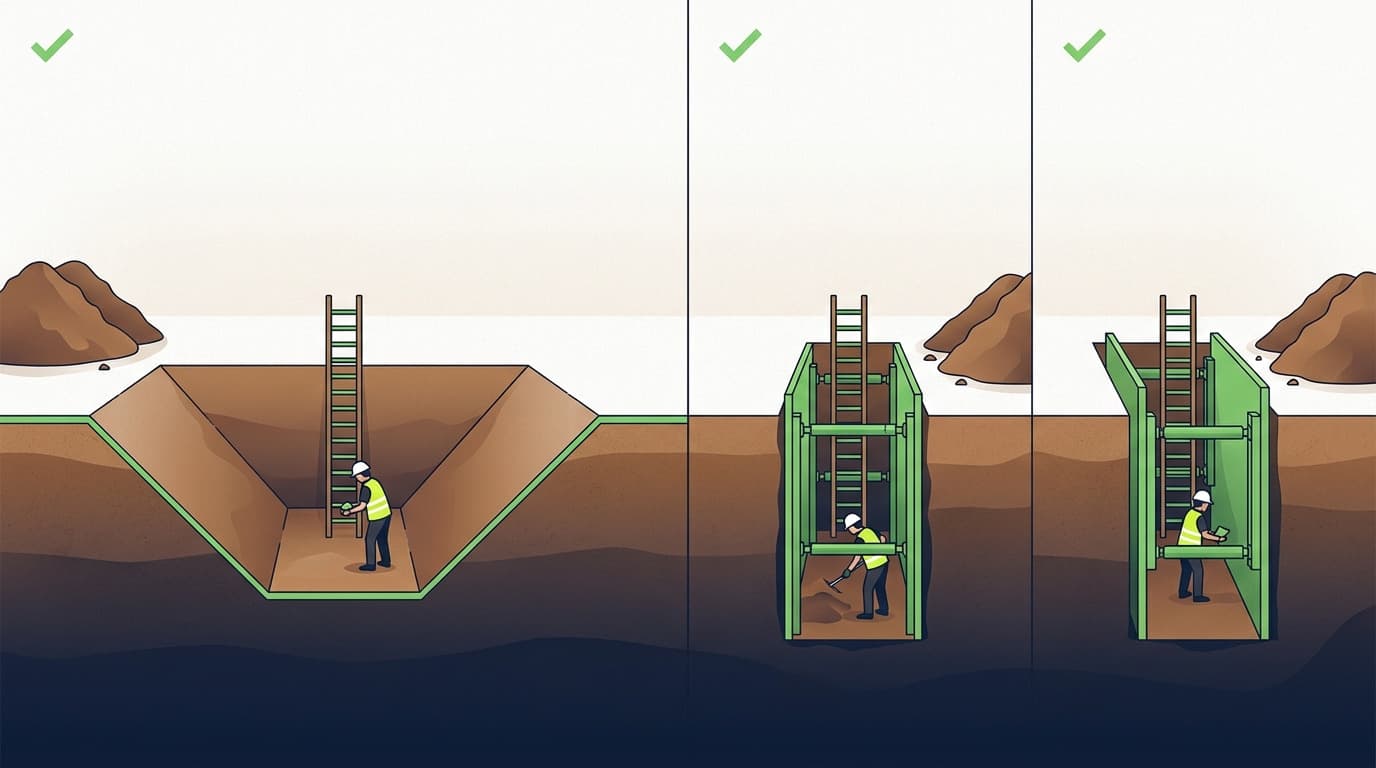
Provide egress within 25 feet. Ladder, steps, or ramp for any trench 4 feet or deeper, positioned so nobody has to travel far along the trench to reach it. In a collapse, the exit you can reach in seconds is the only one that counts.
Match the protective system to the conditions:
- Sloping or benching where there is room, cut to the angle the soil type requires
- Shoring — hydraulic, pneumatic, or timber — where the excavation must stay vertical
- Shielding with a trench box, which does not prevent collapse but protects the worker inside it
- Engineered design by a registered professional engineer for anything over 20 feet
Test the atmosphere where required. Excavations more than 4 feet deep in areas where hazardous atmospheres could exist are tested before entry, and treated as confined spaces where the conditions warrant.
Control water. Do not work in an excavation with accumulating water unless adequate precautions are in place. Water changes soil behaviour completely, and a trench that was stable dry is a different structure wet.
Keep equipment back from the lip. Set exclusion zones for plant working near the edge, and never position workers between operating equipment and the trench wall.
Barricade and light the excavation. Protect people who are not part of your crew — including at night, at weekends, and during shutdowns.
Before you start#
- Confirm the trench has a protective system appropriate to its depth, or that a competent person has documented why one is not required.
- Confirm the competent person inspected this excavation this shift, and again after any rain or vibration.
- Check the spoil pile — at least 2 feet back, further if the soil is soft or previously disturbed.
- Locate your exit: a ladder or ramp within 25 feet of where you will be working.
- Confirm underground utilities were located before the excavation was opened.
- Check for water accumulation, and whether it has changed since yesterday.
- Confirm the atmosphere has been tested if the excavation is more than 4 feet deep and hazardous conditions could exist.
- Check what equipment will operate near the edge while you are inside.
- Confirm the excavation is barricaded and will be lit or secured outside working hours.
Talk it over#
- Look at this trench. What is holding those walls right now, and who checked it this morning?
- If that wall came in while you were at the far end, how many steps to the ladder — and how long would that take?
- It rained overnight. What has changed about this excavation since the last inspection?
The bottom line#
A trench wall fails suddenly and completely, and a cubic metre of soil weighs about as much as a small car — which is why a worker buried to the waist cannot be pulled out by hand. More than a third of all trenching citations are for having no protective system at all, so the single most important control is also the one most often skipped. Never enter an unprotected excavation, get the competent person inspection before every shift and after every rainstorm, keep spoil 2 feet back, know where your ladder is, and treat "it held yesterday" as the warning it actually is.
Frequently asked questions about excavation and trenching#
At what depth does a trench require a protective system?
Under 29 CFR 1926.652(a)(1), every excavation 5 feet or deeper requires sloping, benching, shoring, or shielding — unless it is made entirely in stable rock. Below 5 feet, a competent person must examine the ground and determine whether a protective system is needed.
How often must a trench be inspected?
Under 29 CFR 1926.651(k), a competent person must inspect the excavation, adjacent areas, and protective systems before the start of each shift and as needed throughout the shift, plus after every rainstorm or other hazard-increasing occurrence. If evidence of a possible cave-in is found, workers must be removed until it is corrected.
What is the most commonly cited trenching violation?
Protection of Employees in Excavations (1926.652(a)) accounted for 34.5 percent of all trenching citations from 2011 to 2023 — more than a third (CPWR Data Bulletin, May 2024, from OSHA Enforcement Data). The most common failure is not an inadequate protective system, but no protective system at all.
How many workers die in trenching incidents?
39 workers across all industries died performing trench or excavation work in 2022, up from 15 in 2021 (OSHA, cited in CPWR, May 2024). Construction accounted for 85 percent of all fatal trenching injuries from 2011 to 2021, with a peak of 33 construction deaths in 2016.
How far from the trench edge must spoil be kept?
At least 2 feet, under 29 CFR 1926.651(j) — or retained by a device sufficient to prevent material falling in. Spoil at the edge does double damage: it adds surcharge that pushes the wall inward, and it becomes a struck-by hazard for anyone in the trench.
When does a trench need an engineer to design the protective system?
For excavations more than 20 feet deep, under 29 CFR 1926.652(b), the protective system must be designed by a registered professional engineer, or be based on tabulated data prepared or approved by a registered professional engineer.
Download the excavation and trenching toolbox talk PDF#
Get this excavation and trenching toolbox talk as a print-ready PDF — available in English, Spanish, Portuguese, and Turkish. Print it, hand it to the crew, and collect signatures on the included attendance sheet.
Download the PDF — free account required. New members get 3 free downloads.
Related toolbox talks#
Sources#
- CPWR, Trenching Injuries, Citations and Penalties in Construction, Data Bulletin May 2024: https://www.cpwr.com/wp-content/uploads/DataBulletin-May2024.pdf
- OSHA, 29 CFR 1926 Subpart P — Excavations: https://www.osha.gov/laws-regs/regulations/standardnumber/1926/1926SubpartP
- OSHA, Trenching and Excavation Safety (Publication 2226): https://www.osha.gov/sites/default/files/publications/osha2226.pdf
- Bureau of Labor Statistics, Census of Fatal Occupational Injuries: https://www.bls.gov/iif/
Written by FieldSafetyTalk's safety professional — a CSP, ASP, CHST and OSHA Authorized Outreach Trainer with 14+ years of international construction safety experience across federal, heavy civil, and industrial projects.