Compressed Air Safety
Updated 2026-07-28
In this bundle Tools & Machinery
Print-ready PDF
Download this talk as a print-ready PDF, available in 4 languages.
Compressed air gets treated as the harmless utility on site. It is just air — you breathe it, it is free, it comes out of a hose. Then somebody blows dust off their overalls, or a coupling lets go with a hundred feet of line behind it, and the crew finds out that air at pressure is stored energy like any other. This Compressed Air Safety Toolbox Talk (Safety Talk / Tailgate Talk) is about the rules that exist because of exactly those two events.
Here is the distinction that carries this whole talk: the tool at the end of the line is usually not the hazard — the line is, and so is the air itself. A pneumatic tool is guarded and inspected like any other. The hose that feeds it stores energy along its whole length, disconnects under load, and delivers a jet that can drive dirt, chips and air itself into a human body. Most compressed air injuries happen away from the point of work.
The 30 psi rule, and the sentence right after it#
Everyone quotes half of 1926.302(b)(4). Here it is in full:
Compressed air shall not be used for cleaning purposes except where reduced to less than 30 p.s.i. and then only with effective chip guarding and personal protective equipment which meets the requirements of subpart E of this part. The 30 p.s.i. requirement does not apply for concrete form, mill scale and similar cleaning purposes.
Two things follow, and both surprise people.
First, cleaning with compressed air carries three conditions, not one. Reduce below 30 psi, provide effective chip guarding, and provide PPE. A regulator alone does not make the practice compliant — and neither does safety glasses alone. All three, together.
Second, that final sentence is real and it is narrow. The 30 psi cap does not apply to concrete form, mill scale and similar cleaning purposes — which is a large share of what actually happens on a construction site. But read what it releases and what it does not. It lifts the pressure limit for those specific tasks. It does not lift the requirement for chip guarding and PPE, and it does not make higher-pressure cleaning safe. The debris leaving a form at higher pressure is travelling faster, not slower.
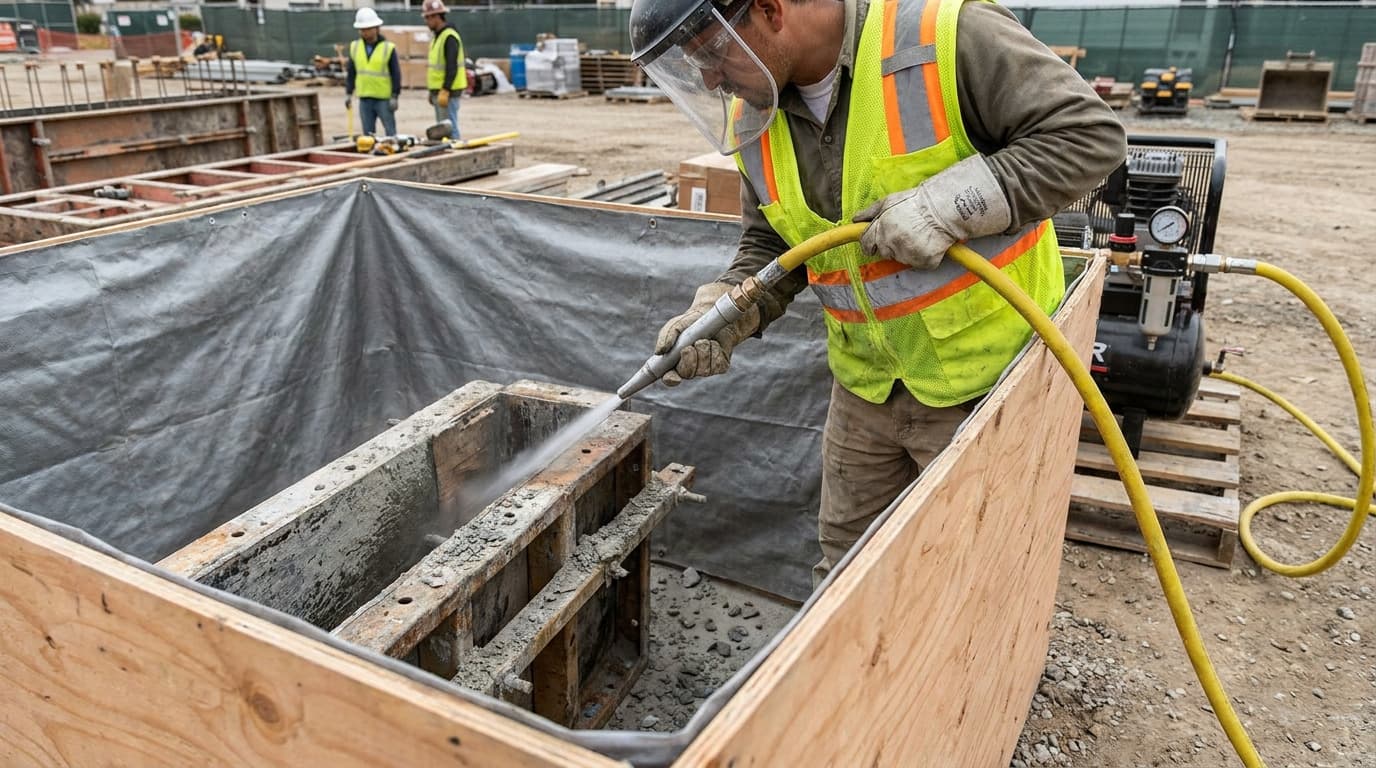
The honest way to use that carve-out is as an explanation of why the pressure limit is not the whole control, rather than as permission to point an unregulated nozzle at anything.
And air is never for cleaning a person. Nothing in the standard contemplates blowing down clothing, hair or skin. Compressed air directed at the body can drive particles into the eye, force air under the skin, and — at surprisingly low pressures — enter the bloodstream. There is no safe pressure for that use.
The hose is the hazard#
Four provisions in 1926.302(b) are about the line rather than the tool, and together they are the whole anti-whip programme:
- (b)(1) — pneumatic power tools shall be secured to the hose or whip by some positive means to prevent the tool from becoming accidentally disconnected. A twist-lock coupling on its own is not a positive means; a retaining cable or pin is.
- (b)(7) — all hoses exceeding 1/2-inch inside diameter shall have a safety device at the source of supply or branch line to reduce pressure in case of hose failure. This is the excess-flow valve people call a hose-check. It is required by size, not by preference.
- (b)(6) — the use of hoses for hoisting or lowering tools shall not be permitted. Common, quick, and against the standard.
- (b)(5) — the manufacturer's safe operating pressure for hoses, pipes, valves, filters and other fittings shall not be exceeded. The weakest fitting sets the system pressure, not the compressor's capability.
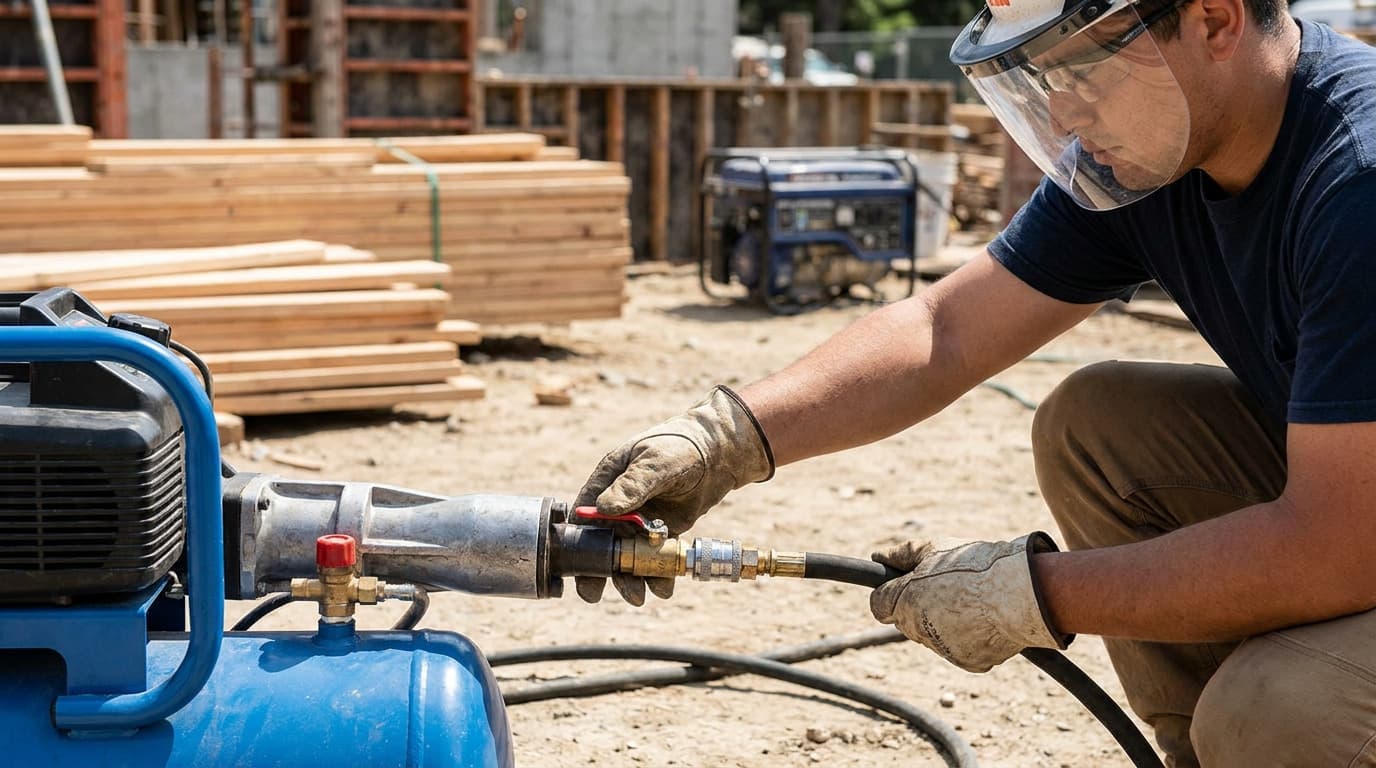
A charged line that separates does not fall to the ground. It travels, at the pressure behind it, at head height, with a metal fitting on the end.
Percussion tools, nailers and blast nozzles#
(b)(2) — safety clips or retainers shall be securely installed and maintained on pneumatic impact (percussion) tools to prevent attachments from being accidentally expelled. A chisel or a moil point leaving a breaker is a projectile, and the retainer is what stops it.
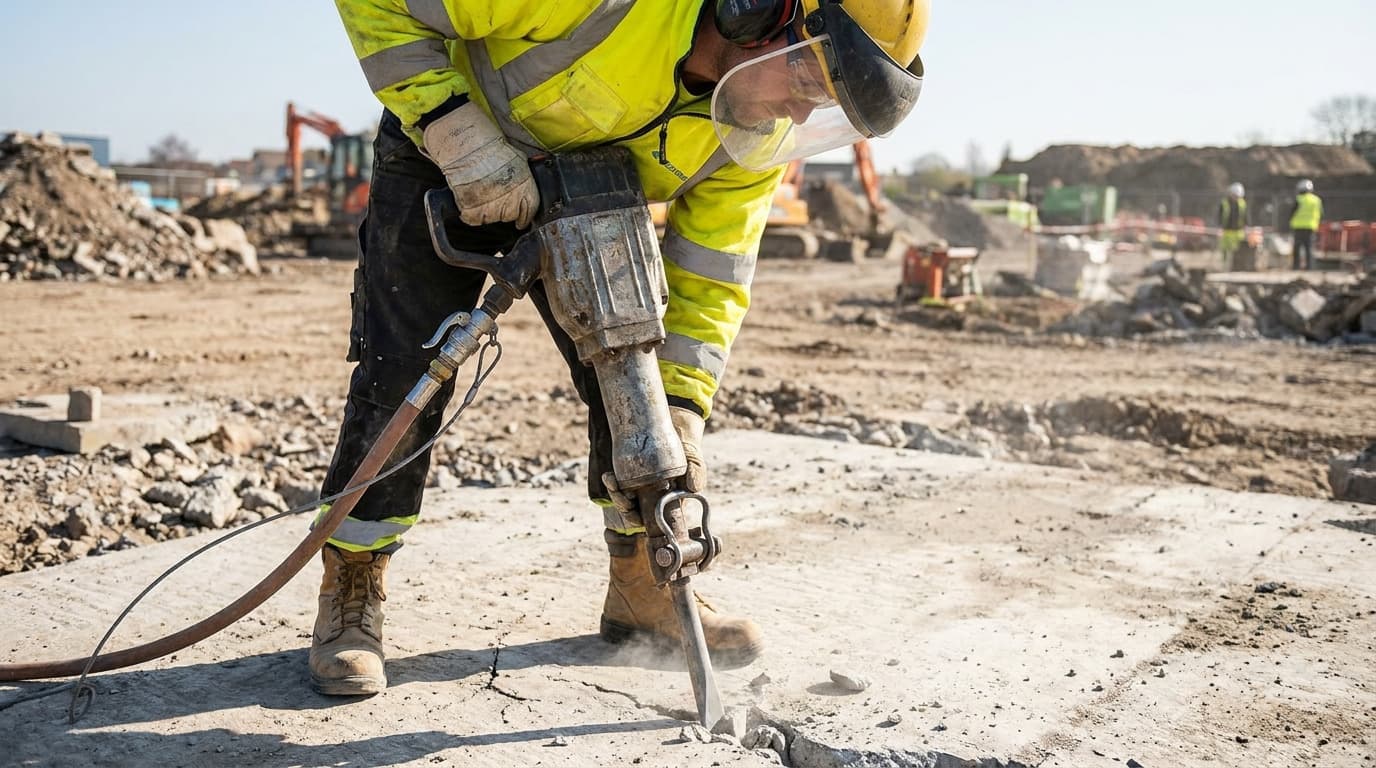
(b)(3) — all pneumatically driven nailers, staplers and similar equipment with automatic fastener feed operating at more than 100 p.s.i. at the tool must have a safety device on the muzzle to prevent the tool ejecting fasteners unless the muzzle is in contact with the work surface. That is the contact trip, and disabling or taping it is removing a required device.
(b)(10) — abrasive blast cleaning nozzles shall be equipped with an operating valve which must be held open manually, with a support provided on which the nozzle may be mounted when not in use. A dead-man valve that has been wedged, wired or clamped open is the exact condition this paragraph prohibits.
What can go wrong?#
Air used to clean a person down. The most common misuse, and the one with the worst outcomes — eye injuries, and injection of air or debris through skin.
A coupling separates under pressure. No retaining device, no excess-flow valve, and a hundred feet of charged line goes looking for something to hit.
The line is dragged, run over and crushed. Damaged hose fails at the weak point, usually at a coupling, usually near somebody.
A chisel leaves a breaker. Retainer missing or worn, and the tool spits its attachment.
A nailer fires unintentionally. Contact trip taped, tied or removed, or the tool carried with a finger on the trigger.
The blast nozzle is wedged open. Operator loses the hose and it becomes an uncontrolled abrasive jet.
Pressure creeps up. Somebody turns the regulator up to make a tool work faster, past the fittings' rating, and now the weakest coupling in the system is the failure point.
Noise nobody counted. Air exhaust and pneumatic breakers are among the loudest things on a site, and hearing damage from them is cumulative and permanent.
How do we do this properly?#
Never use air on skin, clothing or hair. No pressure, no exception, no "just a quick blow down." Use a brush, a vacuum or a rag.
Set up cleaning properly when it is needed. Regulated below 30 psi where the cap applies, with effective chip guarding and PPE — and remember the guarding and PPE are still required for the exempt tasks.
Fit retainers and check them. Positive means securing every tool to its hose; safety clips on every percussion tool, inspected daily rather than assumed.
Fit the safety device on hoses over 1/2 inch inside diameter, at the source of supply or branch line, and check that it is actually there rather than a plain coupling.
Bleed the line before breaking a connection. Shut the valve, release the pressure, then disconnect. Never crack a coupling on a live line.
Never lift or lower a tool by its hose.
Respect the fittings' rating, not the compressor's. Set the regulator to the lowest pressure that does the job.
Route hose out of traffic, off walkways and stairs, protected where it crosses an edge, and inspect it for cuts, bulges and damaged ends.
Wear eye and face protection, and hearing protection. Air work throws particles and makes noise, both continuously.
Before you start#
- Confirm nobody on this crew will use air to clean themselves or anyone else down.
- Confirm the tool is secured to the hose by a positive means, not just a coupling.
- Confirm percussion tools have their safety clips or retainers fitted and undamaged.
- Confirm hoses over 1/2-inch inside diameter have the safety device at the source of supply or branch line.
- Confirm the regulator is set within the rating of the hoses and fittings in use.
- Confirm hose runs are out of traffic, uncrushed and undamaged along their length.
- Confirm nailers have a working muzzle contact device and blast nozzles a working dead-man valve.
- Confirm eye, face and hearing protection is worn before the air goes on.
Talk it over#
- Has anyone here ever been blown down with an air line? What did it feel like afterwards?
- Where is the longest hose run on this site, and what would it hit if a coupling let go?
- Who checks the retainer on our breaker, and how often?
- What pressure is our regulator set to, and who decided that number?
The bottom line#
1926.302(b)(4) allows compressed air for cleaning only when reduced below 30 p.s.i., and then only with effective chip guarding and PPE — three conditions, not one — with a narrow exemption from the pressure limit for concrete form, mill scale and similar cleaning purposes that does not touch the guarding and PPE duties. Air is never for cleaning a person. The line itself is governed separately: tools secured to the hose by a positive means under (b)(1), a safety device on any hose over 1/2-inch inside diameter under (b)(7), no hoisting or lowering tools by hose under (b)(6), and the manufacturer's safe operating pressure never exceeded under (b)(5). Percussion tools need retainers under (b)(2), nailers over 100 p.s.i. need a muzzle contact device under (b)(3), and blast nozzles need a valve held open manually under (b)(10).
Frequently asked questions about compressed air safety#
What is the OSHA 30 psi rule for compressed air?
1926.302(b)(4) provides that compressed air shall not be used for cleaning purposes except where reduced to less than 30 p.s.i., and then only with effective chip guarding and personal protective equipment meeting subpart E. It is three requirements together — the pressure reduction alone is not compliance.
Is there really an exemption to the 30 psi limit?
Yes, and it is narrow. The same paragraph states that the 30 p.s.i. requirement does not apply for concrete form, mill scale and similar cleaning purposes. What it lifts is the pressure cap for those tasks. It does not remove the requirement for effective chip guarding and personal protective equipment, and it does not make higher-pressure cleaning inherently safe.
Can compressed air be used to clean dust off clothing or skin?
No. Nothing in the standard contemplates cleaning a person with compressed air, and doing so can drive particles into the eyes, force air beneath the skin and introduce air into the bloodstream. Use a brush, a vacuum or a cloth instead — there is no pressure at which blowing down a person becomes an acceptable practice.
When does an air hose need a safety device?
1926.302(b)(7) requires that all hoses exceeding 1/2-inch inside diameter have a safety device at the source of supply or branch line to reduce pressure in case of hose failure. The trigger is the hose's inside diameter, so it applies regardless of how short the run is or how careful the crew is.
How should a pneumatic tool be attached to its hose?
1926.302(b)(1) requires pneumatic power tools to be secured to the hose or whip by some positive means to prevent accidental disconnection — a retaining cable, pin or equivalent, in addition to the coupling itself. The coupling is the connection; the positive means is what stops the tool leaving if the coupling releases.
What stops a chisel flying out of a breaker?
1926.302(b)(2) requires safety clips or retainers to be securely installed and maintained on pneumatic impact (percussion) tools to prevent attachments from being accidentally expelled. "Maintained" is the part that gets missed — a worn or bent retainer is not a retainer.
Do pneumatic nailers need a contact trip?
Under 1926.302(b)(3), all pneumatically driven nailers, staplers and similar equipment with automatic fastener feed operating at more than 100 p.s.i. pressure at the tool must have a safety device on the muzzle to prevent the tool ejecting fasteners unless the muzzle is in contact with the work surface. Taping, tying or removing that device removes a required safety feature.
Download the compressed air safety toolbox talk PDF#
Get this compressed air safety toolbox talk as a print-ready PDF — available in English, Spanish, Portuguese, and Turkish. Print it, hand it to the crew, and collect signatures on the included attendance sheet.
Download the PDF — free account required. New members get 3 free downloads.
Related toolbox talks#
Sources#
- OSHA, 29 CFR 1926.302 — Power-operated hand tools: https://www.osha.gov/laws-regs/regulations/standardnumber/1926/1926.302
- OSHA, Letter of Interpretation, 19 January 2005 — Application of OSHA construction standards to pneumatic hand tools used for cleaning concrete forms, bridge decks, and roads: https://www.osha.gov/laws-regs/standardinterpretations/2005-01-19-2
- OSHA, 29 CFR 1926.300 — General requirements (Subpart I, Tools — Hand and Power): https://www.osha.gov/laws-regs/regulations/standardnumber/1926/1926.300
This talk summarises published regulatory guidance. It is not medical advice. Any suspected air or debris injection injury should be treated as a medical emergency and assessed urgently, even when the entry wound appears minor.
Written by FieldSafetyTalk's safety professional — a CSP, ASP, CHST and OSHA Authorized Outreach Trainer with 14+ years of international construction safety experience across federal, heavy civil, and industrial projects.