Lifting Techniques and Posture
Updated 2026-07-24
In this bundle Manual Handling & Body Mechanics
Print-ready PDF
Download this talk as a print-ready PDF, available in 4 languages.
Ask any crew what the OSHA lifting limit is and someone will give you a number. Fifty pounds. Fifty-one. Seventy-five. They are all wrong, but not in the way you would expect — there is no OSHA lifting limit at all. There is no OSHA standard governing manual lifting, and by act of Congress there legally cannot be one like the last attempt. This Lifting Techniques and Posture Toolbox Talk (Safety Talk / Tailgate Talk) is about what actually governs the heaviest thing you will pick up today.
Here is the distinction that carries this whole talk: every other topic on this site starts with a rule and works down to practice. Manual handling has no rule to start from. What it has instead is a calculation — one that treats the weight of the object as only one of seven inputs, and which tells you something most lifting training never mentions: the same box can be safe and unsafe on the same day, depending entirely on where it sits and how you reach it.
The standard that lasted 64 days#
This is not folklore. It is on the record.
- OSHA published its Ergonomics Program Standard on November 14, 2000 (65 FR 68262), as Subpart W of 29 CFR 1910. It became effective January 16, 2001.
- The Senate passed a resolution of disapproval under the Congressional Review Act on March 6, 2001; the House on March 7; and the President signed it as Public Law 107-5 on March 20, 2001.
- OSHA removed the standard from the Code of Federal Regulations effective April 23, 2001.
It was the first OSHA standard ever overturned through that process. And the Congressional Review Act does something further: it prohibits the agency from issuing a rule that is substantially the same as the one that was rescinded. So the absence is not an oversight waiting to be corrected. It is a legal condition.
What governs instead is the General Duty Clause — Section 5(a)(1) of the OSH Act, codified at 29 U.S.C. 654(a)(1): each employer shall furnish a workplace free from recognized hazards that are causing or are likely to cause death or serious physical harm. OSHA has stated it will use this clause to cite employers for ergonomic hazards, whether or not voluntary guidelines exist, and considers four things: whether an ergonomic hazard exists, whether it is recognized, whether it is causing or likely to cause serious physical harm, and whether a feasible means exists to reduce it.
That last factor is the one that matters on site. If there is a practical way to make the lift safer and you did not use it, that is the exposure.
The 51 pounds everybody gets backwards#
With no standard, the authoritative reference is the Revised NIOSH Lifting Equation, published in its applications manual in 1994 (NIOSH Publication No. 94-110). Almost everyone has heard its headline number, and almost everyone has it upside down.
The equation is:
RWL = LC × HM × VM × DM × AM × FM × CM
LC is the load constant: 23 kg (51 lb). And here is the part that gets lost: it is not a limit. It is the best case. It is the weight NIOSH considers acceptable only under ideal conditions — the load directly in front of you, at about knuckle height, moved only a short vertical distance, with no twisting, lifted infrequently, and with good handles. Every one of the six multipliers is a number between zero and one, so every departure from that ideal multiplies the 51 pounds downward. It never goes up.
- HM — Horizontal. How far the load sits from the midpoint between your ankles.
- VM — Vertical. The starting height of your hands.
- DM — Distance. How far the load travels vertically.
- AM — Asymmetry. How much you twist.
- FM — Frequency. How often you lift, and for how long.
- CM — Coupling. How good the grip and handles are.
Then the Lifting Index puts it in plain terms: LI = weight of the load ÷ RWL. An LI at or above 1.0 indicates increased risk of lifting-related low back pain for some portion of the workforce, and the higher it goes, the smaller the fraction of workers who can do that job safely.
Two more facts worth knowing about that 51-pound figure.
It was already a reduction. NIOSH's first lifting equation, published in 1981, carried a maximum recommended weight of 90 lb (41 kg). The 1991 revision cut it to 51. NIOSH nearly halved its own recommendation when better research arrived.
And even the ideal number is not safe for everyone. The load constant was set as a load that, under ideal conditions, is safe for about 75% of women and 90% of men. So one in four women and one in ten men are outside the envelope on a perfect lift. Nobody on your crew is average.
What actually decides whether a lift hurts you#
Read the multipliers again and notice what they describe. Not one of them is technique. They are all about how the work is arranged.
The load away from your body is the single most punishing factor. Holding a load at arm's length multiplies the force on your lower back several times over compared with holding it against your torso, because your spine works as a lever with a very short arm. A 20-pound box held out from the body loads the back more than a 50-pound box held close.
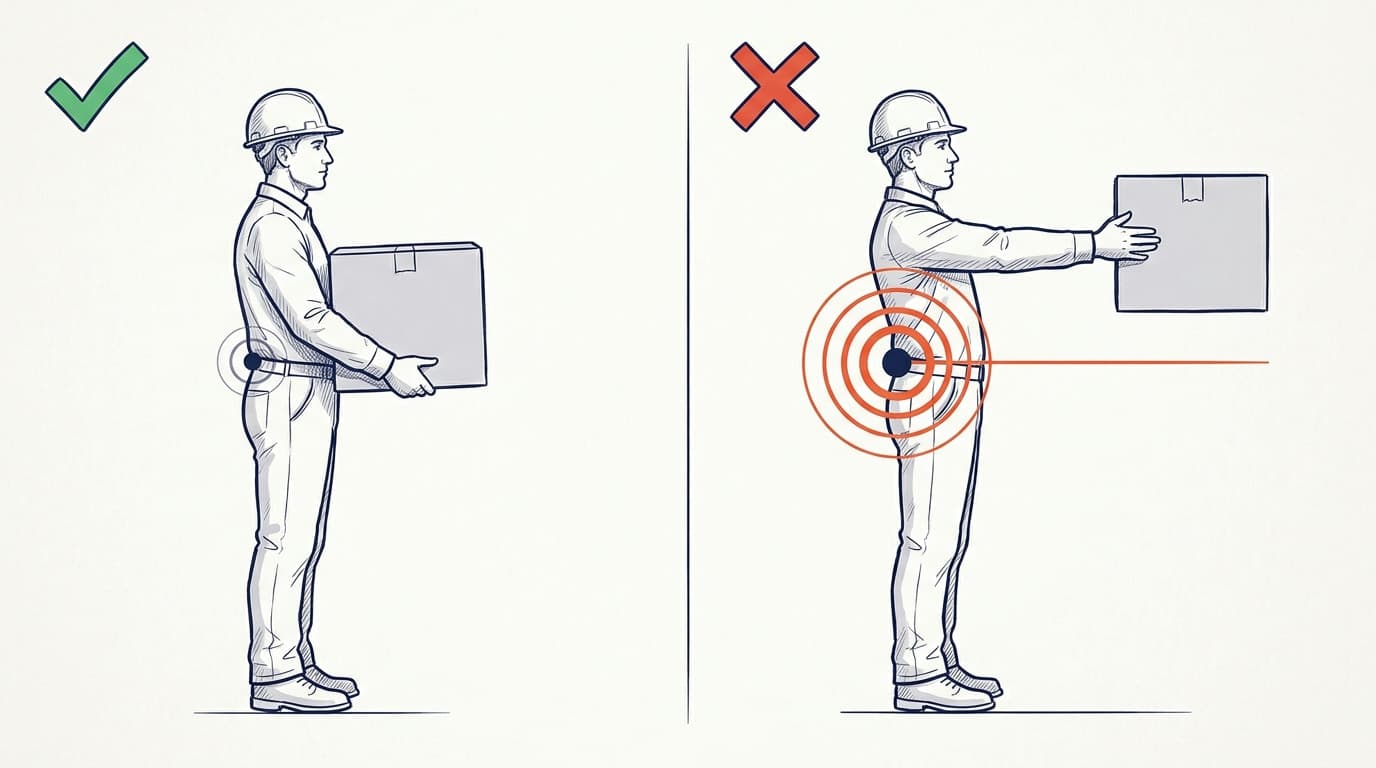
Starting height matters as much as weight. Lifting from the floor and lifting from a bench are different tasks with the same box. Anything that raises the pick-up point — a pallet on a stand, a table, a second person — changes the arithmetic.
Twisting under load is the sharpest single risk multiplier in most real incidents. The asymmetry multiplier exists because rotating the spine while it is compressed is where discs get hurt.
Frequency turns a safe lift into an unsafe job. One lift of 40 pounds may be fine. Four hundred of them across a shift is a different exposure entirely, and the frequency multiplier is what captures that.
Grip is not a detail. No handles, a slippery surface, or a load you have to pinch drops the coupling multiplier and reduces the safe weight.
What can go wrong#
"Lift with your legs" treated as the whole answer. Posture matters, but the equation shows it is one input among many. A perfect squat lift of a load held at arm's length, twisted, at high frequency, is still a damaging task.
Quoting a weight limit that does not exist. Crews set arbitrary numbers — "nothing over 50 alone" — with no reference to reach, height, twist, or frequency, and then treat compliance with that number as safety.
Cumulative damage that never produced an incident report. Manual handling injuries mostly arrive gradually. The lift that finally puts someone out is rarely the one that caused the damage.
The awkward load rather than the heavy one. Sheet goods, long pipe, unbalanced or shifting contents, and anything with no handhold — all of which crush the horizontal and coupling multipliers.
Team lifts with no plan. Uneven load sharing, no agreed signal, mismatched heights, and nobody controlling the set-down.
Carrying while walking backwards, on stairs, or over uneven ground — which is where a manual handling task turns into a fall.
Rushing at the end of the shift, or at the end of a delivery. Frequency and fatigue climbing together.
Assuming younger or bigger workers are exempt. The load constant already excludes a quarter of women and a tenth of men under perfect conditions.
Not reporting early symptoms. Aches that resolve overnight are the warning stage of exactly the disorders this topic exists to prevent.
How do we make lifting safer?#
Change the job before you change the technique. The multipliers are all features of the task layout, so that is where the leverage is. Raise the pick-up height, bring the load closer, reduce the carry distance, remove the twist, cut the frequency, add a handle.
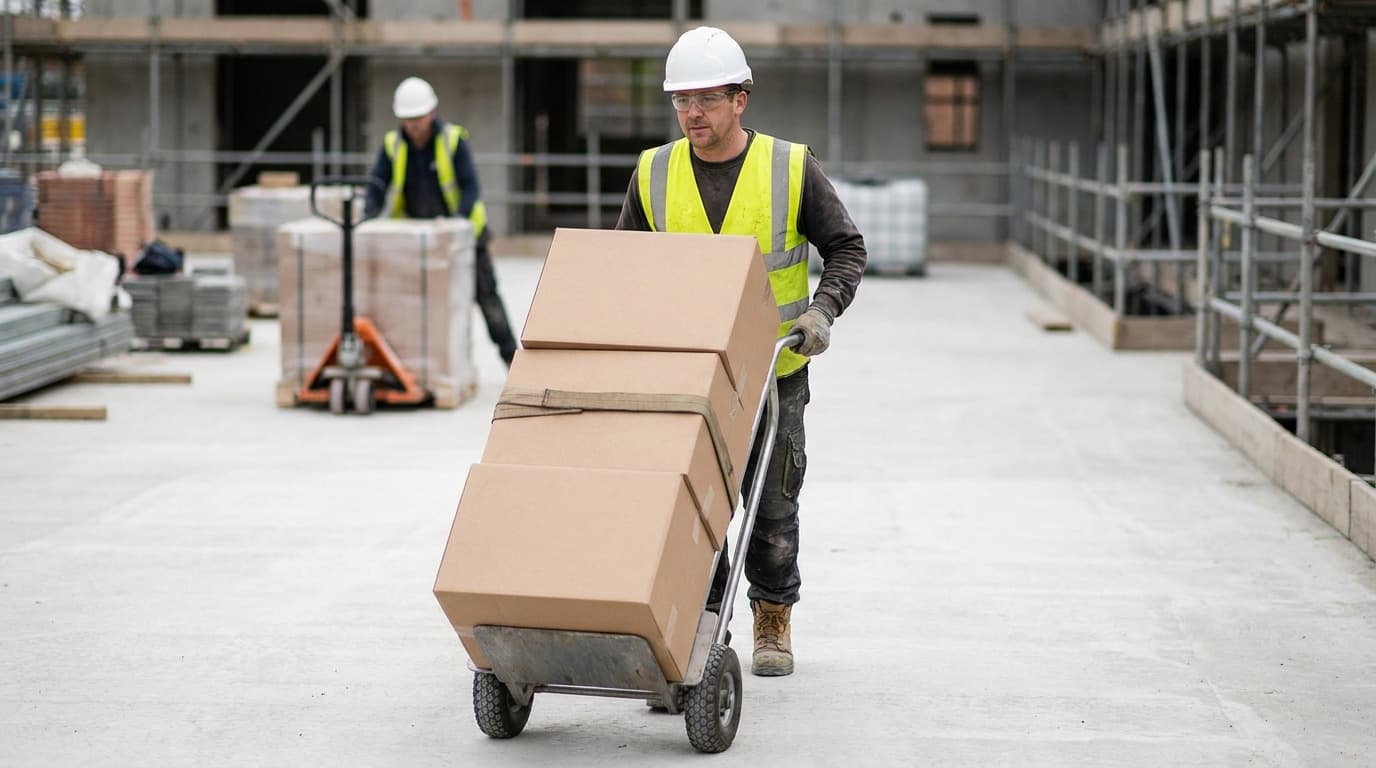
Eliminate the manual lift where you can. A cart, a pallet jack, a hoist, a two-wheeler, or a delivery placed at working height beats any lifting technique.
Get the load close before it leaves the ground. Horizontal distance is the harshest multiplier. Step in rather than reach out.
Turn with your feet, never your spine. If you have to place a load to your side, move your feet and square up.
Set the route before you pick it up. Where it is going, what is in the way, where the free hand goes for doors, and where you will set it down.
Plan team lifts out loud. Who calls it, who leads, matched heights where possible, and an agreed signal for both the lift and the set-down.
Break the load down where the packaging allows. Two trips beat one injury.
Treat frequency as a hazard in its own right. Rotate people through high-repetition tasks and build in recovery.
Ask for early symptoms in the toolbox talk itself. Reporting an ache is what stops it becoming a claim.
On USACE and NAVFAC projects, EM 385-1-1 applies and carries its own manual handling and ergonomics requirements — check them rather than assuming the general absence of an OSHA standard means there is no contractual duty.
Before you start#
- Look at where the load is starting from and where it is going, before you touch it.
- Get the load as close to your body as it will come before lifting.
- Check the grip — handles, surface, whether the contents can shift.
- Confirm the route is clear, including doors, steps, and where you will set it down.
- Decide whether this needs a mechanical aid rather than a person.
- Decide whether it needs two people, and agree who calls it.
- Remove the twist: position your feet so you can turn with them.
- Consider how many times this will happen today, not just once.
- Confirm nobody is carrying while walking backwards or on stairs.
- Report early aches now, not at the end of the job.
Talk it over#
- What is the worst lift on this job — not the heaviest, the worst? What makes it worse than the others?
- Which of today's lifts could be removed entirely with a cart, a jack, or a better delivery position?
- If a load is at arm's length instead of against your chest, what has changed about the force on your back?
The bottom line#
There is no OSHA lifting limit. OSHA's Ergonomics Program Standard took effect in January 2001 and was rescinded by Public Law 107-5 that March under the Congressional Review Act, which also bars a substantially similar rule — so manual handling is governed by the General Duty Clause, 29 U.S.C. 654(a)(1), and the question OSHA asks is whether a feasible means existed to reduce a recognised hazard. The reference everyone half-remembers is the NIOSH load constant of 23 kg (51 lb), and it is not a limit — it is the ideal-conditions best case, reduced by six multipliers for reach, height, travel, twist, frequency, and grip, and calibrated to be safe for only about 75% of women and 90% of men even then. So fix the task, not the posture: raise the pick-up, bring the load in, take out the twist, cut the frequency, and use a machine wherever one will do the job.
Frequently asked questions about safe lifting#
What is the OSHA lifting limit?
There isn't one. OSHA has no standard governing manual lifting weights. Its Ergonomics Program Standard, published November 14, 2000 and effective January 16, 2001, was rescinded by Public Law 107-5 on March 20, 2001 under the Congressional Review Act — which also prohibits OSHA from issuing a rule substantially the same as the one rescinded. Ergonomic hazards are addressed instead under the General Duty Clause, Section 5(a)(1) of the OSH Act (29 U.S.C. 654(a)(1)).
Where does the "51 pounds" figure come from?
From the Revised NIOSH Lifting Equation (NIOSH Publication No. 94-110, 1994). 51 lb (23 kg) is the load constant — the weight NIOSH considers acceptable under ideal conditions only. It is not a limit and not a legal threshold. It is the starting point of a calculation that reduces it based on the actual task.
How is the Recommended Weight Limit calculated?
RWL = LC × HM × VM × DM × AM × FM × CM, where LC is the 23 kg (51 lb) load constant and the six multipliers account for horizontal distance from the body, vertical starting height, vertical distance travelled, asymmetry (twisting), frequency of lifting, and coupling (grip quality). Each multiplier is a value between 0 and 1, so every non-ideal condition reduces the recommended weight below 51 lb.
What is the Lifting Index?
LI = weight of the load ÷ RWL. It expresses the physical stress of a task as a ratio. An LI at or above 1.0 indicates an increased risk of lifting-related low back pain for some portion of the workforce, and the higher the value, the smaller the percentage of workers who can perform the task safely. It is useful for ranking jobs and prioritising which to redesign first.
Is the load constant safe for everyone?
No. NIOSH established the 23 kg (51 lb) load constant as a weight that, under ideal conditions, is safe for approximately 75% of females and 90% of males. Even on a perfect lift, roughly one in four women and one in ten men fall outside that envelope — which is why task design matters more than assuming an individual can cope.
Does correct lifting technique solve the problem?
Only partly. None of the six multipliers in the NIOSH equation describes technique — they all describe how the task is arranged. Good posture helps, but a well-executed lift of a load held at arm's length, with a twist, repeated hundreds of times, remains a high-risk task. The larger gains come from changing the height, the reach, the twist, the frequency, or removing the manual lift altogether.
Why does holding a load away from the body matter so much?
Because the spine acts as a lever with a very short arm, so distance multiplies the compressive force dramatically. This is why the horizontal multiplier is typically the harshest factor in the equation — a light load held at arm's length can stress the lower back more than a considerably heavier load held against the torso.
Download the safe lifting toolbox talk PDF#
Get this lifting techniques and posture toolbox talk as a print-ready PDF — available in English, Spanish, Portuguese, and Turkish. Print it, hand it to the crew, and collect signatures on the included attendance sheet.
Download the PDF — free account required. New members get 3 free downloads.
Related toolbox talks#
Sources#
- OSHA, Ergonomics Program — removal of standard, Federal Register notice, April 23, 2001: https://www.osha.gov/laws-regs/federalregister/2001-04-23
- OSHA, Ergonomics — Standards and Enforcement FAQs: https://www.osha.gov/ergonomics/faqs
- NIOSH, Applications Manual for the Revised NIOSH Lifting Equation, DHHS (NIOSH) Publication No. 94-110, 1994
- CCOHS, NIOSH Lifting Equation — Assessing Relevant Handling Factors: https://www.ccohs.ca/oshanswers/ergonomics/niosh/assessing.html
Written by FieldSafetyTalk's safety professional — a CSP, ASP, CHST and OSHA Authorized Outreach Trainer with 14+ years of international construction safety experience across federal, heavy civil, and industrial projects.