High Pressure Machines
Updated 2026-07-28
In this bundle Tools & Machinery
Print-ready PDF
Download this talk as a print-ready PDF, available in 4 languages.
High pressure equipment is the category where the regulation has been left furthest behind by the tools. Search the construction tool standard for a pressure figure covering fluid and you will find exactly one, it is set at a level modern equipment passes before breakfast, and everything above it is governed by industry practice rather than by a rule. This High Pressure Machines Toolbox Talk (Safety Talk / Tailgate Talk) is about working in that space honestly.
Here is the distinction that carries this whole talk: at high pressure, water stops behaving like water. Below a certain point a jet pushes you; above it, it cuts. A stream that will strip concrete off rebar does not care that it is not a blade, and it does not need to touch you at working distance to injure you — the injury mechanism is a fluid entering tissue through skin that closes behind it, leaving a mark the size of a pinprick over damage that spreads for hours.
The only fluid pressure figure in the standard#
1926.302(b)(8):
Airless spray guns of the type which atomize paints and fluids at high pressures (1,000 pounds or more per square inch) shall be equipped with automatic or visible manual safety devices which will prevent pulling of the trigger to prevent release of the paint or fluid until the safety device is manually released.
And immediately after it, 1926.302(b)(9):
In lieu of the above, a diffuser nut which will prevent high pressure, high velocity release, while the nozzle tip is removed, plus a nozzle tip guard which will prevent the tip from coming into contact with the operator, or other equivalent protection, shall be provided.
That is the whole of it. 1,000 psi is where the construction tool standard starts paying attention to pressurised fluid — and modern hydrodemolition, hydroblasting and jetting equipment operates at ten to forty times that figure. There is no OSHA construction provision that speaks to it, no permit, no operator qualification, no exclusion zone distance, no dump-valve requirement.
What fills the space is the industry consensus document — the WJTA-IMCA Recommended Practices for the Use of High Pressure Waterjetting Equipment — together with manufacturer instructions, contract requirements, and the general duties that apply to any tool: 1926.302(b)(5), the manufacturer's safe operating pressure for hoses, pipes, valves, filters and other fittings shall not be exceeded; 1926.300(a), tools maintained in a safe condition; and 1926.300(c), PPE for employees exposed to flying, abrasive and splashing objects.
Read (b)(9) once more, because it describes a real failure mode. The diffuser nut exists so that if the nozzle tip is removed — for cleaning, for a change, because it blocked — the machine cannot deliver a high pressure, high velocity release. Half the incidents in this family of work happen at exactly that moment: tip off, trigger pulled, nobody expecting anything to come out.
Injection injury: the reason this talk exists#
A high pressure jet does not need to look like a wound to be one. Fluid at pressure enters through a small break in the skin, travels along the tissue planes, and the entry point closes. What the person sees is a pinhole. What is happening underneath is spreading contamination, chemical irritation and swelling in a compartment that has nowhere to expand.
The consequences of treating it as minor are severe and time-dependent, which is why the field rule has to be absolute: any suspected high pressure injection is a medical emergency, regardless of how small the entry mark is and how well the person feels. It is presented at hospital immediately, with the fluid identified — water, paint, hydraulic oil, grease, chemical — and with the working pressure stated, because the treating clinician needs both.
Nobody should be assessing this themselves at the tailgate, and nobody should be waiting to see how it develops overnight.
Where the energy is when nobody is spraying#
The hose is charged along its length. Like compressed air, but with a fluid behind it and far more stored energy. A whipping high pressure hose or a separated coupling delivers the pressure to whatever it reaches.
The dead-man is the primary control. A trigger or foot control that must be held is what makes the jet an intentional act. Wedging, taping or tying one open is removing the only feature that stops the tool running unattended.
Reaction force pushes the operator. Jetting guns and lances push back hard, and the natural response — leaning in, bracing on something unstable, working from a ladder — is how people end up off balance with a live lance.
Blocked nozzles and trapped pressure. Pressure remains in the system after the pump stops. Nothing is opened, changed or cleared until the system is depressurised, and the tip is not removed with the machine capable of firing.
Everyone else is inside the hazard. Ricochet, debris and the jet itself travel. The exclusion zone is not around the machine; it is around everything the jet and the debris can reach.
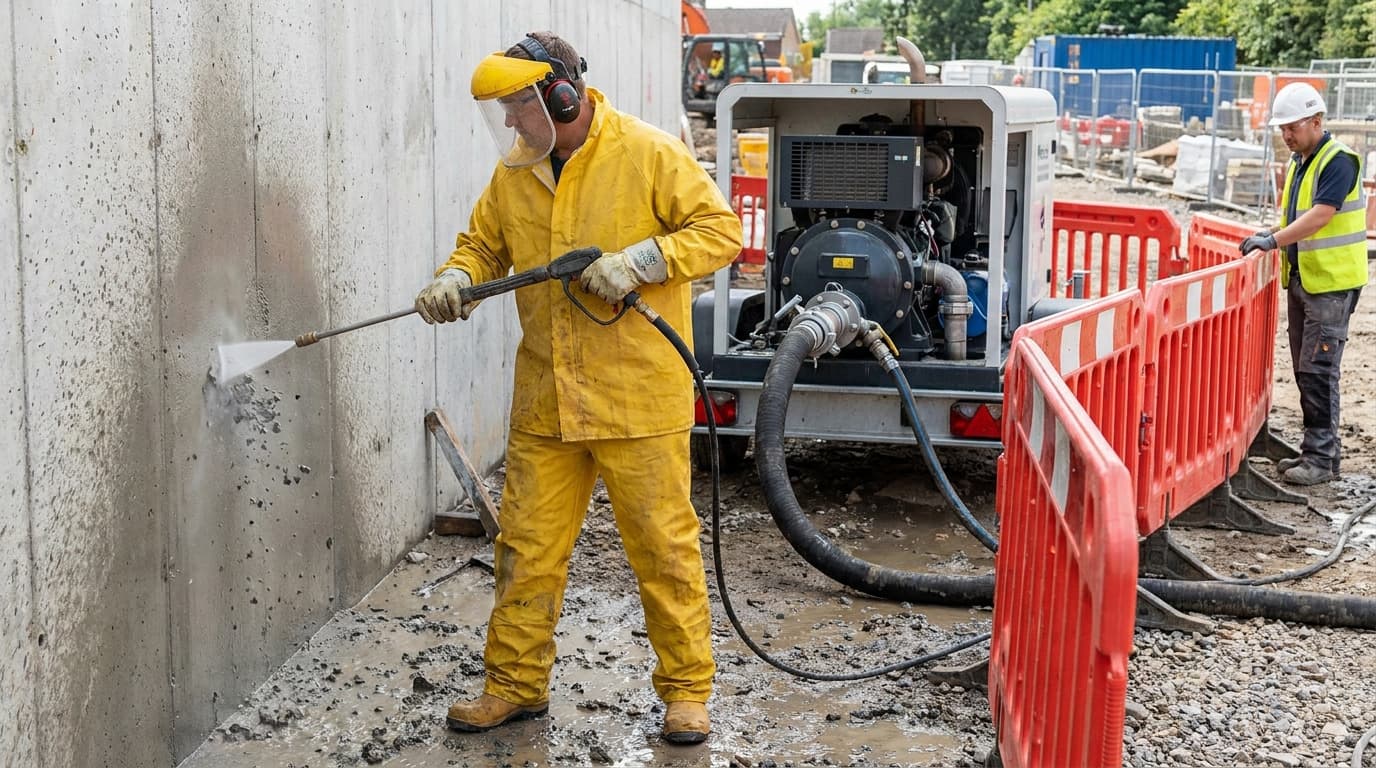
What can go wrong?#
The tip comes off and the trigger gets pulled. Precisely what the diffuser nut in (b)(9) exists to prevent.
The dead-man is tied back. The gun keeps running when it is dropped, and it goes where the reaction force takes it.
The operator braces on something that moves. Scaffold, drum, ladder — reaction force plus an unstable stance.
Pressure is trapped after shutdown. Somebody breaks a connection on a system that still holds energy.
A hose fails at a coupling. Damaged, kinked, dragged over an edge, or run above the fitting's rating.
Someone walks into the zone. No barriers, no signage, no spotter — and jet work is loud, so shouting does not reach anyone.
An injection is treated as a graze. Cleaned up, plastered, back to work — and the person presents hours later with an injury that needed intervention immediately.
How do we do this properly?#
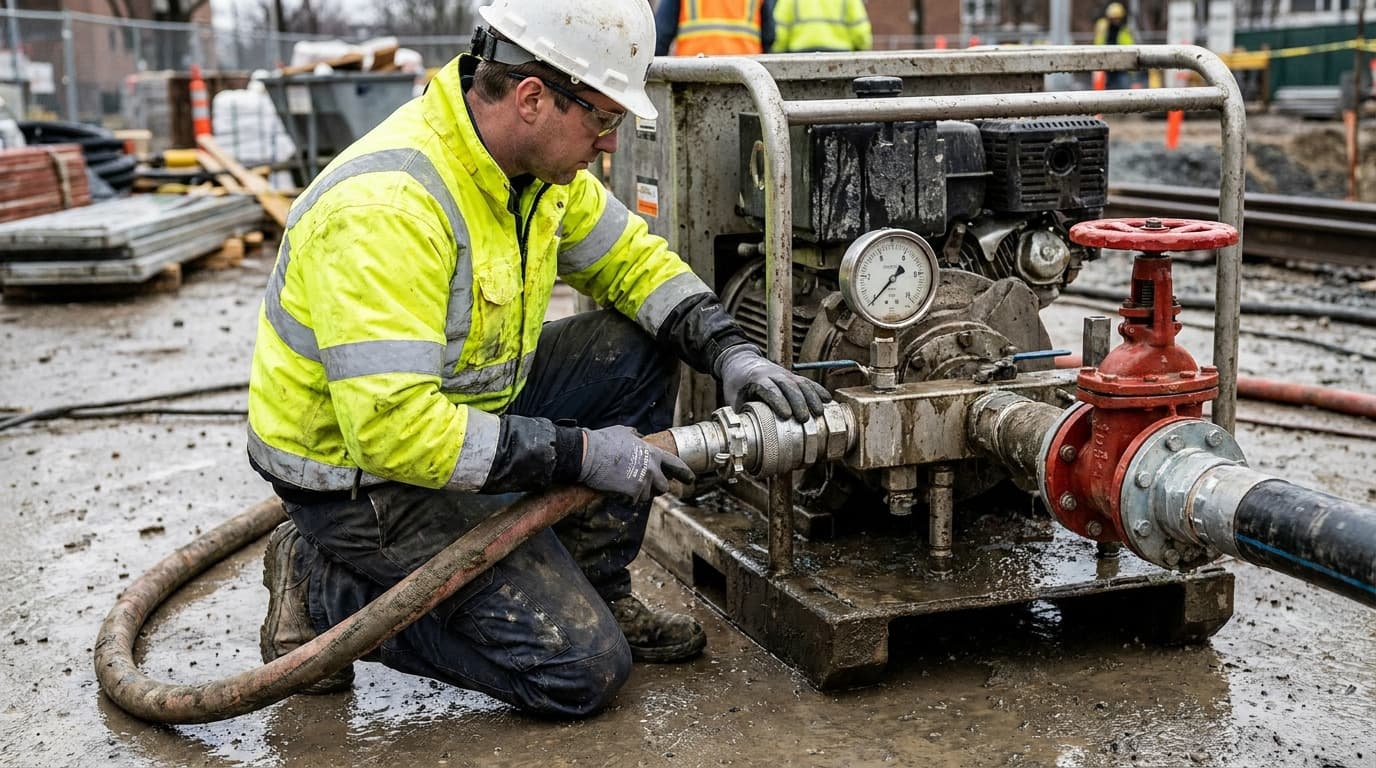
Set the pressure the job needs, and never above the lowest-rated component. 1926.302(b)(5) makes the manufacturer's safe operating pressure a ceiling for hoses, pipes, valves, filters and fittings — the weakest one governs.
Keep the dead-man functional and never defeated. Test it before work, and treat a tied or wedged control as an immediate stop.
Fit the protection (b)(8) and (b)(9) describe on airless spray equipment: the safety device that prevents the trigger being pulled, or the diffuser nut plus nozzle tip guard.
Depressurise before touching anything. Pump off, system bled, pressure confirmed at zero before a tip, hose, fitting or filter is disturbed.
Establish an exclusion zone that accounts for ricochet, not just the working line of the jet — barriers, signage, and a person controlling access who is not the operator.
Stand where the reaction force is manageable. Firm footing, no ladders, no leaning from a platform edge, both hands on the equipment, and never a lance supported by another person.
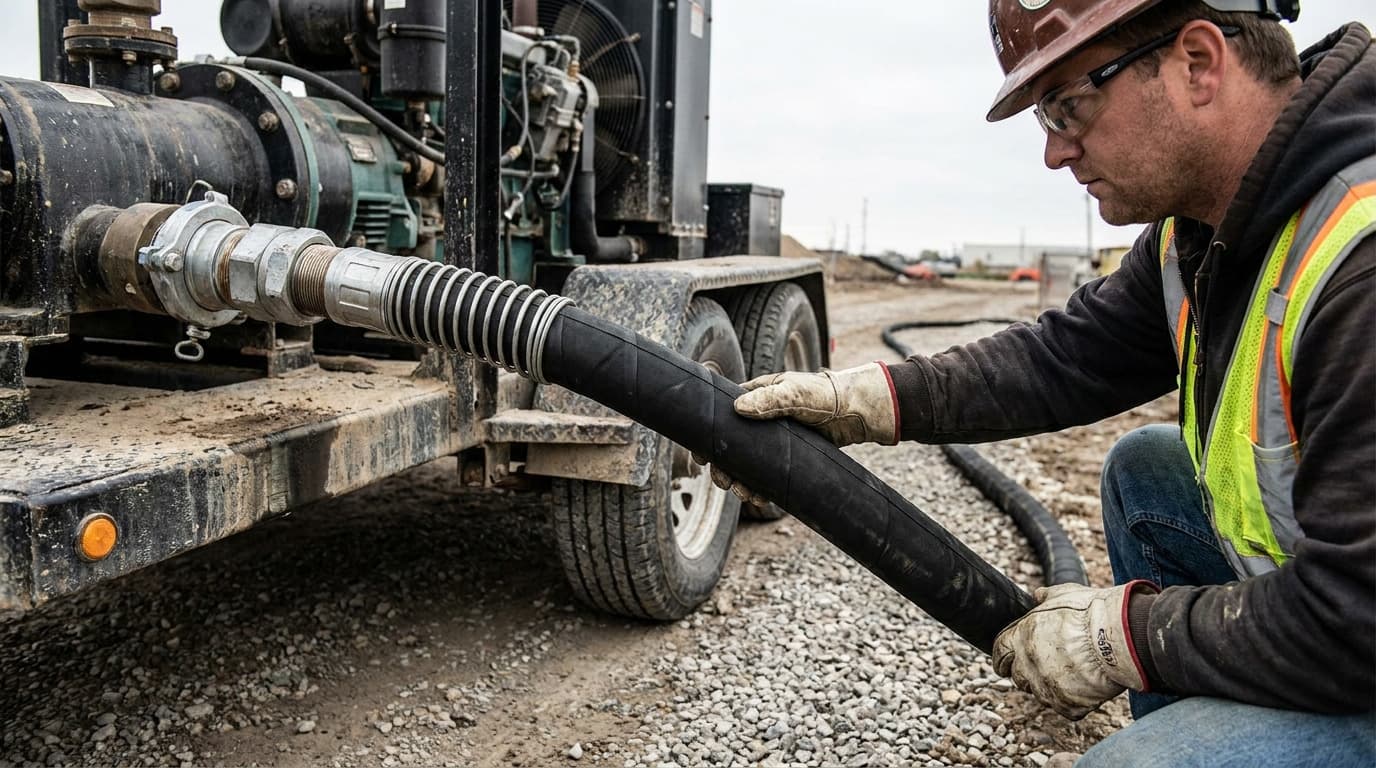
Inspect hoses and connections every shift for cuts, bulges, kinks, corrosion and damaged threads, and route them out of traffic and away from edges.
Wear the assembly, not a piece of it. Full face protection, body protection appropriate to the pressure, hearing protection, and footwear — jetting is one of the loudest and wettest jobs on a site.
Brief the injection rule before starting, so nobody has to make the decision while injured.
Before you start#
- Confirm the working pressure and that no hose, fitting, valve or filter in the system is rated below it.
- Confirm the dead-man control works and has not been tied, taped or wedged.
- Confirm airless spray equipment has the safety device, or the diffuser nut and nozzle tip guard.
- Confirm the exclusion zone is set for ricochet and debris, barriered and controlled by someone other than the operator.
- Confirm your footing and stance can take the reaction force, with no ladder and no unstable brace.
- Confirm the depressurisation sequence, and that nobody will open the system before it is bled.
- Confirm hoses are undamaged, routed clear of traffic and protected at edges.
- Confirm everyone knows that any suspected injection injury goes straight to hospital.
Talk it over#
- What pressure are we running, and what is the lowest-rated fitting in the line?
- Has anyone here had a dead-man control fail or seen one tied back?
- Where would the jet and the debris go if the lance slipped right now?
- If someone took a jet to the hand today, what would happen in the next ten minutes?
The bottom line#
The construction tool standard names one fluid pressure: 1,000 pounds or more per square inch, at which 1926.302(b)(8) requires airless spray guns to have an automatic or visible manual safety device preventing the trigger from being pulled — or, under (b)(9), a diffuser nut preventing high pressure, high velocity release while the nozzle tip is removed, plus a nozzle tip guard. Modern jetting equipment operates far above that figure with no OSHA provision addressing it, so the controls come from the WJTA-IMCA Recommended Practices, the manufacturer, and the general duties — including 1926.302(b)(5), which makes the manufacturer's safe operating pressure an absolute ceiling for every hose, valve and fitting in the system. And the rule that survives every job: a suspected injection injury is an emergency, however small the mark.
Frequently asked questions about high pressure equipment#
Does OSHA have a standard for water jetting or hydrodemolition?
Not a specific one in construction. The construction tool standard addresses pressurised fluid only at 1926.302(b)(8) and (b)(9), which deal with airless spray guns operating at 1,000 pounds or more per square inch. High pressure water jetting equipment operates well above that with no dedicated OSHA construction provision, so the recognised controls come from the WJTA-IMCA Recommended Practices, manufacturer instructions and the general tool and PPE duties.
What does 1926.302(b)(8) actually require?
That airless spray guns of the type which atomize paints and fluids at high pressures — 1,000 pounds or more per square inch — be equipped with automatic or visible manual safety devices which prevent pulling of the trigger, and so prevent release of the paint or fluid, until the safety device is manually released.
What is a diffuser nut and why does the standard mention it?
1926.302(b)(9) allows, in lieu of the trigger safety device, a diffuser nut which prevents high pressure, high velocity release while the nozzle tip is removed, plus a nozzle tip guard preventing the tip contacting the operator, or other equivalent protection. It exists because a common injury moment is the tip being off for cleaning or changing when the trigger is operated.
How high can we set the pressure?
No higher than the lowest-rated component allows. 1926.302(b)(5) provides that the manufacturer's safe operating pressure for hoses, pipes, valves, filters and other fittings shall not be exceeded — so the ceiling is set by the weakest item in the system, not by the pump's capability or by what makes the job quicker.
Why is a high pressure injection injury so serious?
Because the damage is out of all proportion to the entry wound. Fluid driven through the skin travels along tissue planes and the entry point closes behind it, leaving a mark that can look trivial while contamination, irritation and swelling spread beneath it. It is time-critical, which is why any suspected injection is treated as an emergency rather than assessed on site.
What should we do immediately after a suspected injection?
Stop work, get the person to hospital immediately rather than waiting to see how it develops, and take with them the identity of the fluid — water, paint, hydraulic oil, grease, chemical — and the working pressure of the equipment. Both matter to the treating clinician, and neither is easy to establish later.
Can the dead-man control ever be secured open?
No. A control that must be held is what makes the jet an intentional act and what stops the equipment running unattended if it is dropped. Wedging, taping or tying one open removes the primary control on the tool, and it is the same principle as the manually held valve required for abrasive blast nozzles under 1926.302(b)(10).
Download the high pressure machines toolbox talk PDF#
Get this high pressure machines toolbox talk as a print-ready PDF — available in English, Spanish, Portuguese, and Turkish. Print it, hand it to the crew, and collect signatures on the included attendance sheet.
Download the PDF — free account required. New members get 3 free downloads.
Related toolbox talks#
Sources#
- OSHA, 29 CFR 1926.302 — Power-operated hand tools: https://www.osha.gov/laws-regs/regulations/standardnumber/1926/1926.302
- OSHA, 29 CFR 1926.300 — General requirements (Subpart I, Tools — Hand and Power): https://www.osha.gov/laws-regs/regulations/standardnumber/1926/1926.300
This talk summarises published regulatory guidance and industry practice. It is not medical advice. Any suspected high pressure injection injury is a medical emergency and must be assessed at hospital immediately, however minor the entry wound appears.
Written by FieldSafetyTalk's safety professional — a CSP, ASP, CHST and OSHA Authorized Outreach Trainer with 14+ years of international construction safety experience across federal, heavy civil, and industrial projects.