Distracted Driving
Updated 2026-07-28
In this bundle Jobsite Fundamentals & Compliance
Print-ready PDF
Download this talk as a print-ready PDF, available in 4 languages.
Distracted driving is discussed as a discipline problem and it is mostly a scheduling problem. The driver answering the phone at 70 km/h is usually answering it because somebody expects an answer, on a job where being unreachable has a cost. That is why "put your phone away" is the least effective thing a site can say about it, and why the fix is upstream of the cab. This Distracted Driving Toolbox Talk (Safety Talk / Tailgate Talk) is about both ends of it.
Here is the distinction that carries this whole talk: the employer can create the violation. OSHA's position on distracted driving is that it will act against employers who require texting while driving, or who organise work so that texting is a practical necessity — a delivery window that cannot be met without replying en route, a dispatcher who expects immediate confirmation, a culture where an unanswered call means trouble. The behaviour happens in the vehicle; the decision that made it necessary happens in an office.
The federal prohibitions — and their scope#
Part 392, Subpart H of the Federal Motor Carrier Safety Regulations is titled Limiting the Use of Electronic Devices, and it contains two provisions:
49 CFR 392.80 — Prohibition against texting. Texting while driving a commercial motor vehicle is prohibited.
49 CFR 392.82 — Using a hand-held mobile telephone. Using a hand-held mobile telephone while driving a commercial motor vehicle is prohibited.
These are real prohibitions with real consequences, and they extend to the carrier: an employer must not require or permit a driver to do either.
Be precise about who they bind. These are FMCSA rules governing commercial motor vehicles. If your site operates tippers, mixers, low-loaders or anything else meeting the CMV definition, they apply directly to those drivers. They do not, by their own terms, govern a foreman in a pickup, a supervisor in a company car or a worker in their own vehicle.
For everybody else the framework is:
State and local law, which in most jurisdictions now prohibits hand-held phone use and texting for all drivers — and which is where the ticket actually comes from.
Section 5(a)(1), the General Duty Clause, which is the route OSHA has said it will use where an employer requires texting or makes it a practical necessity.
Employer policy, which is what actually governs the pickup — and which is only as strong as the scheduling behind it.
Three kinds of distraction#
This is worth separating, because the popular debate conflates them.
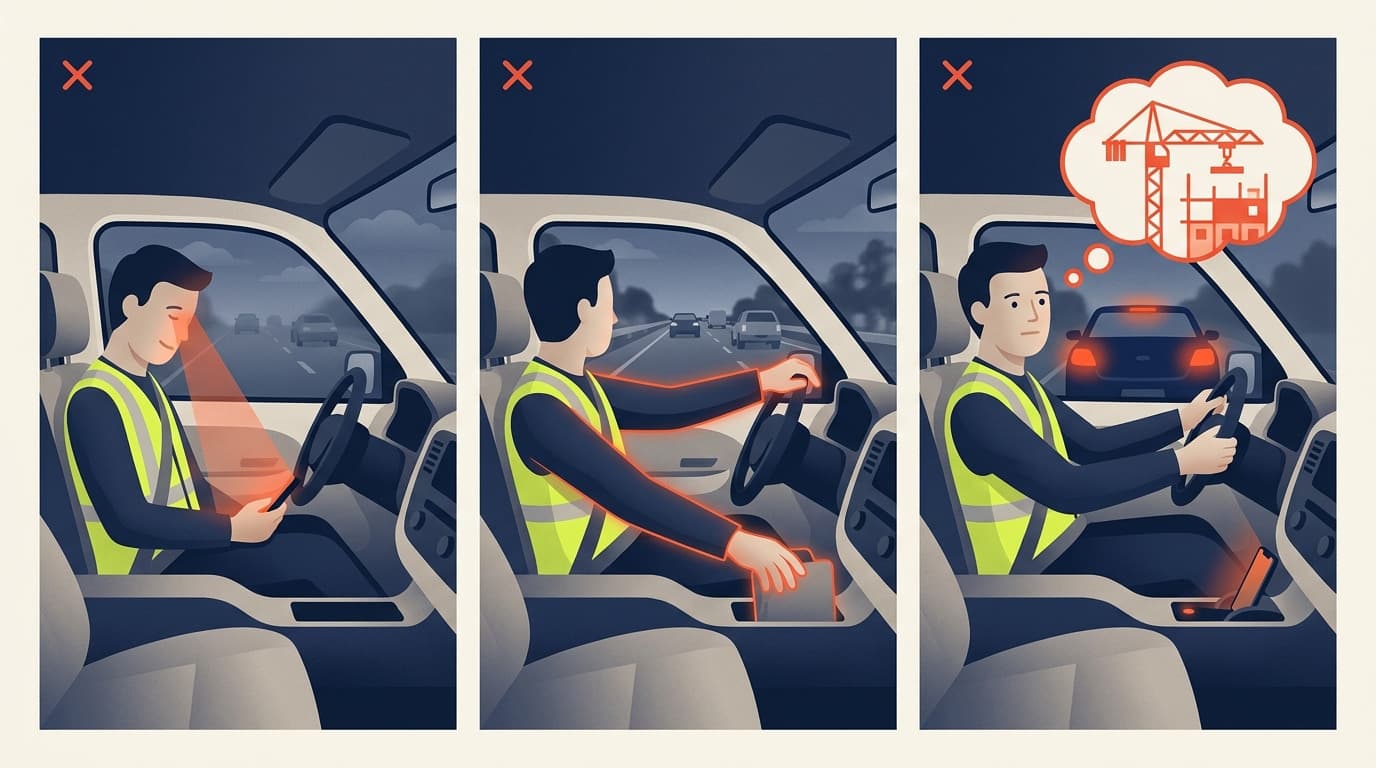
Visual — eyes off the road. The headline figure comes from NHTSA: sending or reading a text takes your eyes off the road for around five seconds, and at highway speed that is roughly the length of a football field travelled blind. Everything ahead can change in that distance.
Manual — hands off the wheel. Reaching, holding, dialling, adjusting. This is what hand-held prohibitions target.
Cognitive — mind off the driving. And this is the one people dismiss. Hands-free is not risk-free. A conversation, hands-free or not, consumes attention that would otherwise be spent scanning, anticipating and processing what the road is doing. Drivers in demanding conversations look at fewer things and remember less of what they passed. The phone being in a cradle solves the visual and manual problem and leaves the cognitive one untouched.
That matters practically: a policy that permits hands-free calling has addressed two of three distraction types and should not be described as having solved the problem.
The distractions that are not phones#
Site radio traffic. On many projects this is more disruptive than a phone, and it carries an implied obligation to respond immediately.
Drawings, delivery notes and paperwork on the passenger seat, consulted while moving.
Navigation, especially reprogramming en route.
Eating and drinking, in a vehicle used as a mobile lunch break.
Passengers, and crew-cab conversation.
Fatigue, which degrades attention the same way distraction does and interacts with it — a tired driver is a more distractible driver.
Thinking about the job. The most under-recognised distraction on any construction project is a driver mentally solving a problem on the site they just left.
What can go wrong?#
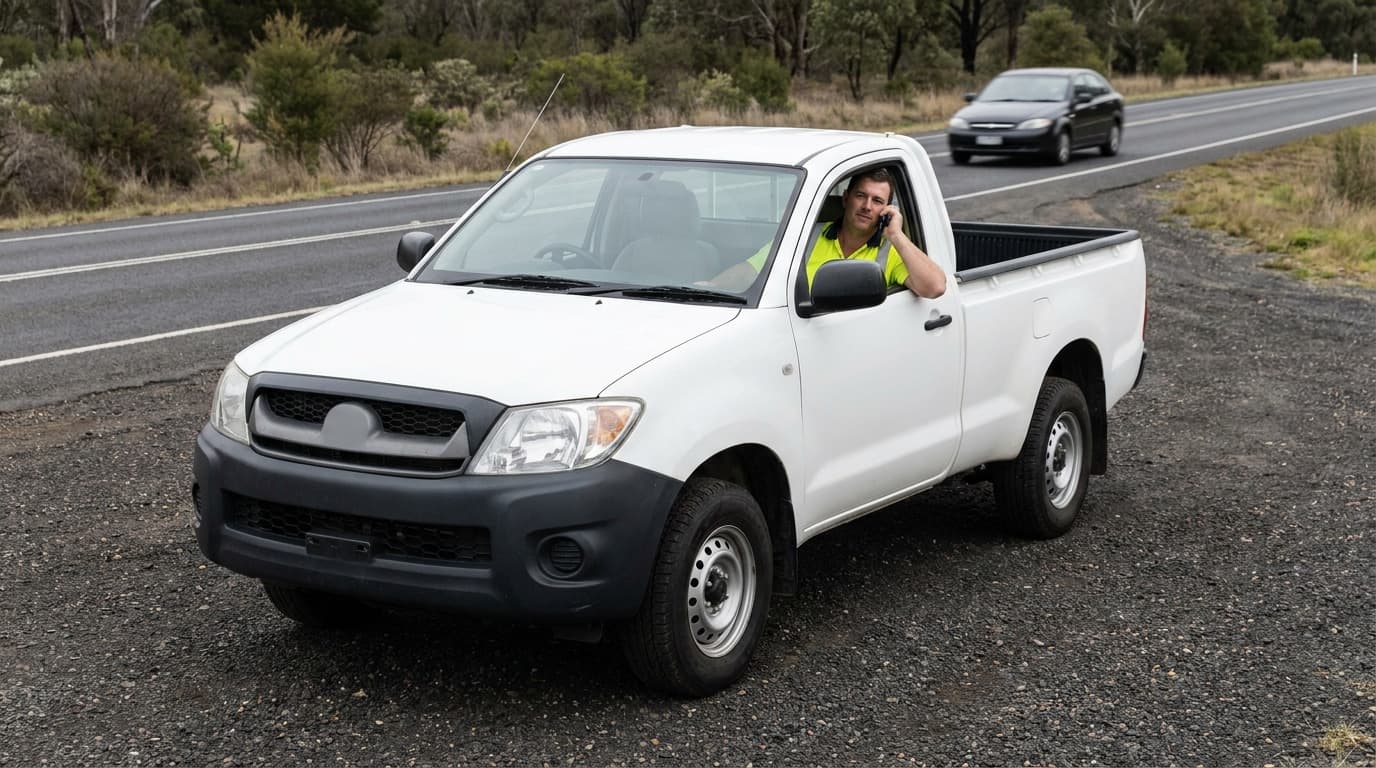
A dispatcher expecting immediate confirmation, so calls get answered in motion.
A delivery slot that cannot be met without dealing with messages on the way.
Radio calls treated as mandatory and instant.
Hands-free treated as safe, so the number of calls taken while driving goes up rather than down.
Navigation reprogrammed at speed because a route changed.
A supervisor visibly taking calls while driving, which authorises it for everyone.
Phone use policed for CMV drivers and ignored for everyone else, because only the drivers were told about the rule.
Reading a drawing at a red light, then continuing to read as it changes.
How do we manage this properly?#
Fix the expectation before the behaviour. Say explicitly that calls and messages will not be answered while driving, and that nobody will be criticised for an unanswered phone. Then have supervisors honour it.
Build the drive into the schedule. If a journey takes forty minutes, that is forty minutes nobody is reachable. Plan on that basis rather than treating it as slack.
Use voicemail and a callback discipline. Pull over properly — off the carriageway — and return the call.
Programme navigation before moving, and pull over to change it.
Treat radio the same as phone. Acknowledge and pull over, or hand the radio to a passenger.
Do not describe hands-free as safe. Permit it if you must, but say plainly that it removes two of three distraction types, not all three.
Supervisors and managers go first. A manager who takes calls while driving has set the policy, whatever the policy document says.
Know which rules bind which vehicles, and apply the stricter standard site-wide rather than sorting people by vehicle class.
Before you start#
- Confirm whether the vehicle you will drive is a commercial motor vehicle, and which rules therefore apply.
- Confirm your phone is stowed or set to reject calls before you move off.
- Confirm navigation is programmed before you set off.
- Confirm anyone expecting to reach you knows you will be driving and unreachable.
- Confirm any paperwork you need has been read before departure, not en route.
- Confirm where you would pull off if you had to take a call.
- Confirm nothing in today's schedule depends on you answering while moving.
- Confirm you are fit to drive — fatigue and distraction compound each other.
Talk it over#
- Who called you while you were driving this week, and did you answer?
- Would anyone here be criticised for not answering the phone in the van?
- Do our delivery windows assume the driver is reachable en route?
- Does anyone believe hands-free is safe? Why?
The bottom line#
The employer can create the violation. OSHA has stated it will act against employers who require texting while driving or who organise work so that texting is a practical necessity — which puts the schedule, the dispatcher and the delivery window inside the safety problem rather than outside it. The hard prohibitions live in Part 392, Subpart H of the FMCSA rules: 392.80 prohibits texting and 392.82 prohibits using a hand-held mobile telephone while driving a commercial motor vehicle, and a carrier must not require or permit either. Note the scope — these bind CMVs, not a foreman's pickup, for which state and local law, Section 5(a)(1) and employer policy apply instead. On the distraction itself, separate the three types: visual (NHTSA puts a text at roughly five seconds of eyes off the road — about a football field's length travelled blind at highway speed), manual, and cognitive — and remember that hands-free is not risk-free, because a cradle solves the first two and leaves the third entirely untouched.
Frequently asked questions about distracted driving#
Is texting while driving federally prohibited?
For commercial motor vehicles, yes. 49 CFR 392.80 prohibits texting while driving a commercial motor vehicle, and 49 CFR 392.82 prohibits using a hand-held mobile telephone while doing so. Both sit in Part 392, Subpart H — Limiting the Use of Electronic Devices, and the employer must not require or permit the practice.
Do those rules cover a pickup or a private car?
Not by their own terms. Part 392 is a Federal Motor Carrier Safety Administration regulation applying to commercial motor vehicles, so it binds drivers of tippers, mixers and similar equipment but not a foreman in a pickup or a worker in their own car. For those, state and local law, the General Duty Clause and employer policy are what apply — which is why the sensible approach is a single site-wide rule rather than sorting people by vehicle class.
Can OSHA act on distracted driving?
It has said it will, in specific circumstances. OSHA's position on distracted driving is that it will act against employers who require texting while driving, or who organise work in a way that makes texting a practical necessity — using the General Duty Clause. The target there is the employer's arrangements, not the individual driver.
Is hands-free safe?
It is safer, not safe. A cradle addresses the visual and manual components of distraction and leaves the cognitive component untouched — a conversation still consumes attention that would otherwise go to scanning and anticipating. Permitting hands-free is a defensible policy; describing it as safe is not.
How long does sending a text take your eyes off the road?
NHTSA puts it at around five seconds, which at highway speed is roughly the length of a football field driven blind. Everything ahead — brake lights, a lane change, a stopped vehicle — can appear within that distance.
What is the most overlooked distraction on a construction project?
Site radio, and thinking about the job. Radio traffic carries an implied duty to respond immediately, which is exactly the pressure that makes phone use dangerous, and it is rarely covered by any policy. Beyond that, a driver mentally working through a problem from the site they just left is cognitively distracted without any device involved at all.
How do we actually reduce it?
Change the expectation, not just the rule. State that drivers will not answer while driving and that an unanswered phone carries no criticism, build journey time into the schedule as genuinely unreachable time, and have supervisors and managers visibly do the same. A policy contradicted by the dispatch schedule loses every time.
Download the distracted driving toolbox talk PDF#
Get this distracted driving toolbox talk as a print-ready PDF — available in English, Spanish, Portuguese, and Turkish. Print it, hand it to the crew, and collect signatures on the included attendance sheet.
Download the PDF — free account required. New members get 3 free downloads.
Related toolbox talks#
Sources#
- FMCSA, 49 CFR Part 392 Subpart H — Limiting the Use of Electronic Devices: https://www.ecfr.gov/current/title-49/subtitle-B/chapter-III/subchapter-B/part-392
- OSHA, Distracted Driving: https://www.osha.gov/distracted-driving
- OSHA, 29 CFR 1926.601 — Motor vehicles: https://www.osha.gov/laws-regs/regulations/standardnumber/1926/1926.601
Written by FieldSafetyTalk's safety professional — a CSP, ASP, CHST and OSHA Authorized Outreach Trainer with 14+ years of international construction safety experience across federal, heavy civil, and industrial projects.