Caught-In or Between
Updated 2026-07-23
In this bundle Manual Handling & Body Mechanics
Print-ready PDF
Download this talk as a print-ready PDF, available in 4 languages.
A cubic yard of soil weighs about as much as a small car, and a trench wall gives way in under a second. That combination is why caught-in or between incidents kill workers who were standing in a place that looked completely stable a moment earlier. This caught-in or between talk is about the hazard that offers no warning and no time to move.
Here is the distinction that carries this whole talk: with most hazards, there is a moment where you could still react — you feel the ladder shift, you hear the machine change note, you see the load start to swing. Caught-in or between removes that moment entirely. A trench wall does not creak before it fails. A rotating shaft does not slow down when it catches your sleeve. The energy involved is so far beyond human strength that once you are caught, nothing you do changes the outcome. Everything that matters happens before you are exposed.
What is a caught-in or between hazard?#
A caught-in or between hazard is one where a worker is squeezed, pinched, crushed or buried between two objects or inside one — a trench wall that gives way, a machine that catches a sleeve, material that shifts. It is one of OSHA's Focus Four construction hazards. What separates it from most others is that the forces involved are far beyond human strength, so once a person is caught, nothing they do changes the outcome.
How dangerous are caught-in or between hazards?#
Caught-in or between is the smallest of OSHA's Focus Four by fatality count, and the most misleading for exactly that reason. According to CPWR, the Center for Construction Research and Training, an average of 58 construction workers died from caught-in or between injuries every year between 2011 and 2020 (CPWR Data Bulletin, March 2023, from BLS Census of Fatal Occupational Injuries).
The non-fatal picture shows where the exposure actually sits:
- 95.3 percent of non-fatal caught-in or between injuries came from being caught in or compressed by equipment or objects between 2011 and 2020 (CPWR). Machinery, not trenches, causes the overwhelming majority of these injuries.
- Injuries from being caught in a collapsing structure, equipment, or material doubled from 80 to 160 between 2019 and 2020 (CPWR).
- Overall, Focus Four hazards caused 65 percent of construction fatalities between 2011 and 2021 — 6,900 of 10,700 deaths (CPWR).
The fatality count is low compared to falls, but the survival rate is what should concern you. Trench collapses in particular have an extremely poor outcome once a worker is buried, because rescue takes far longer than the few minutes available.
OSHA excavation requirements (29 CFR 1926 Subpart P)#
Trenching and excavation are governed by 29 CFR 1926 Subpart P, sections 1926.650 through 1926.652. These are the provisions that decide whether a trench is survivable:
- Protective systems — 1926.652(a)(1). Each employee in an excavation must be protected from cave-ins by an adequate protective system. The exceptions are narrow: excavations made entirely in stable rock, or less than 5 feet deep where a competent person has examined the ground and found no indication of a potential cave-in.
- Engineered design over 20 feet — 1926.652(b). Protective systems for excavations more than 20 feet deep must be designed by a registered professional engineer, or based on tabulated data prepared or approved by one.
- Daily inspection — 1926.651(k). A competent person must inspect excavations, adjacent areas, and protective systems before the start of each shift and as needed throughout the shift, and after every rainstorm or other hazard-increasing event. Where evidence of a possible cave-in is found, exposed employees must be removed from the hazardous area until corrections are made.
- Spoil placement — 1926.651(j). Excavated material and equipment must be kept at least 2 feet from the edge of the excavation, or retained by devices sufficient to prevent it falling in.
- Safe access — 1926.651(c). Trenches 4 feet or deeper must have a stairway, ladder, ramp, or other safe means of egress located so that no employee travels more than 25 feet laterally to reach it.
- Underground utilities — 1926.651(b). The location of utility installations must be determined before opening the excavation, and utilities protected, supported, or removed as work proceeds.
- Hazardous atmospheres — 1926.651(g). Atmospheres in excavations more than 4 feet deep where hazardous conditions could exist must be tested before employees enter.
Machinery hazards fall under different standards: 29 CFR 1910.147 for the control of hazardous energy (lockout/tagout) and 29 CFR 1910.212 for machine guarding. Both appeared on OSHA's FY2025 Top 10 Most Frequently Cited Standards.
On USACE and NAVFAC projects, EM 385-1-1 applies and is more restrictive in several places.
What can go wrong?#
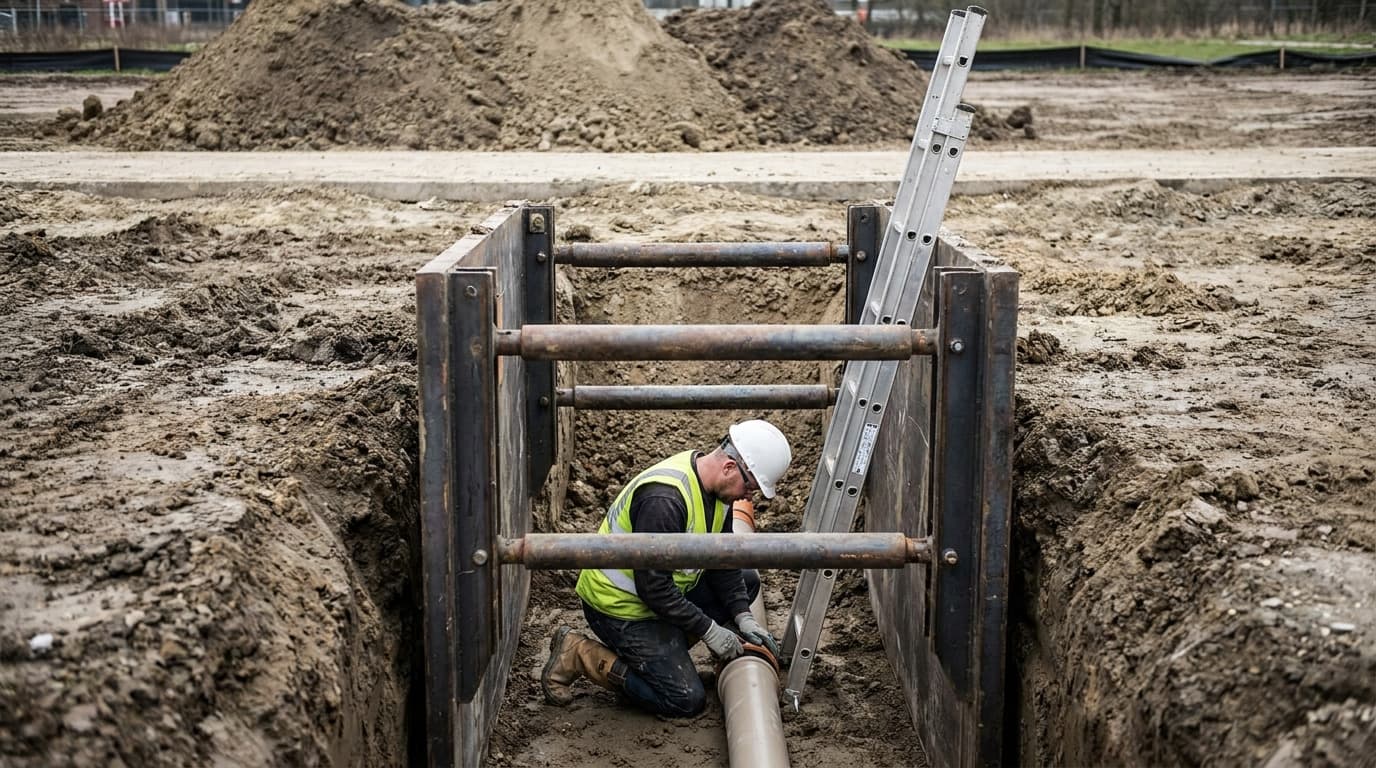
Trench collapse. Soil looks stable until it is not. A cubic yard weighs roughly 2,700 to 3,000 pounds — a worker buried to the waist cannot be pulled free by hand, and burial above the chest prevents breathing within minutes. Contributing factors are predictable: no protective system, spoil piled at the edge, vibration from equipment or traffic, water accumulation, previously disturbed soil, and a trench left open across a rainstorm.
Caught in machinery. Rotating shafts, augers, belts and pulleys, gears, and any in-running nip point. A smooth shaft turning slowly is enough — it catches a glove or sleeve and winds the worker in faster than any reaction. Guards removed for maintenance and not replaced, and machines cleared by hand while still coasting, produce most of these injuries.
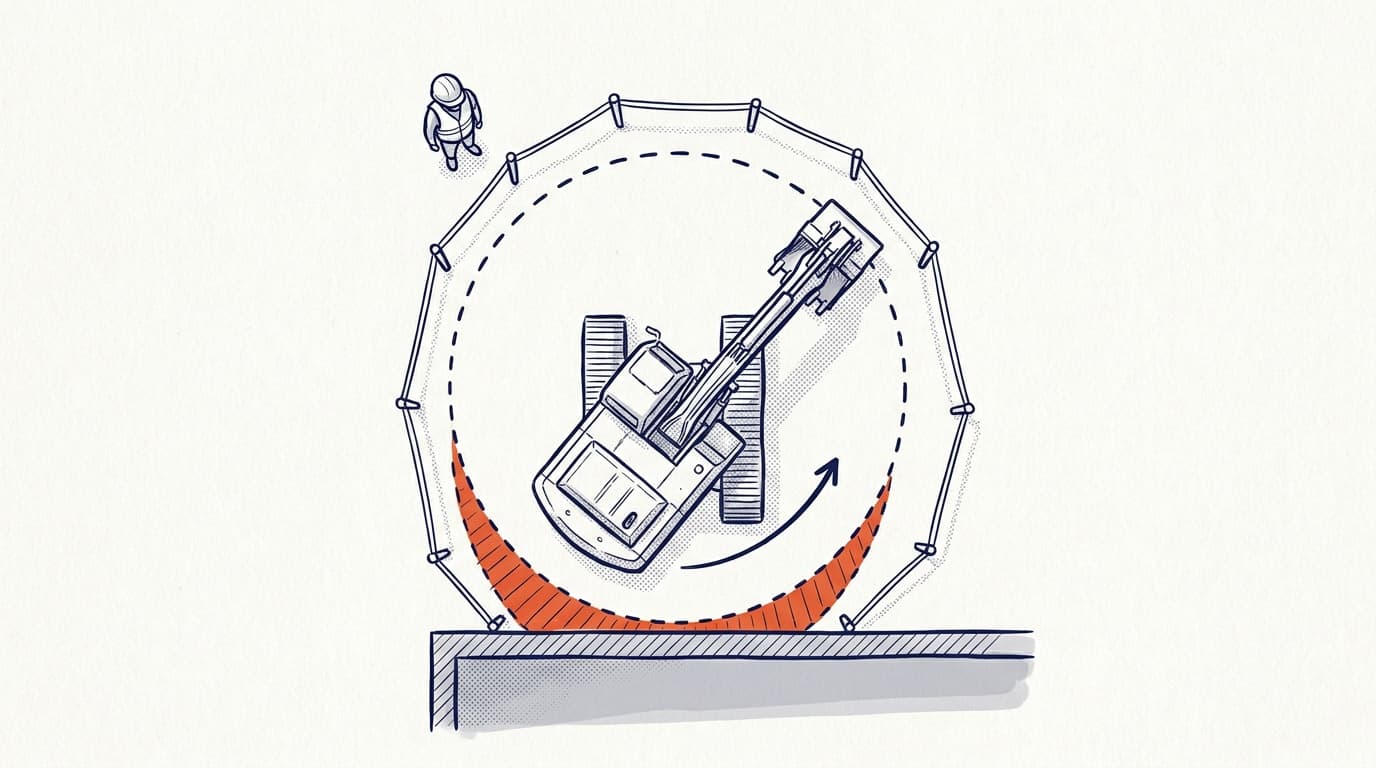
Caught between equipment and a fixed object. A worker positioned between a reversing vehicle and a wall, between a swinging counterweight and a structure, between a load and a stack. Excavator counterweights sweep a full circle with no clearance, and workers on foot are crushed against whatever is behind them.
Caught between materials. Pipe, sheet material, and stacked units that shift or roll. Unbanded loads on delivery, poorly stacked material, and units leaned rather than secured.
Equipment rollover. Operators crushed when a machine tips on a slope, a soft edge, or an unstable surface, particularly without a seatbelt in a machine fitted with rollover protection.
Caught during maintenance. Somebody working inside or beneath equipment that was never locked out, and a second person starts it, or stored energy releases and the component drops.
How do we prevent caught-in or between incidents?#
Never enter an unprotected trench. This is the single rule that prevents most excavation fatalities. Any excavation 5 feet or deeper requires sloping, benching, shoring, or shielding, unless it is entirely in stable rock. Under 5 feet, a competent person decides — and that decision is theirs to make, not yours to assume.
Get the competent person inspection before entry, every shift. Not once when the trench was dug. Before each shift, throughout the shift as conditions change, and after any rain, vibration event, or equipment loading near the edge.
Keep the edge clear. Spoil and equipment at least 2 feet back, and further where the soil is questionable. Material stacked at the edge is both a surcharge load pushing the wall in and a struck-by hazard for anyone below.
Provide egress within 25 feet. Ladder, stair, or ramp for any trench 4 feet or deeper, positioned so nobody has to travel far along the trench to reach it. In a collapse, the exit you can reach in seconds is the only one that counts.
Lock out before you reach in. Any time a hand goes into a machine — clearing a jam, adjusting, cleaning, lubricating — the machine is shut down, isolated, locked with your own lock, and confirmed at zero motion. Coasting is not stopped.
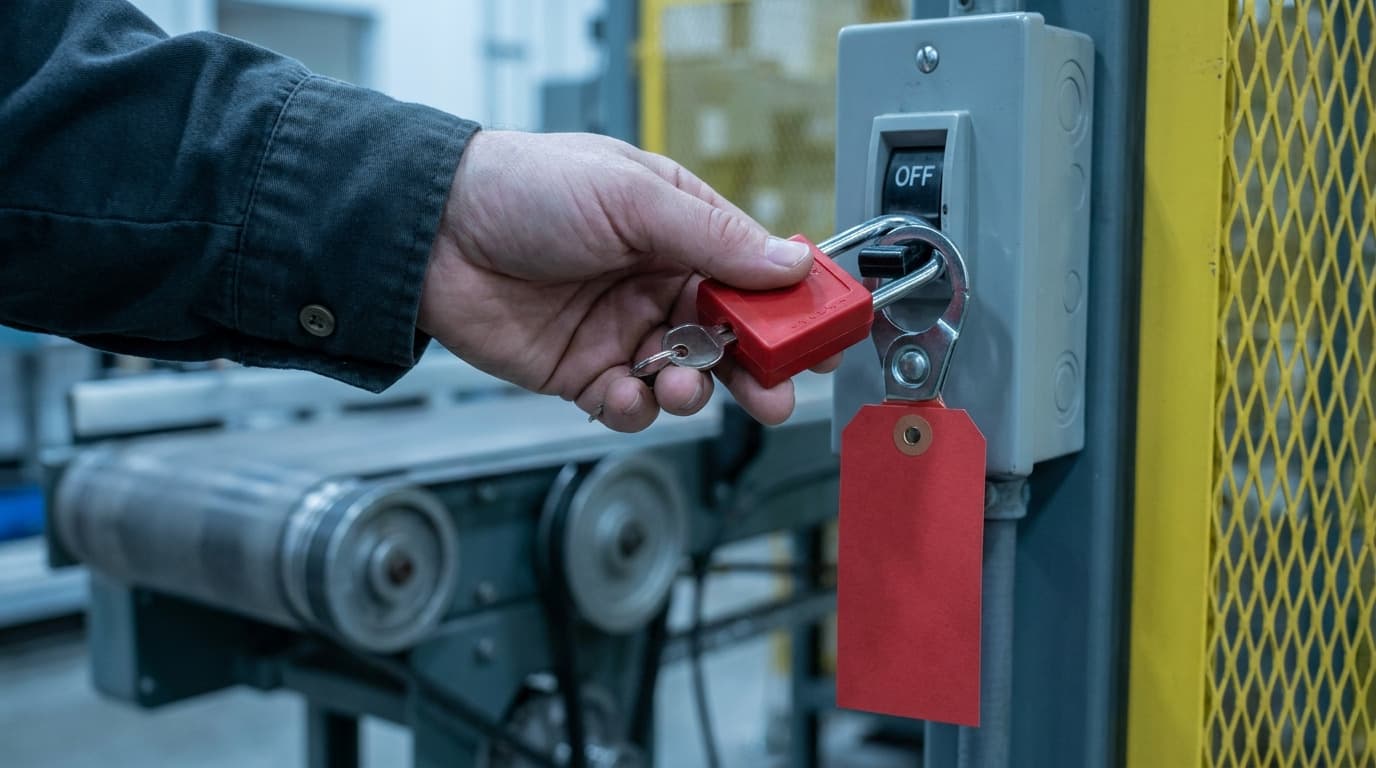
Keep guards in place. A machine with a missing or defeated guard is out of service. Guards address exactly the nip points and rotating parts that cause these injuries.
Control clothing and jewellery near rotating parts. No loose sleeves, gloves near rotating shafts, rings, watches, chains, or untied long hair. Entanglement begins with contact so light the worker does not feel it.
Stay out of the swing radius and the pinch zone. Barricade the swing radius of excavators and cranes. Never position yourself between mobile equipment and a fixed object — if the operator misjudges by a foot, there is nowhere to go.
Wear the seatbelt in machines with rollover protection. The structure protects the operator only if the operator stays inside it.
Before you start#
- Confirm the trench has a protective system appropriate to its depth, or that a competent person has documented why one is not required.
- Confirm the competent person has inspected this excavation this shift, and again after any rain or vibration.
- Check the spoil pile — at least 2 feet from the edge, further if the soil is soft or previously disturbed.
- Locate your egress: ladder or ramp within 25 feet of wherever you will be working.
- Confirm underground utilities were located before the excavation opened.
- For machinery work, confirm the machine is locked out with your own lock and that all motion has fully stopped.
- Confirm every guard is present and secure before starting any machine.
- Check what you are wearing: sleeves, gloves, jewellery, and hair around rotating parts.
- Identify every pinch point between mobile equipment and fixed structures in your area, and stay out of them.
Talk it over#
- Look at this trench. What is holding those walls up right now, and who checked it this morning?
- If that wall came in while you were at the far end, how many steps to the ladder — and how long would that take?
- On the machine you will work on today, where exactly does your hand go, and what is stopping that machine from moving while it is in there?
The bottom line#
Caught-in or between is the hazard with no reaction time. A trench wall gives way in under a second and a cubic yard of soil weighs as much as a small car; a rotating shaft winds you in before you feel contact. So every control happens before you are exposed: never enter an unprotected excavation, get the competent person inspection each shift, keep spoil back from the edge, know where your ladder is, and lock out with your own lock before any hand goes into a machine.
Frequently asked questions about caught-in or between hazards#
What is a caught-in or between hazard?
Being squeezed, pinched, crushed or buried between two objects or inside one — a collapsing trench wall, a machine that catches clothing, shifting material. It is one of OSHA's Focus Four construction hazards.
At what depth does a trench require a protective system?
Under 29 CFR 1926.652(a)(1), every excavation 5 feet or deeper requires sloping, benching, shoring, or shielding — unless it is made entirely in stable rock. Below 5 feet, a competent person must examine the ground and determine whether a protective system is needed.
How often must a trench be inspected?
Under 29 CFR 1926.651(k), a competent person must inspect the excavation, adjacent areas, and protective systems before the start of each shift and as needed throughout the shift, plus after every rainstorm or other event that increases hazards. If evidence of a possible cave-in is found, workers must be removed until it is corrected.
Why are trench collapses so often fatal?
Because of weight and speed. A cubic yard of soil weighs roughly 2,700 to 3,000 pounds and a wall fails in under a second, leaving no time to move. A worker buried to the waist cannot be pulled free by hand, and burial above the chest prevents breathing long before rescue crews can excavate safely.
What causes most non-fatal caught-in or between injuries?
Machinery, not trenches. According to CPWR's analysis of BLS data, 95.3 percent of non-fatal caught-in or between injuries between 2011 and 2020 came from being caught in or compressed by equipment or objects — rotating parts, nip points, and moving components rather than collapsing soil.
How far from the trench edge must spoil be kept?
At least 2 feet, under 29 CFR 1926.651(j) — or retained by a device sufficient to prevent material falling in. Spoil at the edge does double harm: it adds surcharge load that pushes the wall inward, and it becomes a struck-by hazard for anyone in the trench.
When does a trench need an engineer to design the protective system?
For excavations more than 20 feet deep, under 29 CFR 1926.652(b), the protective system must be designed by a registered professional engineer, or be based on tabulated data prepared or approved by a registered professional engineer.
Download the caught-in or between toolbox talk PDF#
Get this caught-in or between toolbox talk as a print-ready PDF — available in English, Spanish, Portuguese, and Turkish. Print it, hand it to the crew, and collect signatures on the included attendance sheet.
Download the PDF — free account required. New members get 3 free downloads.
Related toolbox talks#
Sources#
- CPWR, Fatal and Nonfatal Focus Four Injuries in Construction, Data Bulletin March 2023: https://www.cpwr.com/wp-content/uploads/DataBulletin-March2023.pdf
- OSHA, 29 CFR 1926 Subpart P — Excavations: https://www.osha.gov/laws-regs/regulations/standardnumber/1926/1926SubpartP
- OSHA, Trenching and Excavation Safety (Publication 2226): https://www.osha.gov/sites/default/files/publications/OSHA2226.pdf
- Bureau of Labor Statistics, Census of Fatal Occupational Injuries: https://www.bls.gov/iif/