Backing Up and Spotters
Updated 2026-08-06
In this bundle Vehicle Safety
Working in Washington? See the WA DOSH edition → Washington (WA DOSH)
Print-ready PDF
Download this talk as a print-ready PDF, available in 4 languages.
A spotter exists to solve the blind-spot problem: the operator cannot see behind the machine, so a person on the ground becomes the operator's eyes and guides the move. It works. A trained spotter is one of the most effective ways to prevent a backover. But look at what the job actually asks of that person — to stand on foot, close to a moving machine, in the exact space everyone else is told to stay out of. The spotter protects the crew by taking on the risk themselves, and that is precisely why spotters get killed doing it. This backing up and spotters talk is about the backing operation and, above all, about keeping the spotter alive while they keep everyone else safe.
Here is the distinction that carries this whole talk: the spotter is the one person whose job is to stand in danger so others don't — which means the spotter's own position is the hazard, and a spotter who protects the crew but not themselves is the one who gets hurt. In the blind-spots talk, the rule for a worker on foot is simple: stay out of the blind spot. The spotter cannot follow that rule — the job requires being near the machine. So the whole discipline of spotting is about doing a dangerous thing safely: where you stand, how you stay in contact, and what stops the move the instant either one fails. A spotter who thinks only about guiding the truck and not about their own body is the one who ends up between the truck and a wall.
Where the boundary of this talk sits#
The blind-spots talk owns the operator's zones of no visibility and keeping people on foot out of them. The struck-by talk owns being hit in general. The heavy equipment talk owns operating the machine. This talk owns the backing maneuver itself and the spotter's own safety — where the spotter stands, how they signal, what stops the move, and how backing gets avoided in the first place. Where the question is the blind spot as a hazard zone, that is the blind-spots talk; this one owns the worker who must work right next to it.
First, avoid backing at all#
The safest backing maneuver is the one that never happens. Backing creates a blind zone no operator can fully overcome, so the first control — before spotters, before alarms — is to not need to back up. Position and park vehicles so they can pull forward to leave. Design site flow, staging, and haul routes so equipment drives through rather than reversing. Minimize backing distances where reversing is unavoidable. This is the same planning logic as the internal traffic control plan in the blind-spots talk: the strongest control removes the hazard, and only what cannot be removed gets managed with a spotter. If your site is backing constantly, that is a layout problem to fix, not just a spotting problem to staff.
When the operator is alone#
Not every move gets a spotter, and a driver working alone has to handle backing differently. When there is no spotter, the operator should stop, get out, and walk around the vehicle to confirm the path is clear and look for anything — or anyone — that could move into the path, then back immediately while the picture is still current. Reversing cameras and sensor systems help, but OSHA is clear that they are aids, not a substitute for the rule: with an obstructed rear view, the standard requires an audible alarm or an observer, and where people are near the path, the observer is the real protection. A camera does not have stop-work authority; a spotter does.
The spotter's own safety — the heart of this talk#
This is where spotters are lost, so it is worth being exact. Working close to a backing machine puts the spotter at high risk of being struck or run over, and the failures are usually small: a wrong signal, a brief loss of visual contact, a step into the wrong place.
Never get between the machine and a fixed object. This is the crush point that kills spotters. A worker can be perfectly visible and still be trapped when the machine closes the gap to a wall, another vehicle, a stockpile, or any solid structure. Never position yourself between two moving vehicles, or between a vehicle and anything it could pin you against.
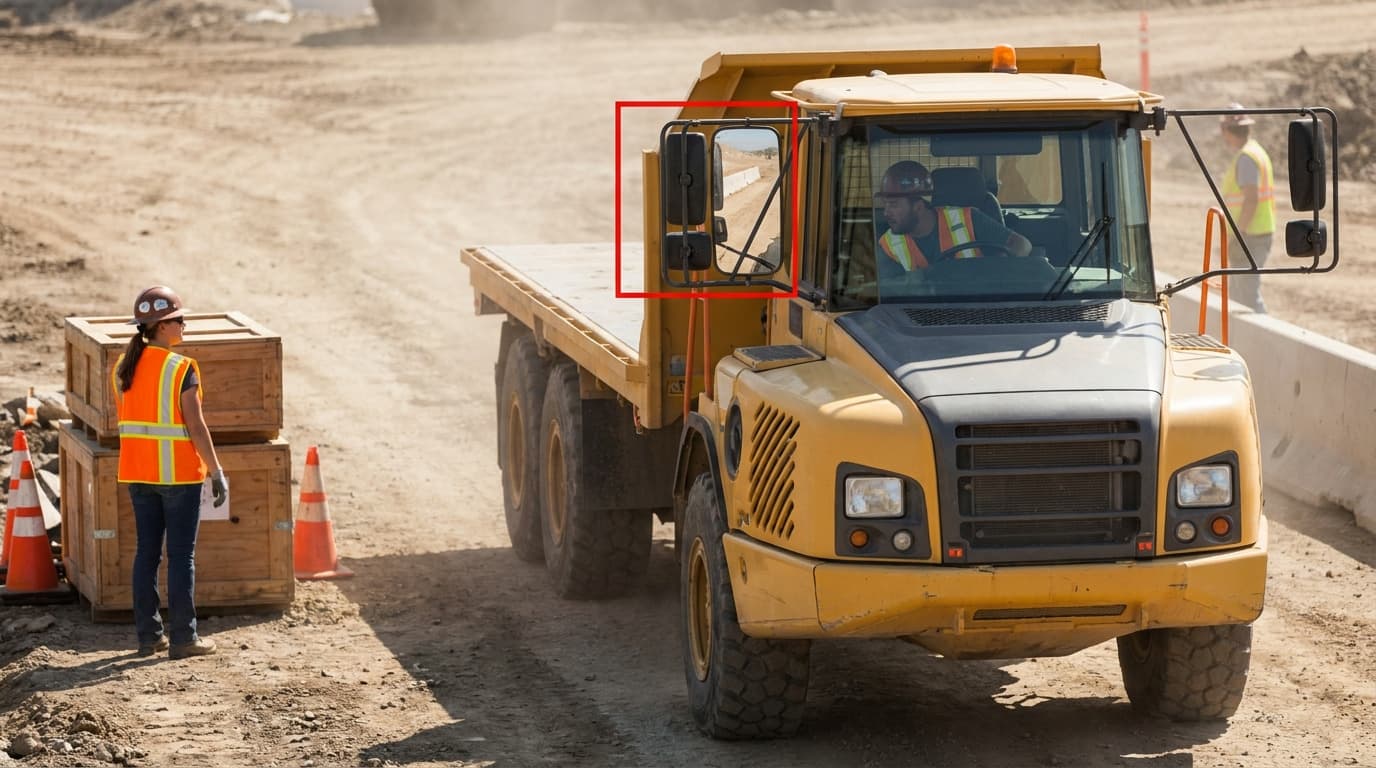
Stay out of the path of travel. The spotter guides the move from beside it, not from within it. NIOSH's guidance is specific: stand on the driver's side, about eight to ten feet from the vehicle, where you are visible in the driver's-side mirror — to the side and rear, never directly behind. Keep a safe distance, allow stopping distance and clearance, and do not walk backward while signaling, because you cannot watch where you are going.
Never break visual contact — and if it breaks, everything stops. The single rule that governs the whole operation is simple: no visual contact means stop. If you cannot see the operator's eyes or face in the mirror, the operator cannot see you, and the move stops until contact is restored. Drivers are instructed to stop backing the instant they lose sight of the spotter. This is not a judgment call to make mid-move; it is automatic.
Do nothing else while spotting. Spotting demands full concentration. One spotter signals one driver — no phone, no headphones, no side conversation, no second task. A spotter dividing their attention is a spotter who misses the moment that matters.
Signals and communication#
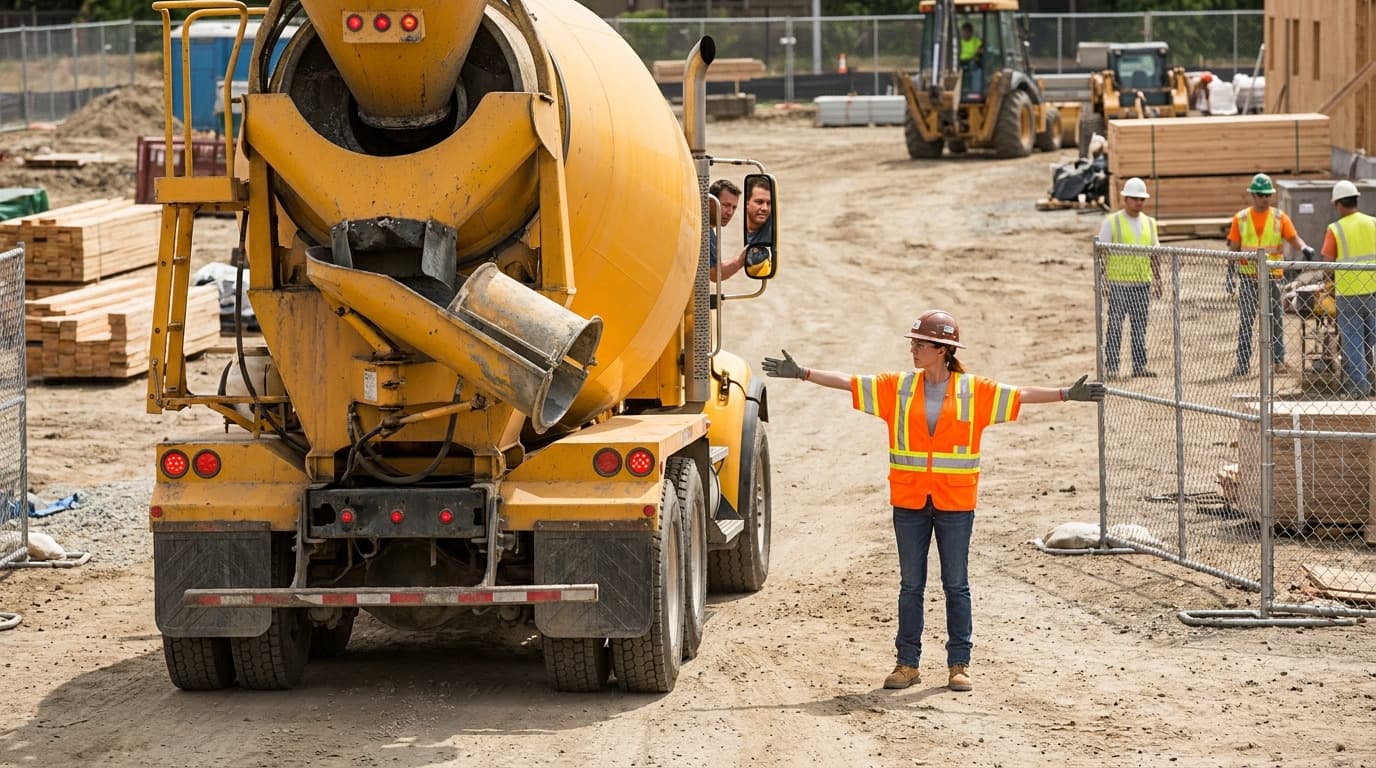
Spotter and operator must agree on the signals before the move begins, not invent them mid-maneuver. Use standardized hand signals — large, distinct arm movements that read clearly in a vibrating mirror — and keep signaling continuously even when the move is proceeding normally, because a spotter who stops signaling looks the same as a spotter who has lost control of the situation. Hand signals are usually better than voice, which gets lost in engine and site noise; where a site runs on radio, the spotter carries a radio too. And the operator's duty is the mirror image: never guess what an unclear signal means — if you do not understand or you lose the spotter, stop. Using a spotter does not transfer responsibility; the operator remains responsible for the safe operation of the machine.
Where the duty sits#
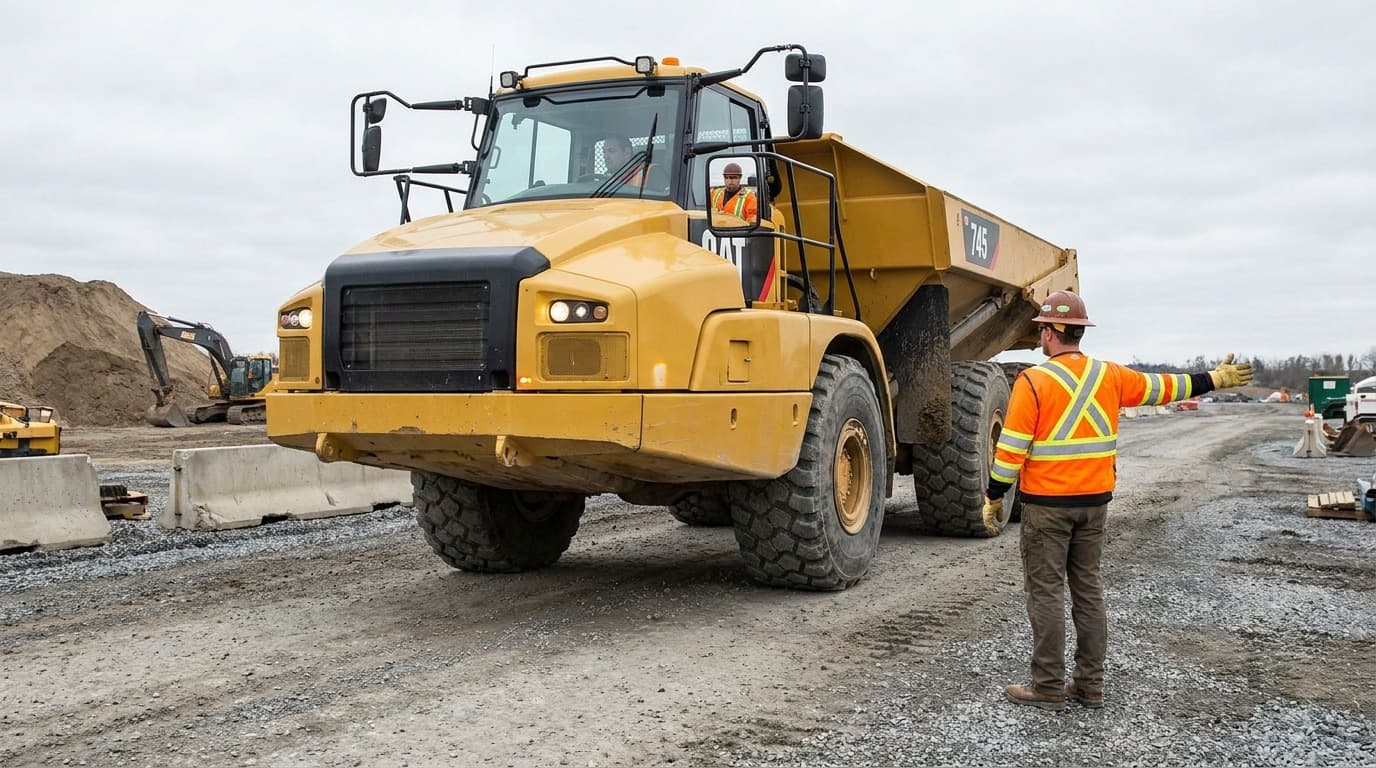
Backing runs on the same standards as blind spots. 1926.601(b)(4) is the core rule: motor vehicle equipment with an obstructed rear view may not be used unless it has a reverse alarm audible above the surrounding noise, or is backed only when an observer signals that it is safe — and that observer is the spotter. 1926.602(a)(9)(ii) carries the same rule for earthmoving and material-handling equipment. Behind them, 1926.21(b)(2) requires training in the hazards and the duties a worker performs during backing, and the General Duty Clause, Section 5(a)(1) covers the recognized struck-by hazard. The consensus standard ANSI/ASSP A10.47 describes the practice — a dedicated spotter with no competing duties, in pre-established communication, positioned outside the vehicle's path, and empowered to stop the move — and NIOSH's Preventing Backovers guidance is the source for the positioning specifics. On federal contract work, EM 385-1-1 carries traffic-control and equipment provisions. Where a site backing policy sets specific requirements, those govern.
What can go wrong?#
- A spotter is caught in the crush point between the machine and a wall, vehicle, or stockpile.
- A spotter stands in the path of travel or directly behind the backing machine.
- Visual contact is lost and the move continues instead of stopping.
- A spotter walks backward while signaling and trips or steps into the path.
- One spotter tries to signal a driver while doing another task or on a phone.
- Signals were never agreed in advance, and the operator guesses at an unclear one.
- The crew staffs a spotter for a backing move that should have been designed out.
- An operator working alone backs without walking the path first.
How do we manage this properly?#
- Avoid backing first — position to pull forward, design flow, minimize backing distance.
- Alone with no spotter: stop, walk the path, confirm clear, then back immediately.
- Spotter never between the machine and a fixed object — that is the crush point.
- Spotter stays out of the path, driver's side ~8–10 ft, visible in the mirror, never walking backward.
- No visual contact = stop — automatic, for both spotter and operator.
- One spotter, one driver, no other duties — full concentration, no phone or headphones.
- Agree standardized hand signals before the move; signal continuously throughout.
- Operator never guesses a signal and remains responsible even with a spotter.
Before you start#
- Confirm whether the backing move can be avoided by repositioning or routing.
- Confirm a dedicated spotter is assigned with no other duties for the move.
- Confirm the spotter has high-visibility clothing and, at night, a light.
- Confirm spotter and operator agreed the hand signals before backing.
- Confirm the spotter's position keeps them out of the path and off the crush points.
- Confirm both know that lost visual contact stops the move immediately.
- Confirm required reverse alarms are operable and audible above the noise.
- On federal work, confirm the EM 385-1-1 traffic-control provisions apply.
Talk it over#
- Could the backing moves on this site be designed out instead of spotted?
- Where are the crush points here — the walls, stockpiles, and parked equipment a spotter could be pinned against?
- What's our signal for stop, and does everyone read it the same way?
- If you lost sight of each other mid-move, what happens?
The bottom line#
The spotter is the one person whose job is to stand in danger so others don't — which means the spotter's own position is the hazard, and a spotter who protects the crew but not themselves is the one who gets hurt. Unlike the worker on foot who is told simply to stay out of the blind spot, the spotter must work right next to the machine, so the whole discipline is doing a dangerous thing safely. Start by avoiding backing altogether — position to pull forward and design it out, because the safest reverse is the one that never happens. When a spotter is needed, the two failures that kill them are losing position and losing contact: never stand between the machine and a fixed object (the crush point), stay out of the path on the driver's side about eight to ten feet and visible in the mirror, never walk backward while signaling, and treat no visual contact as an automatic stop for both spotter and operator. One spotter, one driver, no other duties, on standardized hand signals agreed before the move, signaling continuously — and the operator never guesses a signal and stays responsible even with a spotter. The duty runs through 1926.601(b)(4) (the alarm-or-observer rule, where the observer is the spotter), 1926.602(a)(9), and 5(a)(1), with ANSI/ASSP A10.47 and NIOSH describing the practice. The test for any spotter is one question: if the machine had to stop this instant to save you, could it — or are you standing where nothing could stop in time?
Frequently asked questions about backing up and spotters#
What is a spotter, exactly?
A spotter — also called a signaler or observer — is a designated worker who positions themselves where they can see both the operator and the area the operator cannot, and guides the move with agreed hand signals or radio. Critically, the spotter has the authority to stop the maneuver the instant anyone enters the zone the operator cannot see. It is the "observer" option written into the OSHA backing rule, and a trained, dedicated spotter is one of the most effective ways to prevent a backover — provided the spotter is kept safe while doing it.
Where should a spotter stand?
To the side and rear of the vehicle, on the driver's side, where they stay visible in the driver's-side mirror — NIOSH recommends about eight to ten feet from the vehicle. The spotter must stay out of the path of travel, must never stand directly behind a backing machine, and must never position themselves between the machine and a fixed object like a wall, stockpile, or another vehicle, because that is the crush point where spotters are killed. Keep a safe distance, allow for stopping clearance, and do not walk backward while signaling.
What does "no visual contact means stop" mean?
It is the single rule that governs the whole operation. If the spotter cannot see the operator's face in the mirror, the operator cannot see the spotter — so the move stops immediately until contact is restored. Operators are instructed to stop backing the instant they lose sight of the spotter, and spotters never keep signaling from a position where the driver can no longer see them. It is automatic, not a judgment made mid-move, because the moment contact is lost is exactly the moment the spotter is invisible and in danger.
Can a backup camera or alarm replace a spotter?
No. Cameras and sensor systems are useful aids, but OSHA treats them as aids, not substitutes for the rule. The standard requires an audible alarm or an observer for an obstructed rear view, and where people are near the path, the observer is the real protection — because a camera cannot stop the vehicle and a spotter can. A backup alarm is a warning that can be lost in site noise, and it does nothing about the side blind spots. The strongest control is still avoiding the backing move or using a dedicated spotter.
Why is avoiding backing the first step?
Because backing creates a blind zone no operator can fully overcome, so the most reliable way to prevent a backover is to not back up at all. Position and park equipment to pull forward, design site flow and haul routes so machines drive through rather than reverse, and minimize backing distance where reversing is unavoidable. This is the same logic as separating foot and vehicle traffic by design — the strongest control removes the hazard, and only what cannot be removed gets managed with a spotter. Constant backing is a layout problem, not just a staffing one.
Does using a spotter make the operator less responsible?
No. Using a spotter adds a layer of protection, but the operator remains responsible for the safe operation of the machine. The operator must remove distractions, focus on the spotter's signals, never guess at a signal they do not understand, and stop the instant they lose sight of the spotter or anything is unclear. Spotting is a shared discipline: the spotter guides and stays safe, the operator controls the machine and stops on any doubt. Responsibility is not transferred by putting a person on the ground.
Download the backing up and spotters toolbox talk PDF#
Get this backing up and spotters toolbox talk as a print-ready PDF — available in English, Spanish, Portuguese, and Turkish. Print it, hand it to the crew, and collect signatures on the included attendance sheet.
Download the PDF — free account required. New members get 3 free downloads.
Related toolbox talks#
Sources#
- OSHA, Motor Vehicles — 1926.601 (obstructed rear view: reverse alarm audible above surrounding noise, or an observer signals it is safe): https://www.osha.gov/laws-regs/regulations/standardnumber/1926/1926.601
- OSHA, Preventing Backovers — Backing Safety Solutions (spotters, cameras and sensors as aids, not substitutes for the rule): https://www.osha.gov/preventing-backovers/solutions
- NIOSH / CDC, Spotter Safety Tip Sheet (spotter positioning ~8–10 ft driver's side, never between vehicle and fixed object, visual contact, no other duties): https://stacks.cdc.gov/view/cdc/224021
This talk is general awareness guidance for training purposes. It does not replace your employer's traffic-control or backing policy, the OSHA motor-vehicle and material-handling standards, the OSH Act General Duty Clause, ANSI/ASSP A10.47, or a competent person's duties, and it is not legal advice. Where a site backing policy or contract sets a stricter requirement, that requirement governs.