Concrete Pumping
Updated 2026-08-01
In this bundle Vehicle Safety
Working in Washington? See the WA DOSH edition → Washington (WA DOSH)
Print-ready PDF
Download this talk as a print-ready PDF, available in 4 languages.
A concrete pump arrives on site as a delivery method, and gets treated like one — the pour is the event, the pump is how the concrete gets there. But it is a boom the size of a crane's, a pipeline under real pressure, and a truck standing on four legs in whatever ground happens to be there. This Concrete Pumping Toolbox Talk (Safety Talk / Tailgate Talk) is about the equipment rather than the pour.
Here is the distinction that carries this whole talk: the entire OSHA standard for concrete pumping is two sentences, and neither of them covers the moment that hurts people. Read 1926.702(e) in full — it is short enough to read aloud. (e)(1): "Concrete pumping systems using discharge pipes shall be provided with pipe supports designed for 100 percent overload." (e)(2): "Compressed air hoses used on concrete pumping system shall be provided with positive fail-safe joint connectors to prevent separation of sections when pressurized." That is the whole thing. Pipe supports and hose connectors. Nothing about the boom, the outriggers, the ground, or the hose end at start-up — which is where the injuries come from.
Where the boundary of this talk sits#
Wet cement burns and the alkali mechanism belong to the skin hazards talk. Silica belongs to the dust and silica talk. Struck-by mechanics generally belong to the struck-by talk. Lifting operations, load charts and rigging belong to the crane talk, though 1926.1400(c)(1) expressly excludes concrete pumps from the cranes and derricks standard, because a pump is an adaptation for a non-hoisting use. Breaking out hardened concrete belongs to the jackhammer talk. This talk owns the pumping system: the line, the boom, the outriggers and the hose end.
The moment that hurts people#
If this talk changes one habit, it should be this one.
When a pump stops — for a truck change, a blockage, a break — concrete settles and air gets trapped in the line. Air compresses; concrete does not. On restart, that trapped air expands behind the plug and releases suddenly, and the hose end whips or the material discharges violently. The person holding the hose is at the far end of that.
OSHA knows this. In its 2013 enforcement policy letter on concrete boom pump trucks, the agency points employers to the Concrete Pump Manufacturers Association "Safety Standard for Concrete Pumps, Placing Booms and Delivery Systems" specifically "to protect employees from hazards associated with hose ends during pump starts or restarts." OSHA had to reach outside its own standard to name the hazard, because 1926.702(e) does not cover it.
The practical rules that follow: nobody holds the hose end during a start or restart; clear the area at the discharge; start slowly and let the line prime; and treat every restart after a stoppage as the highest-risk moment of the pour rather than a resumption of routine.
Blockages are stored energy#
The related failure, and the one that produces the worst injuries.
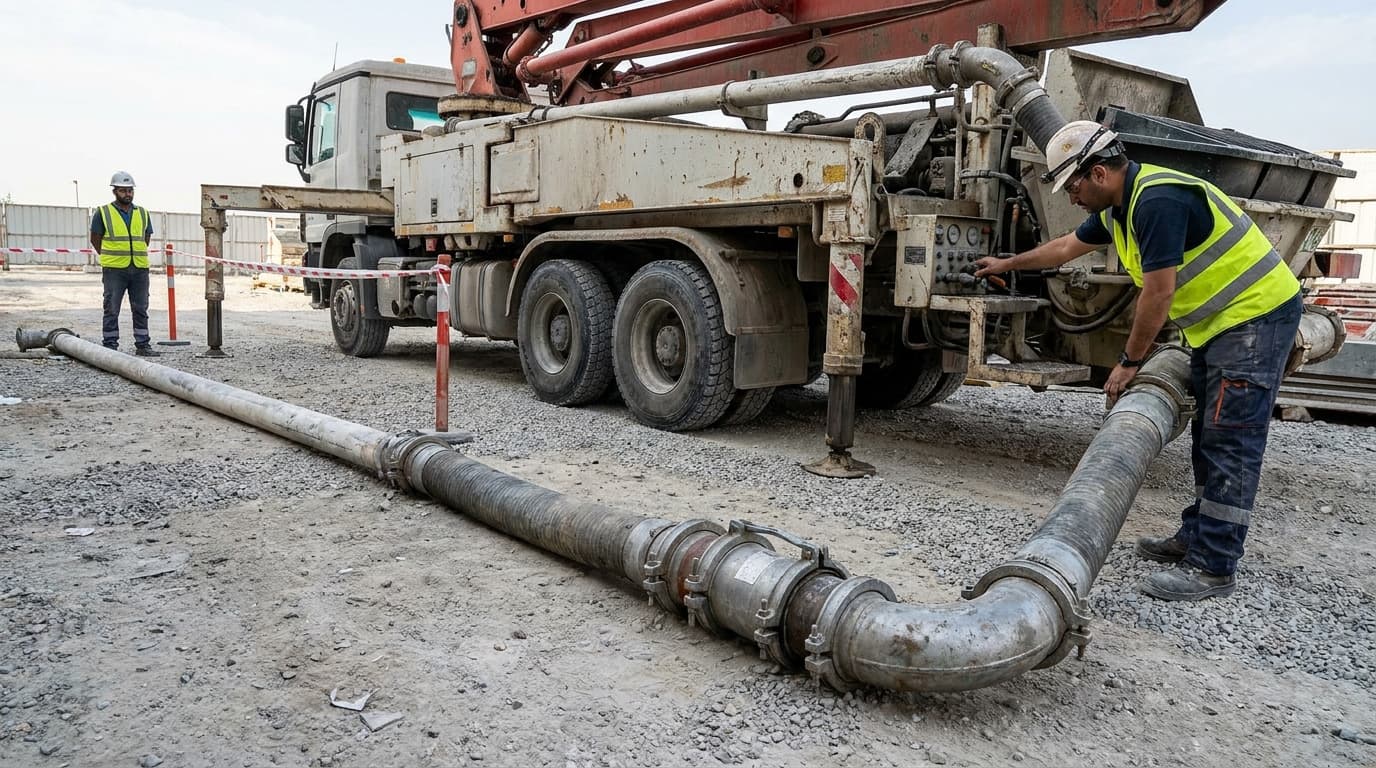
A blocked line is under pump pressure. The concrete in it is stored energy, and it is aimed at whoever opens the coupling. Uncoupling a pressurised line — or standing in front of one — releases that energy along the pipe axis.
So: relieve the pressure before opening anything, by reversing the pump as the manufacturer's procedure directs. Never strike a pressurised line to free a blockage. Never look into a hose end or open coupling. And clearing a blockage is a competent-person task with a defined procedure, not something to improvise while the truck waits.
Note also what (e)(2) is actually about: compressed air is used in some cleaning and clearing operations, and the provision exists because a pressurised air line that separates at a joint becomes a whip. That is the one hazard in this family the standard does address.
The boom is the other killer#
The boom is the part that reaches out over the pour, and it reaches into two things that are not concrete.
Overhead power lines. OSHA's enforcement letter cites 1926.600(a)(6), which requires a minimum clearance of 10 feet for lines rated up to and including 50 kV, with greater clearances required above that. A placing boom swinging over a pour is exactly the geometry that produces contact, and the operator's attention is on the discharge, not the sky.
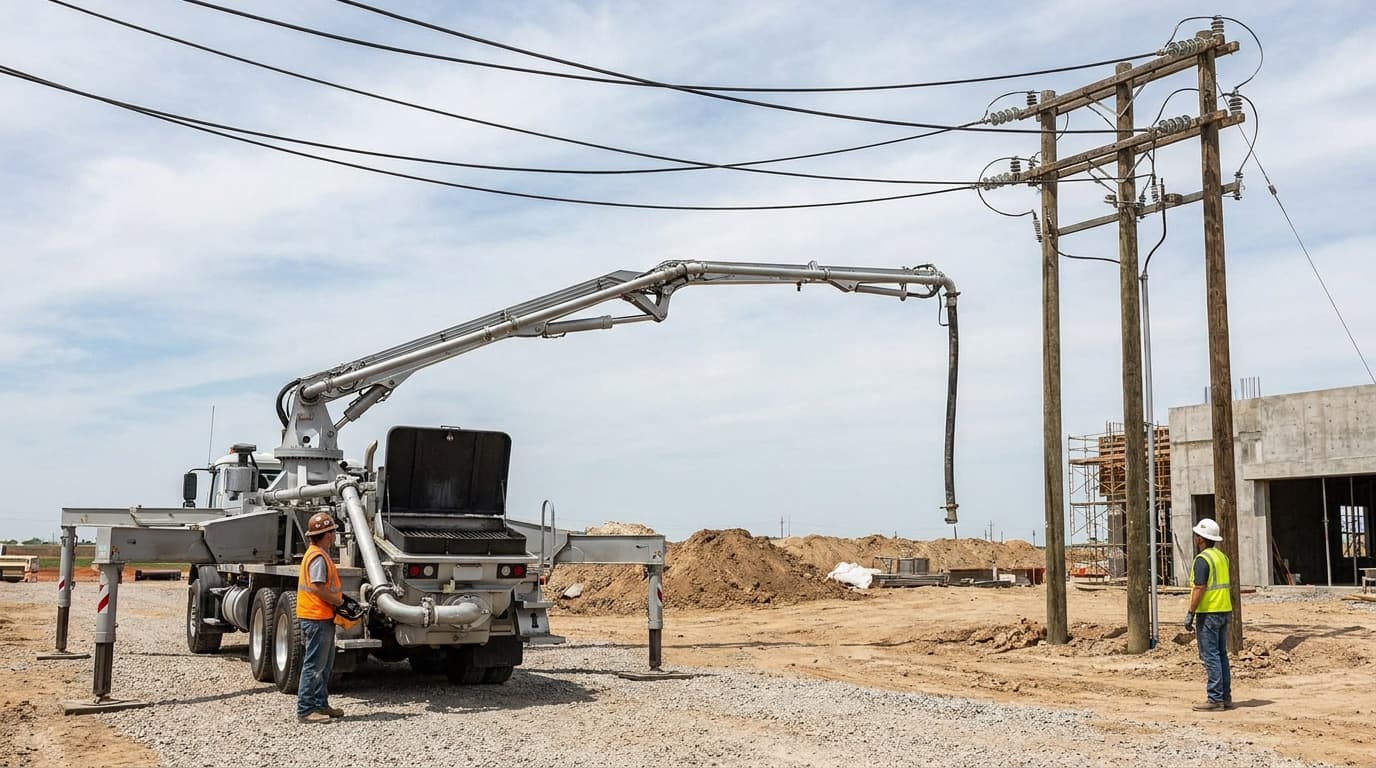
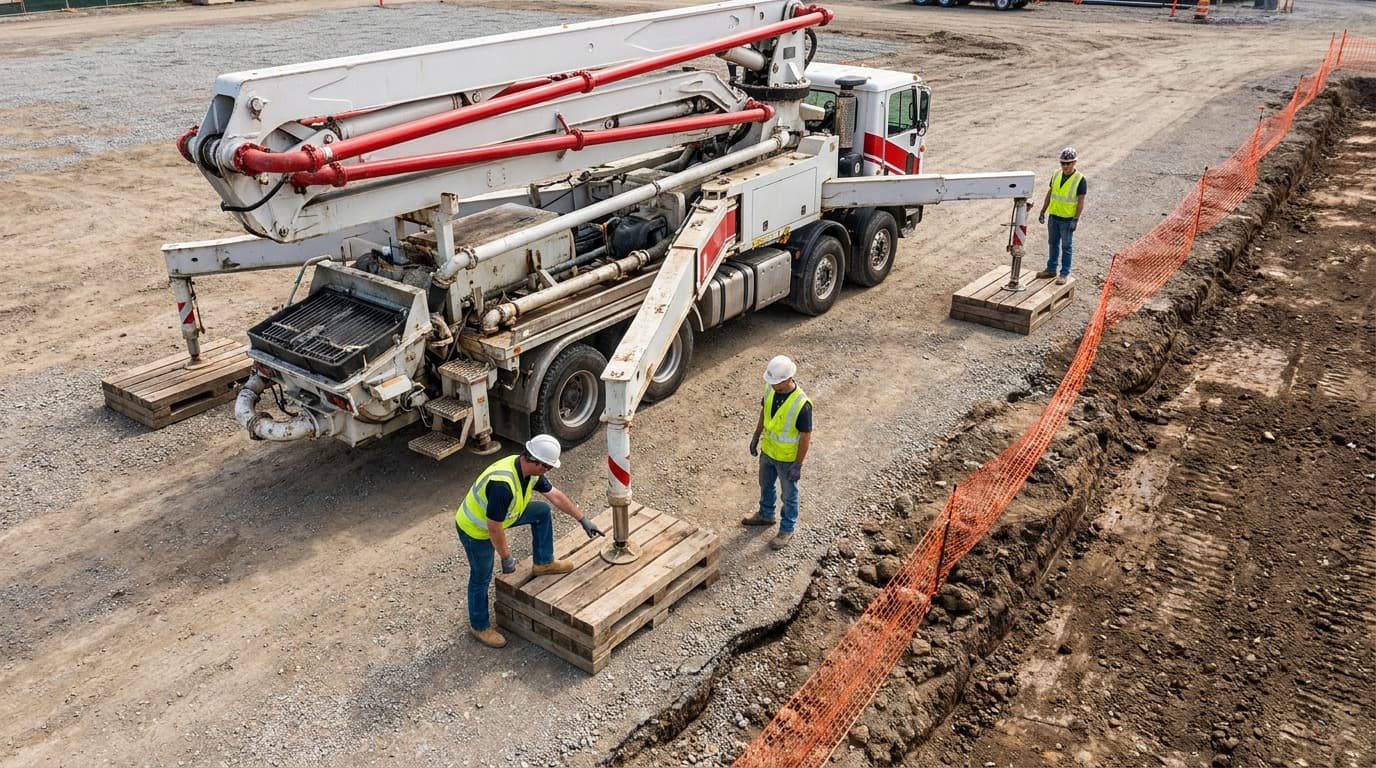
The ground. A pump truck's stability depends entirely on its outriggers and what they are standing on. OSHA's letter directs employers to the American Concrete Pumping Association Safety Manual to address stability and ground support hazards such as tipping hazards, improper outrigger positioning, and inadequate soil conditions. Backfilled trenches, recently excavated ground, buried services, basements, voids and soft edges will all take an outrigger down — and when one leg goes, the boom is already extended.
So the setup decides the outcome, and the setup happens before anybody is watching. Full outrigger extension where the manufacturer requires it, pads sized to the ground, and somebody who has actually thought about what is under the truck.
Who is allowed to operate it#
The letter is useful here too, because it names a provision people forget.
1926.20(b)(4): "The employer shall permit only those employees qualified by training or experience to operate equipment and machinery." OSHA applies this explicitly to operating the truck, the outriggers and the concrete pumping system components. That is not the same as "the pump operator came with the pump" — the site still has to satisfy itself.
And 1926.700(a) sets the scope: Subpart Q protects all construction employees from hazards associated with concrete and masonry operations, and other relevant provisions of Parts 1910 and 1926 also apply. That sentence is what pulls in everything else.
What fills the two-sentence gap#
Because the standard is thin, the recognised practice is what a General Duty Clause case would be measured against. OSHA's own letter names three sources:
The manufacturer's operation, maintenance and parts manual, cited to address improper concrete discharge-hose operation.
The CPMA Safety Standard for Concrete Pumps, Placing Booms and Delivery Systems, cited for hose-end hazards during pump starts or restarts.
The ACPA Safety Manual, cited for stability and ground support — tipping, outrigger positioning, soil conditions.
One more useful piece of interpretation: in a 2010 letter, OSHA was asked whether the double S-bend elbow shut-off valve at the end of a delivery hose — the "Rams Horn" — is prohibited. The answer was that 1926.702(e) does not explicitly prohibit it. The agency instead assesses whether a particular hose-end configuration increases whip risk. Absence of a prohibition is not approval.
Where the duty sits#
1926.702(e) is the specific standard, and it is two sentences: (e)(1) pipe supports designed for 100 percent overload, and (e)(2) positive fail-safe joint connectors on compressed air hoses to prevent separation when pressurised.
Everything else is assembled: 1926.700(a) for scope; 1926.20(b)(4) for who may operate; 1926.21(b)(2) for instruction; 1926.600(a)(6) for the 10-foot clearance to lines up to 50 kV; 1926.1400(c)(1), which expressly excludes concrete pumps from the cranes and derricks standard as a non-hoisting adaptation; and Section 5(a)(1) behind all of it. CPMA, ACPA and the manufacturer's manual are consensus and industry documents, not OSHA rules — but OSHA cites them as establishing what a recognised hazard looks like.
What can go wrong?#
Holding the hose end during a start or restart, when trapped air is about to release.
Opening a coupling on a pressurised line without relieving pressure first.
Striking a blocked line to free it, or looking into an open hose end.
Swinging the boom near overhead lines while watching the discharge.
Setting outriggers on backfilled trench, soft edges or unknown ground, or extending them partially where full extension is required.
Assuming the pump operator's competence because the pump came with a driver.
Treating a restart as routine, when it is the highest-risk moment of the pour.
Reading the absence of a prohibition as approval for a hose-end configuration.
How do we manage this properly?#
Walk the setup before the truck arrives — what is under the outriggers, what is overhead, where the boom will swing, and where people will stand.
Confirm ground bearing and use properly sized pads, and never set an outrigger over a backfilled trench, basement, void or soft edge without checking.
Establish the power line clearance — 10 feet up to 50 kV, more above — and control the boom's swing envelope rather than relying on the operator's judgement in the moment.
Clear the discharge area for every start and restart, and make sure nobody is holding the hose end.
Start slowly and prime the line rather than resuming at working pressure.
Relieve line pressure by the manufacturer's procedure before opening any coupling, and never strike a pressurised line.
Make blockage clearing a defined competent-person task with an agreed procedure, not a decision made under schedule pressure.
Confirm the operator's qualification under 1926.20(b)(4) for the truck, the outriggers and the pumping system.
Have the manufacturer's manual on site and use the CPMA and ACPA guidance to fill what the standard does not cover.
Brief the concrete crew separately from the pump crew — the people holding the hose are usually not the people who set the machine up.
Before you start#
- Confirm what is under each outrigger and that pads are sized for the ground.
- Confirm the boom's full swing envelope and the clearance to any overhead line.
- Confirm the operator is qualified by training or experience for this equipment.
- Confirm who is holding the hose end and that they will not be at a start or restart.
- Confirm the discharge area can be cleared for every restart.
- Confirm the blockage-clearing procedure and who is authorised to carry it out.
- Confirm pipe supports are in place where discharge pipes are used.
- Confirm the manufacturer's manual is on site.
Talk it over#
- What is underneath the ground where the outriggers are going?
- Where does the boom pass in relation to any overhead line?
- Who is on the hose end, and what happens on the first restart after the truck change?
- If the line blocks this morning, who clears it and how?
The bottom line#
The entire OSHA standard for concrete pumping is two sentences, and neither covers the moment that hurts people. 1926.702(e)(1): "Concrete pumping systems using discharge pipes shall be provided with pipe supports designed for 100 percent overload." (e)(2): "Compressed air hoses used on concrete pumping system shall be provided with positive fail-safe joint connectors to prevent separation of sections when pressurized." Pipe supports and hose connectors — nothing about the boom, the outriggers, the ground or the hose end. The dangerous moment is the start or restart after a stoppage: concrete settles and air gets trapped in the line, air compresses where concrete does not, and on restart that trapped air releases suddenly and whips the hose end. OSHA had to reach outside its own standard to name it — its 2013 enforcement policy letter on concrete boom pump trucks cites the CPMA "Safety Standard for Concrete Pumps, Placing Booms and Delivery Systems" specifically "to protect employees from hazards associated with hose ends during pump starts or restarts." So: nobody holds the hose end at a start or restart, clear the discharge area, start slowly and prime the line. A blocked line is the related failure — the concrete in it is stored energy aimed at whoever opens the coupling — so relieve pressure by the manufacturer's procedure before opening anything, never strike a pressurised line, never look into an open hose end, and make blockage clearing a defined competent-person task. The boom is the other killer, reaching into overhead power lines — 1926.600(a)(6) requires 10 feet of clearance up to and including 50 kV, more above — and standing on ground, where OSHA's letter directs employers to the ACPA Safety Manual for tipping hazards, improper outrigger positioning and inadequate soil conditions. On competence, 1926.20(b)(4) permits "only those employees qualified by training or experience to operate equipment and machinery", which OSHA applies to the truck, the outriggers and the pumping system components; 1926.700(a) sets Subpart Q's scope and pulls in other provisions of Parts 1910 and 1926; 1926.1400(c)(1) expressly excludes concrete pumps from the cranes and derricks standard as a non-hoisting adaptation. Filling the gap are the manufacturer's manual, CPMA and ACPA — consensus and industry documents, not OSHA rules. And one interpretation worth keeping: a 2010 OSHA letter confirms 1926.702(e) does not explicitly prohibit the double S-bend "Rams Horn" hose-end valve — absence of a prohibition is not approval.
Frequently asked questions about concrete pumping#
What does the OSHA standard for concrete pumping actually say?
Two sentences, and you can read both aloud. 1926.702(e)(1): "Concrete pumping systems using discharge pipes shall be provided with pipe supports designed for 100 percent overload." 1926.702(e)(2): "Compressed air hoses used on concrete pumping system shall be provided with positive fail-safe joint connectors to prevent separation of sections when pressurized." That is the whole specific standard — pipe supports and hose connectors. The boom, outriggers, ground conditions and hose end are not in it.
When is the most dangerous moment of a pour?
The start or restart after a stoppage. When the pump stops, concrete settles and air becomes trapped in the line. Air compresses; concrete does not. On restart the trapped air expands behind the plug and releases suddenly, whipping the hose end. OSHA's 2013 enforcement letter points employers to the CPMA standard specifically for "hazards associated with hose ends during pump starts or restarts." Nobody should be holding the hose end at that moment.
How should a blocked line be cleared?
By procedure, by a competent person, and never in a hurry. A blocked line is under pump pressure, and the concrete in it is stored energy aimed at whoever opens the coupling. Relieve the pressure first — normally by reversing the pump as the manufacturer's procedure directs. Never strike a pressurised line to free a blockage, and never look into an open hose end or coupling. Clearing a blockage is not something to improvise while a truck waits.
What are the rules for a boom near power lines?
OSHA's enforcement letter cites 1926.600(a)(6), which requires a minimum clearance of 10 feet for lines rated up to and including 50 kV, with greater clearances above that. The risk with a placing boom is geometric: it swings out over the pour while the operator's attention is on the discharge rather than the sky. Establish the full swing envelope and the clearance before the pour, rather than relying on judgement in the moment.
What makes a pump truck tip over?
Its outriggers and what they are standing on. OSHA's letter directs employers to the ACPA Safety Manual for stability and ground support hazards such as tipping hazards, improper outrigger positioning, and inadequate soil conditions. Backfilled trenches, recently excavated ground, buried services, basements, voids and soft edges will all take a leg down — and by then the boom is already extended. Full extension where the manufacturer requires it, pads sized to the ground, and someone who has checked what is underneath.
Who is allowed to operate a concrete pump?
1926.20(b)(4): "The employer shall permit only those employees qualified by training or experience to operate equipment and machinery." OSHA applies this explicitly to operating the truck, the outriggers and the concrete pumping system components. The pump arriving with a driver does not by itself discharge that duty — the site still has to satisfy itself that the person is qualified for this equipment.
If OSHA does not prohibit something, is it allowed?
Not necessarily, and there is a direct example. In a 2010 letter of interpretation OSHA was asked whether the double S-bend elbow shut-off valve — the "Rams Horn" — at the end of a delivery hose is prohibited, and confirmed that 1926.702(e) does not explicitly prohibit it. The agency instead assesses whether a given hose-end configuration increases hose-whip risk. Absence of a prohibition is not approval, and with a two-sentence standard that distinction covers most of the equipment.
Download the concrete pumping toolbox talk PDF#
Get this concrete pumping toolbox talk as a print-ready PDF — available in English, Spanish, Portuguese, and Turkish. Print it, hand it to the crew, and collect signatures on the included attendance sheet.
Download the PDF — free account required. New members get 3 free downloads.
Related toolbox talks#
Sources#
- OSHA, 29 CFR 1926.702 — Requirements for equipment and tools: https://www.law.cornell.edu/cfr/text/29/1926.702
- OSHA, Standard Interpretation, 2 May 2013 — standards and enforcement policy for concrete boom pump trucks: https://www.osha.gov/laws-regs/standardinterpretations/2013-05-02-0
- OSHA, Standard Interpretation, 29 July 2010 — double S-bend elbow ("Rams Horn") shut-off valve: https://www.osha.gov/laws-regs/standardinterpretations/2010-07-29
This talk is general awareness guidance for training purposes. It does not qualify anyone to operate a concrete pump, set outriggers, or clear a blocked line. Those are tasks for people qualified by training or experience under 29 CFR 1926.20(b)(4), working to the manufacturer's procedures for the specific equipment.
Written by FieldSafetyTalk's safety professional — a CSP, ASP, CHST and OSHA Authorized Outreach Trainer with 14+ years of international construction safety experience across federal, heavy civil, and industrial projects.