Safe Usage of Grinder Machine
Updated 2026-07-28
In this bundle Tools & Machinery
Print-ready PDF
Download this talk as a print-ready PDF, available in 4 languages.
The angle grinder is the tool most likely to be found on a jobsite with its guard rotated out of the way, or missing entirely. Not because anyone is reckless — because there is always a cut where the guard is in the way, and taking it off works. It works right up until the wheel breaks. This safe usage of grinder machine talk is about the tool in your hands rather than the wheel on it, and about a question OSHA has already answered.
Here is the distinction that carries this whole talk: the guard is not a cover, it is a direction. Its job is not to hide the wheel — it is to sit between you and the wheel so that if the wheel comes apart, the fragments go somewhere other than into your body. That is why where the guard is positioned matters as much as whether it is fitted, and why a guard spun round to clear the work is doing nothing at all even though it is still bolted on.
The question OSHA was actually asked#
In 2001 a tool user wrote in about a pneumatic angle-drive hand tool used for hole cutting and cut-off work inside pipe. The guard made the job difficult. Could it come off?
Letter of Interpretation 2001-12-11-1 answered with 1926.300(b)(1) — when power operated tools are designed to accommodate guards, they shall be equipped with such guards when in use. The photograph supplied showed the tool was designed for and supplied with a guard, so OSHA's conclusion was that the standard requires the guard during the hole cutting and cut-off operations.
Then it did something worth noticing. OSHA acknowledged in terms that using the tool with the guard in place makes the operation difficult — and instead of relaxing anything, suggested a different tool: cutting-off tools rather than angle drives for cutting from inside the pipe, and a lighter whip hose to improve manoeuvrability in close quarters.
That is the whole logic of grinder guarding in one exchange. "The guard makes this cut awkward" is not an argument for removing the guard; it is information that you have the wrong tool, the wrong wheel, or the wrong approach for that cut.
What the guard has to be — 1926.303(d)#
1926.303(d) Guard design is short and specific:
The safety guard shall cover the spindle end, nut, and flange projections. The safety guard shall be mounted so as to maintain proper alignment with the wheel, and the strength of the fastenings shall exceed the strength of the guard —
with two exceptions: safety guards on operations where the work itself provides a suitable measure of protection to the operator may be constructed so that the spindle end, nut and outer flange are exposed; and where the nature of the work is such as to entirely cover the side of the wheel, the side covering of the guard may be omitted.
"The strength of the fastenings shall exceed the strength of the guard." Read that again. The regulation contemplates the guard being struck hard enough to fail, and requires that when it does, it must not leave its mounting. A guard held on by a stripped thread, a missing bolt, a jubilee clip or one remaining screw fails this even if it looks correct from a metre away.
1926.303(c) adds the requirement people never think of as a guarding rule: all grinding machines shall be supplied with sufficient power to maintain the spindle speed at safe levels under all conditions of normal operation. An underpowered or bogging machine, or one fed through a long undersized cord, is not just slow — it is outside the standard.
Behind both sits 1926.300(b)(1), the design test: a tool built to take a guard must have it fitted in use. And 1926.300(c) requires that employees using hand and power tools who are exposed to falling, flying, abrasive and splashing objects, or to harmful dusts, fumes, mists, vapours or gases, be provided with the personal protective equipment necessary — which is every grinder operator, every time.
Where the guard sits, and cut-off wheels#
For portable grinders, the general industry provisions in 1910.243 describe what good positioning looks like: for right angle head or vertical portable grinders, a maximum exposure angle of 180°, with the guard located so as to be between the operator and the wheel during use, and adjusted so that pieces of an accidentally broken wheel are deflected away from the operator. For other portable grinding machines, maximum angular exposure of 180° with the top half of the wheel enclosed at all times.
"Between the operator and the wheel" is the sentence to take to the field. A guard rotated so the opening faces the operator is worse than useless — it channels fragments toward the person holding the tool.
Cut-off wheels have their own history. Under OSHA's enforcement directive STD 01-12-026, where the guard for a cut-off wheel (not masonry) fails the 150° maximum angular exposure required by 1910.215(b)(5) or 1926.303(d) but does not allow greater than 180°, the violation is treated as de minimis. The same directive records that for construction, 1926.303 and 1926.702(i) allow a 180° angle of exposure for masonry saws such as diamond or tungsten carbide (water cooled) types, and that a semicircular guard on such a saw is in compliance.
That is a narrow enforcement position, not a licence. The practical reading: use the guard the manufacturer supplies for the wheel type you have fitted, and never run a cut-off wheel behind a guard that leaves more than half the wheel exposed.
What can go wrong?#
The guard is rotated out of the way. Still fitted, still bolted, pointing at the operator. The single most common condition on any site.
The guard is removed for one cut. And the tool then goes back in the box, and comes out tomorrow for somebody else.
The wrong guard for the wheel. A Type 27 depressed-centre guard left on when a cut-off wheel goes in, so the wheel's plane is unprotected exactly where a cut-off wheel breaks.
The guard is held on by one fastener. Or by a fastener that was never the right one. The regulation's requirement that the fastenings exceed the strength of the guard is failed silently.
Side-loading a wheel not made for it. Grinding on the face of a cut-off wheel, or cutting with the edge of a grinding wheel.
The machine bogs. Underpowered supply, long thin cord, operator leaning in to compensate — more pressure, more heat, more chance of a break.
Sparks go somewhere nobody checked. Into a stairwell, onto a tarpaulin, into a floor void, onto somebody below. Grinding is a hot work source even when nobody has called it that.
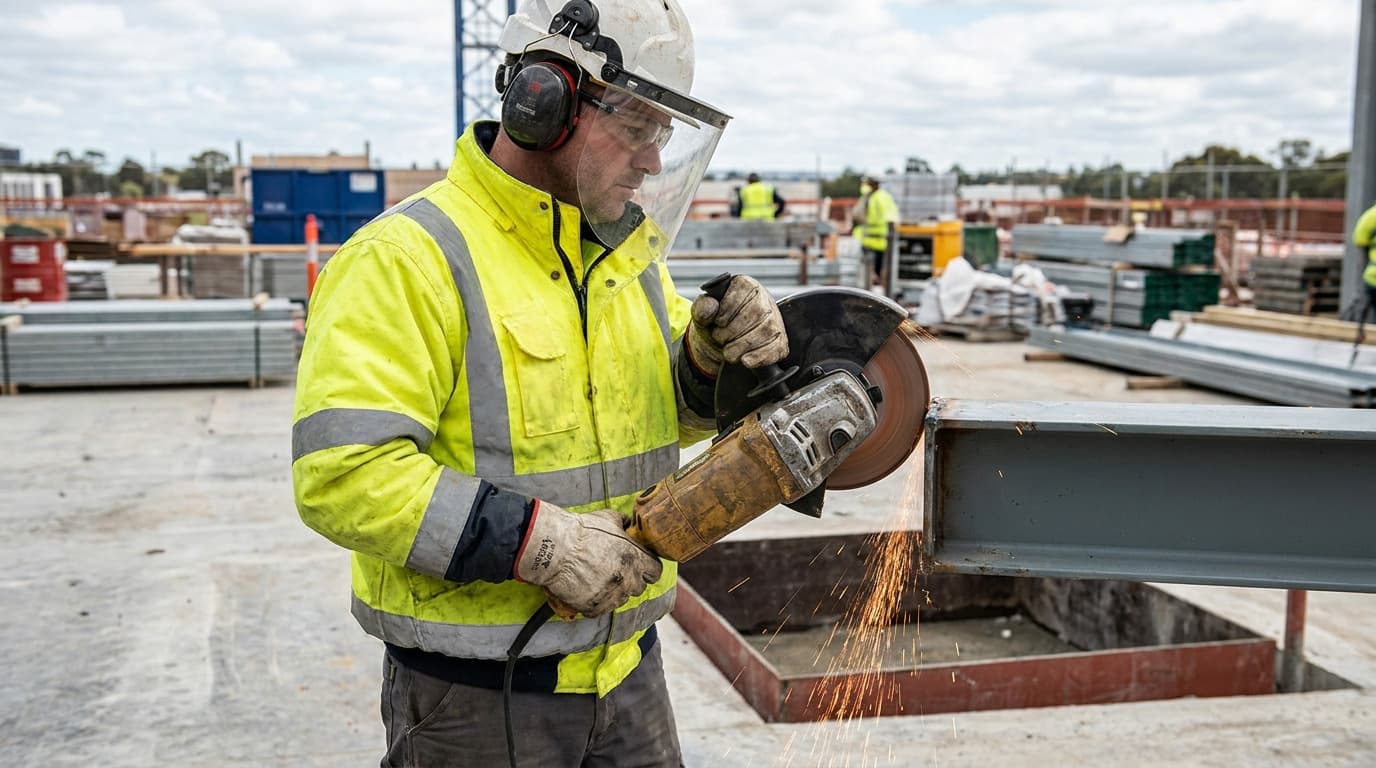
The tool is put down still spinning. A grinder coasts for several seconds and will walk across a bench, a cable or a leg.
How do we do this properly?#
Fit the guard for the wheel you are using, and position it between you and the wheel, so fragments deflect away. Check the position each time you change your body position, not just at the start.
Never remove the guard to make a cut possible. If the guard is in the way, change the tool, the wheel, the access or the method — that is exactly what OSHA suggested when it was asked.
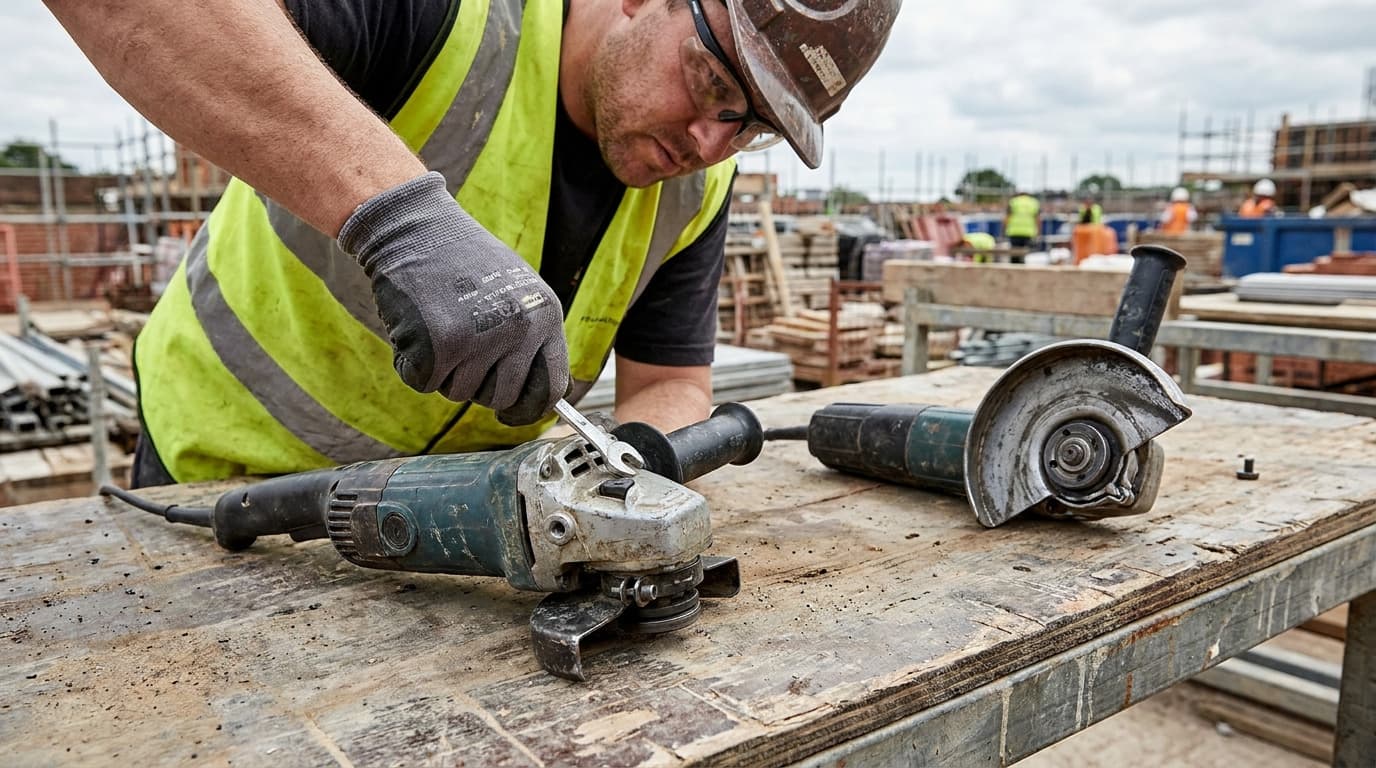
Check the fastenings, not just the guard. All fasteners present, correct and tight, mounting undamaged, guard aligned with the wheel. The fastenings must be stronger than the guard.
Match wheel to task. Cutting wheels for cutting, grinding wheels for grinding, never side-load a cut-off wheel, and never fit a wheel whose rated speed is below the machine's no-load speed.
Give the machine the power it needs, on a short cord of the right size, so the spindle speed stays where it should be under load.
Control the sparks. Screen the work, check where the spark stream lands, clear combustibles, and treat sustained grinding near anything flammable as hot work with the fire watch that entails.
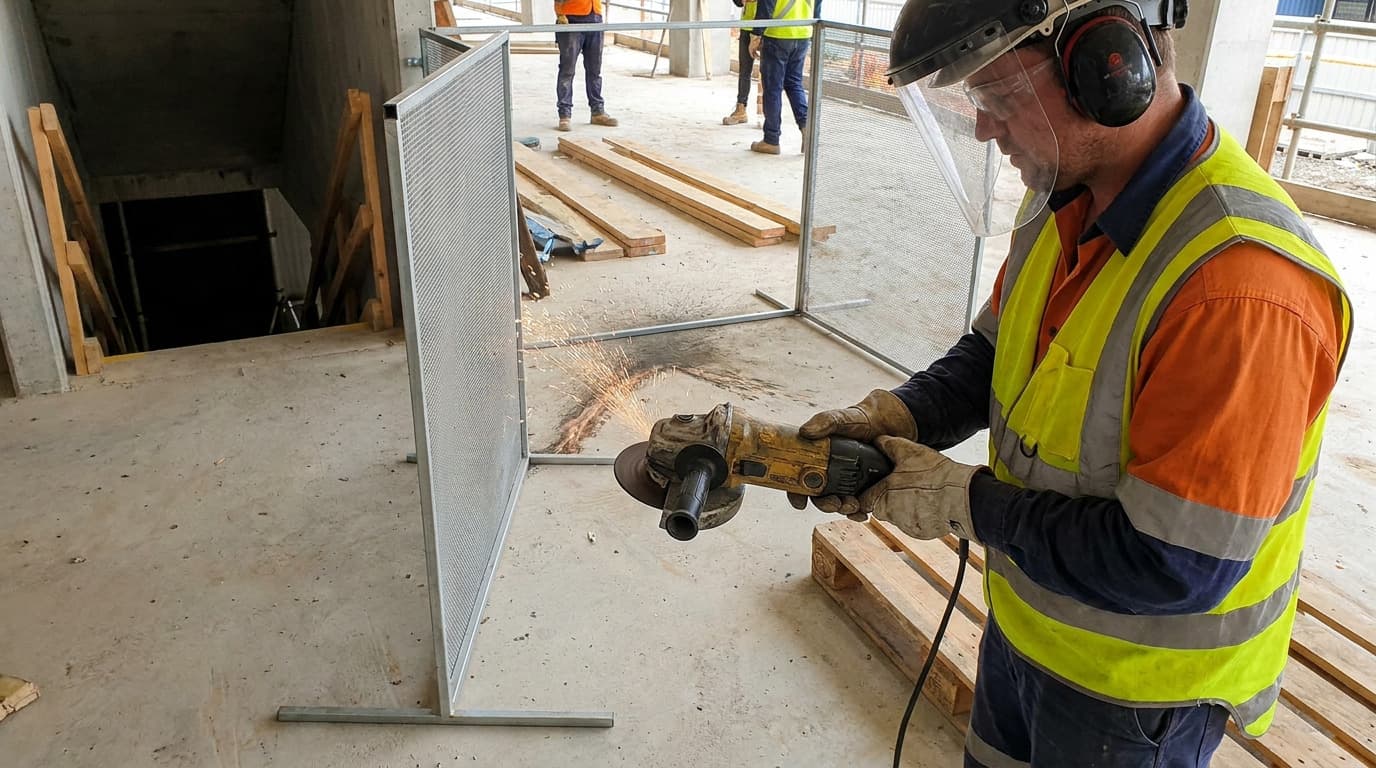
Full face protection. Safety glasses plus a face shield, plus hearing protection, plus attention to what your gloves and sleeves can catch.
Let it stop before you set it down, and unplug or isolate before changing a wheel or adjusting a guard.
Before you start#
- Confirm the guard is fitted, undamaged, and correct for the wheel type in the machine.
- Confirm the guard is positioned between you and the wheel for the cut you are about to make.
- Confirm every guard fastener is present and tight.
- Confirm the wheel's rated speed is at or above the machine's no-load speed.
- Confirm the supply and cord will hold the spindle speed under load.
- Confirm where the sparks will land, and that nothing combustible is there.
- Confirm face and eye protection and hearing protection are on.
- Confirm the tool will be set down only after the wheel has stopped.
Talk it over#
- Where is the guard pointing on the grinder you used last — and where were you standing?
- Has anyone here taken a guard off for a cut? What was the cut, and what else could have been used?
- Which wheel is in the grinder right now, and is it the right one for today's work?
- If the wheel came apart mid-cut, where would the pieces go?
The bottom line#
OSHA has already answered the guard question: in LOI 2001-12-11-1 it applied 1926.300(b)(1) to a hand tool whose guard made the job difficult, held that the guard was still required, and suggested a different tool rather than a relaxation. 1926.303(d) requires the guard to cover the spindle end, nut and flange projections, to be mounted so as to maintain proper alignment with the wheel, and — the clause nobody quotes — requires that the strength of the fastenings exceed the strength of the guard. 1926.303(c) requires enough power to hold spindle speed under all normal operating conditions. For portable grinders, 1910.243 describes the guard sitting between the operator and the wheel at a maximum 180° exposure with the top half enclosed, and OSHA's directive STD 01-12-026 treats a cut-off wheel guard between 150° and 180° as de minimis. A guard rotated to clear the work is not a guard.
Frequently asked questions about grinder safety#
Can I remove the guard from an angle grinder for an awkward cut?
No. 1926.300(b)(1) requires a power-operated tool designed to accommodate guards to be equipped with them when in use, and OSHA applied exactly that to an awkward cut in Letter of Interpretation 2001-12-11-1 — a pneumatic angle-drive tool used for hole cutting and cut-off work inside pipe. OSHA accepted the operation was difficult with the guard on and recommended a different tool and a lighter whip hose, not removal of the guard.
What does OSHA require a grinder guard to cover?
1926.303(d) requires the safety guard to cover the spindle end, nut, and flange projections and to be mounted so as to maintain proper alignment with the wheel. Two exceptions exist: where the work itself provides a suitable measure of protection, the spindle end, nut and outer flange may be exposed; and where the nature of the work entirely covers the side of the wheel, the guard's side covering may be omitted.
Why does the standard mention the strength of the fastenings?
Because the guard is expected to be struck. 1926.303(d) requires that the strength of the fastenings shall exceed the strength of the guard — so that if a bursting wheel overwhelms the guard, the guard is not thrown off its mounting as well. A guard held by one bolt, a stripped thread or an improvised clamp does not meet this even when it appears to be in place.
Where should the guard be positioned on a portable grinder?
Between the operator and the wheel. The general industry provisions at 1910.243 require safety guards on right angle head or vertical portable grinders to have a maximum exposure angle of 180°, located so as to be between the operator and the wheel during use, and adjusted so pieces of an accidentally broken wheel are deflected away from the operator. Other portable grinders are limited to 180° with the top half of the wheel enclosed at all times.
What exposure angle applies to a cut-off wheel?
The referenced requirement is 150° maximum angular exposure under 1910.215(b)(5) and 1926.303(d). OSHA's enforcement directive STD 01-12-026 provides that where a cut-off wheel guard (not masonry) fails the 150° requirement but does not allow greater than 180°, the violation is treated as de minimis. For masonry saws in construction, 1926.303 and 1926.702(i) allow 180°, and a semicircular guard on such a saw is in compliance.
Does the grinder's power supply matter for safety?
Yes, and it is in the standard. 1926.303(c) requires all grinding machines to be supplied with sufficient power to maintain the spindle speed at safe levels under all conditions of normal operation. A machine bogging on an undersized or over-long cord invites the operator to lean in, which increases heat, pressure and the chance of wheel failure.
Is grinding hot work?
For fire purposes, treat it as such. Grinding produces a sustained stream of hot particles that travel, bounce and lodge, and 1926.300(c) already requires PPE for employees exposed to flying and abrasive objects. Where grinding happens near combustibles, openings or other trades, apply the same controls as for hot work — screening, clearance and a fire watch.
Download the grinder safety toolbox talk PDF#
Get this safe usage of grinder machine toolbox talk as a print-ready PDF — available in English, Spanish, Portuguese, and Turkish. Print it, hand it to the crew, and collect signatures on the included attendance sheet.
Download the PDF — free account required. New members get 3 free downloads.
Related toolbox talks#
Sources#
- OSHA, 29 CFR 1926.303 — Abrasive wheels and tools: https://www.osha.gov/laws-regs/regulations/standardnumber/1926/1926.303
- OSHA, Letter of Interpretation, 11 December 2001 — Guarding requirements for a rotary pneumatic angle-drive hand-held tool: https://www.osha.gov/laws-regs/standardinterpretations/2001-12-11-1
- OSHA, STD 01-12-026 — Abrasive Operation Using Cutoff Wheels and Masonry Saws: https://www.osha.gov/enforcement/directives/std-01-12-026
- OSHA, 29 CFR 1910.243 — Guarding of portable powered tools (general industry): https://www.osha.gov/laws-regs/regulations/standardnumber/1910/1910.243