Stepladder
Updated 2026-08-06
In this bundle Fall Protection & Heights
Print-ready PDF
Download this talk as a print-ready PDF, available in 4 languages.
An extension ladder leans on the wall, and everyone can see that the wall is holding it up — so people respect the setup, the angle, the footing. A stepladder leans on nothing. It stands in the open, in the middle of the floor, holding itself up in an A-frame, and because it looks so stable and so ordinary, it gets treated casually — folded and leaned, climbed to the very top, reached out of sideways. That casual treatment is exactly what makes the stepladder one of the most misused tools on a jobsite, because every hazard specific to a stepladder comes from the one thing that makes it different: it supports itself. This stepladder talk is about that self-support — why it's the whole point of a stepladder, and why breaking it is how a stepladder hurts people.
Here is the distinction that carries this whole talk: a stepladder is the only ladder that leans on nothing — it makes its own A-frame, and every stepladder rule exists because that self-support is a promise it only keeps when it's fully open, locked, and you stay inside the frame. An extension ladder borrows its stability from the structure it leans against; a stepladder generates its own, from the geometry of two sections spread apart and locked open. That is a genuinely different machine, and its rules are not the general ladder rules repeated — they are the specific rules that keep the self-supporting shape intact. Fully opened, spreaders locked, all four feet on solid level ground, and your body inside the frame: that is the shape that holds you up. Every fatal stepladder misuse is the same underlying mistake — taking the ladder, or yourself, outside that shape.
Where the boundary of this talk sits#
The general ladder safety talk owns the rules that apply to all ladders — three points of contact, the 4:1 angle for extension ladders, inspecting before use, keeping the base clear. The fall protection talk owns arresting a fall from height. This talk owns what makes a stepladder specifically different: its self-supporting A-frame, and the three ways people break it — folding and leaning it, standing on the top, and overreaching until it tips. Where the question is a general ladder rule or an extension ladder, that is the ladder safety talk; this one owns the stepladder as its own distinct machine.
Misuse one: folding it and leaning it against a wall#
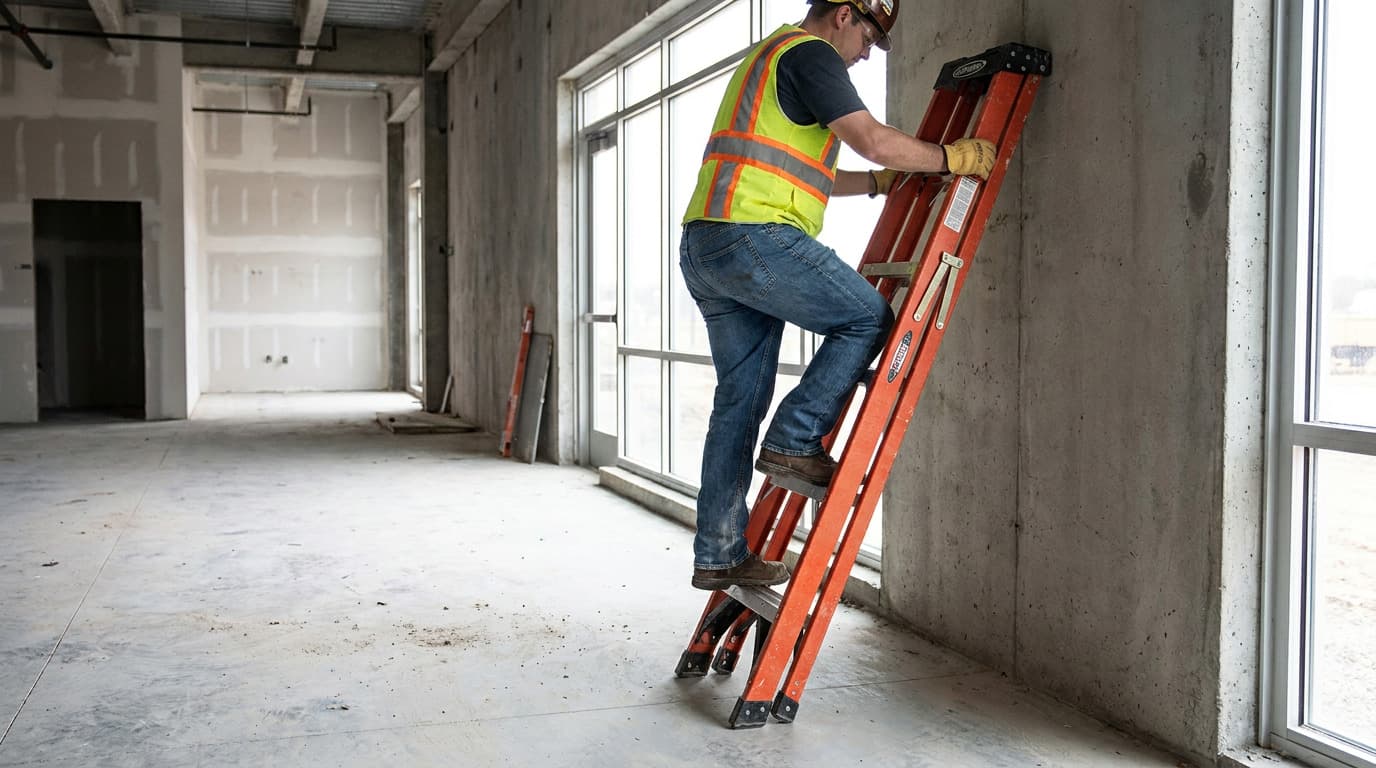
This is the most dangerous stepladder mistake, and it is common because it seems harmless: the stepladder is closed, leaned against a wall, and climbed like a straight ladder. The problem is that a stepladder is a self-supporting ladder, and a straight ladder is a non-self-supporting ladder, and they are designed to entirely different requirements. OSHA is explicit that a ladder shall be used only for the purpose for which it was designed, and using a stepladder folded and leaned as a straight ladder violates that rule because the stepladder was never designed to bear load that way. A folded stepladder has no wide base, its feet are not shaped to grip at a leaning angle, and the whole structure is designed to be loaded in the open A-frame, not as a straight column against a wall. It is worth knowing that OSHA has addressed this directly: even if someone foots the bottom or ties it off, using a stepladder as a straight ladder is still misuse, because the ladder is still being used for something it was not designed to do. The fix is never to lean a closed stepladder — if you need a leaning ladder, use one built to lean.
Misuse two: standing on the top cap or the top step#
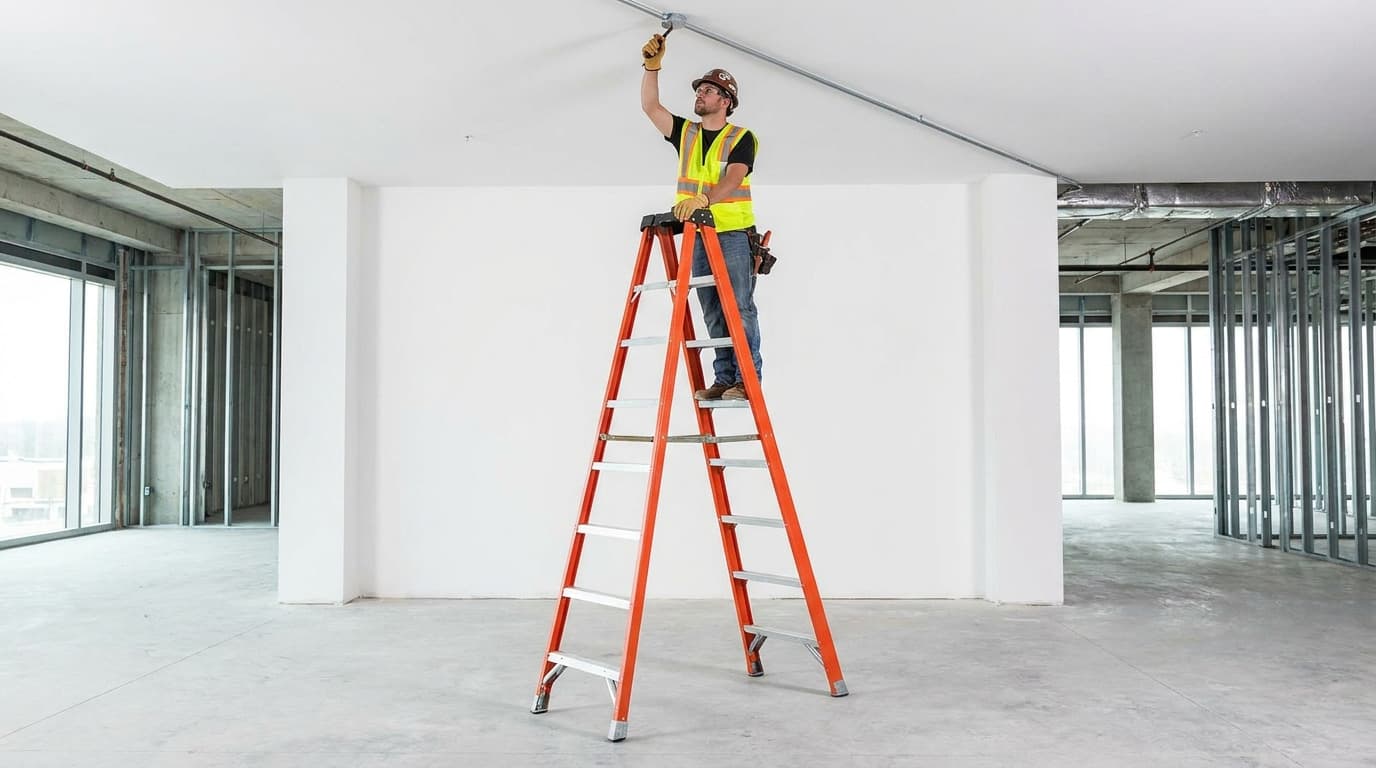
The second fatal misuse is standing on the very top of the stepladder — the top cap, or the top step just below it. OSHA prohibits it directly: the top or top step of a stepladder shall not be used as a step. The reason is about the frame. When you stand on the top cap or top step, your center of gravity rises above and outside the supporting frame, and there is nothing above you to hold onto if you start to go. On any lower step, your weight is inside the A-frame and your hands can reach the ladder above you; on the top, both of those protections are gone at once. The rule of thumb is that if the work is above what you can reach from the second step from the top, the stepladder is too short and you need a taller one. Standing on the top is not a small shortcut — it removes your stability and your handhold in the same motion, at the highest point of the fall.
Misuse three: overreaching until it tips sideways#
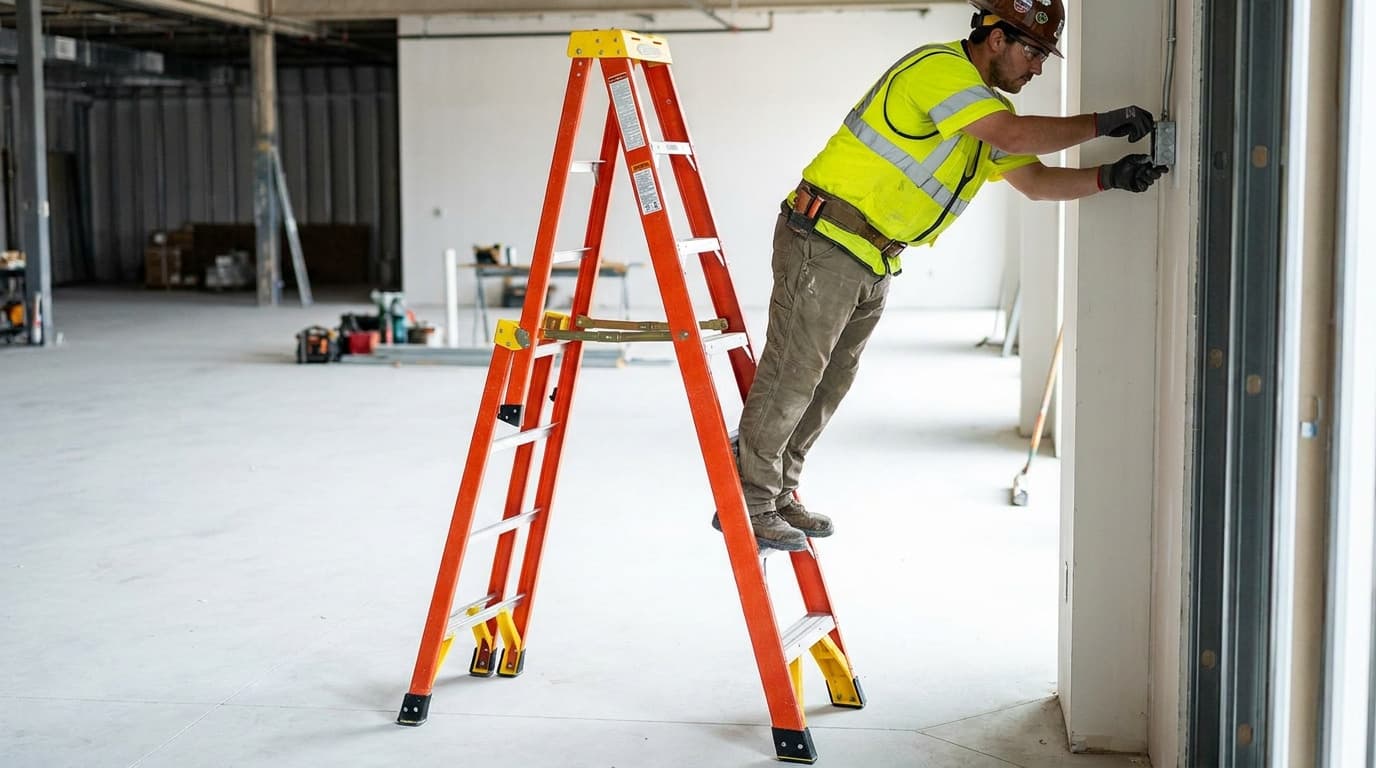
The third misuse is the one that flows straight from the self-support. Because a stepladder leans on nothing, it has no wall to lean into when you reach — and a freestanding A-frame tips sideways with alarming ease when your center of gravity leaves the base. Reaching out to the side to avoid climbing down and moving the ladder is the classic setup: your body goes outside the footprint, the ladder loads unevenly, and it tips out from under you. An extension ladder resists this because the wall is there; a stepladder has nothing on the open sides. The rule is to keep your belt buckle — your center of mass — inside the rails, and to climb down and move the ladder rather than reach for the last bit. The few seconds saved by overreaching are exactly the seconds in which a freestanding ladder goes over.
The rules that protect the frame#
The stepladder-specific requirements all exist to keep the self-supporting shape intact. A metal spreader or locking device must be provided on each stepladder to hold the front and back sections open when it is in use — the spreader is what makes the A-frame rigid, and a broken or missing spreader takes the ladder out of service. The ladder must be fully opened with the spreader locked before anyone climbs; a partially open stepladder is not the machine the rules describe. All four feet must be on solid, level support — shimming one leg with a block of wood is not a fix, and a sloped or uneven surface calls for a ladder built for it. The rear cross-bracing is not for climbing unless the ladder is specifically built with steps on both sides. And the ladder must not be moved or "walked" while someone is on it. None of these is arbitrary; each one protects a specific part of the self-supporting geometry.
Where the duty sits#
The stepladder requirements live in the construction ladder standard, 1926.1053: the spreader or locking device on each stepladder, the prohibition on using the top or top step as a step, the requirement that a ladder be used only for its designed purpose (which is what a folded-and-leaned stepladder violates), the rule against moving a ladder while occupied, and inspection by a competent person. It is worth being precise about one thing: OSHA has said there is no construction standard that specifically prohibits working from a stepladder, and no fall protection is required simply for being on one — the protection comes from using the ladder correctly, not from a harness. The general duties to train workers and protect against recognized hazards run through 1926.21(b)(2) and the General Duty Clause, Section 5(a)(1). And a note on Brazil worth carrying: where the work is at height as their rules define it, the trabalho em altura duties can attach in a way they do not under the US stepladder rules — the local rule governs.
What can go wrong?#
- A stepladder is folded and leaned against a wall like a straight ladder, and it slides or kicks out.
- A worker stands on the top cap or top step, loses balance, and has nothing to grab.
- A worker overreaches sideways and the freestanding ladder tips out from under them.
- The spreader is broken or missing and the ladder folds under load.
- The ladder is used partially open, without the spreader locked.
- One leg is shimmed on uneven ground and the ladder rocks and tips.
- Someone climbs the rear cross-bracing that isn't built for climbing.
- The ladder is "walked" or shifted while someone is standing on it.
How do we manage this properly?#
- Never fold and lean a stepladder — if you need a leaning ladder, use one built to lean.
- Fully open the ladder and lock the spreader before anyone climbs.
- Never stand on the top cap or top step — if the work is higher, get a taller ladder.
- Keep your center of mass inside the rails — climb down and move it rather than overreach.
- Put all four feet on solid, level ground — don't shim a leg or use a slope.
- Take a ladder with a broken or missing spreader out of service.
- Don't climb the rear cross-bracing unless the ladder is built with steps on both sides.
- Never move or "walk" a stepladder while someone is on it.
Before you start#
- Confirm the stepladder is the right tool — not a folded stand-in for a leaning ladder.
- Confirm the spreader locks and the ladder opens fully and stands rigid.
- Confirm all four feet sit solid and level, with no shims or slope.
- Confirm the work can be reached without standing above the second step from the top.
- Confirm the ladder is clear of doorways, traffic, and anything that could displace it.
- Confirm the ladder has been inspected and has no cracked rails or bent parts.
- Confirm everyone knows to keep their belt buckle inside the rails.
- Confirm no one will move the ladder while another worker is on it.
Talk it over#
- Has anyone here leaned a folded stepladder against a wall to save grabbing an extension ladder?
- What's the tallest step you'll actually stand on — and is the top cap ever it?
- When you catch yourself reaching sideways off a stepladder, what's the real fix?
- What would tell you a stepladder should be pulled from service before you climb it?
The bottom line#
A stepladder is the only ladder that leans on nothing — it makes its own A-frame, and every stepladder rule exists because that self-support is a promise it only keeps when it's fully open, locked, and you stay inside the frame. An extension ladder borrows stability from the wall; a stepladder generates its own from the spread, locked geometry, which is why its rules are specific and not just the general ladder rules repeated. The three fatal misuses are all the same underlying mistake — taking the ladder or yourself outside the shape that holds you up: folding and leaning it against a wall turns a self-supporting ladder into a straight ladder it was never designed to be, which OSHA treats as using a ladder outside its designed purpose under 1926.1053(b)(4) — and footing or tying it does not cure that; standing on the top cap or top step puts your center of gravity above and outside the frame with nothing to grab, which 1926.1053(b)(13) prohibits outright; and overreaching sideways sends your center of mass off a freestanding structure that has no wall to lean into. The rules that protect the frame — the spreader locked open under 1926.1053(b)(8), four feet solid and level, no climbing the rear brace, no moving it while occupied — all guard the same self-supporting shape. OSHA doesn't require a harness on a stepladder; the protection is using it correctly. The test is one question: is the ladder fully open and locked, are all four feet solid, and is your body inside the frame — or have you left the shape that's holding you up?
Frequently asked questions about stepladders#
Why can't I just lean a folded stepladder against the wall?
Because a stepladder and a straight ladder are designed to entirely different requirements, and a stepladder was never built to bear load leaning against a wall. OSHA requires that a ladder be used only for the purpose for which it was designed, and using a folded stepladder as a straight ladder violates that rule. A closed stepladder has no wide, stable base for leaning, its feet are not shaped to grip at a leaning angle, and its structure is built to be loaded in the open A-frame. OSHA has addressed this directly and confirmed that even footing the bottom or tying it off does not make it acceptable — it is still being used for something it was not designed to do. If you need a ladder that leans, use one built to lean.
Why is standing on the top cap or top step so dangerous?
Because it removes your stability and your handhold at the same time, at the highest point. OSHA prohibits using the top or top step of a stepladder as a step. On a lower step, your center of gravity is inside the supporting A-frame and you can reach the ladder above you to steady yourself. On the top cap or top step, your weight rises above and outside the frame, and there is nothing above you to grab if you start to go. If the work is above what you can comfortably reach from the second step down from the top, the ladder is too short — the answer is a taller ladder, not one more step up.
Why does a stepladder tip sideways so easily?
Because it leans on nothing. An extension ladder is braced by the wall it leans against, so reaching a little to the side pushes it into the wall. A stepladder is a freestanding A-frame with nothing on its open sides, so when your center of mass moves outside the base — which happens the moment you overreach sideways — the ladder loads unevenly and tips out from under you. This is why the rule is to keep your belt buckle inside the rails and to climb down and move the ladder rather than stretch for the last bit. The self-support that makes a stepladder convenient in the open floor is the same thing that makes overreaching it so unforgiving.
What does the spreader actually do?
The spreader — the metal bar or locking device between the front and back sections — is what makes the A-frame rigid, and OSHA requires one on every stepladder to hold the sections open in use. When it is locked, the two sections cannot splay apart or fold together under load, and the ladder holds its shape. When it is broken, missing, or not locked, the ladder can fold while someone is on it. That is why a stepladder with a broken or missing spreader must be taken out of service, and why the ladder has to be fully opened with the spreader locked before anyone climbs — a partially open stepladder is not the stable machine the rules assume.
Does OSHA require fall protection when I'm on a stepladder?
No. OSHA has stated there is no construction standard that specifically prohibits working from a portable stepladder, and no provision requires fall protection simply for being on one. The protection on a stepladder comes from using it correctly — fully open and locked, four feet solid, staying off the top and inside the frame — not from a harness. There is a nuance: if you are on a surface before getting on or after getting off the ladder for which another standard requires fall protection, that protection applies at those times. But for the act of working from the stepladder itself, the safety is in the correct use, which is exactly why the misuses matter so much.
How is this different from the general ladder safety talk?
The general ladder talk covers what applies to all ladders — three points of contact, inspecting before use, keeping the base clear, the 4:1 angle for extension ladders. This talk covers what is specific to a stepladder: the fact that it is self-supporting, and the three ways people break that self-support — folding and leaning it, standing on the top, and overreaching until it tips. The general rules still apply to a stepladder, but they do not capture what makes a stepladder distinctly dangerous, which is that its stability comes from its own shape rather than from a wall. This talk is about protecting that shape.
Download the stepladder toolbox talk PDF#
Get this stepladder toolbox talk as a print-ready PDF — available in English, Spanish, Portuguese, and Turkish. Print it, hand it to the crew, and collect signatures on the included attendance sheet.
Download the PDF — free account required. New members get 3 free downloads.
Related toolbox talks#
Sources#
- OSHA, Ladders — 29 CFR 1926.1053 (a metal spreader or locking device on each stepladder to hold it open in use; the top or top step shall not be used as a step; a ladder used only for the purpose for which it was designed; not moved while occupied): https://www.osha.gov/laws-regs/regulations/standardnumber/1926/1926.1053
- OSHA, Using a stepladder as a non-self-supporting ladder (standard interpretation, 2010: using a stepladder folded and leaned as a straight ladder violates §1926.1053(b)(4), and footing or tying the bottom does not cure the misuse): https://www.osha.gov/laws-regs/standardinterpretations/2010-01-21
- OSHA, Working from a portable stepladder and fall protection (standard interpretation, 2007: no construction standard specifically prohibits working from a portable stepladder, and no provision requires fall protection simply for being on one): https://www.osha.gov/laws-regs/standardinterpretations/2007-11-28
This talk is general awareness guidance for training purposes. It does not replace your employer's ladder safety program, the OSHA ladder standard, the OSH Act General Duty Clause, the ladder manufacturer's instructions, or a competent person's duties, and it is not legal advice. Where a site ladder procedure or a manufacturer's instruction sets a specific requirement, that requirement governs.