Portable Heater Safety
Updated 2026-08-01
In this bundle Fire, Hot Work & Emergency
Print-ready PDF
Download this talk as a print-ready PDF, available in 4 languages.
Temporary heat arrives on site the way a wheelbarrow does. Somebody hires a unit, somebody else wheels it into the sheeted-off area, and the only question anybody asks is whether it is throwing out enough heat. Nobody asks the question that decides whether it can kill the crew. This Portable Heater Safety Toolbox Talk (Safety Talk / Tailgate Talk) is about that question.
Here is the distinction that carries this whole talk: a heater's danger is decided by where its exhaust goes, not by how hot it burns. Two units can look identical, run on the same fuel and put out the same output — and one of them sends its combustion products outside through a flue while the other sends them into the air you are breathing. The flame is the same. The exhaust path is the whole difference, and it is the first thing to establish about any heater on any site.
OSHA said this out loud, and almost nobody has read it#
The evidence for the anchor is in an OSHA interpretation from 1977, and it is worth quoting because it shows what the agency was actually worried about.
1926.154(d) says simply: "Solid fuel salamanders are prohibited in buildings and on scaffolds."
Crews assume that ban is about open flame, or sparks, or the fire risk of burning wood. OSHA explains otherwise. The standard, it says, "was adopted to prevent the fire and carbon monoxide hazards associated with the burning of spark-producing fuels such as wood and paper in open salamanders." Then it defines the banned device — and this is the sentence that matters: open solid fuel salamanders are "heating units with combustion exhausting into the surrounding enclosed atmosphere."
That is OSHA's own definition of the thing it prohibited. Not "burns wood." Not "has a flame." Combustion exhausting into the atmosphere you are standing in.
Which tells you exactly what to look for in every other heater on site, whether or not it happens to be banned by name. An unvented propane or kerosene heater does the same thing the salamander does. It is legal, it is on hire from every plant depot, and it puts every product of combustion — including carbon monoxide — into the enclosure with the crew.
Where the boundary of this talk sits#
Carbon monoxide exposure limits belong to the portable generator talk, which owns those figures. What carbon monoxide does inside the body, and why every warning sign fails, belongs to the carbon monoxide talk. Fuel storage quantities, safety cans and cabinets belong to the fuel storage talk. General ignition-source control and extinguishers belong to the fire prevention talks. Cold injury physiology belongs to the cold stress talk. This talk owns the heater itself: its exhaust path, its siting, and the requirements at 1926.154.
The interesting failure is the enclosure, not the heater#
Here is why this is a construction problem rather than a domestic one.
The whole reason temporary heat exists on site is to keep work going in cold weather — which means it almost always arrives at the same moment somebody sheets the area in. Polythene on the scaffold, tarpaulins over the deck, hoarding across the openings, a tent over the slab for a concrete pour. The enclosure is what makes the heat worth having.
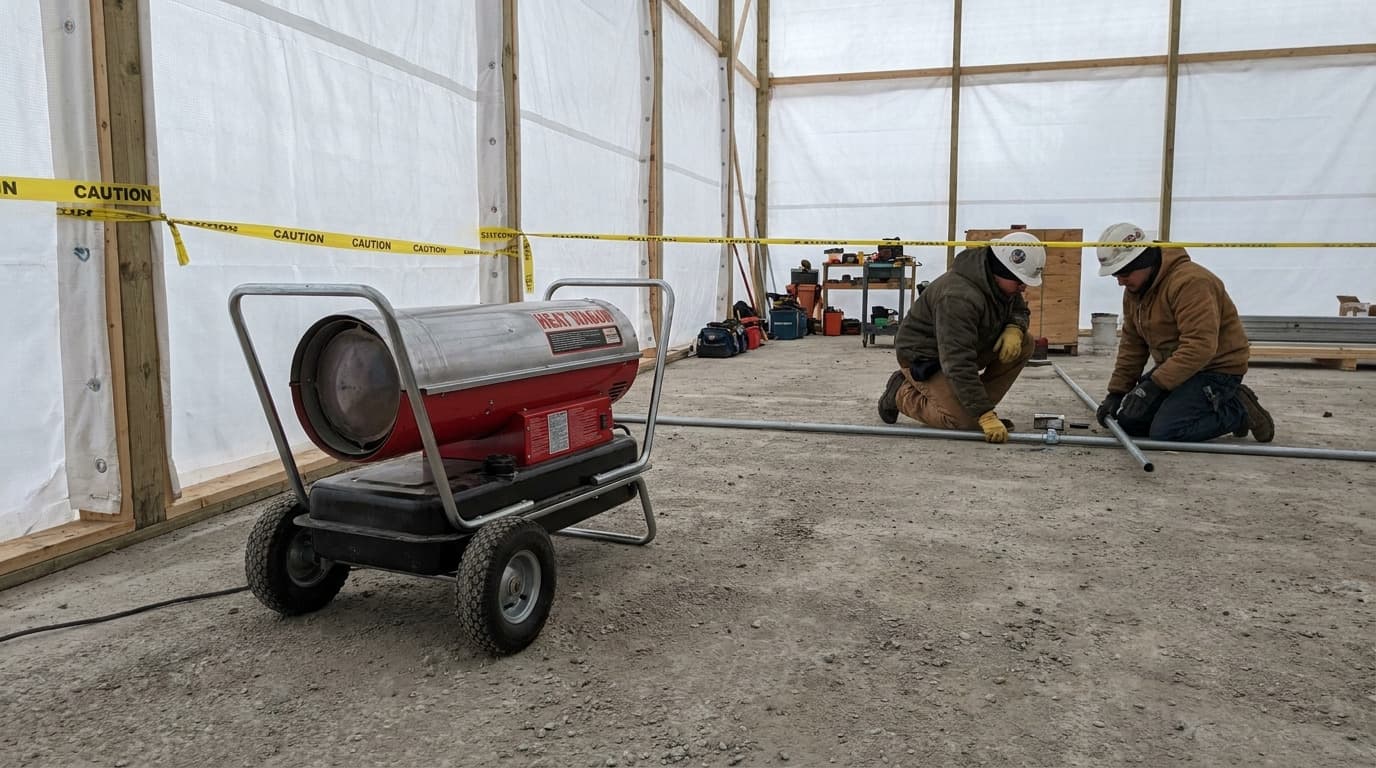
So the heater and the confinement turn up together, and each one makes the other more dangerous. Every hour the enclosure keeps heat in, it also keeps combustion products in and fresh air out. And the tighter the crew makes it — taping the gaps, weighting the sheet edges — the better it works as a heater and the worse it gets as an atmosphere.
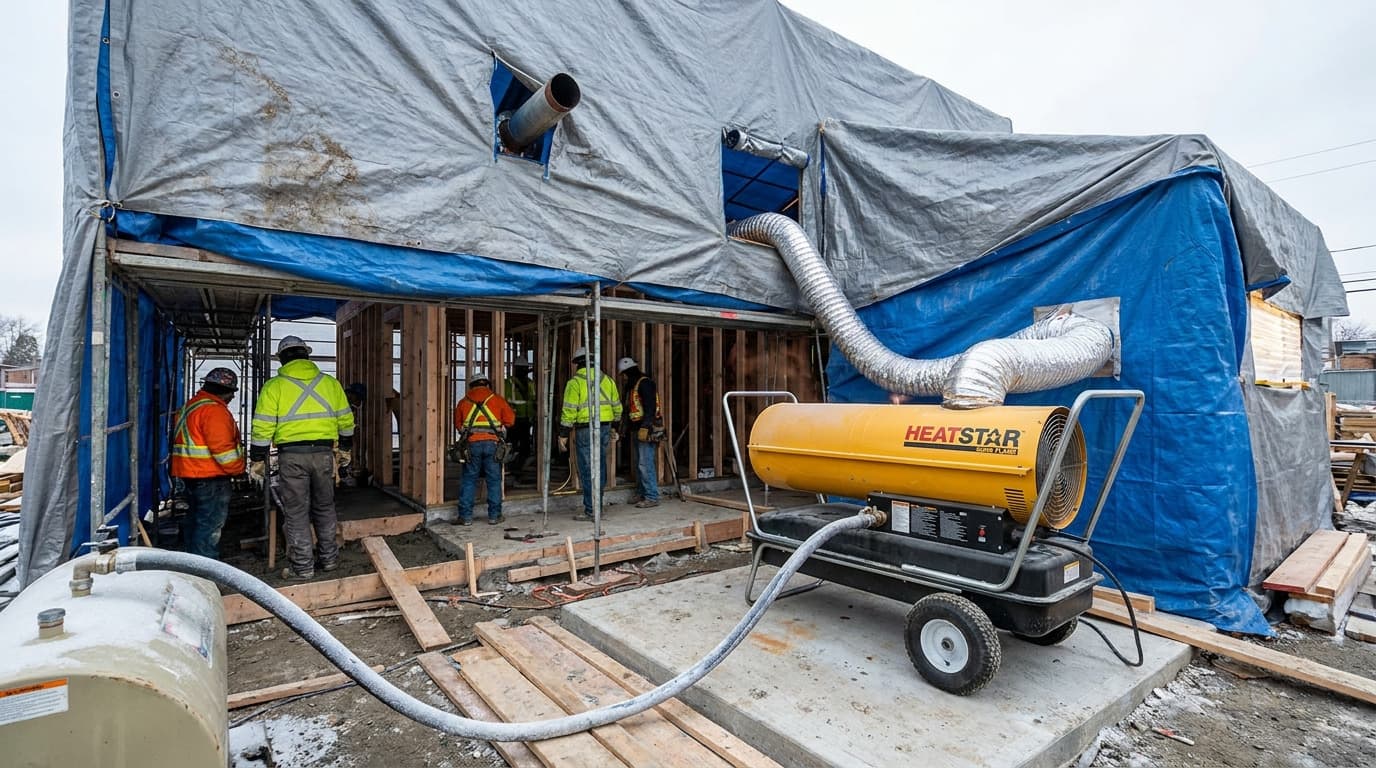
1926.154(a) requires ventilation for temporary heating devices for exactly this reason. Ventilation is not a comfort item here and it is not in tension with the heating; it is what makes the heating survivable.
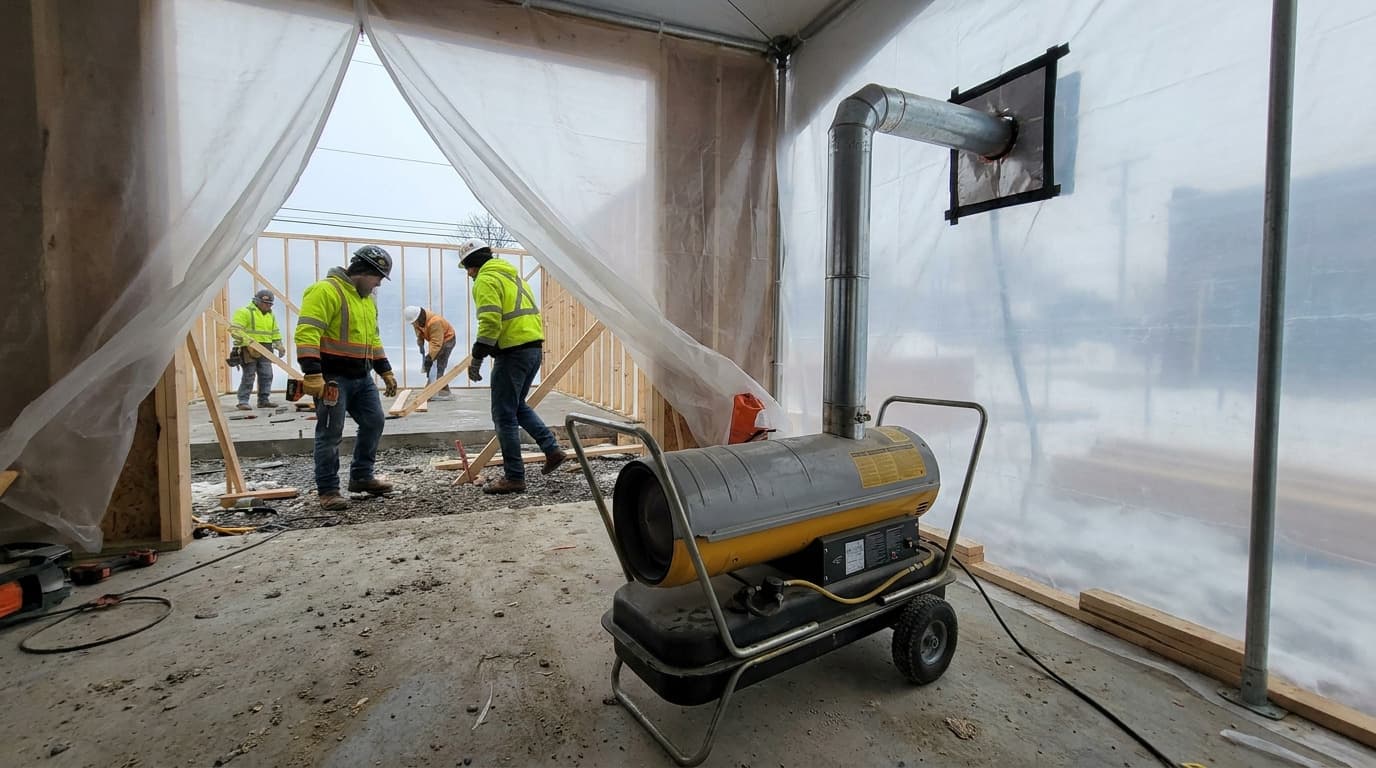
The clearances, verbatim#
1926.154 is short and specific, and these are the provisions crews break most often.
Clearance to combustibles — (b)(1). Temporary heating devices shall be installed with clearance to combustible material not less than the amount shown in Table F-4. Under (b)(2), units listed for lesser clearances may be installed in accordance with their approval — so the plate on the machine can override the table, but nothing else can.
Wood floors — (b)(3). Heaters not suitable for use on wood floors shall not be set directly upon them or on other combustible material. They must rest on suitable heat insulating material or at least 1-inch concrete, or equivalent, and — the part everybody misses — that insulating material shall extend beyond the heater 2 feet or more in all directions.
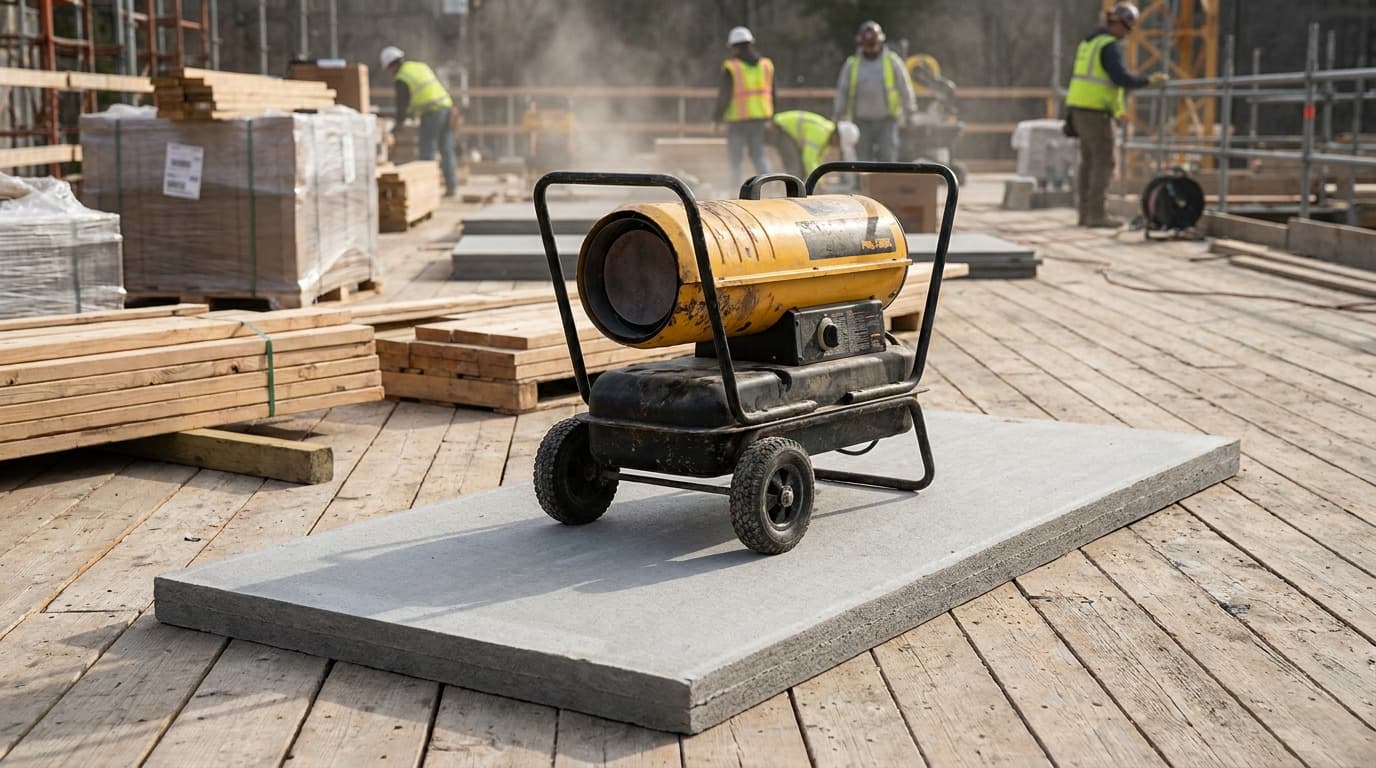
Tarpaulins — (b)(4). Heaters used in the vicinity of combustible tarpaulins, canvas or similar coverings shall be located at least 10 feet from the coverings, and the coverings shall be securely fastened to prevent ignition or upsetting of the heater due to wind action. Read the second half: the standard is not only worried about the sheet catching fire, but about the wind moving the sheet into the heater, or knocking the heater over.
Stability — (c). Heaters in use shall be set horizontally level, unless the manufacturer's markings permit otherwise.
Oil-fired heaters — (e)(1). Flammable liquid-fired heaters shall be equipped with a primary safety control to stop the flow of fuel in the event of flame failure, and barometric or gravity oil feed shall not be considered a primary safety control. If the flame goes out and fuel keeps arriving, you are filling the enclosure with atomised fuel.
Fuel brings its own rules#
LP gas is covered separately at 1926.153, which governs cylinder siting, storage and use — including limits on cylinders inside buildings. A propane heater is two hazards bolted together: the combustion products and the fuel supply.
Never refuel a running or hot heater, and never store the day's fuel beside it. Fuel storage quantities and containers are covered in the fuel storage talk.
And when a heater is left running unattended overnight in an enclosure, everything above compounds: the atmosphere degrades with nobody in it to notice, and the first crew in next morning walks into the result.
Where the duty sits#
1926.154, Temporary heating devices, is the standard, and it is unusually direct — ventilation, clearances, stability, the salamander prohibition and oil-fired controls, all in one short section.
Around it: 1926.153 for liquefied petroleum gas; 1926.151 for general fire prevention; 1926.21(b)(2), requiring the employer to instruct each employee in recognising and avoiding unsafe conditions. Carbon monoxide exposure limits are applied through 1926.55 and are covered in the generator talk. Where no specific provision reaches a hazard, Section 5(a)(1) of the OSH Act still requires a workplace free of recognised hazards.
One point that follows from the anchor rather than from the text: there is no clearance distance, no guard and no tip-over switch that makes an unvented heater safe in a sealed enclosure. Those controls address the fire. The exhaust path addresses the atmosphere, and they are different problems.
What can go wrong?#
Running an unvented heater inside a sheeted enclosure and treating ventilation as optional because it lets the heat out.
Tightening the enclosure as the shift goes on — taping gaps, weighting sheet edges — and steadily removing the fresh air.
Leaving a heater running unattended overnight, so the first crew in the morning enters the result.
Setting a heater directly on a timber deck without insulating material extending 2 feet beyond it in all directions.
Placing a heater within 10 feet of tarpaulins or canvas, or leaving those coverings loose so wind can move them into it.
Setting a heater on uneven ground or a slope, when the standard requires it level.
Using an open solid fuel salamander in a building or on a scaffold, which is prohibited outright.
Refuelling a hot or running heater, or storing the fuel next to it.
How do we manage this properly?#
Establish the exhaust path first. Before anything else, ask whether this unit vents outside or into the space. That answer sets everything that follows.
Prefer indirect-fired or flue-vented heaters for any enclosed area, and electric heat where the supply allows it — an electric heater has no combustion products at all.
Ventilate deliberately and keep it ventilated, per 1926.154(a), and resist the crew's natural instinct to seal the enclosure tighter as the day gets colder.
Monitor for carbon monoxide wherever a fuel-burning heater runs in an enclosure, with an instrument that has a CO sensor, calibrated and bump tested.
Site it to the standard: Table F-4 clearances, insulating material extending 2 feet beyond on combustible floors, 10 feet from tarpaulins, coverings securely fastened, unit level.
Check oil-fired units have a working primary safety control and are not relying on barometric or gravity feed as a substitute.
Shut heaters down when the area is unoccupied, or use units and arrangements specifically designed and permitted for unattended running.
Refuel cold and away from the heater, and keep only the working quantity in the area.
Brief the first crew in each morning to ventilate and test before they start, not after.
Before you start#
- Confirm whether this heater vents outside or exhausts into the work area.
- Confirm what fuel it uses and where that fuel will be stored.
- Confirm the ventilation arrangement and that it will still be there at the end of the shift.
- Confirm the clearance to combustibles meets Table F-4 or the unit's own listing.
- Confirm what the heater is standing on, and that insulation extends 2 feet beyond if required.
- Confirm nothing combustible, including tarpaulins, is within 10 feet, and coverings are fastened.
- Confirm the unit is level and stable.
- Confirm whether it will run unattended, and if so who checks it and when.
Talk it over#
- Does the heater in our area vent outside, and how would we tell by looking?
- What happens to the air in that enclosure between the end of tonight's shift and tomorrow morning?
- Who is going to tighten the sheeting when it gets cold this afternoon?
- What is the heater standing on, and what is within ten feet of it?
The bottom line#
A heater's danger is decided by where its exhaust goes, not by how hot it burns. OSHA said so when it banned the open salamander: 1926.154(d) states that "solid fuel salamanders are prohibited in buildings and on scaffolds", and OSHA's interpretation explains the ban was adopted "to prevent the fire and carbon monoxide hazards" of open salamanders, defining them as "heating units with combustion exhausting into the surrounding enclosed atmosphere." That is the test to apply to every heater on site — an unvented propane or kerosene unit does the same thing legally. The construction-specific trap is that the heater and the enclosure arrive together: sheeting, tarpaulins and hoarding are what make temporary heat worth having, and every hour they keep heat in they keep combustion products in and fresh air out — which is why 1926.154(a) requires ventilation, and why tightening the enclosure improves the heating and degrades the atmosphere at the same time. The siting rules are specific: (b)(1) clearance to combustibles not less than Table F-4, with (b)(2) allowing lesser clearances only where the unit is listed for them; (b)(3) heaters unsuitable for wood floors shall not be set directly upon them, resting instead on suitable heat insulating material or at least 1-inch concrete or equivalent, extending beyond the heater 2 feet or more in all directions; (b)(4) at least 10 feet from combustible tarpaulins, canvas or similar coverings, with those coverings securely fastened to prevent ignition or upsetting of the heater due to wind action; (c) heaters in use set horizontally level; and (e)(1) flammable liquid-fired heaters equipped with a primary safety control to stop the flow of fuel on flame failure, with barometric or gravity oil feed expressly not counting as one. LP gas siting and storage sit at 1926.153, general fire prevention at 1926.151, instruction at 1926.21(b)(2). And the point that follows from the anchor: no clearance, guard or tip-over switch makes an unvented heater safe in a sealed enclosure — those controls address the fire, and the exhaust path addresses the atmosphere.
Frequently asked questions about portable heaters#
What is the first thing to check about a heater on site?
Where its exhaust goes. Not its output, not its fuel, not its guard. A flue-vented or indirect-fired unit sends its combustion products outside; an unvented one puts them into the space with the crew. Two heaters can be identical in every other respect and differ completely in this one, and it decides whether the enclosure gets steadily more dangerous as the shift goes on.
Why are solid fuel salamanders banned but unvented propane heaters are not?
1926.154(d) prohibits solid fuel salamanders in buildings and on scaffolds, and OSHA's interpretation explains it was adopted "to prevent the fire and carbon monoxide hazards" of burning spark-producing fuels in open salamanders — defining those as "heating units with combustion exhausting into the surrounding enclosed atmosphere." An unvented gas or kerosene heater exhausts the same way. It is not banned by name, but the hazard OSHA described applies to it just as directly.
Does ventilation not defeat the point of heating the area?
It costs you some heat, and it is what makes the heating survivable. 1926.154(a) requires ventilation for temporary heating devices. The trap on site is gradual: the crew tapes gaps and weights sheet edges through the day because it feels colder, and every improvement to the enclosure as a heater is a degradation of it as an atmosphere. Plan the ventilation, then protect it from being closed up.
What are the clearance rules for a portable heater?
1926.154(b)(1) requires clearance to combustible material not less than Table F-4, and (b)(2) allows lesser clearances only for units listed and approved for them. (b)(3): heaters not suitable for wood floors must not be set directly on them, but on heat insulating material or at least 1-inch concrete or equivalent, extending 2 feet or more beyond the heater in all directions. (b)(4): at least 10 feet from combustible tarpaulins or canvas, with the coverings securely fastened.
Why does the standard care about tarpaulins being fastened?
Because the risk runs both ways. 1926.154(b)(4) requires coverings to be securely fastened "to prevent ignition or upsetting of the heater due to wind action on the covering." The obvious hazard is the sheet catching fire. The one crews miss is wind moving a loose sheet into the heater, or knocking the heater over — which is also why (c) requires heaters in use to be set horizontally level.
What is special about oil-fired heaters?
1926.154(e)(1) requires flammable liquid-fired heaters to have a primary safety control that stops the flow of fuel if the flame fails — and states expressly that barometric or gravity oil feed does not count as a primary safety control. The reason is direct: if the flame goes out while fuel keeps being delivered, the unit fills the enclosure with atomised fuel, and the next ignition source finds it.
Is it safe to leave a heater running overnight in a sheeted area?
It is the highest-risk arrangement on this list, because the atmosphere degrades with nobody present to notice and the first crew in next morning walks into the result. Shut heaters down when an area is unoccupied unless the unit and the arrangement are specifically designed and permitted for unattended operation — and where a fuel-burning heater has run in an enclosure, ventilate and test with a CO-capable instrument before anybody starts work, not after.
Download the portable heater toolbox talk PDF#
Get this portable heater safety toolbox talk as a print-ready PDF — available in English, Spanish, Portuguese, and Turkish. Print it, hand it to the crew, and collect signatures on the included attendance sheet.
Download the PDF — free account required. New members get 3 free downloads.
Related toolbox talks#
Sources#
- OSHA, 29 CFR 1926.154 — Temporary heating devices: https://www.osha.gov/laws-regs/regulations/standardnumber/1926/1926.154
- OSHA, Standard Interpretation, 25 March 1977 — solid fuel salamanders under 1926.154(d): https://www.osha.gov/laws-regs/standardinterpretations/1977-03-25
- eCFR, 29 CFR 1926.154: https://www.ecfr.gov/current/title-29/subtitle-B/chapter-XVII/part-1926/subpart-F/section-1926.154
This talk is general awareness guidance for training purposes. It is not medical advice and nothing in it is a diagnosis. Anyone who feels unwell in an area heated by a fuel-burning appliance should be moved to fresh air and assessed by a qualified medical professional, who should be told that carbon monoxide exposure is suspected.
Written by FieldSafetyTalk's safety professional — a CSP, ASP, CHST and OSHA Authorized Outreach Trainer with 14+ years of international construction safety experience across federal, heavy civil, and industrial projects.