Near-Miss Reporting
Updated 2026-07-28
In this bundle Jobsite Fundamentals & Compliance
Print-ready PDF
Download this talk as a print-ready PDF, available in 4 languages.
A near miss is the same event as an accident. Same hazard, same sequence, same failure — with one variable different, usually luck. The scaffold board that flipped and was caught. The load that swung through where somebody had been standing a minute earlier. The energised circuit that turned out to be dead because of who had been on site the day before. Nothing to report, because nothing happened. This Near-Miss Reporting Toolbox Talk (Safety Talk / Tailgate Talk) is about why that reasoning is expensive.
Here is the distinction that carries this whole talk: a near miss is the only free information a site ever gets. Every other data point about how the work actually fails is bought with an injury. The near miss delivers the identical lesson — the same mechanism, the same broken control, the same gap between the plan and the day — and charges nothing for it. A site that collects them is being told what will hurt somebody, in advance, at no cost.
There is no standard requiring it#
Worth saying plainly, because it explains why near-miss systems are so uneven: OSHA has no standard requiring near misses to be reported or recorded. Part 1904 recordkeeping is built around injuries and illnesses. A near miss produces no injury, so it produces no recordable case and no entry anywhere.
What exists nearby:
1926.20(b)(2) requires frequent and regular inspections of the job sites, materials and equipment by competent persons designated by the employer — and a near-miss report is the highest-value input an inspection programme can get, because it points at a specific failure rather than a general condition.
1926.21(b)(2) requires employees to be instructed in the recognition and avoidance of unsafe conditions — and near misses are how a site learns which conditions its own people are failing to recognise.
Section 5(a)(1), the General Duty Clause, turns on recognised hazards. A reported near miss is evidence the hazard was recognised, which cuts both ways: it establishes the duty, and it is also the record that the employer acted.
1904.35 requires a reporting procedure that does not deter or discourage reporting. It is written about injuries, but a site whose culture discourages injury reporting will not collect near misses either — the two rise and fall together.
So the near-miss system is entirely voluntary in a legal sense, and entirely decisive in a practical one.
Why people do not report them#
Nothing happened. The most honest reason, and the one that requires reframing rather than persuasion.
It would identify someone. Most near misses involve somebody doing something they should not have, and reporting feels like informing.
It reflects on the reporter. People are least likely to report the near miss they caused, which is exactly the one with the most information in it.
It takes too long. A form, a login, a laptop, a supervisor to find — each step loses a proportion of reports.
Nothing came of the last one. The single strongest predictor of whether someone reports again is whether they ever heard what happened to the last report.
It sounds like an excuse. Reporting a near miss during a delay can look like justifying the delay.
The four things that decide whether a system works#
Blame-free in practice, not in policy. Every reporting system claims to be blame-free. Workers judge it by what happened to the last person who reported something, not by what the policy says. One disciplinary response to a self-reported near miss will end the flow of reports for months.
Effortless to submit. Verbal to anyone, on the spot, with someone else doing the writing. Every additional step — a form, an app, a login, finding a specific person — removes a share of the reports, and the ones lost first are the small ones that carry the pattern.
Fed back visibly. Tell the crew what came in and what changed. This is the mechanism that makes reporting self-sustaining, and it is the one most sites skip.
Acted on quickly, and visibly. A near miss reported on Monday and fixed on Tuesday teaches the whole site that reporting works. The same report fixed in six weeks teaches the opposite.
Everything else — categories, forms, dashboards, monthly counts — is optional. Those four are not.
What is worth reporting#
Dropped objects that hit nothing. Tool, fixing, offcut, material from height.
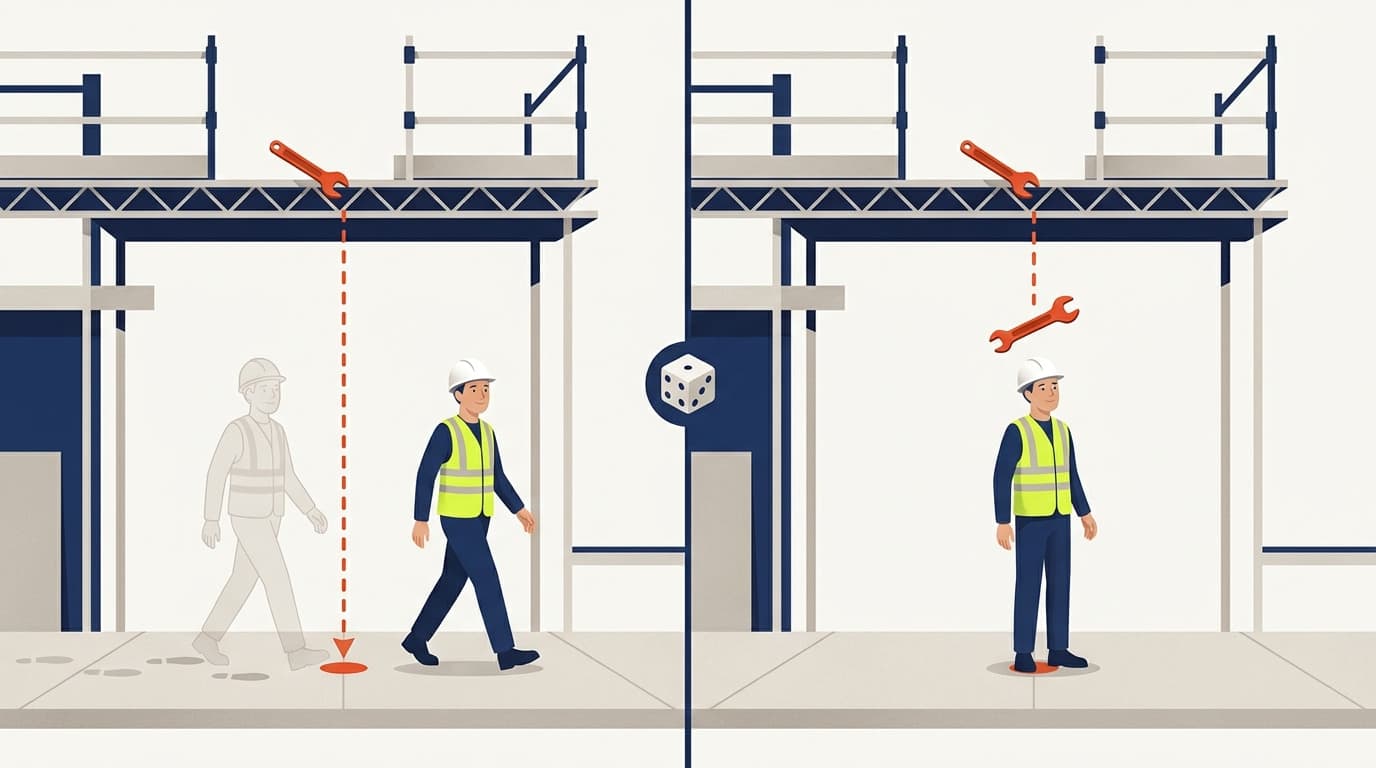
Contact that did not happen — plant and pedestrian, load swing, vehicle reversing.
Failed or missing controls found in use — a guard off, a defeated interlock, a missing guardrail, a harness clipped to nothing.
Wrong isolation — the circuit, valve or machine that turned out to be live, or the lock that was on the wrong thing.
Ground and structure movement — a trench wall spalling, a scaffold tie missing, a temporary work moving under load.
The task that could not be done as planned, and got improvised. That improvisation is a near miss even if it worked.
Anything where the outcome depended on where someone happened to be standing.
What can go wrong?#
Reports collected and never analysed. A pile of forms is not a system.
The count becomes the target. Sites that measure the number of near-miss reports get more reports and less information, because quantity is easy to produce.
Only the tidy ones get reported — housekeeping, minor trips — while the ones involving judgement or seniority never surface.
The reporter gets investigated rather than the event.
Fixes never close. Reported, logged, assigned and open six months later.
Other contractors never hear. A near miss on one package is a live hazard for the next trade.
It stays on paper. No trend, no learning, no change to the method.
How do we make this work?#
Reframe what counts. "It nearly happened" is the whole threshold — no severity test, no judgement about whether it was serious enough.
Take reports verbally, on the spot, and let the supervisor do the writing.
Protect the reporter absolutely, including when they caused it. The report that costs someone something is the last one you will get from that crew.
Feed back at the next toolbox talk. What was reported, what was found, what changed.
Fix fast and visibly, because speed is what proves the system is real.
Pass it across contractors. The hazard does not stop at a package boundary.
Look for repeats. The same near miss three times is a design or planning problem, not three individual lapses.
Measure what changed, not how many were reported.
Before you start#
- Confirm you know who to tell if something nearly goes wrong today.
- Confirm reporting can be verbal and immediate, without paperwork on the spot.
- Confirm the crew knows nobody is disciplined for a self-reported near miss.
- Confirm what came of the last near miss reported here.
- Confirm whether any hazard reported previously is still open.
- Confirm other trades near you have been told about anything relevant.
- Confirm any improvised method used today gets reported even though it worked.
- Confirm someone owns turning reports into changes.
Talk it over#
- What nearly happened to you this week that you did not mention?
- What was the last near miss reported here, and what changed because of it?
- Would you report one that was your own fault? Honestly?
- What is the quickest way to report something on this site right now?
The bottom line#
There is no OSHA standard requiring near-miss reporting — Part 1904 records injuries and illnesses, and a near miss produces neither. What the near miss produces is the only free information a site ever gets: the same hazard, the same failed control and the same gap between plan and reality that an injury would have revealed, at no cost. Nearby duties give it a home — 1926.20(b)(2) frequent and regular inspections by competent persons, 1926.21(b)(2) instruction in recognising unsafe conditions, Section 5(a)(1) and its recognised hazards, and 1904.35's requirement that a reporting procedure must not deter or discourage. Whether the system works comes down to four things: blame-free in practice, effortless to submit, fed back visibly, and acted on quickly. Everything else is optional.
Frequently asked questions about near-miss reporting#
Does OSHA require near misses to be reported?
No. There is no OSHA standard requiring near misses to be reported or recorded. Part 1904 recordkeeping is built around work-related injuries and illnesses, and a near miss produces neither — so it generates no recordable case. Near-miss systems are voluntary in law and decisive in practice.
Then why bother?
Because it is the only safety information that costs nothing. A near miss contains the same hazard, the same failed control and the same mechanism as the injury that did not happen — the difference is usually where someone happened to be standing. Collecting them means being told what will hurt somebody before it does.
What actually counts as a near miss?
Anything where the outcome depended on luck rather than control: a dropped object that hit nothing, a load that swung through an empty space, a guard found removed, an isolation that turned out to be wrong, a trench wall starting to move — and any task that had to be improvised because it could not be done as planned, even if the improvisation worked.
Should someone be disciplined for a near miss they caused?
If you want the reports to stop, yes. The near miss with the most information in it is almost always the one the reporter caused, and people will not surrender that information if it costs them. A single disciplinary response to a self-reported near miss typically ends reporting across a crew for months.
What makes a reporting system actually work?
Four things: it is blame-free in practice rather than in policy; it is effortless to submit, ideally verbal and on the spot; results are fed back visibly to the people who reported; and issues are acted on quickly. Forms, categories and dashboards are optional — those four are not.
Should we set a target for the number of near-miss reports?
It is a common mistake. Measuring the count reliably produces more reports and less information, because low-value reports are the easiest to generate. Measure what changed as a result instead — fixes made, methods altered, hazards closed out.
Does a near-miss report create legal exposure?
It creates a record that the hazard was recognised — which is precisely why it matters under Section 5(a)(1), whose duty turns on recognised hazards. That cuts both ways: the report establishes recognition, and it is also the evidence that the employer identified and addressed the hazard. Not reporting does not remove the hazard; it removes the proof that anyone dealt with it.
Download the near-miss reporting toolbox talk PDF#
Get this near-miss reporting toolbox talk as a print-ready PDF — available in English, Spanish, Portuguese, and Turkish. Print it, hand it to the crew, and collect signatures on the included attendance sheet.
Download the PDF — free account required. New members get 3 free downloads.
Related toolbox talks#
Sources#
- OSHA, 29 CFR 1926.20 — General safety and health provisions: https://www.osha.gov/laws-regs/regulations/standardnumber/1926/1926.20
- OSHA, 29 CFR 1926.21 — Safety training and education: https://www.osha.gov/laws-regs/regulations/standardnumber/1926/1926.21
- OSHA, 29 CFR 1904.35 — Employee involvement: https://www.osha.gov/laws-regs/regulations/standardnumber/1904/1904.35
Written by FieldSafetyTalk's safety professional — a CSP, ASP, CHST and OSHA Authorized Outreach Trainer with 14+ years of international construction safety experience across federal, heavy civil, and industrial projects.