Dump Truck Safety
Updated 2026-08-05
In this bundle Vehicle Safety
Print-ready PDF
Download this talk as a print-ready PDF, available in 4 languages.
Watch a dump truck tip a load and the dangerous moment looks obvious: the bed going up, material coming out, the truck rocking on its springs. Everybody stands clear for that. Then the load is gone, the tension goes out of the operation, and the truck does the two things that actually kill people. This dump truck safety talk is about the minute after the load leaves.
Here is the distinction that carries this whole talk: a dump truck is most dangerous when the load has already gone. The bed is still up, the job feels finished, and the driver's attention has moved to the next run. The two events that kill in that window are driving away with the bed raised into an overhead line, and going underneath a raised bed. Both happen after the part everybody was watching.
Where the boundary of this talk sits#
The reverse alarm and the alarm-versus-observer rule at 1926.601(b)(4) and 1926.602(a)(9)(ii) belong to the heavy equipment talk, which owns that either/or — and also owns the horn rule at 1926.602(a)(9)(i), the shift inspection, seat belts and ROPS. Struck-by mechanics in general belong to the struck-by talk. Energy isolation procedure belongs to the lockout/tagout talk. This talk owns the dump body: what happens when it is up, and the provisions written specifically for it.
Why a raised bed is a different machine#
The stability change is real and it works against you in three ways at once.
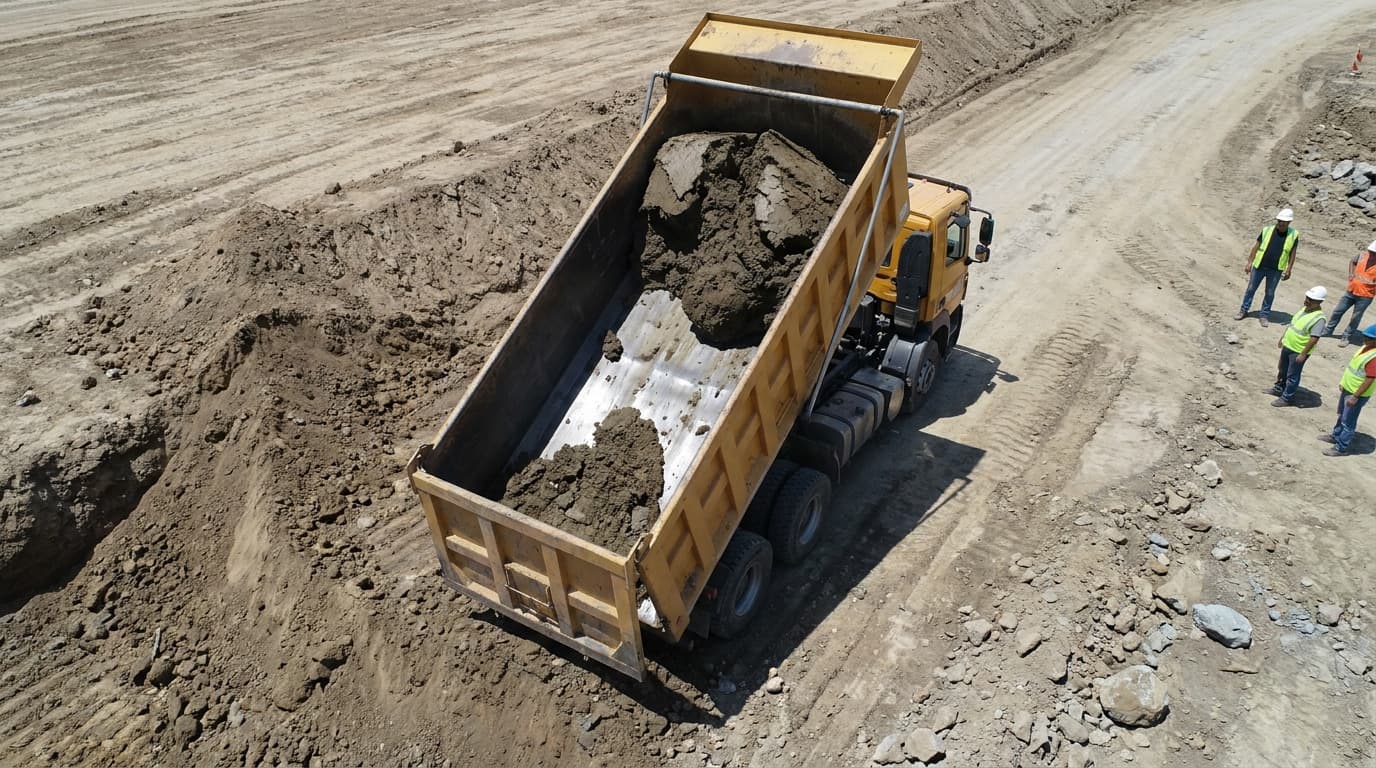
The centre of gravity rises. NIOSH states plainly that the dump truck can become unstable when the bed is raised. A body that sat low over the frame is now a tall structure pivoted at the rear.
A sticking load makes it worse. NIOSH names the mechanism: uneven or incomplete material flow out of the dump bed — for example a problem with clayey or frozen material. When part of the load releases and part does not, the remaining weight is high, off-centre, and no longer where anybody expects it. This is the classic side-tip: the truck was fine until half the load let go.
Ground and wind finish it. A raised bed on a soft shoulder, a crowned haul road, or a fill edge has a lever arm it did not have before. NIOSH also says to be conscious of abnormal conditions such as high winds — a raised empty body is a large sail.
So the rule is not "dump carefully." It is that the bed comes down before anything else happens.
Driving away with the bed up#
This is the electrocution route, and the mechanism is specific.
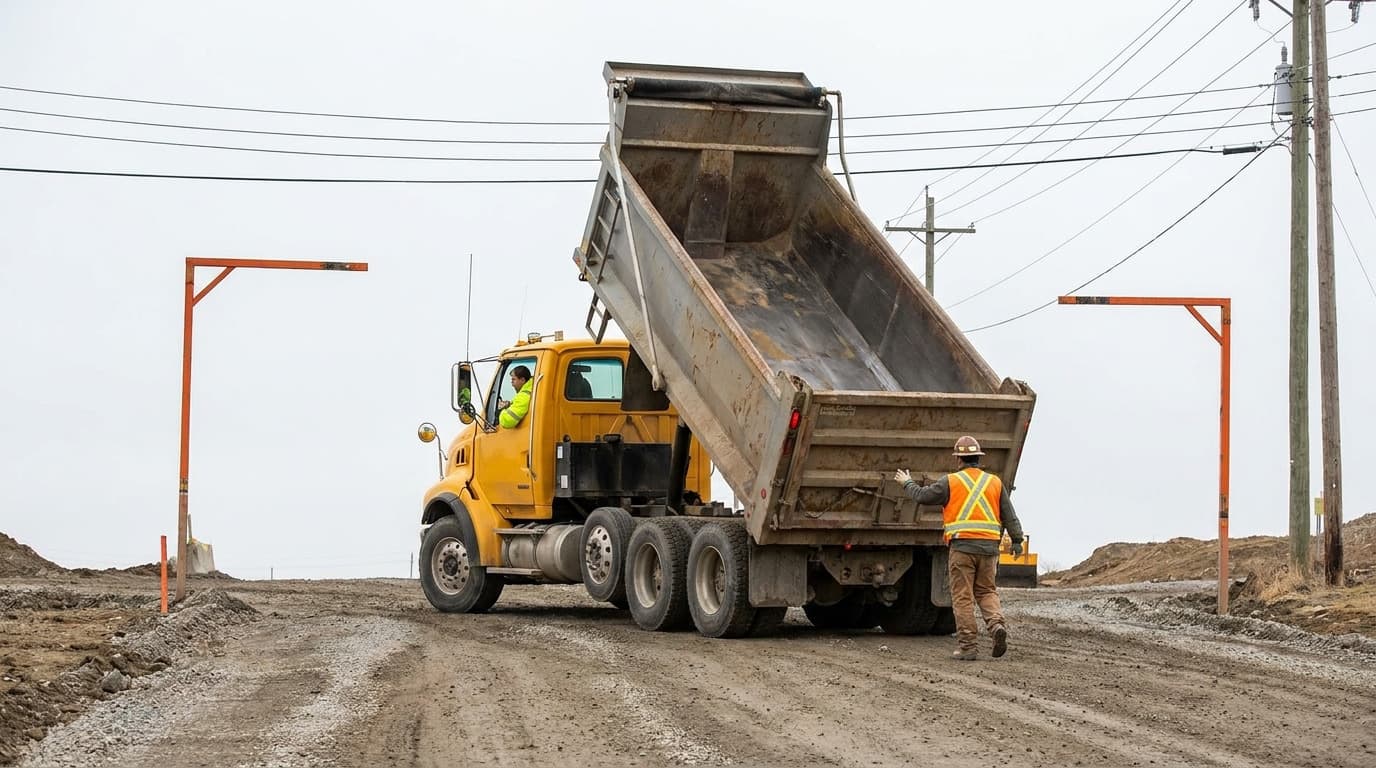
Contact with an overhead line typically occurs when a truck pulls away while the dump bed is still raised. Not while dumping — while leaving. The driver has done the job, the mirrors show the site behind, and the truck drives under a line it passed safely on the way in, because on the way in the body was down.
Two controls follow.
The bed is confirmed down before the truck moves. Not "I think it's down" — a positive check, every time, made a habit rather than a reminder.
The lines get marked so the driver can see them from the cab. NIOSH's guidance is to clearly mark electrical power lines in a construction zone with surface-level signage or goal posts — because a wire overhead is nearly invisible from a driving seat, and a goal post is not.
Under the bed is where the fatalities are#
The other half of the anchor, and OSHA has counted it.
In its Safety and Health Information Bulletin on unintended movement of dump truck body beds, OSHA reviewed its accident data and identified 31 accidents over ten years involving the unanticipated release or movement of an elevated truck bed.
The provisions exist for exactly this. 1926.601(b)(10): "Trucks with dump bodies shall be equipped with positive means of support, permanently attached, and capable of being locked in position to prevent accidental lowering of the body while maintenance or inspection work is being done." And 1926.600(a)(3)(i) requires that dump bodies be fully lowered or blocked when being repaired or when not in use.
Read the wording of (b)(10): positive, permanently attached, capable of being locked. Three separate requirements, and each one rules out something people do.
Why the prop does not save them#
This is the part worth spending time on, because the prop is present in most of these fatalities.
OSHA's bulletin sets out how body props fail in practice.
They are misused. Props are commonly raised upright without having the weight of the bed supported or braced on them — swung into position but never actually loaded. The prop is standing there doing nothing, and it looks exactly like a prop that is working.
They corrode and get damaged. Props are subject to rust and damage, live under the body in the worst possible environment, and are almost never inspected.
They get substituted. OSHA illustrates makeshift props — a wooden block, and a steel I-beam sitting across the truck frame, not attached to either the frame or the body, which can be displaced sideways by any inadvertent movement of the bed. Neither is "permanently attached." Neither is positive.
And they are not adjustable. Manufacturer body props support the dump body at one specific position — so the bed has to be brought to that position, not near it.
The prop is a component with a condition, not a talisman. Check it, use it properly, and isolate the energy as well.
The rest of the truck#
Operating levers — 1926.601(b)(11). Levers controlling hoisting or dumping devices on haulage bodies must have a latch or other device which will prevent accidental starting or tripping of the mechanism. That is the provision that stops somebody's knee raising the bed.
Tailgate trip handles — 1926.601(b)(12). Trip handles for tailgates shall be so arranged that, in dumping, the operator will be in the clear. The whole provision is about where the person is standing when the gate lets go.
Isolation for maintenance. OSHA's guidance on preventing unintended bed movement includes implementing components of a lockout/tagout programme — the hydraulic and control energy has to be dealt with, not just the mechanical support. The lockout/tagout talk owns that procedure.
Reversing and the site. Trucks spend most of their time on a job reversing, and the alarm-versus-observer rule and the horn requirement sit in the heavy equipment talk. What belongs here: the reversing risk does not stop being real because the truck is familiar.
Loading. Nobody in the cab is safe from a loader dropping into the body from height, and nobody should be beside the truck during loading.
Where the duty sits#
The dump-specific provisions are in Subpart O, and there are four worth knowing by number.
1926.601(b)(10) — positive, permanently attached, lockable means of support. 1926.600(a)(3)(i) — dump bodies fully lowered or blocked when repaired or not in use. 1926.601(b)(11) — latch on hoisting and dumping levers. 1926.601(b)(12) — tailgate trip handles arranged so the operator is in the clear.
Around them: 1926.601(b)(4) reverse signal and 1926.602(a)(9) alarms and horns, both covered in the heavy equipment talk; 1926.601(b)(14) shift checks; 1926.21(b)(2), which OSHA's own bulletin cites as requiring instruction in recognising and avoiding these hazards; and Section 5(a)(1) behind them.
What can go wrong?#
Driving away with the bed still raised, into an overhead line.
Tipping on a soft shoulder or a fill edge with the bed up.
Continuing to raise the bed when the load has stuck, especially with clayey or frozen material.
Going under a raised bed to look at a problem, without support or isolation.
Swinging the prop up without letting the bed's weight down onto it.
Using a wooden block or a loose I-beam as a body prop.
Relying on a prop that is rusted or damaged, because nobody inspects it.
Standing in line with the tailgate when it trips.
How do we manage this properly?#
Make "bed down" a positive check before the truck moves, every load, every time — a habit, not a reminder.
Mark overhead lines with goal posts or surface-level signage so a driver can see them from the seat.
Stop raising when a load sticks. Bring the bed down, and clear the material by a method that does not involve a raised body and a person underneath.
Never go under a raised bed without the manufacturer's prop correctly positioned and the energy isolated under lockout/tagout.
Load the prop. Bring the bed down onto it so it is carrying weight — a prop standing free is not a support.
Inspect props as equipment — rust, damage, deformation, the brackets that hold them.
Ban makeshift supports outright, and say why: not permanently attached, not positive, displaced by any movement.
Check the lever latch works before the shift, so the mechanism cannot be tripped accidentally.
Stand clear of the tailgate line during dumping, and confirm nobody is behind the truck.
Assess the ground before tipping — soft shoulders, fill edges, crowned haul roads — and treat high wind as a reason not to raise an empty body.
Before you start#
- Confirm where the overhead lines are and whether they are marked.
- Confirm the ground at the tipping point will take a raised bed.
- Confirm the body prop is present, undamaged and the correct one for this truck.
- Confirm the lever latch is working.
- Confirm the tailgate trip arrangement puts the operator in the clear.
- Confirm nobody will go under the bed without prop and isolation.
- Confirm the bed-down check before moving is understood by every driver today.
- Confirm what happens if a load sticks, and who decides.
Talk it over#
- What is overhead between the tipping point and the site exit?
- Has anyone here seen a bed still up after a truck pulled away?
- If the load sticks halfway out this morning, what do we do?
- Where is the prop on this truck, and when was it last looked at?
The bottom line#
A dump truck is most dangerous when the load has already gone — the bed is still up, the job feels finished, and the two events that kill both happen in that window. First, driving away with the bed raised: contact with an overhead line typically occurs when a truck pulls away while the dump bed is still raised, on a route the truck passed safely inbound with the body down. So confirm the bed is down before the truck moves, and mark power lines with goal posts or surface-level signage, as NIOSH advises, because a wire is nearly invisible from a driving seat. Second, going underneath: OSHA's Safety and Health Information Bulletin on unintended movement of dump truck body beds reviewed its accident data and identified 31 accidents over ten years involving unanticipated release or movement of an elevated truck bed. The provisions are specific. 1926.601(b)(10): "Trucks with dump bodies shall be equipped with positive means of support, permanently attached, and capable of being locked in position to prevent accidental lowering of the body while maintenance or inspection work is being done" — positive, permanently attached, lockable, three requirements each ruling out a common practice. 1926.600(a)(3)(i) requires dump bodies fully lowered or blocked when being repaired or when not in use. And the prop fails in known ways: it is commonly raised upright without the weight of the bed supported or braced on it, it is subject to rust and damage, it gets substituted with a wooden block or a steel I-beam not attached to frame or body that any movement can displace, and manufacturer props are non-adjustable, supporting the body at one position only. The prop is a component with a condition, not a talisman — and OSHA's guidance also calls for lockout/tagout on the hydraulic and control energy. On stability, NIOSH states the truck can become unstable when the bed is raised, made worse by uneven or incomplete material flow, for example clayey or frozen material, and by abnormal conditions such as high winds on a raised empty body. Two more provisions: 1926.601(b)(11) requires a latch or other device on hoisting and dumping levers to prevent accidental tripping, and 1926.601(b)(12) requires tailgate trip handles "so arranged that, in dumping, the operator will be in the clear." Reversing alarms, the observer alternative and the horn rule sit in the heavy equipment talk.
Frequently asked questions about dump trucks#
When is a dump truck most dangerous?
After the load has gone, not during the tip. The bed is still raised, the job feels finished, and attention moves to the next run — and that is the window in which the two fatal events happen: driving away into an overhead line with the bed up, and going underneath a raised bed. Everybody stands clear while material is coming out; almost nobody treats the following minute with the same seriousness.
How do dump trucks contact power lines?
Usually while leaving, not while dumping. Contact typically occurs when a truck pulls away while the dump bed is still raised — on a route the truck travelled safely on the way in, because the body was down then. The controls are a positive bed-down check before the truck moves, and marking the lines so the driver can see them: NIOSH advises clearly marking power lines with surface-level signage or goal posts, since a wire overhead is nearly invisible from the cab.
What does OSHA require for working under a raised bed?
1926.601(b)(10): trucks with dump bodies must have positive means of support, permanently attached, and capable of being locked in position, to prevent accidental lowering of the body while maintenance or inspection work is being done. Separately, 1926.600(a)(3)(i) requires dump bodies to be fully lowered or blocked when being repaired or when not in use. OSHA's guidance also calls for lockout/tagout of the hydraulic and control energy — the mechanical support alone is not the whole control.
Why do body props still fail?
Because of how they are used and kept. OSHA's bulletin describes props commonly raised upright without having the weight of the bed supported or braced on them — in position but carrying nothing, and indistinguishable at a glance from one that is working. Props are also subject to rust and damage and rarely inspected. And they get substituted with makeshift supports: a wooden block, or a steel I-beam laid across the frame, attached to neither frame nor body, which any inadvertent movement can displace.
What makes a raised bed unstable?
Three things at once. The centre of gravity rises — NIOSH states the truck can become unstable when the bed is raised. The load sticks unevenly — NIOSH names uneven or incomplete material flow, for example with clayey or frozen material, which leaves weight high and off-centre. And ground and wind finish it: soft shoulders, fill edges and crowned haul roads give the raised body a lever arm, while abnormal conditions such as high winds act on what is effectively a large sail.
What should we do if a load sticks halfway out?
Stop raising. Continuing to lift is what produces the side-tip, because the remaining material is high and off-centre. Bring the bed down and clear the material by a method that does not put a raised body over a person. Never climb up, reach in, or go underneath to free it. If the material is clayey or frozen, expect this and plan the release method before the truck arrives rather than improvising at the tipping point.
Which OSHA provisions are specific to dump trucks?
Four. 1926.601(b)(10) — positive, permanently attached, lockable means of support. 1926.600(a)(3)(i) — bodies fully lowered or blocked when repaired or not in use. 1926.601(b)(11) — hoisting and dumping levers fitted with a latch or other device which will prevent accidental starting or tripping of the mechanism. 1926.601(b)(12) — tailgate trip handles "so arranged that, in dumping, the operator will be in the clear." Reversing alarms and horns sit at 1926.601(b)(4) and 1926.602(a)(9), covered in the heavy equipment talk.
Download the dump truck toolbox talk PDF#
Get this dump truck safety toolbox talk as a print-ready PDF — available in English, Spanish, Portuguese, and Turkish. Print it, hand it to the crew, and collect signatures on the included attendance sheet.
Download the PDF — free account required. New members get 3 free downloads.
Related toolbox talks#
Sources#
- OSHA, 29 CFR 1926.601 — Motor vehicles: https://www.osha.gov/laws-regs/regulations/standardnumber/1926/1926.601
- OSHA, Safety and Health Information Bulletin: Hazards of Unintended Movement of Dump Truck Body Beds (18 September 2006): https://www.osha.gov/sites/default/files/publications/shib091806.pdf
- NIOSH, Preventing Dump Truck-related Injuries and Deaths During Construction (Publication 2023-137): https://www.cdc.gov/niosh/docs/2023-137/
This talk is general awareness guidance for training purposes. It does not qualify anyone to operate, maintain or work beneath a dump truck body. Working under a raised body requires the manufacturer's positive support correctly positioned and the hydraulic and control energy isolated under a lockout/tagout procedure.