Trailer Hitching
Updated 2026-08-06
In this bundle Vehicle Safety
Print-ready PDF
Download this talk as a print-ready PDF, available in 4 languages.
Most of the vehicle hazards on a jobsite are about a machine under power — a forklift backing, a conveyor running, a truck at a dock. Hitching a trailer is different. There is no engine in the thing you are working on; it just sits there, quiet, while you connect it to a truck. And that is exactly what makes it deceptive, because the whole hazard is not in the trailer or the truck — it is in the connection between them, and a connection can look finished and be wrong. This Trailer Hitching Toolbox Talk (Safety Talk / Tailgate Talk) is about why a trailer coupling is built the way it is, why a bad hitch tows fine right up until it doesn't, and why hitching is something you verify, not just something you do.
Here is the distinction that carries this whole talk: a trailer hitch is the only connection on the jobsite designed on the assumption that it will fail — the coupler, the safety chains, and the breakaway brake are three separate answers to the same question, because a trailer that comes loose is a projectile nobody is steering. Think about what that redundancy is telling you. A trailer does not have one attachment to the truck; it has three, layered on purpose. The coupler is the primary connection. The safety chains exist for when the coupler fails or was never latched. The breakaway brake exists for when the chains fail too. Each layer assumes the one before it did not hold. No other routine connection on the site is built with that many independent backups — because the thing being prevented is a multi-ton trailer breaking loose at speed and going wherever physics sends it, into oncoming traffic, off the road, into people. The redundancy is not overkill. It is a measure of how bad the failure is.
Where the boundary of this talk sits#
The distracted driving and rain-and-fog talks own the driving itself. The securing-loads talk owns the cargo on the trailer. The struck-by talk owns being hit in general. This talk owns the connection — the coupler, the safety chains, the breakaway system, the hitch and vehicle ratings, and the verification that all of it is actually engaged. Where the question is how the loaded trailer is secured or driven, that is those talks; this one owns the moment of joining trailer to truck and confirming it will hold.
The failure is silent until it's catastrophic#
This is why hitching gets people. Every part of a bad hitch looks connected. A coupler resting on the ball but not latched sits down over it and looks seated. Safety chains that are attached but hanging straight down, dragging on the road instead of crossed under the tongue, look hooked up. A breakaway cable clipped to the same point the coupler is mounted to looks ready. All of these will tow fine down the yard, out the gate, and for miles down the road — and then let go on a bump, a turn, or a hard stop, with no warning at all. You cannot tell a good hitch from a bad one by watching it tow, because they look identical until the moment they don't. That is the entire reason hitching is a verification task: you confirm each layer is truly engaged before you move, because the road will not tell you in time.
Layer one: the coupler, actually latched#
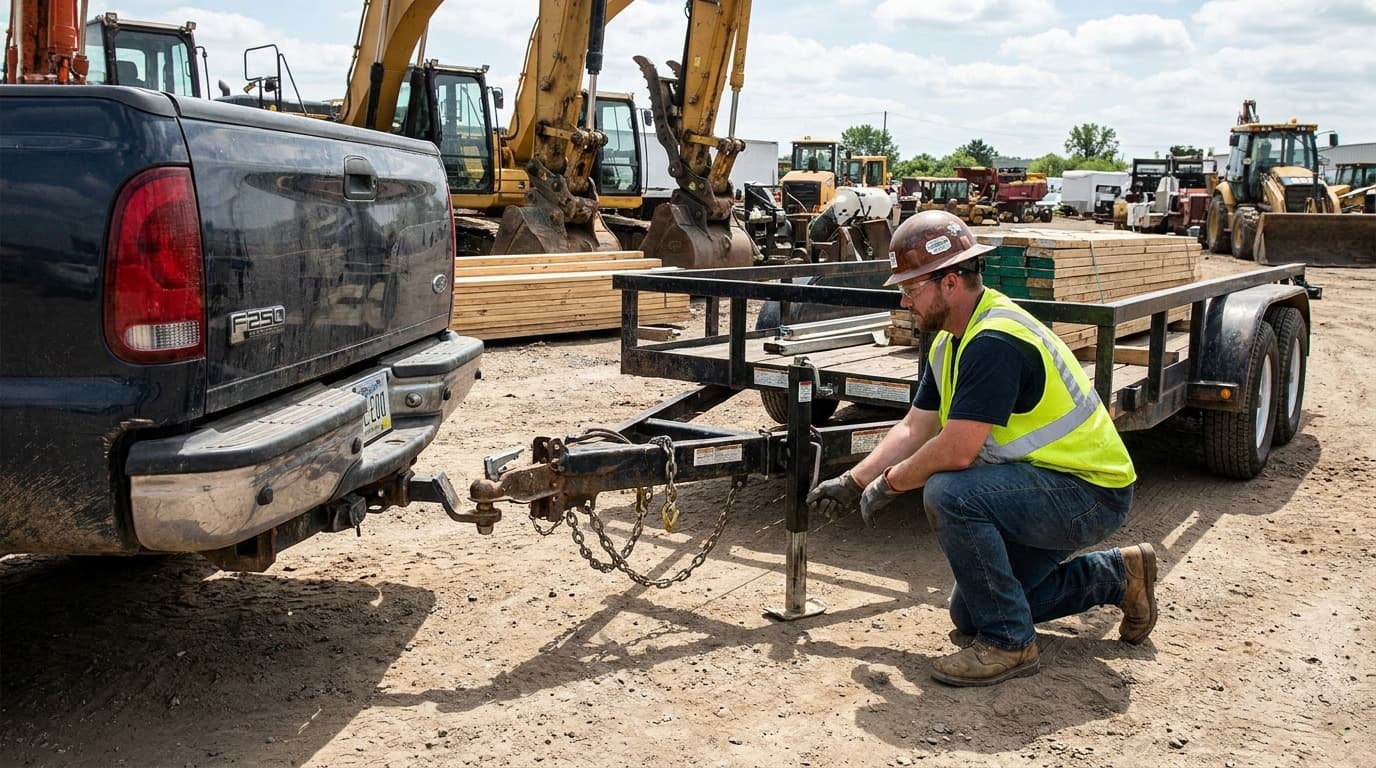
The coupler is the primary connection, and the single most common failure is simple — it is set down on the ball but the latch never closed and locked. So the verification is physical, not visual. The coupler must be fully seated on a ball of the correct size (a coupler sized for a larger ball will sit on a smaller one and look fine, then jump off), the latch closed, and the locking device engaged — a pin or lock through the latch so it cannot bounce open. The federal rule requires the coupling to have a locking device that prevents accidental separation of the towed and towing vehicles; your job is to confirm it is actually doing that. The standard test is to raise the trailer tongue with the jack after latching — if the truck's rear rises with it, the coupler is holding; if the coupler lifts off the ball, it was never latched. Do that test every time, before the chains go on.
Layer two: safety chains, crossed to cradle the tongue#
The safety chains are the backup for a coupler that fails or opens, and how they are attached is not decorative. They must be crossed underneath the trailer tongue and then attached to the towing vehicle — not run straight, not left dangling. Crossed chains form a cradle under the coupler, so if the coupler comes off the ball, the tongue drops into the X of the chains instead of onto the pavement where it would dig in and flip the trailer. The chains attach to the frame of the towing vehicle at separate points, not to the ball mount or the same fitting the coupler uses — because a backup attached to the thing that just failed is not a backup. They are rated to hold the loaded trailer, connected with enough slack to turn but not enough to drag, and the hooks are latched or safetied so they cannot bounce off. Straight, dragging, or single-point chains are the most common way the second layer is quietly defeated.
Layer three: the breakaway brake#
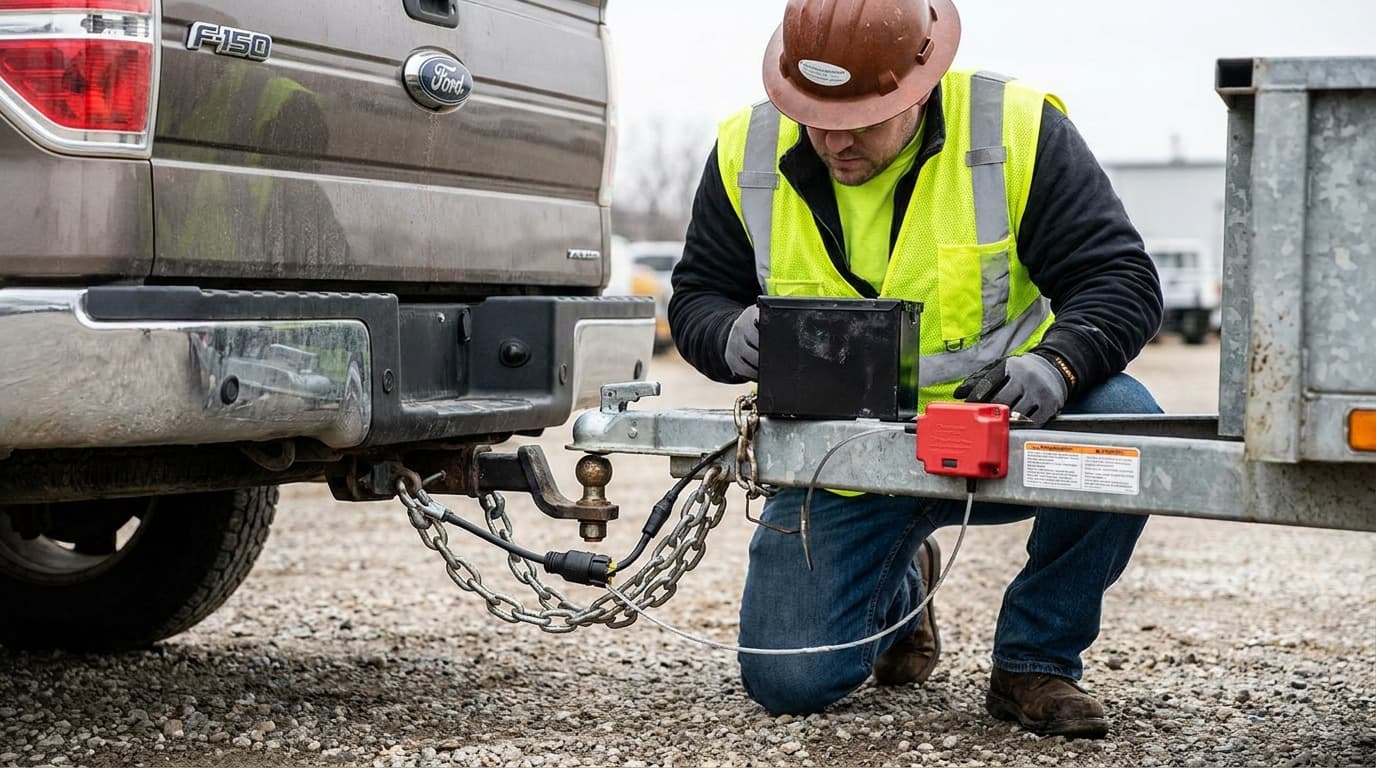
On a braked trailer, the breakaway system is the last layer — a battery-powered unit on the trailer connected to the tow vehicle by a thin cable and pin. If the trailer separates completely, the cable pulls the pin and the trailer's own brakes lock on, stopping the runaway instead of letting it roll free. Two things defeat it. First, a dead breakaway battery — the unit does nothing if it has no charge, so it gets checked, not assumed. Second, and critically, the breakaway cable must attach to an independent point on the tow vehicle, never to the hitch ball, the coupler, or the same assembly that would be gone in a real breakaway. A breakaway cable clipped to the part that just broke away goes with it and never pulls the pin. The federal standard requires that a towing vehicle be able to stop if the trailer breaks away; the breakaway system is how a trailer holds up its end of that.
Ratings, and who is responsible#
A hitch is only as strong as its weakest rated part, and the numbers have to line up. The trailer's loaded weight must be within the hitch's rating, the ball's rating, the receiver's rating, and the tow vehicle's Gross Combined Weight Rating (GCWR) — the manufacturer's maximum for truck plus trailer plus everything in both. The lowest-rated component sets the real limit, so a heavy-duty hitch on a light truck does not raise the truck's limit. And on the road, the responsibility is clear: the party towing the trailer is responsible for it being in compliance, not the trailer's manufacturer. Know the ratings before you couple, not after something bends.
Where the duty sits#
Trailer towing on public roads is primarily Department of Transportation / FMCSA territory, not OSHA — the connection standards live in 49 CFR Part 393. 393.70 requires the coupling to have a locking device preventing accidental separation, and requires safety devices (safety chains or cables) to keep the trailer from breaking loose if the coupling fails. 393.43 requires breakaway and emergency braking so the towing vehicle can still stop if the trailer breaks away. 393.42 requires brakes on trailers above the weight threshold and makes the motor carrier — the party towing — responsible for compliance. On the jobsite, OSHA governs through the General Duty Clause, Section 5(a)(1) and 1926.601, which requires motor vehicles to be maintained and their brakes operable, with 1926.21(b)(2) training behind it. So the rule of thumb is simple: DOT governs the trailer on the road, OSHA governs it on the site, and both point at the same connection. Where a hitch or trailer manufacturer sets a specific rating or procedure, that governs.
What can go wrong?#
- The coupler is set on the ball but the latch never closed, and it jumps off on a bump.
- The coupler is sized for a bigger ball, sits on the smaller one, and separates in a turn.
- Safety chains run straight or drag instead of crossing under the tongue to cradle it.
- Chains are attached to the ball mount — the same part that fails — instead of the frame.
- The breakaway cable is clipped to the hitch and goes with the trailer in a breakaway.
- The breakaway battery is dead, so the trailer's brakes never lock on when it separates.
- The loaded trailer exceeds the hitch, ball, receiver, or vehicle rating and overwhelms the connection.
- The hitch is never load-tested with the jack, so a bad latch is discovered on the road.
How do we manage this properly?#
- Treat hitching as a verification task — confirm each layer is engaged, don't assume it.
- Seat the coupler on the correct-size ball, close the latch, engage the locking pin.
- Jack-test the connection — raise the tongue; if the truck rises, it's latched.
- Cross the safety chains under the tongue and attach to the frame, not the ball mount.
- Rate the chains for the loaded trailer; enough slack to turn, not enough to drag.
- Attach the breakaway cable to an independent point, never the hitch or coupler.
- Check the breakaway battery has charge — the last layer is useless dead.
- Confirm the loaded weight is within the lowest of hitch, ball, receiver, and GCWR ratings.
Before you start#
- Confirm the ball size matches the coupler and both are rated for the load.
- Confirm the coupler latch is closed and the locking pin or lock is engaged.
- Confirm the jack-test was done and the connection held.
- Confirm the safety chains are crossed under the tongue and framed-mounted.
- Confirm the breakaway cable is on an independent point and the battery has charge.
- Confirm trailer lights and brakes are connected and working.
- Confirm the loaded weight is within every rating in the chain.
- On the road, confirm DOT/FMCSA requirements; on site, confirm 1926.601 vehicle condition.
Talk it over#
- What's the jack-test, and does everyone here do it before every tow?
- Why do the safety chains cross under the tongue instead of running straight?
- Where does the breakaway cable clip — and why never to the hitch?
- What's the lowest rating in your setup, and do you know the loaded trailer weight?
The bottom line#
A trailer hitch is the only connection on the jobsite designed on the assumption that it will fail — the coupler, the safety chains, and the breakaway brake are three separate answers to the same question, because a trailer that comes loose is a projectile nobody is steering. The three layers are built in on purpose, each assuming the one before it did not hold, which is a measure of how bad the failure is. And the failure is silent until it's catastrophic: a coupler resting-but-not-latched, chains hanging straight instead of crossed, a breakaway cable on the wrong point — all tow fine for miles and let go without warning, which is why hitching is a verification task. Confirm each layer: the coupler seated on the right-size ball with the latch and locking pin engaged and jack-tested; the safety chains crossed under the tongue to cradle it and framed to a separate point; the breakaway cable on an independent point with a charged battery; and the loaded trailer within the lowest of the hitch, ball, receiver, and vehicle GCWR ratings. The duty is split by where you are — 49 CFR 393 (393.70 coupling and safety devices, 393.43 breakaway braking, 393.42 brakes) on the road, 5(a)(1) and 1926.601 on the site — but both point at the same connection. The test for any hitch is one question: if the coupler let go right now, what are the next two things that would stop the trailer — and did you check both of them?
Frequently asked questions about trailer hitching#
Why do safety chains have to cross under the tongue?
Because crossed chains form a cradle. If the coupler comes off the ball, the trailer tongue drops — and if the chains are crossed under it, the tongue lands in the X of the chains instead of hitting the pavement. A tongue that digs into the road can catch and flip the trailer; caught in the crossed chains, it stays off the ground and the trailer stays behind the truck long enough to stop. Chains that run straight or hang down do not form that cradle, so even though they are "attached," they do not do the job the second layer exists to do.
What is the jack-test and why do it every time?
It is the one reliable way to confirm the coupler actually latched, because a coupler resting on the ball looks identical to one locked onto it. After you close and pin the latch, use the trailer jack to raise the tongue. If the rear of the tow vehicle rises with it, the coupler is gripping the ball and the connection is good. If the coupler lifts up off the ball, it was never latched — and you just found out in the yard instead of on the highway. It takes seconds and it catches the most common and most dangerous hitching failure.
Where should the breakaway cable attach?
To an independent, solid point on the tow vehicle — never to the hitch ball, the coupler, or the ball mount. The whole purpose of the breakaway system is to work when the trailer separates from the hitch, so if the cable is clipped to the hitch, it separates too and never pulls the pin that applies the trailer's brakes. Attach it to a dedicated hole in the receiver or a frame point, with enough slack to turn but short enough to pull the pin before the trailer is fully gone. And confirm the breakaway battery has charge, because a dead battery makes the whole last layer do nothing.
What ratings do I need to check before towing?
Four, and the lowest one wins. The hitch (receiver) rating, the ball rating, the ball mount rating, and the tow vehicle's Gross Combined Weight Rating — the maximum combined weight of truck, trailer, and everything loaded in both. The loaded trailer must be within all of them, and the weakest component sets the real limit, so putting a heavy-duty hitch on a light truck does not let you tow more. Know the loaded trailer weight and compare it to the lowest rating in the chain before you couple, not after a part bends or the truck can't stop.
Is trailer hitching an OSHA or a DOT rule?
Both, depending on where the trailer is. On public roads, trailer coupling, safety chains, and breakaway braking are Department of Transportation / FMCSA requirements under 49 CFR Part 393, and the party towing is responsible for compliance. On the jobsite, OSHA governs through the General Duty Clause and the motor-vehicle standard 1926.601, which requires vehicles to be maintained with operable brakes. They are not in conflict — they point at the same connection from two directions. Follow the manufacturer's ratings and procedures for the specific hitch and trailer, which sit under both.
Can't I just skip the chains for a short move across the yard?
No. Short, slow moves are where people skip the layers, and they are exactly where a coupler that was never latched lets go — except now nothing catches it. The whole point of the redundancy is that you do not get to choose which failure happens or when, so the backups go on every time, including the two-minute move across the yard. A trailer breaking loose at five miles an hour in a yard full of people is still a multi-ton object nobody is steering. Hitch it completely or do not move it.
Download the trailer hitching toolbox talk PDF#
Get this trailer hitching toolbox talk as a print-ready PDF — available in English, Spanish, Portuguese, and Turkish. Print it, hand it to the crew, and collect signatures on the included attendance sheet.
Download the PDF — free account required. New members get 3 free downloads.
Related toolbox talks#
Sources#
- Electronic Code of Federal Regulations, 49 CFR 393.70 — Coupling devices and towing methods (locking device preventing accidental separation; safety chains/cables to prevent breaking loose): https://www.ecfr.gov/current/title-49/subtitle-B/chapter-III/subchapter-B/part-393/subpart-F/section-393.70
- Electronic Code of Federal Regulations, 49 CFR 393.43 — Breakaway and emergency braking (towing-vehicle protection so it can stop if the trailer breaks away): https://www.ecfr.gov/current/title-49/subtitle-B/chapter-III/subchapter-B/part-393/subpart-C/section-393.43
- OSHA, Motor Vehicles — 1926.601 (motor vehicles maintained in safe operating condition; brakes operable — the worksite duty): https://www.osha.gov/laws-regs/regulations/standardnumber/1926/1926.601
This talk is general awareness guidance for training purposes. It does not replace your employer's vehicle or towing program, the DOT/FMCSA motor-carrier safety regulations, the OSHA motor-vehicle standard, the OSH Act General Duty Clause, the hitch or trailer manufacturer's ratings and instructions, or a competent person's duties, and it is not legal advice. Where a manufacturer's rating or a DOT requirement sets a stricter limit, that limit governs.
Written by FieldSafetyTalk's safety professional — a CSP, ASP, CHST and OSHA Authorized Outreach Trainer with 14+ years of international construction safety experience across federal, heavy civil, and industrial projects.