Flammable Storage Safety for Construction
Updated 2026-08-06
In this bundle Fire, Hot Work & Emergency
Print-ready PDF
Download this talk as a print-ready PDF, available in 4 languages.
Almost everyone who works around flammable liquids pictures the hazard wrong, and the mistake is a natural one: they picture the liquid itself catching fire. But in a flammable-liquid fire, what actually ignites and carries the flame is the vapor above the liquid — mixed with air in the flammable range — not the body of the liquid. That single fact is the key to everything a storage standard requires. The vapor is invisible, and many flammable-liquid vapors are heavier than air, so they can sink and creep along the floor and travel — sometimes a surprising distance — until they reach an ignition source you cannot see from where you are standing. If the vapor-air mixture there is within its flammable range, it ignites and the flame can propagate back through the vapor to the container. Once you understand that the vapor is the fire, every rule about how flammable liquids are stored stops looking like a list of arbitrary numbers and starts looking like what it is: a coordinated effort to control vapor. This flammable storage safety for construction talk is built around that shift in understanding.
Here is the distinction that carries this whole talk: what burns in a flammable-liquid fire was never the liquid — it's the vapor above it, invisible, often heavier than air, pooling along the floor and spreading to an ignition source you can't see; so every rule in the standard is really one rule seen three ways — limit how much flammable liquid is stored in one place, keep it in closed containers so vapor stays put, and keep any vapor away from anything that can light it — and the cabinet itself doesn't make the liquid safe or stop a fire: it's a protective layer, not a fireproof safe. Sit with what that reframes. The gallon limits are not bureaucratic caps on how much you can own; they control how much flammable liquid is concentrated in one place, and so the fire load if containers fail. The cabinet is not a fireproof safe that makes the contents harmless; it is an enclosure that adds containment and fire protection, and in a fire slows the heat getting to what's inside. The bonding wire, the ventilation, the "no ignition sources" rule — all of it exists because vapor plus a spark is the whole hazard. Get the vapor idea, and the standard teaches itself.
Where the boundary of this talk sits#
Flammable storage touches several other talks, and this one owns the storage of the liquids themselves. The fire prevention talk owns the broad picture of ignition sources, fire classes, and housekeeping across the whole site. The hot work permit talk owns the specific, high-risk activity of cutting and welding near anything flammable. The static electricity talk owns the physics of static generation and discharge in detail. This talk owns flammable-liquid storage: why the vapor is the hazard, how quantity limits control the amount of vapor, what a storage cabinet actually does and doesn't do, why bonding and grounding matter when you transfer liquid, and how safety cans and proper containers keep vapor in. Where the focus is ignition sources in general, a welding permit, or static theory, those talks own the detail; this one owns the drum, the can, and the cabinet — how the liquid is kept, and why the way it's kept is entirely about keeping its vapor controlled.
Vapor is the hazard — and flash point tells you how easily it forms#
If the vapor is what burns, then the property that matters most about any flammable liquid is how readily it gives off vapor, and that is exactly what flash point measures: the lowest temperature at which a liquid produces enough vapor to form an ignitable mixture at its surface. The lower the flash point, the more easily the liquid makes vapor at ordinary temperatures, and the more dangerous it is to store and handle. OSHA and NFPA 30 sort liquids into categories by flash point and boiling point — Category 1 ignites most readily, with a flash point below 73.4°F, and the categories climb from there — and that category number is what drives the storage rules that follow. This is why classification is the first step: you cannot know how to store a liquid until you know how eagerly it makes vapor. A liquid with a very low flash point is giving off ignitable vapor at room temperature, right now, every moment its container is open, which is why the discipline around keeping containers closed is not fussiness — an open container is a vapor source, and a closed one is not.
Rule seen one way: limit how much liquid is open#
The first face of the single rule is quantity, and once you see vapor as the hazard, the gallon limits make immediate sense: they control how much flammable liquid is concentrated in a storage location, which limits the potential fire load and hazard if a container fails or a fire starts nearby. On a construction site, 1926.152(b) draws the lines clearly: no more than 25 gallons of flammable liquids may be stored in a room outside an approved storage cabinet, and any quantity beyond that 25 gallons must go into an approved cabinet. A single approved cabinet may hold no more than 60 gallons of Category 1, 2, or 3 flammable liquids, or 120 gallons of Category 4 — and no more than three such cabinets may be located in a single storage area, with anything beyond that moving to an inside storage room built for the purpose. Out in the work area, only the amount actually needed for the task should be present; the bulk belongs in the cabinet or storage room, not sitting open on a bench. None of these numbers is arbitrary. Each one is a limit on how much vapor-producing liquid is concentrated in one place, so that if the worst happens, the fire has a bounded amount of fuel and the people nearby have a bounded problem rather than an unbounded one.
Rule seen a second way: keep the vapor contained — and what the cabinet really does#
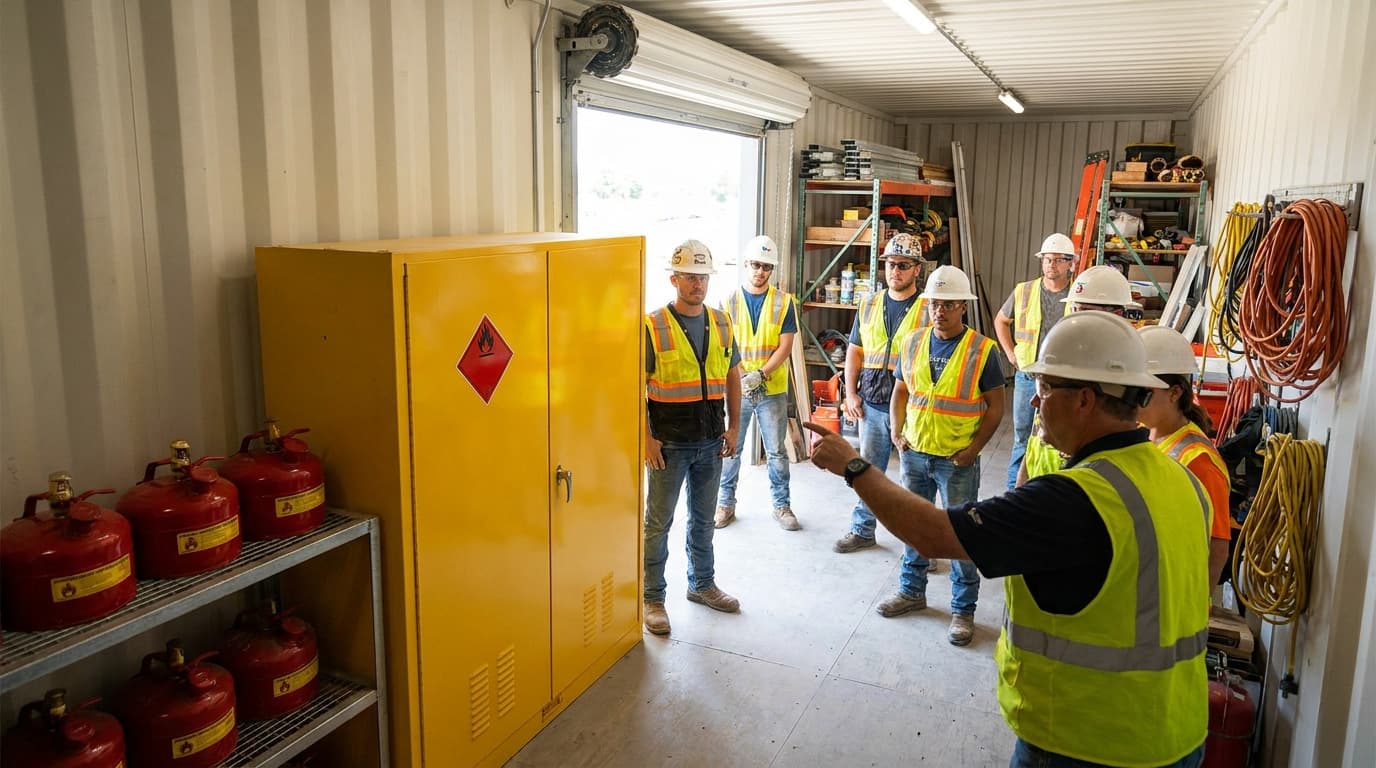
The second face of the rule is containment, and this is where the most important misunderstanding on any jobsite lives. People treat a flammable storage cabinet as a fireproof safe — as though putting liquids inside it makes them safe. It does not. What the cabinet does is two things. During normal storage, the vapor is held in mainly by keeping liquids in approved, closed containers; the closed cabinet adds a layer of secondary containment for spills and clearly labels the hazard — "Flammable — Keep Fire Away." And where a metal cabinet is used, its listing is built around limiting the internal temperature during a standard fire test — a test condition, not a promise that the cabinet is fireproof or that you have a set number of minutes to get out. What it means in practice is that the cabinet slows the heat reaching the containers, delaying the point at which they rupture and feed the fire. It is a protective layer, not a fireproof safe. Understanding this changes how you treat a cabinet: you keep its door closed and latched (an open cabinet gives you neither containment nor fire protection), you don't overfill it past its rated quantity, you don't defeat the self-closing mechanism, and you never treat "it's in the cabinet" as license to relax about ignition sources nearby.
Rule seen a third way: keep the vapor away from ignition — including the spark you make yourself#
The third face is ignition control, and it includes an ignition source many people never think of: themselves. Keeping vapor away from open flames, hot work, smoking, and electrical arcs is the obvious part. The less obvious part is static electricity. When you pour a flammable liquid from one container to another, the flow of liquid generates a static charge, and if that charge builds and then discharges as a spark across the vapor at the container mouth — exactly where the ignitable vapor is most concentrated — it can ignite with no open flame anywhere in sight. This is why 1926.152(e)(2) requires that the transfer of Category 1, 2, or 3 flammable liquids from one container to another be done only when the containers are electrically interconnected — bonded. Bonding equalizes the charge between the two containers so no spark can jump between them; a common practice is to also ground the setup so any accumulated charge drains safely to earth, though the construction standard's explicit requirement is the bond. It is a wire and a clamp, it takes seconds, and it prevents an ignition source that has killed people who were doing everything else right. The standard adds two more controls worth knowing: for transfers of more than 5 gallons at one time, 1926.152(e)(1) requires the transfer area to be separated from other operations and ventilated to keep vapor at or below 10% of the lower flammable limit; and at the point of final use, 1926.152(f)(3) allows Category 1, 2, or 3 liquids to be used only where there are no open flames or other ignition sources within 50 feet, unless conditions require greater clearance. Control every ignition source, including the static spark your own pouring creates.
Safety cans and proper containers: keeping the vapor in#
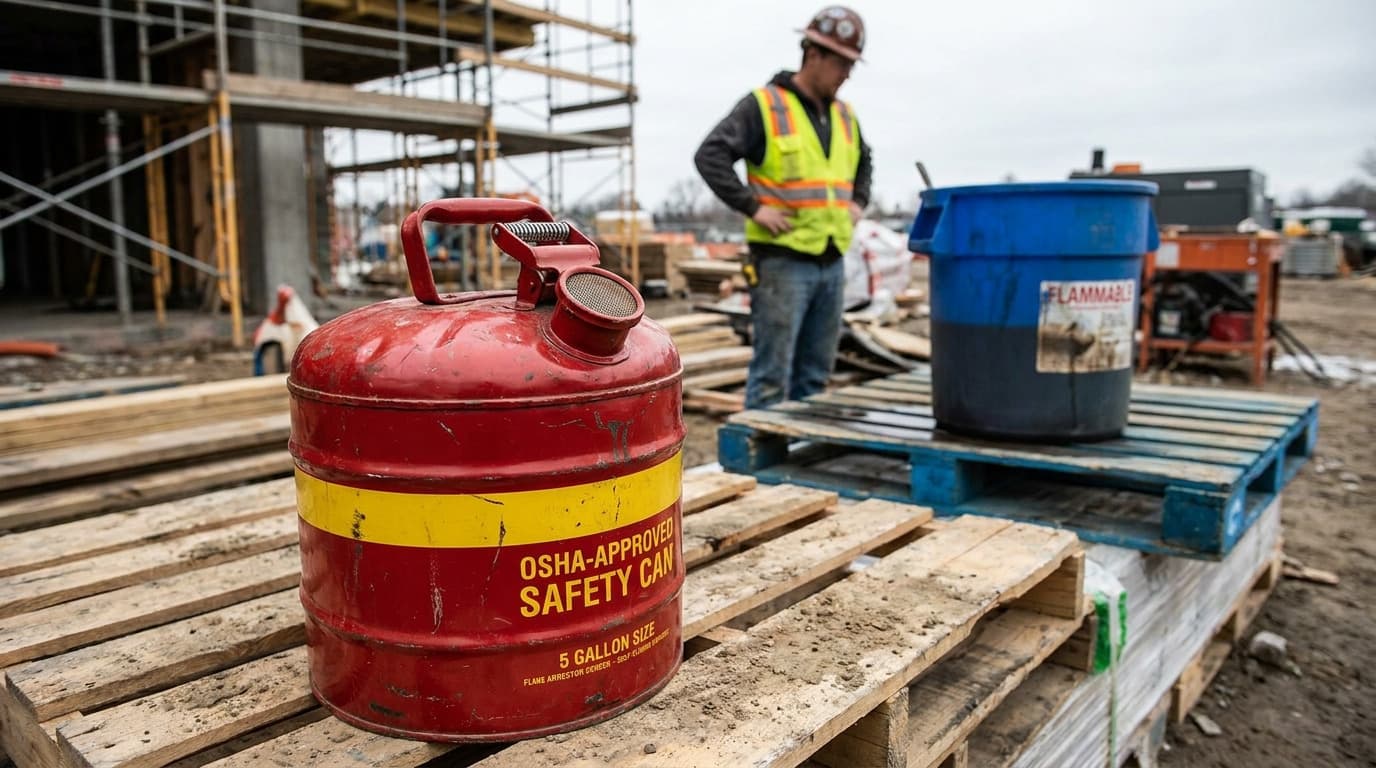
The container is where all three faces of the rule meet, which is why the standard is specific about them. A safety can is an approved container of no more than 5 gallons with a spring-closing lid and spout cover, designed to safely relieve internal pressure when exposed to fire — and for construction, OSHA's definition at 1926.155(l) adds that it must also have a flash-arresting (flame-arresting) screen. Each of those features earns its place: the self-closing lid means the can is only open while you're actively pouring, so vapor doesn't escape the rest of the time; the flame-arrester screen stops a flashback from traveling into the can and turning it into a bomb; and the pressure-relief design lets it vent gradually in a fire instead of bursting. A standard gas can or an open bucket has none of this, which is why using one for workplace flammable storage is both dangerous and a citable violation (only NRTL-listed, approved cans meet the requirement). And remember 1926.152(f)(1): keep Category 1, 2, or 3 flammable liquids in closed containers when not actually in use. The same logic covers container size limits and the rule that flammable liquids stay in approved, closed containers. When you see a safety can, understand that you are looking at a purpose-built vapor-control device, and treat the small disciplines — closing it, keeping it upright, not leaving it open "just for a minute" — as what they are: keeping the vapor where it belongs.
Where the duty sits#
On construction sites, flammable-liquid storage is governed by 1926.152 — Flammable liquids, in Subpart F (Fire Protection and Prevention). General requirements at 1926.152(a) require approved containers and portable tanks: approved safety cans or DOT-approved containers for handling flammable liquids in quantities of 5 gallons or less, and for quantities of one gallon or less the original container may be used. Indoor storage is at 1926.152(b): no more than 25 gallons may be stored in a room outside an approved cabinet (b)(1); quantities in excess of 25 gallons must be in an approved cabinet (b)(2) — an acceptable wooden cabinet built of exterior-grade plywood at least 1 inch thick with rabbeted, screw-fastened joints, or an approved metal cabinet; no more than 60 gallons of Category 1, 2, or 3 liquids (120 gallons of Category 4) per cabinet, and no more than three cabinets in a single storage area (b)(3), with excess going to an inside storage room (b)(4) built to the required fire-resistive rating (fire-test specifications per NFPA 251), with one clear aisle at least 3 feet wide and no containers over 30 gallons stacked on one another. Outside storage is at (c), and fire control at (d) — at least one portable fire extinguisher rated not less than 20-B located outside of, but not more than 10 feet from, the door of any room storing more than 60 gallons. Alongside OSHA, NFPA 30 (Flammable and Combustible Liquids Code) carries far more detail on room construction and maximum allowable quantities and is frequently stricter, and your local fire code and the Authority Having Jurisdiction may be stricter still; the safe practice is to design to the strictest of the three. Hazard communication for the liquids runs through 1926.59 (which adopts 1910.1200). Where NFPA 30, a local code, or your employer's program sets a stricter requirement, that requirement governs.
What can go wrong?#
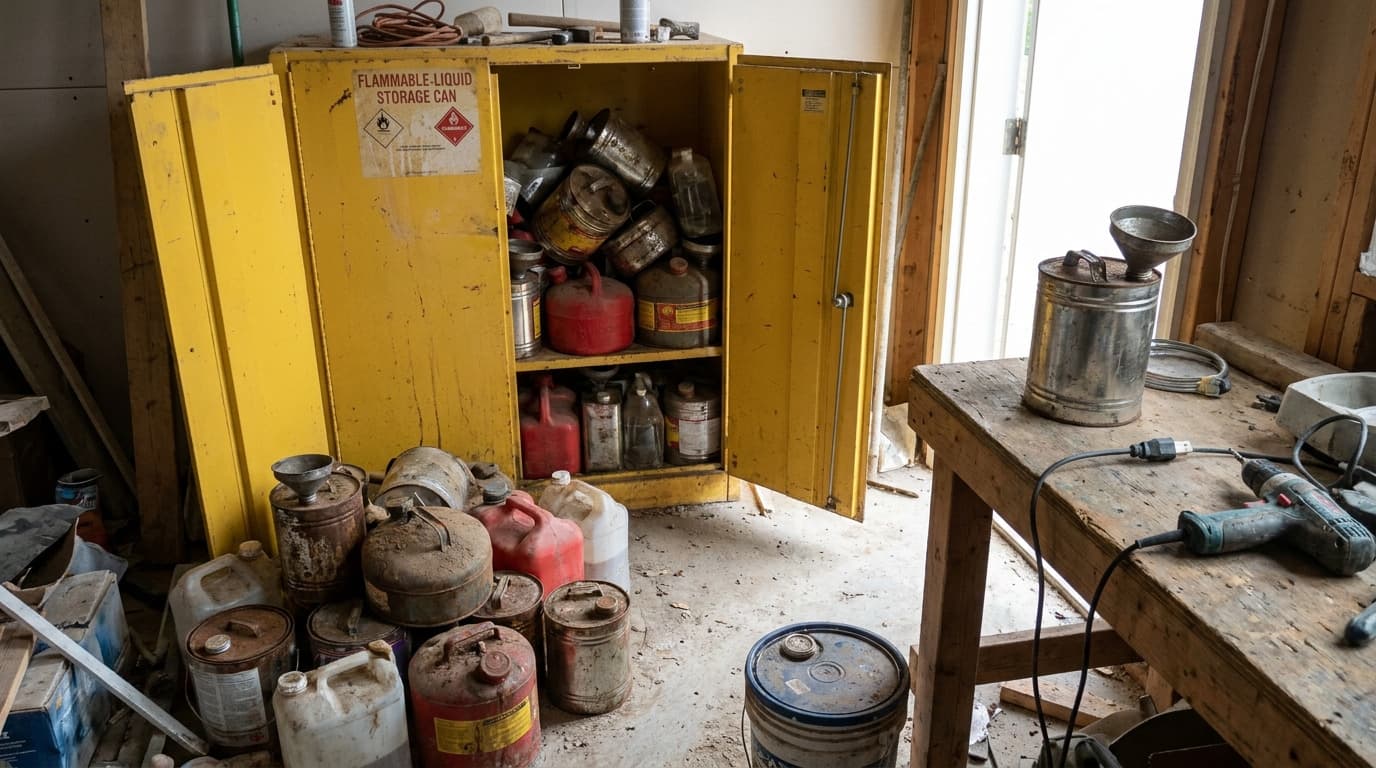
- A worker treats a storage cabinet as a fireproof safe and stacks ignition sources right next to it.
- A cabinet is left open or its self-closing door is defeated, so it provides neither containment nor fire protection.
- Liquid is poured between metal containers with no bonding or grounding, and a static spark ignites the vapor.
- Flammable liquid is kept in an ordinary gas can or open bucket instead of an approved safety can.
- Far more than the task needs is left open in the work area, filling the space with vapor.
- A cabinet is overfilled past its rated quantity, or too many cabinets share one fire area.
- Containers are left open "just for a minute," and vapor accumulates near a hidden ignition source.
- Poor ventilation lets vapor build to an ignitable concentration low along the floor.
How do we manage this properly?#
- Remember the vapor is the fire — everything you do is about controlling vapor.
- Limit quantity — only what the task needs in the work area; the rest in cabinets or a storage room.
- Keep the cabinet closed and latched, not overfilled — it only protects you if it's shut.
- Treat the cabinet as a protective layer, not a fireproof safe — never relax about ignition sources because "it's in the cabinet."
- Bond and ground containers before transferring liquid — a wire and a clamp stop the static spark.
- Use approved safety cans — self-closing lid, flame arrester, pressure relief — not gas cans or buckets.
- Keep containers closed whenever you're not actively pouring — an open container is a vapor source.
- Ensure ventilation so vapor can't build to an ignitable concentration, and control all ignition sources.
Before you start#
- Confirm you know the flash-point category of each liquid you're storing or handling.
- Confirm only the quantity needed for the task is in the work area.
- Confirm cabinets are closed, latched, within rated quantity, and properly labeled.
- Confirm bonding and grounding equipment is on hand for any liquid transfer.
- Confirm liquids are in approved safety cans or containers, not gas cans or open vessels.
- Confirm the area is ventilated and free of ignition sources near where vapor could travel.
- Confirm SDSs for the stored liquids are available to workers in the area.
- Confirm you know where the nearest fire extinguisher is and that it's rated for flammable liquids.
Talk it over#
- If someone dropped a match into a puddle of our solvent, what would actually catch — the liquid, or the vapor around it?
- Do we treat our flammable cabinet like a fireproof safe, or do we remember it's only a protective layer — and that its ten-minute fire-test rating is a test condition, not an escape clock?
- When we pour between containers, do we bond and ground every time — or only when we remember?
- Is there more open flammable liquid in our work area right now than the job actually needs?
The bottom line#
What burns in a flammable-liquid fire was never the liquid — it's the vapor above it, invisible, often heavier than air, pooling along the floor and spreading to an ignition source you can't see; so every rule in the standard is really one rule seen three ways — limit how much flammable liquid is stored in one place, keep it in closed containers so vapor stays put, and keep any vapor away from anything that can light it — and the cabinet itself doesn't make the liquid safe or stop a fire: it's a protective layer, not a fireproof safe. Flash point tells you how eagerly a liquid makes vapor, which is why classification comes first. The quantity limits cap how much vapor-producing liquid is concentrated in one place. The cabinet adds containment and fire protection — its fire-test rating is a test condition, not an evacuation clock — so it's a protective layer, not a fireproof safe: keep it closed, latched, and not overfilled. And ignition control means every source, including the static spark your own pouring makes, which is why bonding a transfer — required by 1926.152(e)(2) — is a wire, a clamp, and a life. On a construction site it all rests on 1926.152, with the 25-gallon room limit and cabinet rule at (b)(1)–(b)(2), the 60-gallon-per-cabinet and three-cabinet cap at (b)(3), inside storage rooms at (b)(4), transfer bonding at (e)(2), keeping liquids closed when not in use at (f)(1), and the 20-B extinguisher within 10 feet at (d) — with NFPA 30 and your local fire code often stricter. The question to carry is not "is the liquid put away?" It is: where is the vapor right now, how much of it is there, and is there anything nearby that could light it?
Frequently asked questions about flammable storage safety#
Why do you say the vapor burns and not the liquid?
Because that's the physical reality of how flammable liquids ignite, and understanding it changes how you handle them. A flammable liquid continuously gives off vapor at its surface, and it is that vapor — mixed with air in the right proportion — that actually ignites and burns, not the body of the liquid itself. A higher-flash-point liquid at room temperature isn't producing enough vapor at its surface to form an ignitable mixture, so it's much harder to ignite. But a low-flash-point liquid like gasoline is giving off plenty of ignitable vapor at ordinary room temperature, so its vapor ignites readily. Many flammable-liquid vapors are heavier than air, so they sink and spread along the floor, flowing into low spots and traveling to ignition sources some distance from the container — though vapor density varies by product, so check the SDS. When it reaches a spark or flame, it ignites, and the flame travels back through the vapor to the source. Every storage rule — quantity limits, closed containers, cabinets, ventilation, ignition control — exists to manage that vapor. Once you picture the hazard as an invisible vapor that can travel and pool low rather than a puddle of liquid, the whole standard makes intuitive sense.
Does a flammable storage cabinet make the liquids inside safe?
No, and this is one of the most important and most common misunderstandings in the workplace. A flammable storage cabinet is not a fireproof safe that renders its contents harmless. It does two specific things, both related to vapor and time. During normal storage, vapor is held in mainly by the approved closed containers; the cabinet adds secondary containment and clearly labels the hazard inside. In a fire, a listed metal cabinet is built to limit its internal temperature to no more than 325°F during a ten-minute standard fire test — meaning it slows the heat reaching the containers, delaying the point at which they would rupture and feed the fire. Here's the key point most people get wrong: that ten-minute figure is the duration of the specified fire test, not a guaranteed real-world evacuation period or a promise the cabinet is fireproof. It is a protective layer, not a fireproof safe. This is why the cabinet only works if you use it correctly: keep the door closed and latched, because an open cabinet gives neither containment nor fire protection; don't overfill it beyond its rated quantity; don't defeat the self-closing door; and never let "it's in the cabinet" become a reason to be careless about ignition sources nearby. The cabinet is a valuable layer of protection, but only when treated as the protective enclosure it actually is — not a fireproof safe.
Why do I have to bond and ground containers when I transfer liquid?
Because pouring flammable liquid from one container to another generates static electricity, and a static spark is a fully capable ignition source — one that needs no flame, no hot surface, and no obvious cause. As the liquid flows, it builds up an electrical charge. If that charge accumulates and then jumps as a spark between the two containers — right at the pour point, where the ignitable vapor is most concentrated — it can ignite the vapor and cause a fire or explosion with nothing else around that looks dangerous. Bonding means connecting the two containers with a conductive wire so they are at the same electrical potential and no spark can jump between them. Grounding means connecting to earth so any accumulated charge drains away safely. On a construction site OSHA requires this directly at 1926.152(e)(2): the transfer of Category 1, 2, or 3 flammable liquids from one container to another must be done only when the containers are electrically interconnected (bonded). It is one of the highest-value, lowest-effort safety steps there is: a bonding wire and a clamp, a few seconds to attach, and you've eliminated an ignition source that has caused documented fatalities among workers who were otherwise careful. The reason it feels unnecessary is exactly why it's dangerous — the spark is invisible until it ignites the vapor, so people skip the step because nothing appears to be wrong.
What makes a safety can different from a regular gas can?
For construction, OSHA defines a safety can at 1926.155(l) as an approved container of no more than 5 gallons with a spring-closing lid and spout cover, a flash-arresting (flame-arresting) screen, and a design that safely relieves internal pressure when exposed to fire. Each feature earns its place. The spring-loaded, self-closing lid seals automatically the moment you release it — so the can is only open while you're actively pouring, and vapor can't escape the rest of the time. The flame-arrester screen is a fine mesh that lets liquid and vapor pass but stops a flame from traveling back through the spout into the can, preventing a flashback from igniting the contents. And the pressure-relief design lets it vent gradually if the can is heated in a fire, instead of bursting violently. A regular gas can has none of these, which is why using one — or an open container — for workplace flammable liquid storage is both genuinely dangerous and a citable violation. When you use an approved safety can properly — closing it, keeping it upright, not leaving it open — you're using a purpose-built container the way it was designed to be used.
How much flammable liquid can we keep, and why are there limits?
The limits exist because quantity is directly tied to how much ignitable vapor can be produced and how big a fire's fuel supply would be, so capping quantity caps the hazard. On a construction site, OSHA's standard at 1926.152(b) is specific: no more than 25 gallons of flammable liquids may be stored in a room outside an approved cabinet, and anything above that must go into an approved cabinet. A single cabinet may hold no more than 60 gallons of Category 1, 2, or 3 flammable liquids, or 120 gallons of Category 4, and no more than three such cabinets may be located in a single storage area — with anything beyond that moving into a purpose-built inside storage room with fire-resistive construction and ventilation. Out in the actual work area, the guiding principle is that only the amount needed for the current task should be present, with the bulk kept in the cabinet or storage room. It's worth knowing that NFPA 30 and adopted fire/building codes may set additional or more detailed limits — including maximum allowable quantities per fire area — so meeting OSHA alone doesn't guarantee full compliance. The practical takeaway is to keep working quantities small, store the rest properly, and remember that open or improperly closed containers can release vapor into the work area.
Where does static, ventilation, and ignition control fit into storage?
They're the third face of the single rule — keeping vapor away from anything that can ignite it — and they matter even when everything is stored correctly, because vapor can still be present during handling and from small leaks or openings. Ventilation is the first line: provide the ventilation required for the storage room or operation so vapor can't accumulate to an ignitable concentration, and because many flammable vapors are heavier than air and collect low, that ventilation should draw from near the floor where the vapor actually gathers (an inside storage room requires an exhaust system giving at least six air changes per hour). Ignition control means eliminating or separating every possible source of ignition from areas where vapor could be present: open flames, smoking, hot work like cutting and welding, and electrical equipment that could arc. Static electricity is the ignition source people most often forget, which is why bonding and grounding during transfers is so important. Together these measures recognize that even well-stored flammable liquids involve some vapor during normal handling, so the environment around the storage has to be kept free of the things that could light that vapor. Storage safety isn't only about the container and the cabinet; it's also about the space around them being ventilated and free of ignition sources.
Download the flammable storage safety toolbox talk PDF#
Get this flammable storage safety toolbox talk as a print-ready PDF — available in English, Spanish, Portuguese, and Turkish. Print it, hand it to the crew, and collect signatures on the included attendance sheet.
Download the PDF — free account required. New members get 3 free downloads.
Related toolbox talks#
Sources#
- OSHA, Flammable liquids — 29 CFR 1926.152 (construction standard in Subpart F, Fire Protection and Prevention; indoor storage at (b) — no more than 25 gallons outside an approved cabinet (b)(1), quantities over 25 gallons in an approved cabinet (b)(2), no more than 60 gallons Category 1-3 or 120 gallons Category 4 per cabinet and no more than three cabinets per storage area (b)(3), inside storage rooms (b)(4); fire control at (d) — a 20-B extinguisher within 10 feet of any room storing more than 60 gallons): https://www.osha.gov/laws-regs/regulations/standardnumber/1926/1926.152
- OSHA, Flammable liquids — 29 CFR 1926.152 (construction standard in Subpart F; approved safety cans/DOT containers ≤5 gal and storage cabinets at (a)–(b); 25-gallon room limit, 60-gal-per-cabinet and three-cabinet cap at (b); dispensing and container-to-container bonding at (e)(2), >5-gallon transfer separation/ventilation at (e)(1); closed containers when not in use at (f)(1) and 50-foot ignition-source clearance at (f)(3); 20-B extinguisher within 10 feet at (d)) — safety-can definition with flame-arrester screen at 1926.155(l): https://www.osha.gov/laws-regs/regulations/standardnumber/1926/1926.152
- NFPA 30, Flammable and Combustible Liquids Code, and OSHA hazard communication for construction at 29 CFR 1926.59 (which adopts 1910.1200) (NFPA 30 and adopted fire/building codes may add more detailed room-construction and maximum-allowable-quantity requirements; flash-point categories drive storage rules; check the SDS for flash point, vapor density, and fire/handling hazards of the stored liquids): https://www.osha.gov/flammable-liquids
This talk is general awareness guidance for training purposes. It does not replace your employer's flammable liquid program, OSHA 1926.152, NFPA 30, your local fire code, the Authority Having Jurisdiction, or the safety data sheets for the liquids you store, and it is not legal advice. Where NFPA 30, a local code, or your employer's program sets a stricter requirement, that requirement governs.