Right to Know & Your OSHA Rights
Updated 2026-08-06
In this bundle Jobsite Fundamentals & Compliance
Print-ready PDF
Download this talk as a print-ready PDF, available in 4 languages.
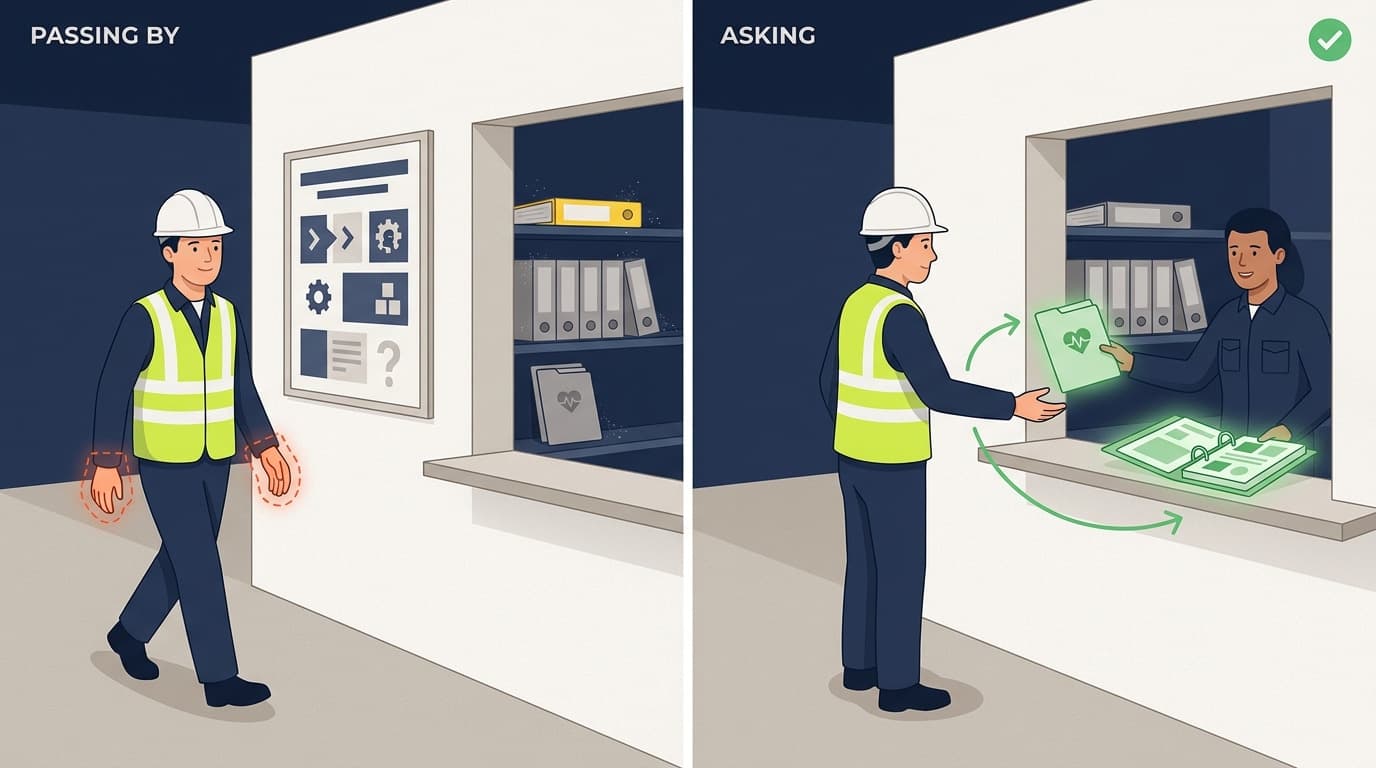
Every jobsite has the poster on the wall — the one that lists your rights as a worker under OSHA. Most people walk past it a thousand times and never read it, and even the ones who do rarely act on it. That is the quiet problem this talk is about. You have a real, legally enforceable set of rights to information about the hazards you work around and the exposures your body takes on — the right to know. But those rights have a catch that almost nobody explains: most of them are yours only if you use them, and using them means knowing to ask. The poster announces the rights. It does not hand them to you. This Right to Know & Your OSHA Rights Toolbox Talk (Safety Talk / Tailgate Talk) is about closing the gap between having a right and actually using it.
Here is the distinction that carries this whole talk: your OSHA rights to information are real and legally enforceable — but almost all of them are pull, not push: the hazard information, the safety data sheets, and your own exposure and medical records all exist and the employer must give them to you, but mostly only when you ask, so the poster on the wall announces rights it doesn't actually deliver, and a right you don't know how to use protects you exactly as much as one you don't have. Think about what "pull, not push" means in practice. The safety data sheet for the chemical you used today exists, and your employer has to make it available — but it sits in a binder or a system you have to go to. Your exposure record, showing how much of a toxic substance the monitoring found in your air, exists and must be kept for thirty years — but you only see it if you request it. The written hazard communication program exists — but you have to ask for it. None of this is automatic. The law builds the rights and requires the employer to honor them, but for most of them the trigger is a worker who knows the right exists and knows to reach for it. That is why this talk matters: the rights are only as strong as your willingness to use them.
Where the boundary of this talk sits#
Your rights as a worker connect to several other talks, and this one owns the information rights and how to use them. The hazard communication talk owns the mechanics of labels, safety data sheets, and the chemical program itself. The incident reporting talk owns the duty to report injuries and the protection around reporting. The stop-work talk owns the right to stop unsafe work before someone is hurt. This talk owns the worker's rights to information and the protection around exercising them: the right to know the hazards you face, the right to see the records that document your exposure, and the right to raise a concern or file a complaint without being punished for it — and the fact that most of these are yours only when you ask. Where the focus is the chemical program, the injury report, or the work stoppage, those talks own the detail; this one owns knowing what you are entitled to and how to actually claim it.
The right to know the hazard before it reaches you#
The oldest piece of "right to know" is exactly that phrase: the Hazard Communication Standard, which gives every worker the right to know what hazardous chemicals they work with and how to protect themselves. It works through three things you should know how to use. Labels on containers tell you the hazard at a glance, in a standardized format with signal words, pictograms, and precautions. Safety data sheets — the SDS — give the full picture for each chemical: its hazards, the protective equipment you need, first aid, spill response, and more, in a standardized sixteen-section format. And training tells you how to read both and how to work safely. The right to know means the employer must have a written hazard communication program, must keep the safety data sheets available to you, and must make that written program available on request. But notice the pattern again: the SDS is available, the program is available — available meaning you can get to it, not that it is handed to you. Knowing that you can pull up the SDS for anything you are working with, and actually doing it when something is unfamiliar, is the difference between the right existing and the right protecting you.
The right to the records that document your exposure#
The second layer is less well known and, over a career, may matter even more: the right to your own exposure and medical records. When your employer monitors the air for a toxic substance, or a doctor examines you because of a workplace exposure, those results are records — and you have a substantive right to see and copy them, not just a summary. In construction this right comes through the access standard, whose requirements are identical to the general-industry records rule. The details are worth carrying: exposure records must be kept for thirty years, because occupational diseases can take decades to appear, and medical records must be kept for the duration of employment plus thirty years. When you request access, the employer generally must provide it within fifteen working days. Your designated representative — including a union or an attorney — can obtain exposure records on your behalf, and the employer cannot refuse by claiming the exposures were within acceptable limits or citing confidentiality. This is a powerful right precisely because it outlives the job: the exposure you cannot feel today may be the record that explains an illness thirty years from now, and that record only helps you if you know it exists and know you can get it.

The right to speak up without being punished#
The third right is the one that makes the other two usable: you can raise a safety concern, ask for these records, or file a complaint with OSHA, and it is illegal for your employer to retaliate against you for doing so. This anti-retaliation protection is long-standing law, and it covers the whole range of adverse actions — not just firing, but demotion, discipline, or anything that would punish you for exercising your rights. But there are two practical things everyone should know, because they trip people up. First, if you file a retaliation complaint with OSHA, there is a deadline — generally thirty days from the retaliatory act — and missing it can cost you the claim, so acting promptly matters. Second, filing a complaint is not the same as staying anonymous. You can ask OSHA to keep your name confidential from your employer, and OSHA will honor that in how it handles the complaint — but if an inspection happens and the circumstances make it obvious who raised the issue, or if the process requires your participation, your identity may effectively become known. Knowing that up front lets you make an informed choice rather than a surprised one. The protection is real and worth relying on; it is just not a cloak of invisibility.
Where the duty sits#
The right to know about chemical hazards is the Hazard Communication Standard, 1910.1200, which requires labels, safety data sheets, a written program, and training, and makes the written program and SDSs available to employees and their designated representatives on request. The right to your exposure and medical records is the Access to Employee Exposure and Medical Records standard at 1910.1020; for construction, 1926.33 applies the identical requirements. Exposure records are kept thirty years and medical records for the duration of employment plus thirty years, and access is generally provided within fifteen working days of a request. OSHA's July 16, 2018 interpretation confirms that posting the Federal Labor Laws poster does not by itself satisfy the 1910.1020 duty to inform employees of the existence and availability of their records — the poster announces, but the specific notification duty remains. The right to raise concerns and file complaints free from retaliation comes from Section 11(c) of the OSH Act, with a complaint deadline generally of thirty days. General training and information duties run through 1926.21(b)(2), and the General Duty Clause, Section 5(a)(1) underlies it all. Where your employer's program or a specific standard sets a more protective requirement, that requirement governs.
What can go wrong?#
- A worker uses a chemical for months without ever reading its safety data sheet.
- Someone needs the SDS in an emergency and doesn't know where or how to find it.
- A worker never requests their exposure records, and a decades-later illness has no documentation.
- A worker assumes the poster on the wall is all the notification they get, and never asks for their records.
- Someone stays silent about a hazard because they wrongly believe reporting isn't protected.
- A worker files a retaliation complaint after the thirty-day window and loses the claim.
- Someone assumes a complaint is fully anonymous, and is caught off guard when their identity becomes known.
- A right that would have protected a worker goes unused because nobody knew it existed.
How do we manage this properly?#
- Know that your information rights are pull, not push — most are yours only when you ask.
- Know how to find and read the SDS for anything you work with — and actually do it when it's unfamiliar.
- Know you can request your exposure and medical records — kept 30 years — and how to ask.
- Remember records access is generally provided within fifteen working days of your request.
- Know that raising a concern or filing a complaint is protected from retaliation.
- If retaliation happens, act within the thirty-day deadline to file with OSHA.
- Understand a complaint can be kept confidential but is not guaranteed anonymous if an inspection follows.
- Treat the poster as an announcement, not the delivery — the rights require you to use them.
Before you start#
- Confirm everyone knows where the safety data sheets and written hazard program are kept.
- Confirm everyone can find the SDS for the chemicals in today's work.
- Confirm the crew knows they can request their own exposure and medical records.
- Confirm everyone understands raising a safety concern is protected from retaliation.
- Confirm the crew knows the thirty-day deadline for a retaliation complaint.
- Confirm everyone understands a complaint can be confidential but not guaranteed anonymous.
- Confirm who to go to on this site to exercise any of these rights.
- Confirm the crew treats the poster as a starting point, not the whole picture.
Talk it over#
- Does everyone here actually know where to find the SDS for what we're using today?
- Has anyone ever requested their own exposure or medical records — and does everyone know they can?
- Do we all understand that raising a safety concern is protected, and what the deadline is if we're punished for it?
- What's one right on that poster that you've never actually used — and would you know how to?
The bottom line#
Your OSHA rights to information are real and legally enforceable — but almost all of them are pull, not push: the hazard information, the safety data sheets, and your own exposure and medical records all exist and the employer must give them to you, but mostly only when you ask, so the poster on the wall announces rights it doesn't actually deliver, and a right you don't know how to use protects you exactly as much as one you don't have. The rights come in layers: the right to know the hazard before it reaches you, through HazCom 1910.1200 — labels, safety data sheets, training; the right to the records that document your exposure, through 1910.1020 and, in construction, 1926.33 — exposure records kept thirty years, provided within fifteen working days of a request; and the right to speak up free from retaliation under Section 11(c), with a thirty-day complaint deadline and the honest caveat that confidential is not the same as anonymous. OSHA's 2018 interpretation confirms the poster announces but does not by itself deliver the records notification. The question to carry is not "do I have rights?" — you do. It is: do I know how to use them — because a right I never reach for protects me exactly as much as one I never had.
Frequently asked questions about right to know and your OSHA rights#
What does "right to know" actually mean?
"Right to know" is the everyday name for the Hazard Communication Standard, which gives every worker the right to know what hazardous chemicals they work with and how to protect themselves from them. It is built on three things: labels on containers that show the hazard in a standardized format with signal words and pictograms; safety data sheets — the SDS — that give the full details for each chemical in a standardized sixteen-section format, covering hazards, protective equipment, first aid, and spill response; and training that teaches you how to read both. Your employer must have a written hazard communication program, keep the safety data sheets available to you, and make the written program available on request. The important thing to understand is that "available" means you can get to it, not that it is delivered to you automatically. The right protects you only when you use it — when you actually pull up the SDS for something unfamiliar rather than assuming it is fine. Knowing how to find and read that SDS is the whole point of the right.
Can I really see my own exposure and medical records?
Yes, and it is one of the most valuable rights you have, precisely because it outlives the job. When your employer monitors the air for a toxic substance, or a doctor examines you because of a workplace exposure, those are records, and you have a substantive right to see and copy them — the actual records, not just a summary. In construction, this comes through the access standard, whose requirements are identical to the general-industry records rule. Exposure records must be kept for thirty years, because occupational diseases can take decades to show up, and medical records for as long as you are employed plus thirty years. When you request access, the employer generally has to provide it within fifteen working days, and a designated representative such as a union or attorney can request exposure records on your behalf. The employer cannot refuse by claiming the exposures were within acceptable limits or by citing confidentiality. The catch, as with the rest of these rights, is that you have to ask — the record sits in a file until you request it.
Why does it matter that the records are kept for thirty years?
Because many occupational diseases do not appear until decades after the exposure that caused them, and by then the only proof of what you were exposed to may be that record. Someone who breathed a toxic substance in their twenties might not develop the related illness until their fifties or sixties, long after they have left that employer. If the exposure monitoring from back then still exists — and the law requires it to be kept for thirty years for exactly this reason — it can document what happened and support a medical diagnosis or a claim. Medical records tied to workplace exposure are kept even longer: the duration of employment plus thirty years. This is why requesting and keeping copies of your own records over a career can matter enormously: the exposure you cannot feel today is invisible now, but the record makes it visible later. A right that reaches thirty years into the future only helps you if you know it exists and act on it while the records are still being kept.
Isn't posting the OSHA rights poster enough notification?
Not by itself, and this is a point OSHA has clarified directly. Posting the Federal Labor Laws poster — the "Job Safety and Health: It's the Law" poster — is required and useful, but OSHA's July 2018 interpretation confirms that the poster alone does not satisfy the separate duty under the records-access standard to inform employees of the existence, location, and availability of their exposure and medical records and who is responsible for them. Much of the records information cannot even be posted, because it involves personal privacy. So the poster announces the general rights, but it does not deliver the specific notification the records standard requires, and it certainly does not hand you the records themselves. This is the clearest illustration of the whole talk's point: the poster is an announcement, not a delivery. Treating it as the beginning of your rights rather than the whole of them — and knowing there is more you can ask for — is exactly the mindset that turns a right on paper into protection in practice.
Am I protected if I report a safety problem or ask for these records?
Yes. It is illegal for your employer to retaliate against you for exercising your safety and health rights — raising a concern, requesting your records, or filing a complaint with OSHA. This protection comes from Section 11(c) of the OSH Act and covers the full range of adverse actions, not just firing but demotion, discipline, cut hours, or anything meant to punish you for using your rights. Two practical points matter. First, if you believe you have been retaliated against and want to file a complaint with OSHA, there is a deadline — generally thirty days from the retaliatory act — and missing it can cost you the claim, so act promptly. Second, protected does not automatically mean anonymous. You can ask OSHA to keep your identity confidential, and it will honor that in how it handles things, but if an inspection results and the situation makes it obvious who raised the concern, your identity may effectively become known. The protection is real and worth relying on — it is just important to go in understanding both the deadline and the difference between confidential and anonymous.
How do I actually use these rights on a day-to-day basis?
Start by treating the rights as things you reach for, not things that come to you. Know where the safety data sheets and the written hazard communication program are kept on your site, and make a habit of actually reading the SDS when you are working with something unfamiliar, rather than assuming it is fine. Know that you can request your own exposure and medical records, know roughly how — a request to your employer, generally answered within fifteen working days — and consider keeping your own copies over the years. Know that raising a safety concern is protected, that a formal retaliation complaint has a thirty-day deadline, and that confidential is not the same as anonymous. And find out, on your specific site, who you go to for each of these — the safety staff, the supervisor, the records custodian. None of this requires you to be a lawyer; it just requires you to know the rights exist and to reach for them when you need them. That single shift — from walking past the poster to knowing what is behind it — is what turns these rights from words on a wall into real protection.
Download the right to know & your OSHA rights toolbox talk PDF#
Get this right-to-know and OSHA rights toolbox talk as a print-ready PDF — available in English, Spanish, Portuguese, and Turkish. Print it, hand it to the crew, and collect signatures on the included attendance sheet.
Download the PDF — free account required. New members get 3 free downloads.
Related toolbox talks#
Sources#
- OSHA, Hazard Communication — 29 CFR 1910.1200 (the right to know: labels, safety data sheets, written program, and training; the written program and SDSs made available to employees and their designated representatives on request): https://www.osha.gov/laws-regs/regulations/standardnumber/1910/1910.1200
- OSHA, Access to Employee Exposure and Medical Records — 29 CFR 1910.1020 and Construction — 29 CFR 1926.33 (substantive right of access to exposure and medical records; exposure records kept 30 years, medical records employment plus 30 years; access generally within 15 working days; 1926.33 requirements identical to 1910.1020): https://www.osha.gov/laws-regs/regulations/standardnumber/1910/1910.1020
- OSHA, Standard interpretation — Access to records and the Federal Labor Laws poster (Jul 16, 2018) (posting the Federal Labor Laws poster does not by itself satisfy the 1910.1020(g)(1) duty to inform employees of the existence, location, and availability of their exposure and medical records): https://www.osha.gov/laws-regs/standardinterpretations/2018-07-16
This talk is general awareness guidance for training purposes. It does not replace your employer's hazard communication program, OSHA's Hazard Communication or records-access standards, Section 11(c) of the OSH Act, or your safety staff's guidance, and it is not legal advice. Deadlines and procedures can vary; where a specific standard or your employer's program sets a more protective requirement, that requirement governs.
Written by FieldSafetyTalk's safety professional — a CSP, ASP, CHST and OSHA Authorized Outreach Trainer with 14+ years of international construction safety experience across federal, heavy civil, and industrial projects.