Hand Injuries
Updated 2026-07-24
In this bundle Manual Handling & Body Mechanics
Print-ready PDF
Download this talk as a print-ready PDF, available in 4 languages.
Somebody handed you a pair of gloves this morning and told you they were cut-resistant. That phrase, on its own, tells you almost nothing. Cut resistance is measured on a scale that runs from 200 grams to over 6,000 grams — a thirtyfold range — and every glove across the whole of it can legitimately be sold as "cut-resistant." Whether the pair in your pocket is right for what you are about to touch depends on a number, and most people on most sites have never looked for it. This Hand Injuries Toolbox Talk (Safety Talk / Tailgate Talk) is about reading that number.
Here is the distinction that carries this whole talk: with most PPE, the choice is binary — you are either wearing the hard hat or you are not. Gloves are graded, and they are graded against several different hazards that have nothing to do with each other. The right glove for a sheet metal edge is the wrong glove for rebar ties, and both are the wrong glove near a rotating shaft, where the correct answer may be no glove at all.
The number on the glove#
ANSI/ISEA 105-2016 is the American standard for hand protection classification. Its cut scale has nine levels, A1 through A9, and each one is a measured force in grams — the load required for a blade to cut through the material.
| Level | Grams to cut |
|---|---|
| A1 | 200 – 499 |
| A2 | 500 – 999 |
| A3 | 1,000 – 1,499 |
| A4 | 1,500 – 2,199 |
| A5 | 2,200 – 2,999 |
| A6 | 3,000 – 3,999 |
| A7 | 4,000 – 4,999 |
| A8 | 5,000 – 5,999 |
| A9 | 6,000 and above |
The test method is ASTM F2992-15, run on a TDM-100 tomodynamometer: a straight blade travels in a straight line under load across the glove material, with a new blade for every cut, sampled repeatedly at different loads. That last detail matters — the old test methods allowed blade dulling to flatter the result. The current method does not.
Three things follow that are worth saying out loud on site.
"Cut-resistant" without a level is a marketing phrase, not a specification. An A1 glove and an A9 glove are both cut-resistant. One stops a blade at 200 grams of load and the other at over 6,000.
Old and new ratings are not interchangeable. The 2016 revision replaced the previous scale with the A1–A9 system and changed the test method. A glove marked under the older standard does not correspond to the same-numbered level today. If your store has old stock, or you buy from more than one supplier, that mismatch is sitting in the box right now.
ANSI/ISEA 105 is a voluntary consensus standard, not a regulation. Nobody is required to comply with it. It is simply the accepted basis on which hand protection is specified in the United States, which means the number on the glove is only useful if somebody chose it deliberately.
What OSHA actually requires#
There is no dedicated hand protection standard in the construction rules the way there is in general industry. What applies is broader:
- 1926.95(a) requires protective equipment for the extremities to be provided, used and maintained in a sanitary and reliable condition wherever it is necessary by reason of hazards capable of causing injury or impairment through absorption, inhalation, or physical contact.
- 1926.28(a) makes the employer responsible for requiring the wearing of appropriate PPE in all operations where there is exposure to hazardous conditions.
- General industry 1910.138 is the useful reference for how to choose, and its logic transfers: employers must select hand protection based on an evaluation of the performance characteristics relative to the task, the conditions present, the duration of use, and the hazards identified. It names the hazards it has in mind — skin absorption of harmful substances, severe cuts or lacerations, severe abrasions, punctures, chemical burns, thermal burns, and harmful temperature extremes.
- The General Duty Clause, Section 5(a)(1), backs all of it where a recognised hazard has a feasible control.
Note what 1910.138(b) is really saying: the duty is not "issue gloves." It is match the glove to the task. A box of one glove type for the whole site does not satisfy that logic no matter how good that glove is.
Cut is not puncture is not abrasion#
This is the mistake that puts people in hospital wearing the right gloves.
Under ANSI/ISEA 105, cut resistance, puncture resistance, and abrasion resistance are separate properties, tested separately and rated separately. A glove can score highly on one and poorly on another. High cut resistance often comes from fibres that resist a slicing blade — and a slicing blade is not what a rebar tie end, a wire, a splinter, or a nail does. Those are puncture hazards, and they defeat a cut-rated glove by going between the fibres rather than through them.
So the question is never "do I have cut gloves." It is what does this task actually do to a hand:
- Slicing edge — sheet metal, glass, banding, blades, cut steel → cut rating
- Point — rebar ties, wire, nails, splinters, swarf → puncture rating
- Grinding contact — concrete, block, rough timber, abrasive wheels → abrasion rating
- Chemical — solvents, admixtures, fuels, epoxies → chemical permeation data, not a cut level
- Heat — hot work, hot pipe, exhausts → thermal rating
- Impact — struck fingers, pinch, dropped material → back-of-hand impact protection
They are different gloves, and one pair rarely covers two of these well.
Higher is not safer#
This is counterintuitive enough that it needs saying directly. Buying the highest cut level available is often the wrong decision.
High-level cut protection generally means a thicker, stiffer glove with less dexterity and less feel. Three things follow:
- Workers take them off. A glove that makes the task impossible gets removed for "just this bit" — which is exactly the bit with the hazard.
- Dexterity loss causes its own injuries. Fumbling a component, over-gripping a tool, or losing fine control puts the hand into the hazard it was protected against.
- Grip force goes up. Stiffer gloves require more squeeze to hold the same object, which feeds directly into the repetitive strain problems the rest of this bundle covers.
The correct choice is the lowest level that covers the actual hazard while remaining wearable for the whole task. A glove that stays on at A3 beats a glove in a pocket at A6.
The glove that causes the injury#
Some tasks are safer with no glove at all. Around rotating machinery — drill presses, lathes, bench grinders, augers, rotating shafts — a glove can be caught and drag the hand in, turning a minor contact into an amputation. This is a genuine reversal of the usual rule, and it needs to be stated explicitly rather than left to judgement: check the machine's requirements before assuming gloves are protective.
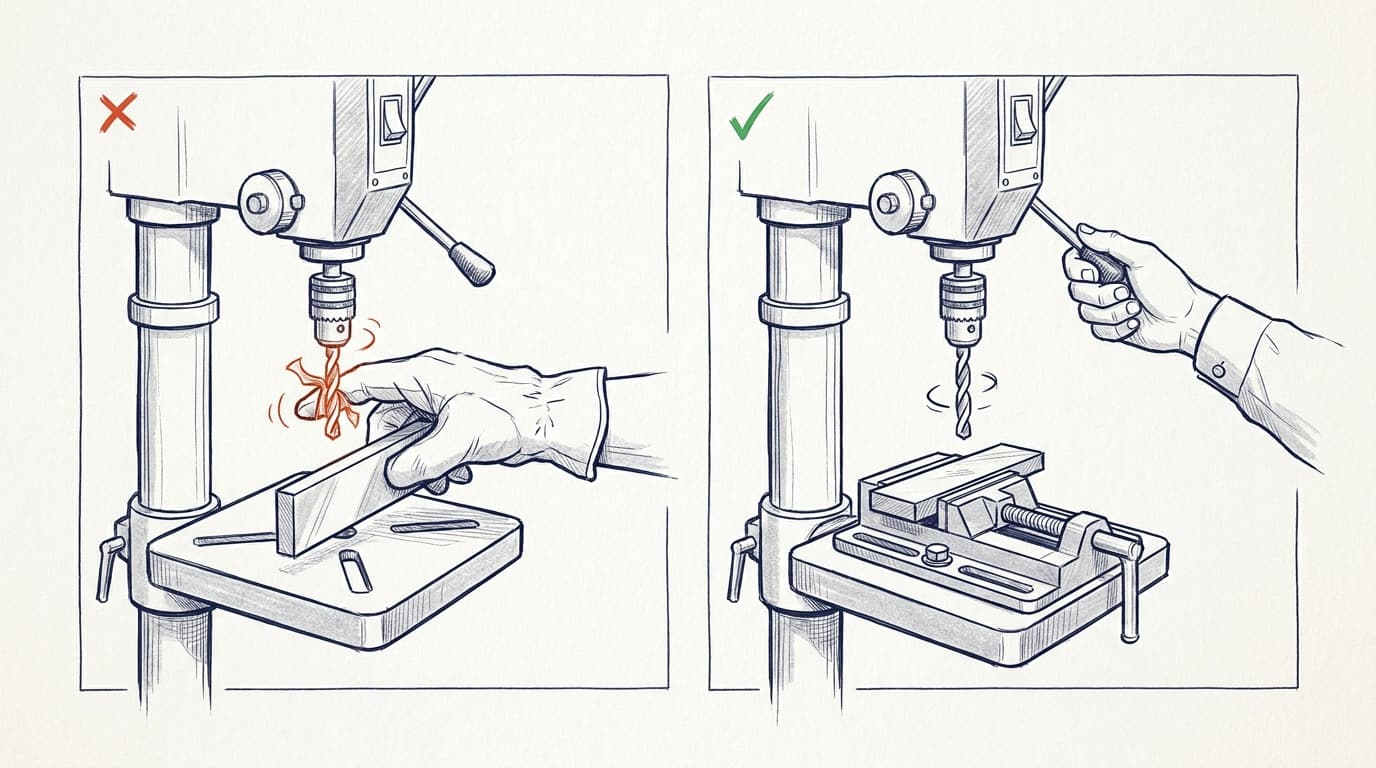
The same logic applies to loose cuffs near moving parts, rings and jewellery under gloves, and gloves worn so oversized that the fingertips extend past the hand.
What can go wrong#
One glove for every task. The site buys a single type in bulk and issues it for everything.
Never reading the level. The rating is printed on the cuff or the back of the hand, and almost nobody looks.
Mixing old and new ratings. Two boxes on the same shelf, rated under different versions of the standard.
Cut-rated gloves against puncture hazards. Rebar ties and wire ends going straight between the fibres.
Gloves worn out and still in service. Cut protection degrades with abrasion, contamination, laundering, and holes. A worn glove carries its printed rating and none of its performance.
Wet, oily, or contaminated gloves that no longer grip, causing the drop or the slip that injures the hand.
Gloves near rotating equipment where they should not be worn at all.
Line of fire. The hand placed where the load will land, the tool will slip, or the material will shift — no glove rating addresses that.
Bracing with the hand. Steadying a workpiece, a panel, or a pipe by hand in the path of the cut, the drill, or the load.
Removing them for "just a second" for the fiddly part of the task, which is usually the part with the sharp edge.
Rings. Degloving injuries from a ring catching, with or without a glove over it.

How do we protect hands?#
Identify what the task does to a hand before choosing the glove. Slice, point, abrasion, chemical, heat, or impact. Then choose against that, not against a general sense of toughness.
Read the ANSI level and specify it in the task plan. "A4 cut with a coated palm" is a specification. "Cut gloves" is not.
Choose the lowest level that covers the hazard and stays wearable. Dexterity is a safety property, not a comfort preference.
Get puncture rating separately for rebar, wire, and swarf work — do not assume a cut level covers it.
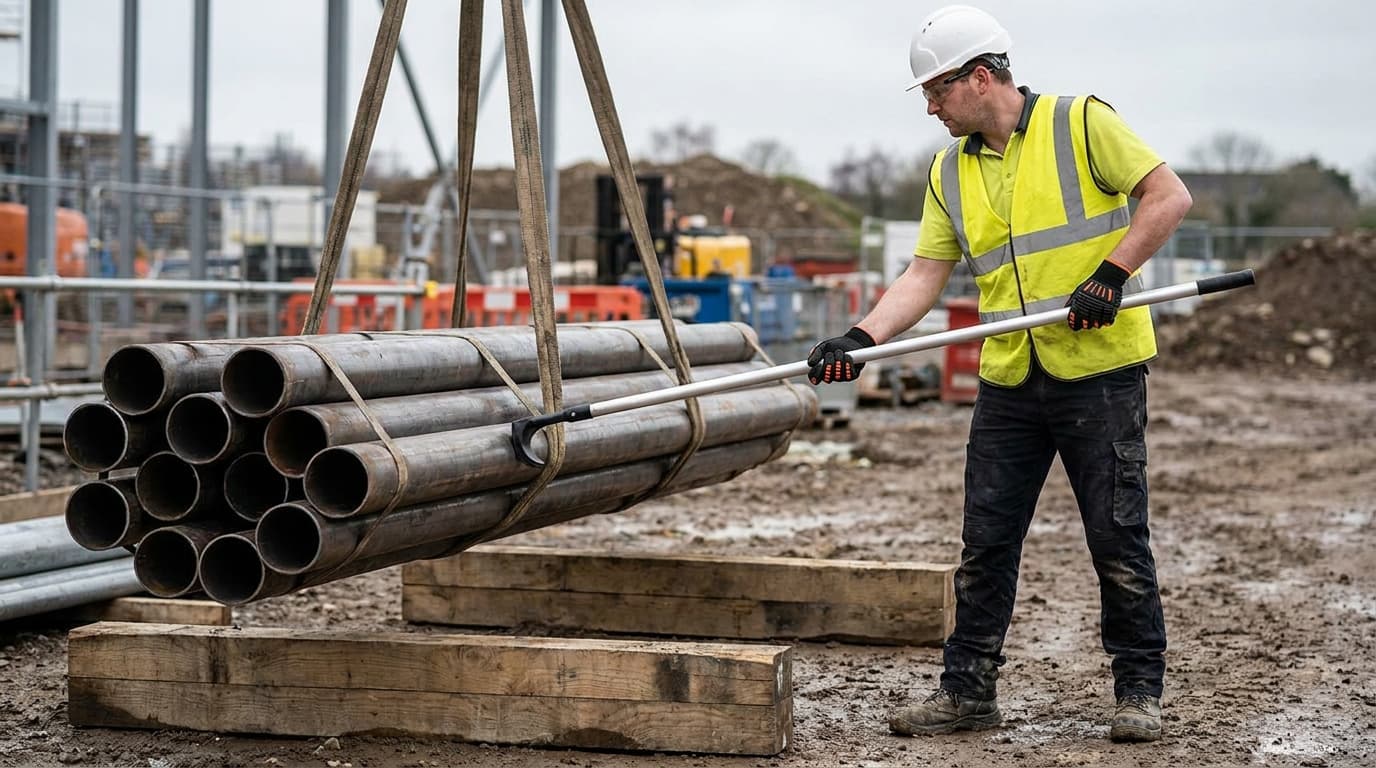
Keep the hands out of the line of fire. The best hand protection is the one hazard control no glove replaces: use a clamp, a jig, a push stick, a magnet, a hook, or a second person, so the hand is never where the energy is going.
Check the machine before gloving up. Rotating equipment may require bare hands.
Inspect and replace gloves. Holes, worn palms, contamination, and stiffness all mean the printed rating no longer applies.
Remove rings before work, under any glove.
Report cuts and punctures immediately, however minor — hand wounds infect, and tendon and nerve damage is not always obvious at the time.
On USACE and NAVFAC projects, EM 385-1-1 applies and carries its own PPE selection and hazard assessment requirements.
Before you start#
- Identify the specific hand hazard: slice, point, abrasion, chemical, heat, or impact.
- Read the ANSI level printed on the glove and confirm it matches that hazard.
- Confirm you are not relying on a cut rating against a puncture hazard.
- Confirm the gloves are intact — no holes, worn palms, or contamination.
- Confirm the glove still allows enough dexterity to do the whole task with it on.
- Check whether the equipment requires gloves to be removed, especially rotating machinery.
- Remove rings and secure loose cuffs.
- Identify where your hands will be if the tool slips or the load shifts — and move them.
- Set up clamps, jigs, or supports so hands are not holding the workpiece in the line of cut.
- Confirm you know where the first aid kit is and who reports a hand injury.
Talk it over#
- Look at the cuff of your glove. What level is printed on it, and what does that number mean?
- What is the sharpest or most pointed thing you will touch today, and is that a cut hazard or a puncture hazard?
- Where will your hands be if the thing you are cutting, drilling, or lifting moves unexpectedly?
The bottom line#
"Cut-resistant" is not a specification. ANSI/ISEA 105-2016 grades cut protection from A1 (200–499 grams to cut) to A9 (6,000 grams and above), measured on the ASTM F2992-15 test with a new blade for every cut — and everything across that thirtyfold range is sold under the same two words. Ratings from before the 2016 revision are not comparable with today's. Cut, puncture, and abrasion are separate ratings, so a cut-rated glove will not stop a rebar tie. Pick the lowest level that covers the actual hazard and stays wearable, because a high-rated glove in a pocket protects nobody and a stiff one causes the fumble. And remember the control that outranks every glove: keep the hand out of the line of fire in the first place.
Frequently asked questions about hand injuries#
What do the ANSI cut levels A1 to A9 mean?
They are the cut-resistance classifications in ANSI/ISEA 105-2016, each defined by the grams of load required to cut through the material on the ASTM F2992-15 test: A1 is 200–499 g, A2 500–999 g, A3 1,000–1,499 g, A4 1,500–2,199 g, A5 2,200–2,999 g, A6 3,000–3,999 g, A7 4,000–4,999 g, A8 5,000–5,999 g, and A9 6,000 g and above.
Are old cut ratings the same as the new ones?
No. The 2016 revision of ANSI/ISEA 105 replaced the earlier scale with A1–A9 and standardised the test method on the TDM-100 machine under ASTM F2992-15. A rating issued under the older version does not correspond to the same-numbered level today, so gloves from different eras or suppliers cannot be compared by number alone.
Does OSHA require cut-resistant gloves?
OSHA does not mandate a specific cut level. In construction, 1926.95(a) requires protective equipment for the extremities wherever it is necessary because of hazards capable of causing injury, and 1926.28(a) makes the employer responsible for requiring appropriate PPE where hazardous conditions exist. General industry 1910.138 sets out the selection logic: hand protection must be chosen based on an evaluation of performance characteristics relative to the task, conditions, duration of use, and the hazards identified.
Is a higher cut level always better?
No. Higher levels generally mean thicker, stiffer gloves with reduced dexterity and grip feel. That leads to gloves being removed for fiddly work, to fumbling that puts the hand into the hazard, and to increased grip force which contributes to strain injuries. Select the lowest level that adequately covers the hazard while keeping enough dexterity that the glove is worn for the whole task.
Will a cut-resistant glove stop a puncture?
Not reliably. Under ANSI/ISEA 105, cut, puncture, and abrasion resistance are separate properties, tested and rated separately. Cut-resistant fibres resist a slicing blade; a rebar tie end, wire, nail, or splinter can pass between the fibres. Puncture hazards need a glove selected against the puncture rating.
Are there tasks where gloves should not be worn?
Yes. Around rotating machinery — drill presses, lathes, bench grinders, augers, and rotating shafts — a glove can be caught and pull the hand into the equipment, turning a contact injury into an amputation. Check the machine's requirements before assuming gloves are protective, and keep cuffs, jewellery, and loose clothing clear of moving parts.
How do I know when to replace gloves?
When the material is compromised, regardless of what the label still says. Holes, worn or thinned palms, cuts in the fabric, chemical contamination, stiffening, and heavy soiling all mean the printed rating no longer reflects performance. Inspect gloves as part of the pre-task check, the same way you would any other piece of protective equipment.
Download the hand injuries toolbox talk PDF#
Get this hand injuries toolbox talk as a print-ready PDF — available in English, Spanish, Portuguese, and Turkish. Print it, hand it to the crew, and collect signatures on the included attendance sheet.
Download the PDF — free account required. New members get 3 free downloads.
Related toolbox talks#
Sources#
- OSHA, 29 CFR 1926.95 — Criteria for personal protective equipment: https://www.osha.gov/laws-regs/regulations/standardnumber/1926/1926.95
- OSHA, 29 CFR 1926.28 — Personal protective equipment: https://www.osha.gov/laws-regs/regulations/standardnumber/1926/1926.28
- OSHA, 29 CFR 1910.138 — Hand protection: https://www.osha.gov/laws-regs/regulations/standardnumber/1910/1910.138
- International Safety Equipment Association, ANSI/ISEA 105-2016 — American National Standard for Hand Protection Classification
- ASTM International, F2992/F2992M-15 — Standard Test Method for Measuring Cut Resistance of Materials Used in Protective Clothing with Tomodynamometer (TDM-100) Test Equipment
Written by FieldSafetyTalk's safety professional — a CSP, ASP, CHST and OSHA Authorized Outreach Trainer with 14+ years of international construction safety experience across federal, heavy civil, and industrial projects.