Trench Box Safety
Updated 2026-08-06
In this bundle Jobsite Fundamentals & Compliance
Print-ready PDF
Download this talk as a print-ready PDF, available in 4 languages.
There is a dangerous misunderstanding about trench boxes that gets people killed, and it hides inside a reasonable-sounding assumption: that the box is there to hold the walls back. It is not. A trench box — also called a trench shield — does nothing to stop the walls of a trench from collapsing. It is not shoring; it does not press against the soil to keep it in place. What it does is create a strong steel pocket of protected space that stays intact when the walls come down, so that a worker standing inside it is not buried. That distinction changes everything about how the box is used, and it explains why the most dangerous moment on a trench-box job is not when the crew is working down inside the box — it is when the box is going in, coming out, or being moved. This Trench Box Safety Toolbox Talk (Safety Talk / Tailgate Talk) is about what the box actually does, and what it does not.
Here is the distinction that carries this whole talk: a trench box doesn't hold the walls up and it doesn't prevent a cave-in — it's a steel shield that does nothing to stop a collapse and everything to keep you alive when one happens, protecting only the pocket of space inside it, which means you're safe only when you're inside a box rated for the full depth of the trench, and the most dangerous moment of the whole job is when the box is going in, coming out, or being moved — because that's exactly when a worker is outside the one thing protecting them. Sit with what that means. The soil can still cave in at any time; the box does not change that. What the box changes is the outcome of a cave-in for the person inside it: instead of being buried, they are in a rigid steel enclosure that holds its shape against the pressure. So safety is entirely about being inside that protected pocket, with a box strong enough for the depth you are at. The instant a worker steps out of the box, or works in the open trench while the box is being set or pulled, the protection is simply not there — and the cave-in that the box would have survived becomes the cave-in that kills.
Where the boundary of this talk sits#
Trench work spans several talks, and this one owns the box itself. The excavation and trenching talk owns the general Subpart P picture — soil classification, sloping and benching, access and egress, spoil placement, the competent person's daily role. The deep foundations talk owns the narrow vertical hole you mostly work around. The confined space talk owns atmospheric hazards in enclosed spaces. This talk owns the trench shield specifically: what it protects and what it doesn't, why the worker has to stay inside it, why it has to be rated for the full depth, and why installing, removing, and moving it is the moment the protection is absent. Where the hazard is soil type and sloping, a deep footing hole, or bad air, those talks own the detail; this one owns the box — the protective system that saves the worker inside it and only the worker inside it.
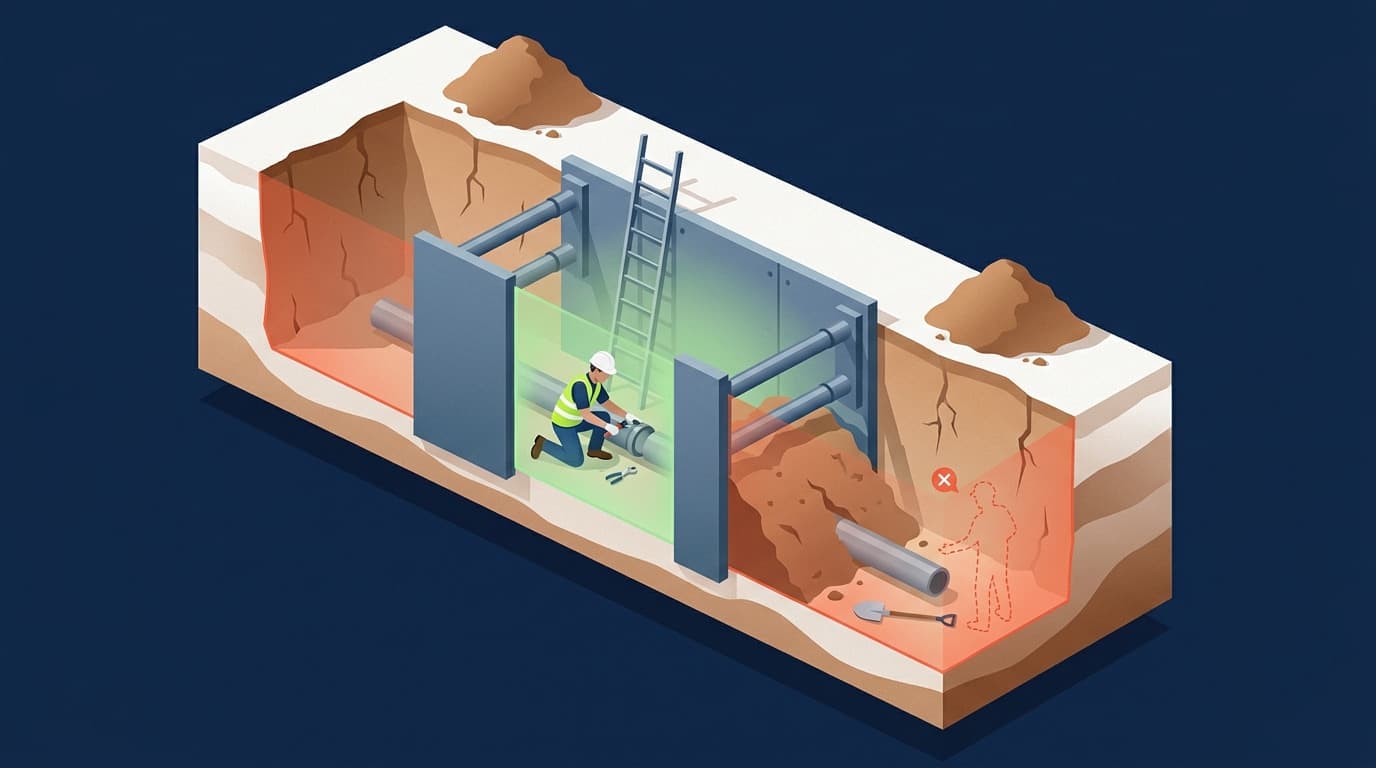
The box protects the space inside it — so stay inside it#
Because the box protects only the pocket of space it encloses, the first and most important rule is the simplest: stay inside the box whenever you are in the trench. A worker who steps outside the shield to reach a pipe, retrieve a tool, or work a few feet down the trench has stepped out of the only thing protecting them, into open unprotected soil that can collapse without warning. The box does not extend its protection to the area around it; there is no partial coverage, no safe zone just outside the steel. This is also why the box has to be sized and positioned for the actual work — if the crew needs to work along a length of trench, the box has to protect that length, and if it needs to be moved to reach the next section, that move is a planned operation, not something done with people still down in the open trench. The rule is not "have a box on site" or "have a box nearby." It is "be inside the box." Everything else follows from that.
The box must be rated for the full depth of the trench#
A trench box only protects you if it is strong enough for the soil pressure at the depth you are working, and that is not automatic. Every legitimate trench box is designed and rated — its strength documented in the manufacturer's tabulated data, which by definition has been approved by a registered professional engineer. That data states the depth and soil conditions the box is built for, and using the box outside those limits means it may not hold when a cave-in loads it. Two practical points follow. First, the box has to cover the full depth of the trench: if the box is shorter than the trench is deep, the soil above or below the box is unprotected, and a cave-in there can still bury or injure a worker — so the upper part of the trench above the box may need to be sloped back to achieve full-depth protection, and the box is generally set so it extends about eighteen inches above the vertical portion of the trench wall. Second, depth has a hard line: trenches twenty feet deep or greater must have a protective system designed by, or based on tabulated data approved by, a registered professional engineer — the manufacturer's off-the-shelf rating is not enough on its own past that depth. A copy of the tabulated data has to be available at the jobsite while the system is in use.
Installing, removing, and moving the box is the deadly moment#
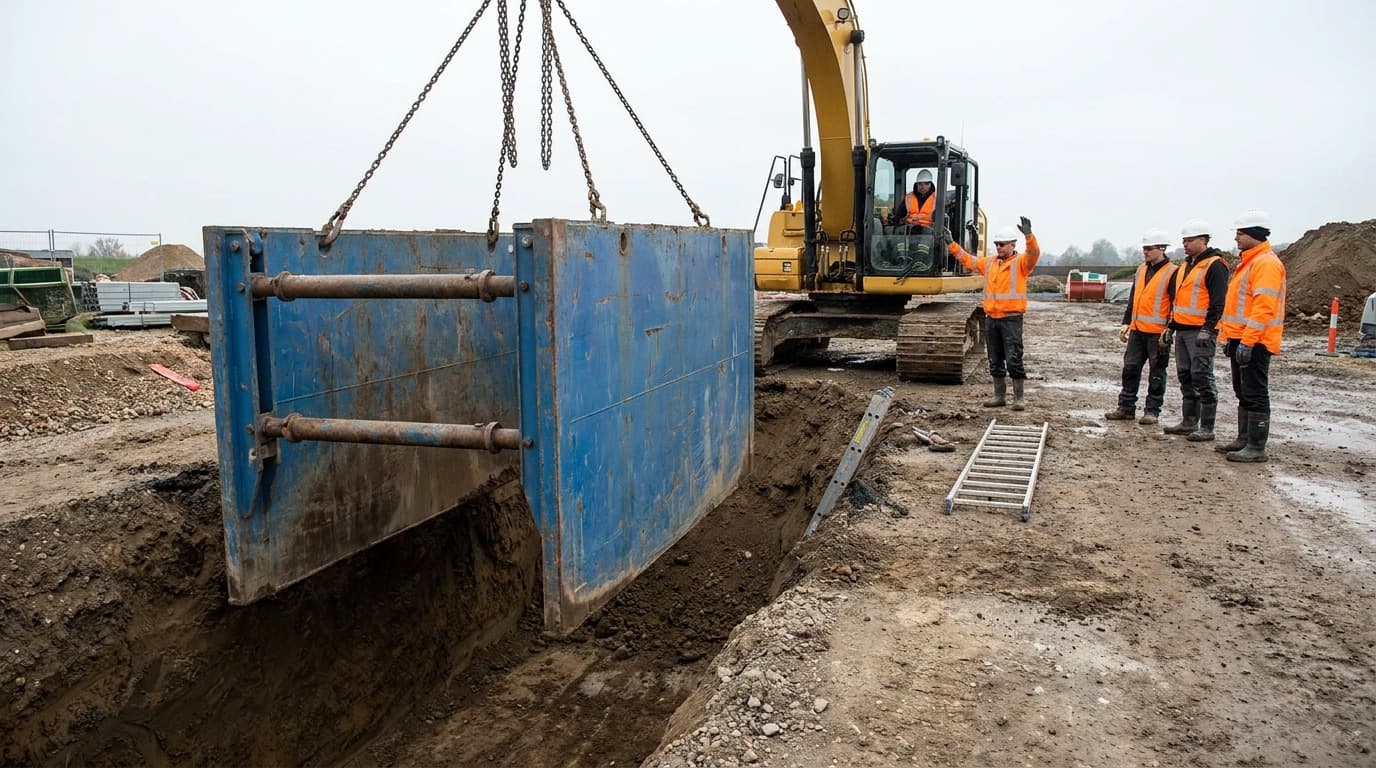
Here is the part that most needs saying, because it is where trench-box jobs actually kill people: the box protects you only once it is in place and you are inside it, which means the moments when it is being installed, removed, or moved are precisely the moments the protection is not there. OSHA's rule is explicit — employees are not allowed in the shield when it is being installed, removed, or moved vertically. But the deeper point extends past the letter of that line: during those operations, a worker must not be in the open unprotected trench at all, because the whole reason those moments are dangerous is that the protective pocket is not yet, or no longer, protecting anyone. The classic fatal sequence is a worker down in the trench guiding or hooking the box, or stepping into the open cut to prepare the next section, while the box is being lowered, lifted, or dragged — and the wall lets go. The safe practice is to remove workers from the trench before the box is set, lifted, or moved, so that when the protection is absent, so is the exposure. If the box has to be raised to move it, the workers come out first; when the excavation just below the box needs digging, it is limited and the box is designed and set so no one is exposed below it.
The box has to be sound, and used as designed#
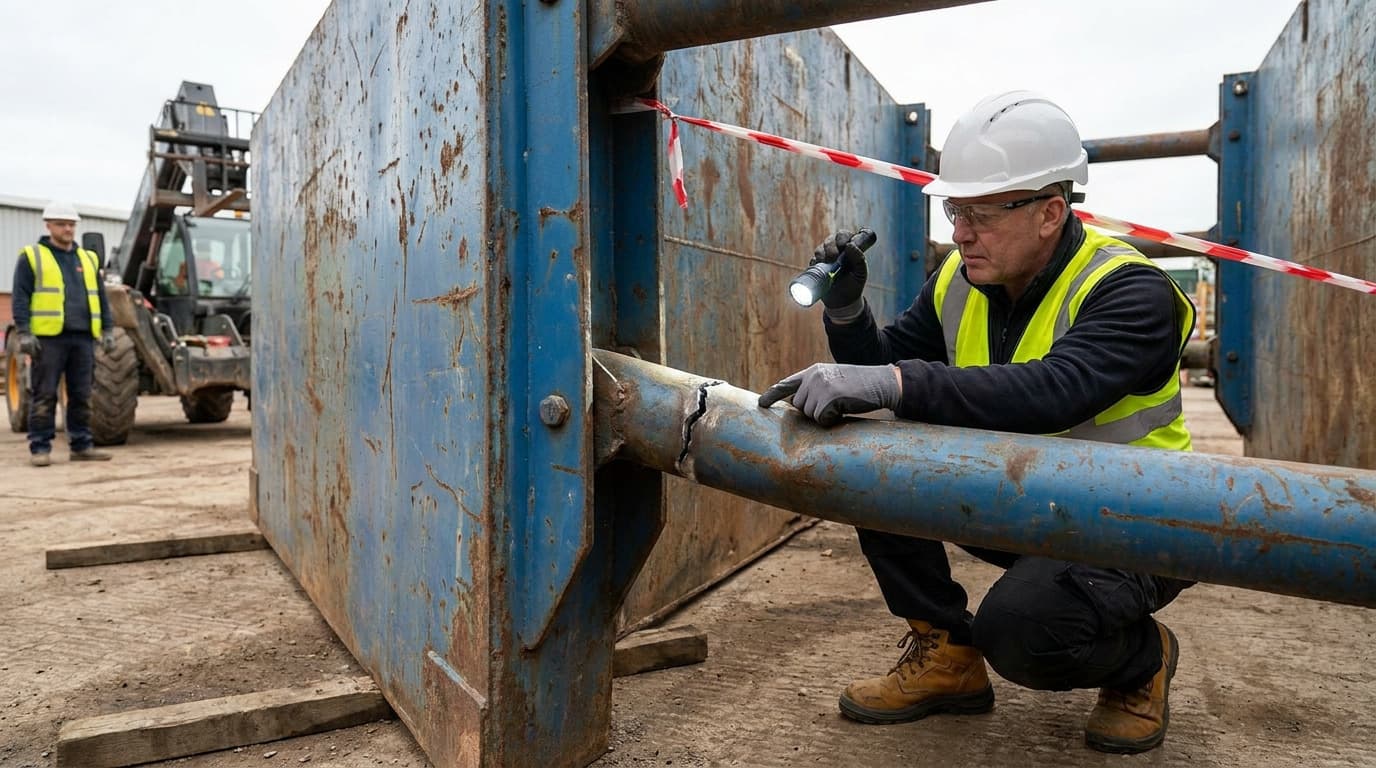
A protective system only performs if it is intact and used within its design, so a few more rules close the loop. The box must not be loaded beyond what it was designed to withstand — you cannot stack surcharge loads, heavy equipment, or spoil against or on top of a shield beyond its rating, and the spoil pile still has to be kept back from the trench edge as in any excavation. A damaged shield is not usable until it has been examined by a competent person and, where its structural integrity is affected, repaired and recertified by the manufacturer or a registered professional engineer — a bent, cracked, or gouged box may look serviceable and fail under load. The manufactured system has to be used and maintained consistent with the manufacturer's recommendations, which is why the tabulated data is not paperwork to file and forget but the actual operating manual for the box. And none of the box rules replace the rest of Subpart P: the competent person still inspects daily and after any event that changes conditions, egress is still within the required travel distance, and workers still leave the trench if conditions deteriorate. The box is one protective system among the requirements, not a substitute for them.
Where the duty sits#
Trench boxes are protective systems under OSHA's excavation standard, 1926 Subpart P, and the specific rules live in 1926.652 — Requirements for protective systems. The core duty is 1926.652(a): each employee in an excavation must be protected from cave-ins by an adequate protective system, unless the excavation is in stable rock or is less than five feet deep with no indication of a potential cave-in. Shield design comes from 1926.652(c) — Option (2) allows use of the manufacturer's tabulated data (which, per 1926.650(b), must be approved by a registered professional engineer), and Option (4) is design by an RPE, required for excavations over twenty feet deep. The shield-specific rules are in 1926.652(g): shields must not be loaded beyond their design, must be installed to resist lateral movement, must protect employees from cave-ins when entering or exiting, and — critically — employees shall not be allowed in shields when the shields are being installed, removed, or moved vertically. Excavation below the shield is limited by 1926.652(g)(2). Damaged-material evaluation and manufacturer-consistent use come from 1926.652(a) and its subparts. The General Duty Clause, Section 5(a)(1) and training under 1926.21(b)(2) apply throughout. Where the manufacturer's tabulated data or the competent person sets a specific requirement, that requirement governs.
What can go wrong?#
- A worker steps outside the box to reach a pipe or tool and the unprotected wall caves in.
- The box is shorter than the trench is deep, and the soil above or below it collapses on a worker.
- A box rated for shallow soil is used in a deeper trench and fails when the cave-in loads it.
- A worker is down in the trench guiding or hooking the box while it's being lifted or moved, and the wall lets go.
- The box is used past twenty feet deep with only manufacturer data and no engineer design.
- A damaged, bent, or cracked box is used and fails under the load of a cave-in.
- Spoil or heavy equipment is loaded against the box beyond its rating.
- The crew treats "a box on site" as protection while people work in the open trench.
How do we manage this properly?#
- Understand the box protects only the space inside it — stay inside the box in the trench.
- Confirm the box is rated for the full depth — tabulated data on site, sloped upper trench if needed.
- Set the box to extend about eighteen inches above the vertical trench wall, or slope above it.
- For trenches twenty feet or deeper, use an RPE-designed system, not off-the-shelf rating alone.
- Remove workers from the trench before the box is installed, removed, or moved — no one in the open cut.
- Never load the box beyond its rating, and keep spoil back from the edge.
- Take a damaged box out of service until a competent person and RPE/manufacturer clear it.
- Keep the rest of Subpart P — daily competent-person inspection, egress, leave if conditions worsen.
Before you start#
- Confirm the box's tabulated data is on site and covers the depth and soil of this trench.
- Confirm the box is tall enough for the full depth, or the upper trench is sloped to compensate.
- Confirm the box is undamaged and rated for the loads it will see.
- Confirm the plan keeps workers inside the box whenever they're in the trench.
- Confirm workers will be out of the trench before the box is installed, removed, or moved.
- Confirm how the next section will be reached — moving the box with no one in the open cut.
- Confirm spoil is set back from the edge and nothing overloads the box.
- Confirm the competent person has inspected and will re-inspect as conditions change.
Talk it over#
- Does everyone understand the box doesn't stop a cave-in — it just keeps you alive inside it?
- Is our box rated for the full depth of this trench, and is the tabulated data here on site?
- What's our exact plan for moving the box — and is everyone out of the trench before it moves?
- Has anyone seen the box take damage, and would we catch a bent or cracked one before using it?
The bottom line#
A trench box doesn't hold the walls up and it doesn't prevent a cave-in — it's a steel shield that does nothing to stop a collapse and everything to keep you alive when one happens, protecting only the pocket of space inside it, which means you're safe only when you're inside a box rated for the full depth of the trench, and the most dangerous moment of the whole job is when the box is going in, coming out, or being moved — because that's exactly when a worker is outside the one thing protecting them. Three things have to be true at once: the worker stays inside the shield, the shield is rated for the full depth — manufacturer's tabulated data approved by an engineer, extending about eighteen inches above the vertical wall or with the upper trench sloped, and an RPE-designed system past twenty feet — and nobody is in the shield or the open trench while it's being installed, removed, or moved vertically. It all sits in 1926.652, with the shield rules in 1926.652(g) and the tabulated-data requirement in 1926.652(c), inside the larger duties of Subpart P. The question to carry is the one that separates surviving a cave-in from being killed by one: am I inside a box rated for this depth right now — and is everyone out of the trench before that box moves?
Frequently asked questions about trench box safety#
Does a trench box stop the walls from caving in?
No, and this is the single most important thing to understand about it. A trench box — also called a trench shield — does not hold the soil back or prevent a cave-in the way shoring does. It is a strong steel structure that creates a protected pocket of space, and its entire job is to stay intact when the walls collapse so that the worker inside it is not buried. The soil can still let go at any moment; the box does not change that at all. What it changes is the outcome for the person inside: instead of being crushed or buried by the collapsing wall, they are inside a rigid enclosure that holds its shape against the pressure. This is why "stay inside the box" is the central rule — the protection exists only in the pocket the box encloses, and stepping outside it means stepping into soil that can collapse without warning, with nothing between you and the cave-in.
Why is installing or moving the box the most dangerous part?
Because the box only protects you once it is in place and you are inside it, so the moments when it is being installed, removed, or moved are exactly the moments when that protection is not there. OSHA states it directly: employees are not allowed in the shield while it is being installed, removed, or moved vertically. But the real danger goes a step further — a worker should not be in the open, unprotected trench at all during those operations, because the reason those moments are deadly is that the protective pocket is not yet, or no longer, protecting anyone. The classic fatal sequence is a worker down in the cut guiding or hooking the box, or stepping in to prep the next section, while the box is being lowered, lifted, or dragged — and the wall lets go while they are exposed. The safe practice is to get workers out of the trench before the box is set, lifted, or moved, so that when the protection is absent, so is the person.
How do I know if the box is strong enough for my trench?
By the manufacturer's tabulated data, which every legitimate trench box has and which by definition must be approved by a registered professional engineer. That data states the depths and soil conditions the box is designed to withstand, and using the box within those limits is what makes it a protective system rather than a false sense of security. Two things matter especially. The box has to be rated for the actual soil pressure at the depth you are working — a box adequate for a shallow trench can be overwhelmed in a deeper one. And the box has to cover the full depth: if it is shorter than the trench, the soil above or below it is unprotected, so the upper part of the trench above the box may need to be sloped back, and the box is generally set to extend about eighteen inches above the vertical part of the wall. A copy of the tabulated data has to be kept on the jobsite while the system is in use, so it is there to consult, not filed away.
What about trenches deeper than twenty feet?
Depth is where the rules get stricter, and twenty feet is the hard line. For a trench twenty feet deep or greater, the protective system must be designed by a registered professional engineer, or be based on tabulated data that a registered professional engineer has approved for that depth — the manufacturer's ordinary off-the-shelf rating is not sufficient on its own past twenty feet. This is because the soil pressures at that depth are large and site-specific enough that they need engineering judgment about the actual conditions: soil type, surcharge loads, groundwater, and adjacent structures. Below twenty feet, using manufacturer's tabulated data is permitted as long as the use is within the limits of that data, including its depth and soil-type limits. Either way, the design or the data has to be documented and available on site. If you are working a deep trench and no one can point to an engineer's design or engineer-approved data for that depth, that is a stop-work signal, not a detail to sort out later.
Can I use a box that's been damaged?
Not until it has been evaluated and cleared, because a damaged shield can fail under the load of a cave-in even when it looks usable. If a trench box is bent, cracked, gouged, or otherwise damaged, a competent person has to examine it and evaluate whether it is still suitable for use. Where the damage affects the structural integrity or the box's ability to perform as designed, it cannot be used until it has been repaired and recertified by the manufacturer or a registered professional engineer. The danger is that structural damage is not always obvious — a box can look serviceable and still have compromised strength — which is why the evaluation is a competent-person judgment, not a glance from across the yard. The same principle applies to how the box is loaded: it must never be subjected to loads beyond what it was designed to withstand, so heavy equipment, surcharge, or spoil piled against or over the box beyond its rating is its own way of overloading a system that was sound to begin with.
Isn't having a trench box on site enough to be compliant?
No — having a box on site and being protected by it are completely different things, and the gap between them is where people get hurt. The box protects only the worker who is actually inside it, in a box rated for the full depth, set and used correctly. A box sitting at the edge of the trench, or in the trench while workers are outside it, or too short for the depth, or damaged, or being moved while people are in the cut, protects no one. Compliance and safety both come from the box being in place and doing its job around the worker, not from its mere presence on the job. This is the practical heart of the whole talk: the question is never "do we have a box?" It is "is the worker inside a box rated for this depth, and is everyone out of the trench whenever that box is being put in, taken out, or moved?" That is what turns a piece of steel on site into actual protection.
Download the trench box safety toolbox talk PDF#
Get this trench box safety toolbox talk as a print-ready PDF — available in English, Spanish, Portuguese, and Turkish. Print it, hand it to the crew, and collect signatures on the included attendance sheet.
Download the PDF — free account required. New members get 3 free downloads.
Related toolbox talks#
Sources#
- OSHA, Requirements for protective systems — 29 CFR 1926.652 (each employee in an excavation protected from cave-ins by an adequate protective system at 1926.652(a); shield systems at 1926.652(g), including that shields must not be loaded beyond design, must protect employees entering and exiting, and that employees shall not be allowed in shields when the shields are being installed, removed, or moved vertically; excavation below the shield limited at 1926.652(g)(2)): https://www.osha.gov/laws-regs/regulations/standardnumber/1926/1926.652
- OSHA, Standard interpretation — Design of protective systems in trenches (May 21, 1992) and Construction standards addressing excavations (Mar 23, 1992) (manufacturer's tabulated data under 1926.652(c)(2) must be approved by a registered professional engineer; tabulated data can be used past 20 feet only within the limits of the data; damaged shields cannot be used until repaired and recertified by an RPE or the manufacturer): https://www.osha.gov/laws-regs/standardinterpretations/1992-05-21-2
- OSHA, Standard interpretation — Adjusting work practices to comply with §1926.652 (Jul 29, 2005) (removing employees from the trench before raising the trench box more than 2 feet eliminates employee exposure to the cave-in hazard while the box is lifted and moved): https://www.osha.gov/laws-regs/standardinterpretations/2005-07-29
This talk is general awareness guidance for training purposes. It does not replace your employer's excavation program, OSHA Subpart P and 1926.652, the manufacturer's tabulated data, or a competent person's or engineer's duties, and it is not legal advice. Where the manufacturer's tabulated data, the competent person, or a registered professional engineer sets a specific requirement, that requirement governs.
Written by FieldSafetyTalk's safety professional — a CSP, ASP, CHST and OSHA Authorized Outreach Trainer with 14+ years of international construction safety experience across federal, heavy civil, and industrial projects.