Vibrating Tools Safety
Updated 2026-08-06
In this bundle Health & Environmental Exposure
Print-ready PDF
Download this talk as a print-ready PDF, available in 4 languages.
Most jobsite hazards announce themselves. A fall has an edge, a cut has a blade, a live wire has a warning. The hazard in a vibrating tool is different, and that difference is what makes it so easy to ignore: the thing hurting you is the tool working exactly the way it is supposed to. A grinder that is running smoothly, a jackhammer breaking concrete cleanly, a rotary hammer drilling a perfect hole — none of those is malfunctioning. The vibration coming out of them is not a defect; it is the normal, designed operation of the tool. And that same normal vibration, traveling through the handle into your hands, is doing quiet, microscopic, cumulative damage to the nerves and blood vessels in your fingers the entire time you hold it. This Vibrating Tools Safety Toolbox Talk (Safety Talk / Tailgate Talk) is about a hazard you cannot out-work with good technique, because the tool doing its job correctly is the exposure.
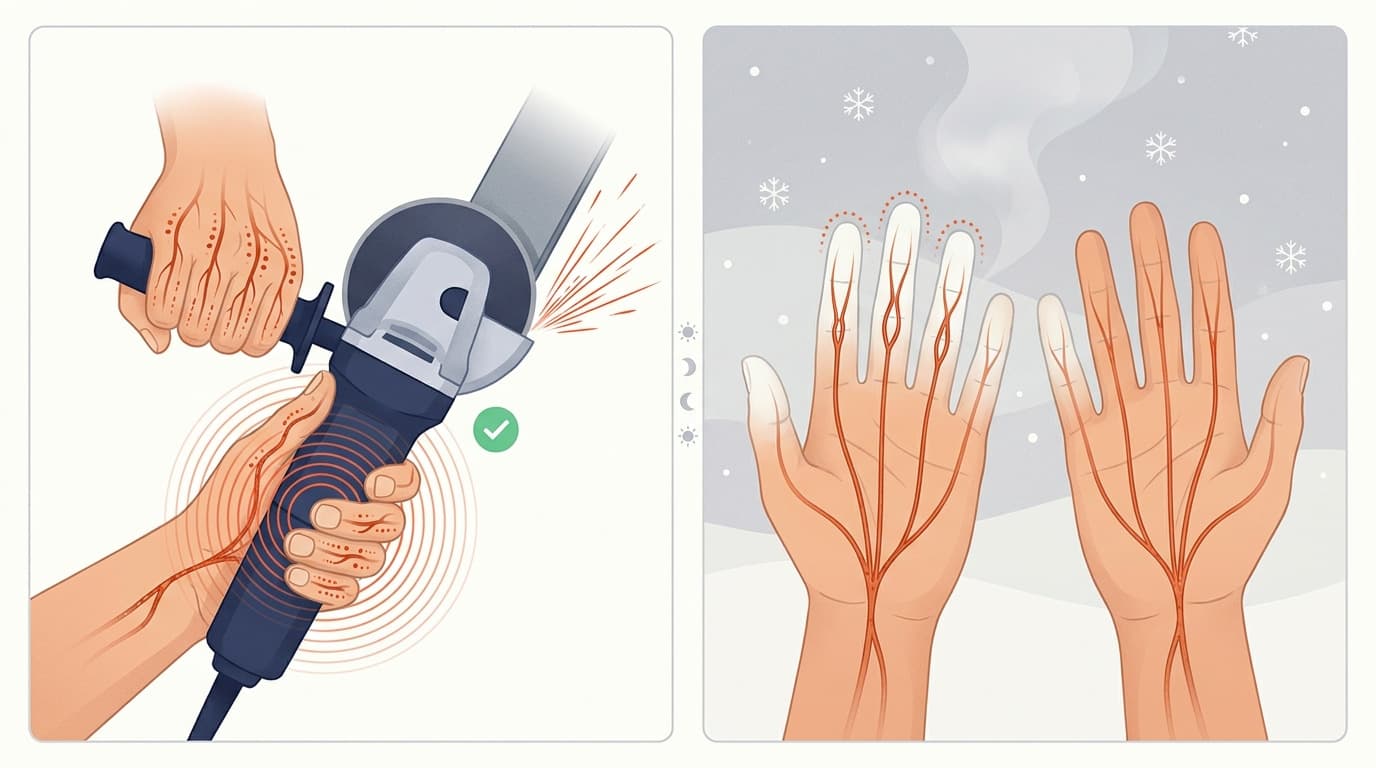
Here is the distinction that carries this whole talk: with a vibrating tool the thing hurting you is the tool working exactly as designed — not a mistake, not a malfunction, but the normal vibration of a running grinder or jackhammer being pumped into your hands every second you hold it, doing microscopic, painless, permanent damage to the nerves and blood vessels in your fingers, so by the time you feel the numbness or see the white finger, the injury is already done and can't be undone. The condition has a name — hand-arm vibration syndrome, or HAVS, which NIOSH describes as a collective term for the vibration-induced neurological, vascular, and musculoskeletal disorders of the hand and arm. Its hallmark is vibration white finger, a form of secondary Raynaud's phenomenon in which repeated vibration causes the small blood vessels in the fingers to collapse, so the fingers lose blood flow, turn white, go numb, and lose dexterity and grip. The cruelty of it is the timeline: the damage accumulates painlessly for months or years, and the first symptoms you notice — the tingling, the numbness, the finger that blanches in the cold — are not an early warning you can act on to reverse it. They are the sign that irreversible damage has already happened. That is why this hazard has to be managed before you feel anything.
Where the boundary of this talk sits#
Vibrating tools touch a few other talks, and this one owns the vibration itself. The repetitive strain talk owns injuries that come from the motion and posture of repeated work — the thousands of movements, each fine on its own. The hand-and-power tools talk owns the mechanical and electrical hazards of the tools — guarding, kickback, cords, bits. The hearing conservation talk owns the noise those same tools make. This talk owns the vibration: hand-arm vibration syndrome and its white finger, whole-body vibration from riding or standing on vibrating equipment, why the exposure is the tool operating normally, and why the controls are about reducing the dose rather than improving technique. Where the harm is the repeated motion, the spinning bit, or the noise, those talks own the detail; this one owns the energy the tool pumps into your body just by running — the hazard you cannot feel doing its damage.
You can't out-technique it — so you reduce the dose#
The hardest thing to accept about vibration is that being careful does not protect you from it. With most hazards, good technique is the answer: cut away from your body, keep your guard up, mind your footing. But you can hold a vibrating tool perfectly, with textbook posture and a relaxed stance, and the vibration still travels through the handle into your hands at the same rate. Technique changes almost nothing about the exposure, because the exposure is simply the tool running. That reframing is the key to the whole talk: since you cannot work your way out of the vibration, the only thing you can control is the dose — how much vibration energy your hands absorb, and over how long. Everything that follows is a way of turning the dose down. There is no OSHA number that caps it for you on a construction site, so the responsibility falls on the crew and the employer to manage the exposure deliberately, using the tool, the time, and the conditions as the levers.
Lever one: the tool and its condition#
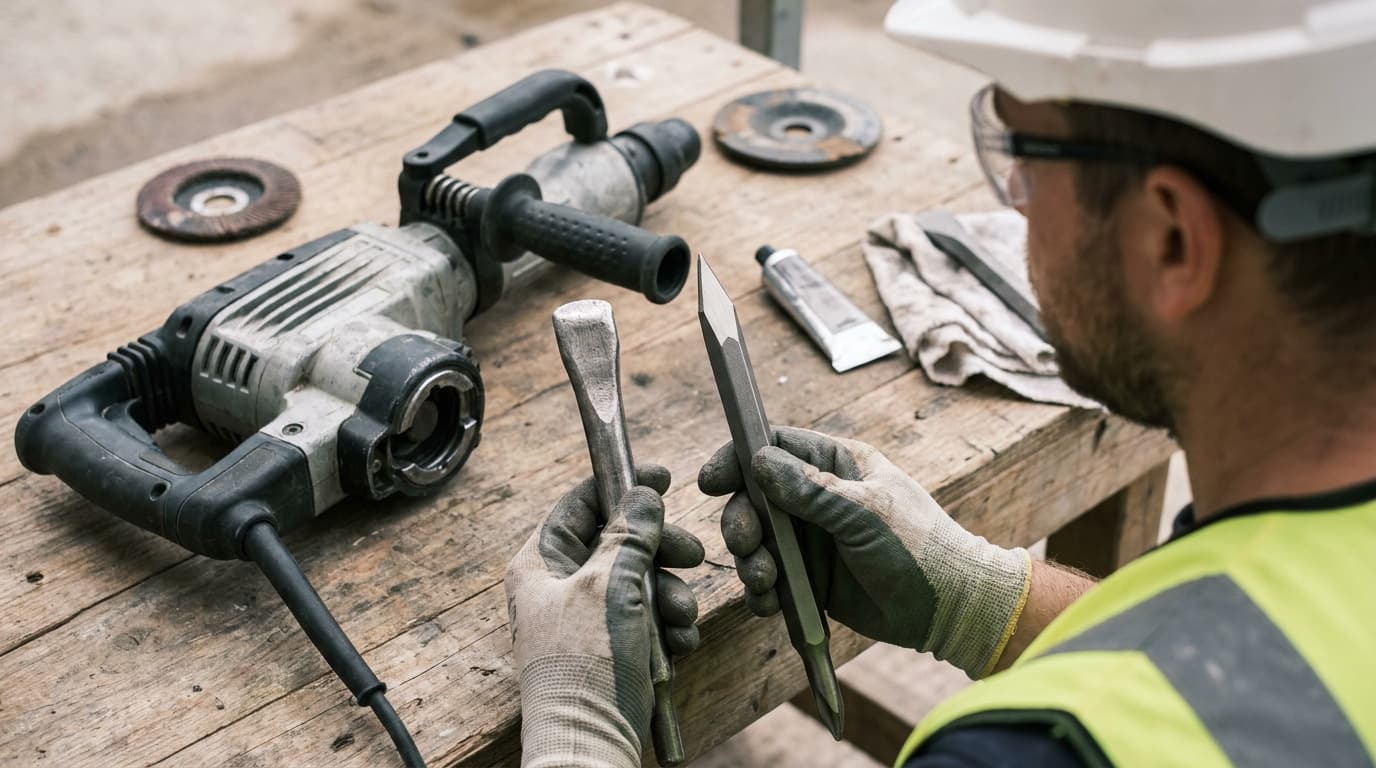
The first and biggest lever is the tool itself, because two tools doing the same job can deliver wildly different amounts of vibration. Manufacturers publish vibration data, and the NIOSH Power Tools Database collects vibration values for many tools common in construction, so lower-vibration models can be chosen for jobs where a lot of tool time is expected. Anti-vibration tools — with isolated or damped handles designed to absorb energy before it reaches your hands — meaningfully reduce the dose for the same work. Anti-vibration gloves exist and can help at certain frequencies, but they are a supplement, not a solution, and a glove that is too bulky can make you grip harder, which works against you. The condition of the tool matters just as much as its design: a dull bit, a worn wheel, an unbalanced grinder, or a poorly maintained tool vibrates far more than a sharp, balanced, well-kept one, so keeping cutting edges sharp and tools maintained is not just about productivity — it directly lowers the vibration your hands take on. Choosing the right tool and keeping it in good shape is the single most effective thing a crew can do about vibration.
Lever two: time on the tool#
The second lever is exposure time, because the dose is vibration multiplied by duration — the longer your hands are on a running tool, the more damage accumulates. This is why duty cycles and breaks matter so much. Continuous, all-day use of a high-vibration tool is the worst-case exposure; breaking that up — rotating the task among crew members, alternating vibrating work with non-vibrating work, and building in regular breaks off the tool — spreads the dose and gives the tissues recovery time. Job rotation is not just fairer; it is a genuine exposure control, because no single worker absorbs the whole day's vibration. Planning the work so that the high-vibration tasks are shared and interrupted, rather than piled onto one person for a full shift, is one of the most practical ways to keep any individual's dose down. The goal is that nobody spends hours of uninterrupted contact with a tool that is quietly damaging their hands the entire time.
Lever three: warmth and grip#
The third lever is the condition of your hands while you work, because two things make the vascular damage worse: cold and a tight grip. Cold is a direct aggravator — vibration white finger is triggered and worsened by cold, and the blood-vessel damage shows up first as fingers that blanch in cold conditions, so keeping the hands warm and dry genuinely reduces the harm. That means warm gloves in cold weather, keeping the hands out of cold wind and water where possible, and warming up before and during vibrating work. Grip is the other factor: the harder you clench a vibrating tool, the more efficiently the vibration couples into your hands and the more your own muscles and tendons take on. Gripping only as tightly as the job actually requires — letting the tool do the work rather than strangling the handle — lowers both the vibration transfer and the muscular strain. Warm hands and a light grip will not make a high-vibration tool safe, but they measurably reduce the damage the same exposure does.
Watch for the early signs — they're the only warning you get#
Because the damage is painless and cumulative, the early symptoms are the only signal a worker gets that the exposure is doing harm, and they must not be ignored. The early signs of HAVS are infrequent numbness or tingling in the fingers, hands, or arms, and whiteness or blanching in the fingertips when exposed to cold. They may be mild at first, come and go, and affect only a fingertip. It is tempting to dismiss them as nothing — but they are the point at which a worker should report the symptoms, be evaluated by a medical professional, and have their exposure reduced, because continued exposure past this point is what turns reversible early changes into permanent disability: constant numbness, loss of grip and dexterity, and frequent painful attacks of white finger. Whole-body vibration, from operating or riding heavy equipment or standing on vibrating platforms, produces different early signals — fatigue, low-back discomfort, headache, stomach upset, and a general shakiness — and deserves the same response: report it, and look at reducing the exposure. The early signs are not the problem to tolerate; they are the warning to act on.
Where the duty sits#
There is no OSHA standard that sets a specific numerical exposure limit for vibration on a construction site, so the controlling authority is the General Duty Clause, Section 5(a)(1), which requires employers to furnish a workplace free from recognized hazards likely to cause death or serious physical harm — and hand-arm vibration syndrome is a well-recognized, seriously disabling hazard. Training and information duties come through 1926.21(b)(2). The recognized exposure benchmarks come from consensus bodies: the ACGIH Threshold Limit Value (TLV) for hand-arm vibration sets action levels and limits that responsible programs apply, and NIOSH provides guidance and the Power Tools Database of measured tool vibration values. The measurement standards are ISO 5349 for hand-arm vibration and ISO 2631 for whole-body vibration, and the Stockholm Workshop Scale is used to stage HAVS severity clinically. Where vibrating tools also create noise, the hearing conservation requirements apply in parallel. Where a manufacturer's data, a consensus TLV, or your employer's program sets a specific limit or control, that requirement governs — and in the absence of a hard OSHA number, the recognized-hazard duty still requires the exposure to be managed.
What can go wrong?#
- A worker runs a high-vibration tool all day, every day, and develops irreversible white finger.
- Early numbness and tingling get dismissed as nothing, and the exposure continues until the damage is permanent.
- A dull bit or worn wheel doubles the vibration, and nobody connects the tool's condition to the harm.
- One worker is assigned all the jackhammer work for weeks, absorbing the entire crew's vibration dose.
- Cold-weather work with no hand warmth accelerates the vascular damage.
- A worker strangles the tool handle, coupling far more vibration into the hands than the job requires.
- Anti-vibration gloves are treated as a fix, and the underlying exposure is never actually reduced.
- Whole-body vibration from equipment gets ignored because it doesn't look like a hazard.
How do we manage this properly?#
- Treat the tool running normally as the exposure — you can't out-technique it, so reduce the dose.
- Choose lower-vibration and anti-vibration tools, and use the NIOSH data to pick them.
- Keep tools sharp, balanced, and maintained — a dull or worn tool vibrates far more.
- Limit time on the tool — duty cycles, breaks, and job rotation spread the dose.
- Keep hands warm and dry, especially in cold weather — cold worsens the vascular damage.
- Grip only as hard as the job needs — a tight grip couples in more vibration.
- Report early numbness, tingling, or white fingers — they're the only warning before it's permanent.
- Treat whole-body vibration from equipment as a real exposure too, and reduce it.
Before you start#
- Confirm the tool for this job is a lower-vibration model where one is available.
- Confirm the tool is sharp, balanced, and well-maintained.
- Confirm the plan limits any one worker's continuous time on high-vibration tools.
- Confirm job rotation or breaks are built in for extended vibrating work.
- Confirm hands can be kept warm and dry, especially in cold conditions.
- Confirm the crew knows to grip only as tightly as the work requires.
- Confirm everyone knows the early signs of HAVS and to report them.
- Confirm whole-body vibration exposures from equipment are considered, not just hand tools.
Talk it over#
- Is anyone on this crew running a high-vibration tool for hours at a stretch, day after day?
- Are our tools sharp and maintained — or is a worn tool making the vibration worse than it needs to be?
- Has anyone noticed numbness, tingling, or fingers going white in the cold — even mildly?
- How can we share and break up the high-vibration work so no one person absorbs all of it?
The bottom line#
With a vibrating tool the thing hurting you is the tool working exactly as designed — not a mistake, not a malfunction, but the normal vibration of a running grinder or jackhammer being pumped into your hands every second you hold it, doing microscopic, painless, permanent damage to the nerves and blood vessels in your fingers, so by the time you feel the numbness or see the white finger, the injury is already done and can't be undone. Because you cannot out-technique the exposure — the vibration comes through no matter how carefully you work — the whole job is reducing the dose on three levers: the tool (lower-vibration and anti-vibration models, kept sharp and maintained, because a dull tool vibrates far more), the time (duty cycles, breaks, and job rotation so no one absorbs it all), and your hands (warm and dry against the cold that worsens white finger, and a light grip that couples in less). Watch for the early signs — numbness, tingling, blanching fingers — because they are the only warning you get, and reporting them is what stops reversible changes from becoming permanent. With no OSHA number to lean on, the recognized-hazard duty under 5(a)(1), the ACGIH TLV, and NIOSH guidance are what govern. The question to carry is not "am I using this tool correctly?" — you probably are. It is: how much vibration are my hands actually taking on today, and what are we doing to turn that dose down?
Frequently asked questions about vibrating tools safety#
What is hand-arm vibration syndrome?
Hand-arm vibration syndrome, or HAVS, is what NIOSH calls a collective term for the vibration-induced neurological, vascular, and musculoskeletal disorders of the hand and arm caused by regular use of vibrating tools. In plain terms, the vibration from tools like grinders, jackhammers, chain saws, drills, and riveters travels into the hands and, over time, causes repeated tiny injuries to the small nerves and blood vessels in the fingers. The best-known part of HAVS is vibration white finger, a form of secondary Raynaud's phenomenon in which the damaged blood vessels collapse and the fingers lose blood flow — turning white, going numb, and losing dexterity, especially in the cold. But HAVS is broader than just white finger; it also includes nerve damage that causes numbness and tingling and musculoskeletal effects that weaken grip. The critical feature is that it develops gradually and painlessly, and once it reaches the stage where you clearly feel it, the damage is generally irreversible. That is why it has to be prevented through exposure control rather than caught and fixed later.
If I use the tool correctly, am I protected from the vibration?
No, and this is the single most important thing to understand about vibration. Good technique protects you from many hazards, but not from vibration, because the vibration is not caused by using the tool wrong — it is caused by using the tool at all. A grinder running smoothly, a jackhammer breaking concrete cleanly, a hammer drill boring a clean hole are all working exactly as designed, and the vibration they produce is part of that normal operation. You can hold the tool with perfect posture and a relaxed stance, and the same amount of vibration still travels through the handle into your hands. That is why the answer to vibration is not "be more careful" but "reduce the dose" — choose a lower-vibration tool, keep it sharp and maintained, limit how long your hands are on it, rotate the work, and keep your hands warm with a light grip. Technique is not the lever here; exposure is. Accepting that is what lets a crew actually protect itself, instead of assuming that careful workers are safe.
Why does a dull or worn tool matter for vibration?
Because the condition of a tool has a large effect on how much it vibrates, and a dull, worn, or unbalanced tool vibrates far more than a sharp, balanced, well-maintained one doing the same job. A dull bit or blade has to be forced through the material, which makes the tool chatter and buck and increases the vibration reaching your hands. A worn or unbalanced grinding wheel spins with a wobble that translates directly into vibration. Loose or worn parts add their own shaking. So maintenance is not just about getting the work done faster or protecting the tool — it directly reduces the vibration dose your hands absorb, which makes it a real health control. Keeping cutting edges sharp, replacing worn wheels and bits, and maintaining tools so they run smoothly and balanced is one of the most practical and effective ways to lower vibration exposure. When you pick up a tool that is chattering, bucking, or shaking more than it should, that extra vibration is going straight into your hands, and the fix is to service or replace the tool, not to push through.
How long is too long to use a vibrating tool?
There is no single number that applies to every tool on a construction site, because the safe duration depends on how much vibration the specific tool produces — a high-vibration jackhammer reaches a harmful dose far faster than a low-vibration tool. That is exactly why the ACGIH publishes threshold limit values that relate vibration level to allowable time, and why manufacturers and the NIOSH Power Tools Database provide vibration values: together they let a program estimate how long a given tool can be used before the dose becomes a concern. The practical takeaway for the crew is that time on the tool is the exposure, so the goal is to avoid long, uninterrupted, day-after-day contact with high-vibration tools. Breaking the work up with duty cycles, alternating vibrating and non-vibrating tasks, building in regular breaks off the tool, and rotating the high-vibration jobs among several workers all reduce how much any one person absorbs. If one worker is doing hours of continuous jackhammer or grinder work every day, that is the pattern most likely to cause harm, regardless of the exact number.
Do anti-vibration gloves solve the problem?
Not on their own. Anti-vibration gloves can help reduce vibration at certain frequencies and are a reasonable supplement, but they are not a complete solution and should not be relied on as the main control. There are a couple of reasons. First, gloves are more effective at some vibration frequencies than others, so they do not uniformly cut the dose across all tools. Second, a glove that is too thick or bulky can force you to grip the tool harder to keep control, and a tighter grip couples more vibration into your hands — which can partly cancel out the benefit. Gloves also help keep the hands warm, which is genuinely useful because cold worsens vibration white finger, so there is real value there. But the effective controls are the ones that reduce the vibration at its source and limit exposure: choosing lower-vibration and anti-vibration tools, keeping them sharp and maintained, limiting time on the tool through duty cycles and rotation, and keeping a light grip. Think of anti-vibration gloves as one supporting measure within that set, not as the fix that lets you skip the rest.
Is vibration from riding equipment a hazard too?
Yes. Most of this talk focuses on hand-arm vibration from hand-held tools, but whole-body vibration — from operating or riding heavy equipment, driving over rough ground, or standing on vibrating platforms and surfaces — is a separate exposure with its own health effects. Instead of damaging the fingers, whole-body vibration transmits through the seat or the feet into the whole body, and its effects include fatigue, low-back pain and discomfort, headache, stomach upset, loss of balance, and a general shakiness during or after exposure. Over the long term, whole-body vibration is associated with back problems in particular. The controls are analogous to the hand-arm case: well-maintained equipment and good suspension seating reduce the vibration, smoother ground and slower speeds over rough terrain reduce it, and limiting continuous exposure time helps. The measurement standard for whole-body vibration is ISO 2631, distinct from the ISO 5349 standard used for hand-arm vibration. The key point is not to dismiss equipment vibration just because it does not look like a classic hazard — like hand-arm vibration, it does its damage quietly over time, and it deserves the same attention to reducing the dose.
Download the vibrating tools safety toolbox talk PDF#
Get this vibrating tools safety toolbox talk as a print-ready PDF — available in English, Spanish, Portuguese, and Turkish. Print it, hand it to the crew, and collect signatures on the included attendance sheet.
Download the PDF — free account required. New members get 3 free downloads.
Related toolbox talks#
Sources#
- OSHA, Woodworking eTool — Vibration and General Duty Clause, OSH Act Section 5(a)(1) (both hand-held and stationary tools that transmit vibration can cause vibration white finger / hand-arm vibration syndrome; there is no OSHA-specific numerical vibration standard, so recognized-hazard exposures are addressed under Section 5(a)(1)): https://www.osha.gov/etools/woodworking/health-hazards/vibration
- NIOSH (CDC), Hand-arm vibration and the NIOSH Power Tools Database (HAVS is a collective term for vibration-induced neurological, vascular, and musculoskeletal disorders of the hand-arm system; risk exists regardless of whether the tool is electric, gasoline, or air powered; the Power Tools Database provides measured vibration values for construction tools)
- ACGIH, Threshold Limit Value (TLV) for Hand-Arm Vibration, and ISO 5349 (hand-arm) / ISO 2631 (whole-body) (the US has no OSHA vibration PEL; the ACGIH TLV provides action levels and limits relating vibration level to allowable exposure time; ISO 5349 and ISO 2631 are the measurement standards; the Stockholm Workshop Scale stages HAVS severity): https://www.ccohs.ca/oshanswers/phys_agents/vibration/vibration_measure.html
This talk is general awareness guidance for training purposes. It does not replace your employer's health and exposure program, the General Duty Clause, the ACGIH TLV, manufacturer vibration data, or a medical professional's evaluation, and it is not medical or legal advice. Where a manufacturer's data, a consensus TLV, or your employer's program sets a specific limit or control, that requirement governs.
Written by FieldSafetyTalk's safety professional — a CSP, ASP, CHST and OSHA Authorized Outreach Trainer with 14+ years of international construction safety experience across federal, heavy civil, and industrial projects.