Common Unsafe Conditions
Updated 2026-07-28
In this bundle Jobsite Fundamentals & Compliance
Print-ready PDF
Download this talk as a print-ready PDF, available in 4 languages.
An unsafe condition is not an event. It is a state that persists, that everybody walks past, and that becomes invisible in about a week. That is the whole difficulty: conditions do not announce themselves, they accumulate — and the people best placed to notice them are the ones who have stopped seeing them. This Common Unsafe Conditions Toolbox Talk (Safety Talk / Tailgate Talk) is about looking again.
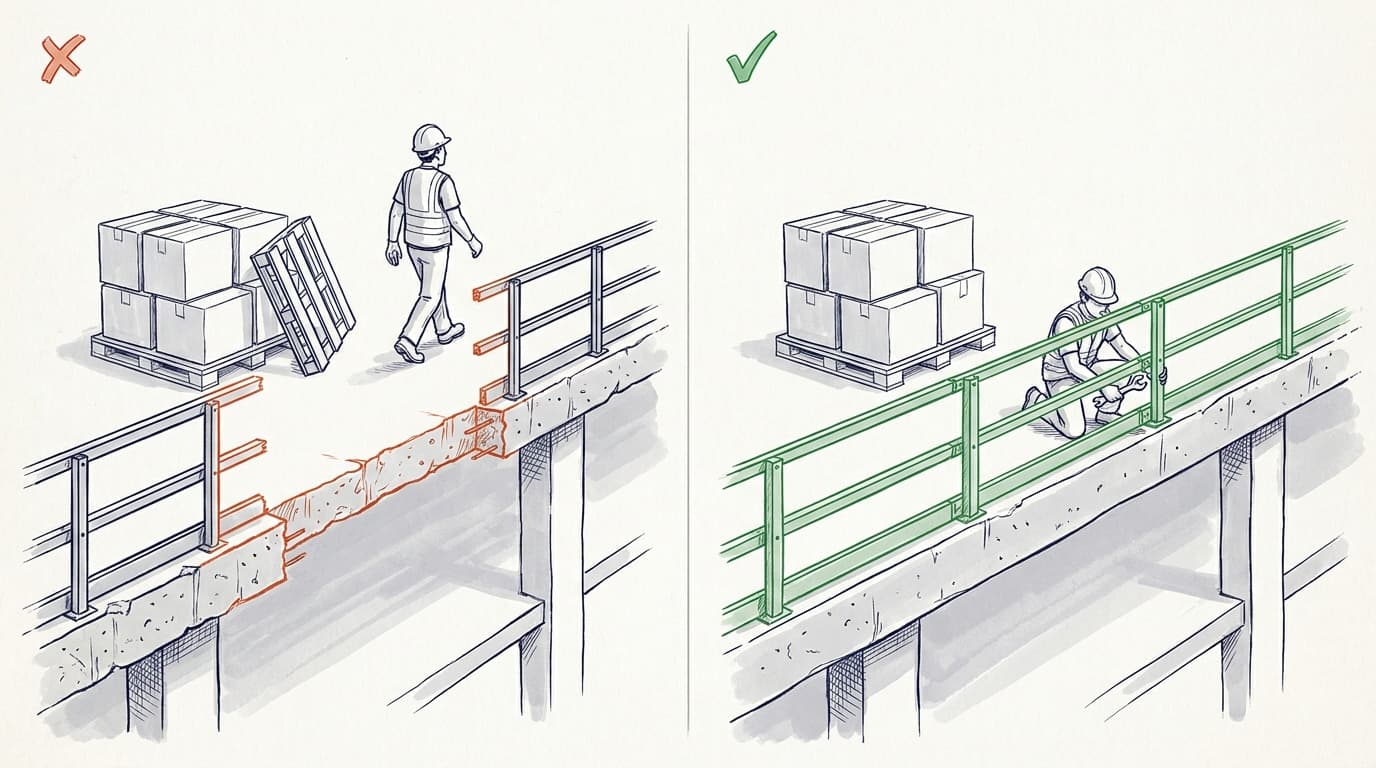
Here is the distinction that carries this whole talk: conditions produce the behaviour that people get blamed for. If the only route past a stack of material is to climb over it, someone will climb over it. If the guardrail was removed for a delivery and never went back, someone will work at the edge. If the correct tool is three floors down, the wrong tool will be used. Naming the resulting act as carelessness stops the inquiry exactly one step short of the thing that could have been fixed.
The definition with two halves — 1926.32(f)#
Most of construction's inspection duties rest on one defined term, and the definition is doing more work than people realise:
Competent person means one who is capable of identifying existing and predictable hazards in the surroundings or working conditions which are unsanitary, hazardous, or dangerous to employees, and who has authorization to take prompt corrective measures to eliminate them.
Two halves, joined by and.
The first half is capability — being able to identify hazards. That is the part everyone trains for.
The second half is authority — authorization to take prompt corrective measures to eliminate them. That part is not training; it is a decision the employer makes about what a person is permitted to do.
Someone who can spot an unsafe condition but has to seek permission before fixing it does not meet the definition. OSHA has been explicit on the point, stating that these definitions provide that a competent person must have authority to take prompt measures to eliminate hazards at the work site and have the experience to be capable of identifying them. If your competent person has to phone someone before a guardrail goes back, you have appointed half a competent person.
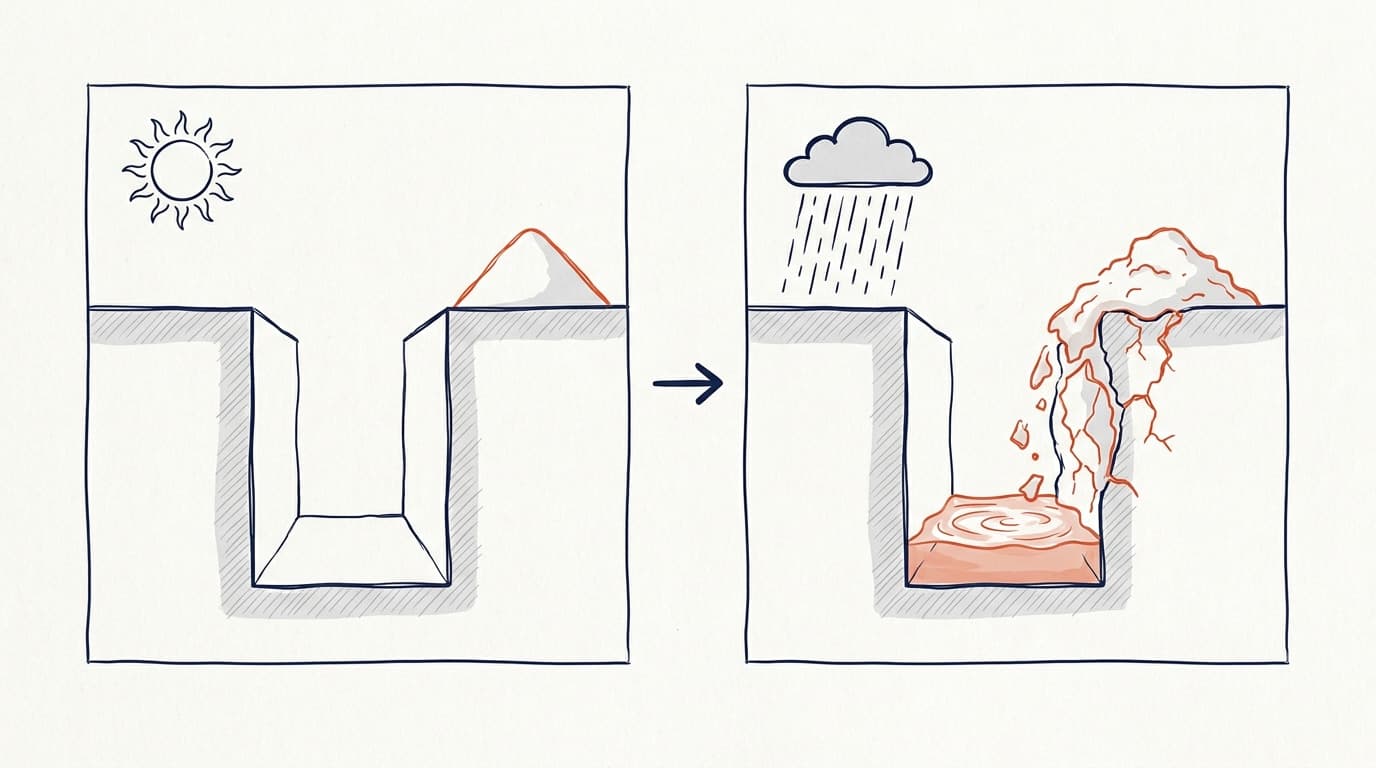
And note the other phrase people skip: existing and predictable hazards. The definition does not stop at what is wrong now. It reaches what will be wrong — the excavation that will take rain overnight, the material stack that will be climbed, the edge that will be exposed when the formwork strikes tomorrow.
Where the duty sits#
1926.20(b)(2) — accident prevention programmes must provide for frequent and regular inspections of the job sites, materials and equipment to be made by competent persons designated by the employer. Two requirements in one line: the inspections must be frequent and regular, and the person doing them must be designated and must meet 1926.32(f) in both halves.
1926.21(b)(2) — the employer must instruct each employee in the recognition and avoidance of unsafe conditions. Recognition is trainable; the standard treats it as the employer's job to build it.
Section 5(a)(1) — the General Duty Clause turns on recognised hazards. A condition that has been walked past for a fortnight is, by any ordinary reading, recognised.
The conditions that keep recurring#
Access and egress. Blocked routes, material stacked in walkways, ladders at the wrong angle or not extending above the landing, temporary stairs without handrails.
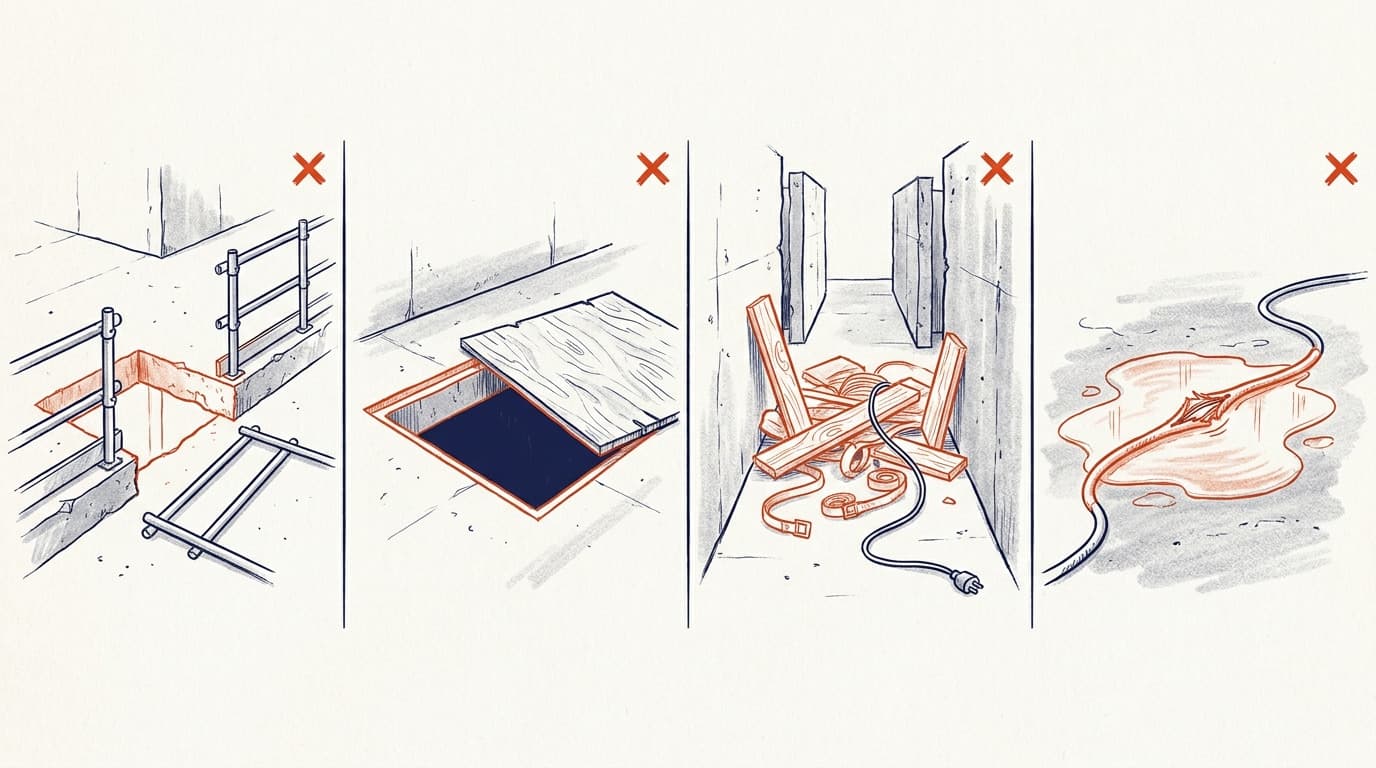
Edges and openings. Guardrails removed for a lift and not replaced, floor openings with covers that are not secured or marked, riser shafts opened for services.
Housekeeping. Offcuts, banding, packaging and cable across routes — individually trivial, collectively the most common source of injury on any site.
Lighting. Task lighting that has failed, stair cores unlit, transitions from bright to dark.
Temporary electrics. Damaged cords, open panels, cable in water, connections made and never revisited.
Excavations and ground. Spoil at the edge, water accumulating, a wall that has changed since the last look, plant working close to an unsupported face.
Scaffolds and platforms. Missing components after another trade adjusted them, boards removed for access, ties taken out for a delivery.
Material and storage. Stacks too high or unstable, sheet material leaning, cylinders unsecured, loads left slung.
Weather-changed conditions. Everything above, after rain, wind, frost or a hot afternoon.
The pattern worth noticing: most of these are the trace of a task that finished badly — someone removed something to get work done and did not restore it. That is why the last five minutes of a task matter more than the first five.
Why conditions become invisible#
Habituation. The brain stops reporting what does not change. A hazard present on day one is genuinely not seen by day ten, and that is physiology rather than negligence.
Ownership gaps. The condition belongs to whoever created it, who has left, and to whoever is affected, who did not create it. Between the two, nothing happens.
No authority. The person who sees it cannot fix it — which is exactly what 1926.32(f) was written to prevent.
Reporting friction. If reporting a condition takes a form, a login and a supervisor, most conditions will not be reported.
Normal for this site. The most dangerous sentence in construction, because it converts a defect into a standard.
What can go wrong?#
A guardrail removed for a delivery and never replaced, with everyone assuming somebody else will.
A cover on a floor opening that is not secured or marked, and gets moved by the next trade.
A condition reported and logged but never closed, so reporting stops.
Inspections done by someone without authority to correct anything.
The same finding on every inspection report for two months.
Conditions inherited between shifts with no handover, so the night crew meets a site they did not build.
Predictable hazards ignored because they are not hazards yet — the classic being the excavation before the forecast rain.
Fixes that create new conditions: a temporary barrier that blocks the fire route, a cover that becomes a trip hazard.
How do we manage this properly?#
Appoint competent persons with both halves — the capability to identify and the authorisation to take prompt corrective measures. Say so explicitly, so they know they can act.
Make inspections frequent and regular as 1926.20(b)(2) requires, and vary who does them, because fresh eyes see what habituated eyes cannot.
Look for predictable hazards, not just existing ones. What will this look like after rain, after the next trade, after the formwork strikes?
Fix it now if you can. The single most valuable safety habit on any site is correcting the small condition in the moment rather than reporting it for later.
Close the loop on what you cannot fix. A reported condition with no visible outcome teaches people not to report.
Restore at the end of the task. Guardrails back, covers secured and marked, tools cleared, cable lifted, routes reopened. Build it into the method rather than into goodwill.
Hand over between shifts and between trades, because most inherited conditions arrive without a message.
Walk the site as a stranger. Once a week, deliberately, along the routes people actually take rather than the ones on the drawing.
Before you start#
- Confirm who the designated competent person is for this area, and that they can correct things without asking.
- Confirm the access route to your work area is clear and lit.
- Confirm every edge and opening near you is protected, covered or marked.
- Confirm nothing has been removed by another trade since yesterday.
- Confirm the ground and any excavation nearby has been looked at since the last rain.
- Confirm temporary power in your area is undamaged and panels are closed.
- Confirm what you will restore before you finish today.
- Confirm how you report a condition you cannot fix yourself, and who closes it.
Talk it over#
- What have you walked past every day this week without thinking about it?
- What did the last trade leave behind in your area?
- Can the person doing our inspections actually fix what they find?
- What is going to be unsafe here tomorrow that is fine today?
The bottom line#
1926.32(f) defines a competent person as one capable of identifying existing and predictable hazards in the surroundings or working conditions and who has authorization to take prompt corrective measures to eliminate them — two halves joined by "and", and someone who must ask permission before correcting a hazard does not meet it. Note also predictable: the definition reaches hazards that have not appeared yet. 1926.20(b)(2) requires frequent and regular inspections of job sites, materials and equipment by competent persons designated by the employer; 1926.21(b)(2) requires employees to be instructed in the recognition and avoidance of unsafe conditions; and Section 5(a)(1) turns on recognised hazards — which a condition walked past for a fortnight plainly is. The framing that matters on site: conditions produce the behaviour people get blamed for, and most unsafe conditions are the trace of a task that finished badly.
Frequently asked questions about unsafe conditions#
What is OSHA's definition of a competent person?
Under 1926.32(f), one who is capable of identifying existing and predictable hazards in the surroundings or working conditions which are unsanitary, hazardous or dangerous to employees, and who has authorization to take prompt corrective measures to eliminate them. The definition has two halves and both are required.
Does a competent person need authority to fix things?
Yes — it is half the definition. OSHA has stated that the definitions provide that a competent person must have authority to take prompt measures to eliminate hazards at the work site and the experience to be capable of identifying them. Someone who can only identify a hazard and must escalate before anything is done does not meet 1926.32(f).
What does "predictable hazards" mean?
That the duty is not limited to what is wrong right now. The definition covers existing and predictable hazards — so the excavation that will take water in tonight's rain, the material stack that will be climbed, and the edge that will be exposed when formwork strikes tomorrow are all within scope of what a competent person is expected to identify.
How often must inspections happen?
1926.20(b)(2) requires accident prevention programmes to provide for frequent and regular inspections of the job sites, materials and equipment by competent persons designated by the employer. The standard does not set an interval, so "frequent and regular" has to be judged against the pace at which conditions change on your site.
Why do people stop noticing hazards?
Habituation. The brain stops reporting stimuli that do not change, so a hazard present on day one is genuinely not seen by day ten. That is why rotating who performs inspections, and occasionally walking the site as a stranger along the routes people actually use, finds conditions that daily familiarity hides.
What is the most common source of unsafe conditions?
Tasks that finished badly. A large share of conditions — removed guardrails, unsecured covers, cable across routes, material in walkways, ties taken out for a delivery — are the trace of someone removing or moving something to get work done and not restoring it. That is why the last five minutes of a task matter more than the first five.
What should happen to a condition you cannot fix?
Report it, and someone must close it visibly. A condition reported, logged and left open teaches the crew that reporting achieves nothing, and reporting then stops — which removes the site's early warning system. If it cannot be corrected immediately, it should at least be isolated, barricaded or marked so nobody meets it unprepared.
Download the unsafe conditions toolbox talk PDF#
Get this common unsafe conditions toolbox talk as a print-ready PDF — available in English, Spanish, Portuguese, and Turkish. Print it, hand it to the crew, and collect signatures on the included attendance sheet.
Download the PDF — free account required. New members get 3 free downloads.
Related toolbox talks#
Sources#
- OSHA, 29 CFR 1926.32 — Definitions: https://www.osha.gov/laws-regs/regulations/standardnumber/1926/1926.32
- OSHA, 29 CFR 1926.20 — General safety and health provisions: https://www.osha.gov/laws-regs/regulations/standardnumber/1926/1926.20
- OSHA, Competent Person — Overview: https://www.osha.gov/competent-person
Written by FieldSafetyTalk's safety professional — a CSP, ASP, CHST and OSHA Authorized Outreach Trainer with 14+ years of international construction safety experience across federal, heavy civil, and industrial projects.