Personal Protective Equipment (PPE)
Updated 2026-07-23
In this bundle Jobsite Fundamentals & Compliance
Working in Washington? See the WA DOSH edition → Washington (WA DOSH)
Print-ready PDF
Download this talk as a print-ready PDF, available in 4 languages.
Personal protective equipment (PPE) is the most visible safety measure on any site and the most misunderstood. Everyone can see who is wearing a hard hat. Nobody can see whether the guardrail behind them was ever installed. That visibility makes PPE feel like the centre of a safety programme when it is actually the last thing standing between a worker and an injury every other control failed to prevent. This PPE talk is about the protection that only matters after everything else has already gone wrong.
Here is the distinction that carries this whole talk: every other control removes the hazard or separates you from it. A guardrail means you cannot fall. A lockout means the machine cannot start. PPE does neither — the hazard still reaches you, and the equipment simply changes what happens when it does. That is why PPE sits at the bottom of the hierarchy of controls, and why a site that relies on it heavily is telling you something about the controls above it. Wear it, always. But never mistake wearing it for being protected.
Why is PPE the last line of defence?#
The hierarchy of controls ranks protection by reliability, and PPE ranks last for a reason: it depends on a person putting it on correctly, every time, and it fails silently when they do not.
Enforcement data shows how often that dependence is misplaced. On OSHA's Top 10 Most Frequently Cited Standards for Fiscal Year 2025, three PPE-related standards appear:
- Respiratory Protection (29 CFR 1910.134) — fifth
- Eye and Face Protection (29 CFR 1926.102) — ninth
- Machine Guarding (29 CFR 1910.212) — tenth
(National Safety Council, preliminary FY2025 data.)
Penalties reflect the seriousness: OSHA assesses $16,550 per serious violation and up to $165,514 for willful or repeated violations, effective January 2025. Penalties apply per violation, so several unprotected workers multiply the total quickly.
The underlying injury picture is what PPE is meant to reduce. Struck-by incidents — flying fragments, falling tools, ejected material — account for 21.5 percent of all non-fatal construction injuries, the largest single category (CPWR Data Bulletin, March 2023, from BLS data). Eye and face injuries cluster in exactly those environments.
OSHA PPE requirements (29 CFR 1926 Subpart E)#
Construction PPE is governed by 29 CFR 1926 Subpart E, sections 1926.95 through 1926.107.
A significant change took effect on January 13, 2025. OSHA amended 1926.95(c) to require that PPE is "selected to ensure that it properly fits each affected employee." The construction standard previously had no explicit fit requirement, unlike general industry. If your PPE programme predates 2025, this provision needs checking.
- General requirement — 1926.95(a). PPE must be provided, used, and maintained in a sanitary and reliable condition wherever it is necessary because of hazards from processes or environment.
- Employee-owned PPE — 1926.95(b). Where employees provide their own equipment, the employer must assure its adequacy, including proper maintenance and sanitation.
- Design and fit — 1926.95(c). All PPE must be of safe design and construction for the work, and selected to ensure it properly fits each affected employee (as amended, effective January 13, 2025).
- Who pays — 1926.95(d)(1). PPE used to comply with the standard must be provided by the employer at no cost to employees. The narrow exceptions under 1926.95(d)(2) are non-specialty safety-toe footwear and non-specialty prescription safety eyewear, provided the employer permits those items to be worn off the jobsite.
- Employer responsibility — 1926.28(a). The employer is responsible for requiring the wearing of appropriate PPE in all operations where there is an exposure to hazardous conditions.
- Head protection — 1926.100. Required where there is a possible danger of head injury from impact, falling or flying objects, or electrical shock and burns.
- Eye and face protection — 1926.102. Required when machines or operations present potential eye or face injury. Protectors must be reasonably comfortable, fit snugly, and not unduly interfere with the wearer's movements (1926.102(a)(5)).
- Foot protection — 1926.96. Safety-toe footwear meeting the applicable consensus standard.
- Hearing protection — 1926.101. Required where noise exposure cannot be reduced to acceptable levels by engineering or administrative controls.
- Respiratory protection — 1926.103. Governed by 29 CFR 1910.134, including fit testing, medical evaluation, and a written programme.
On USACE and NAVFAC projects, EM 385-1-1 applies and is more restrictive in several places.
What can go wrong with PPE?#
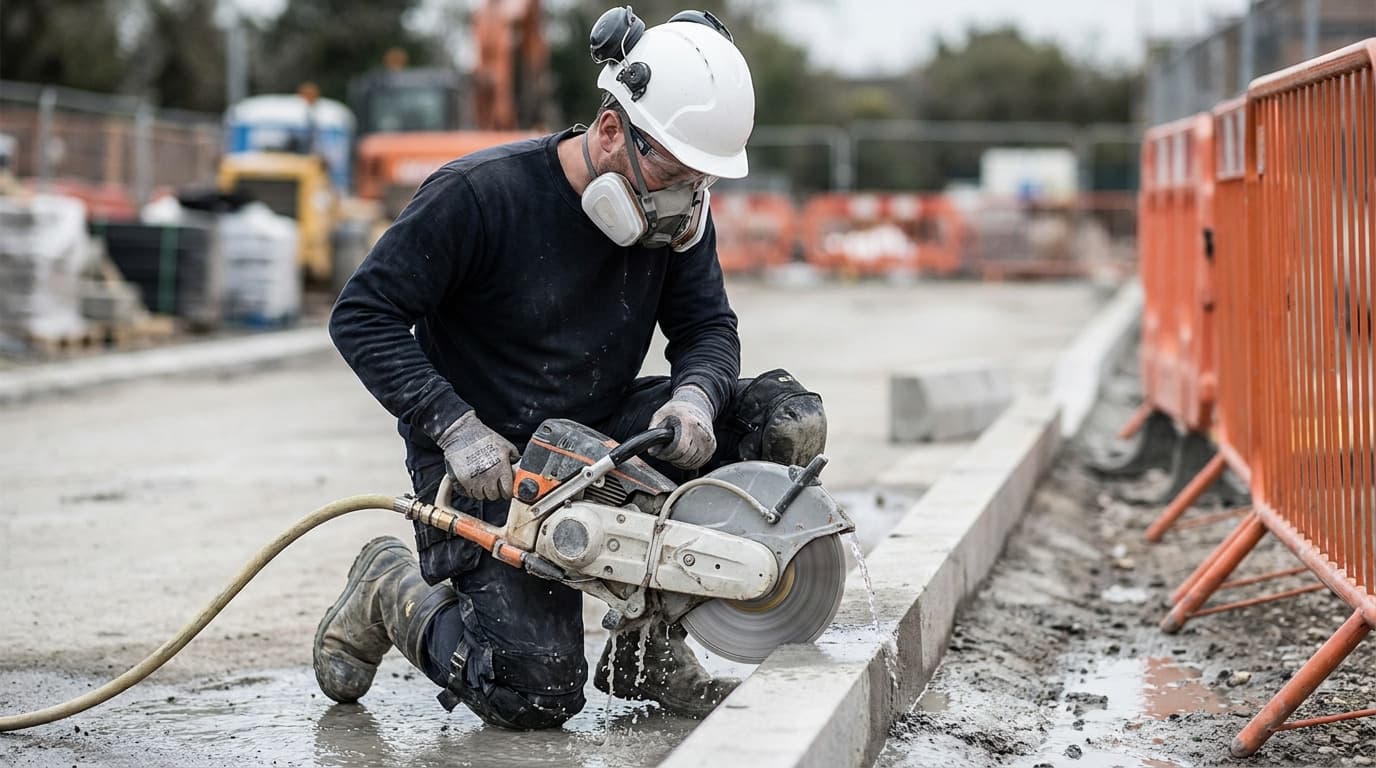
Wrong PPE for the actual hazard. Safety glasses where a face shield is needed for grinding. Leather gloves where chemical-resistant gloves are required. A dust mask where a respirator is needed for silica. The worker is wearing something, feels protected, and is not.
PPE that does not fit — now explicitly a violation. Loose gloves near rotating parts create an entanglement hazard worse than bare hands. A harness sized wrong will not distribute arrest forces correctly. A respirator that leaks provides no protection at all. Fit has always mattered; since January 2025 the construction standard says so directly.
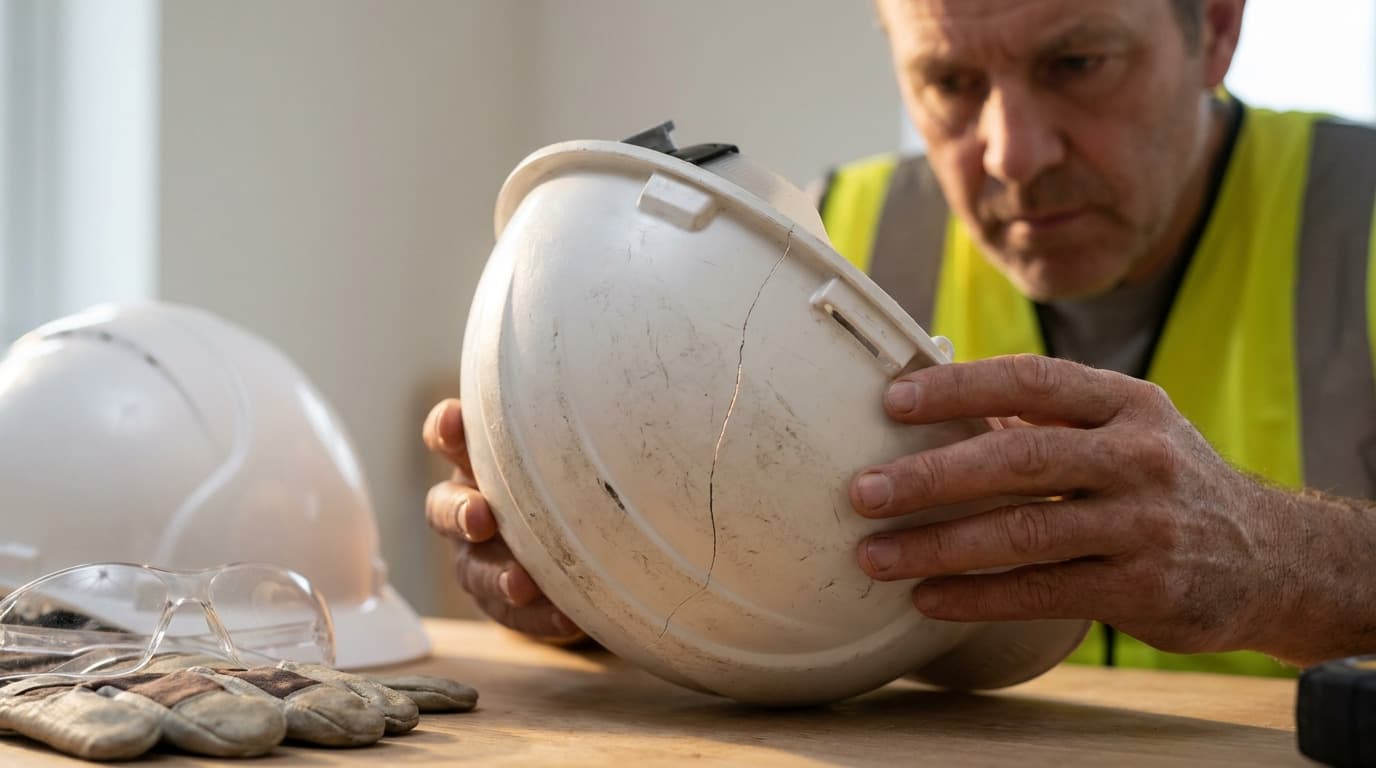
Damaged or expired equipment. Scratched lenses that obscure vision, cracked hard hat shells, harnesses with cut webbing, respirator cartridges past their service life, and voltage-rated gloves past their test date. Damaged PPE looks like working PPE.
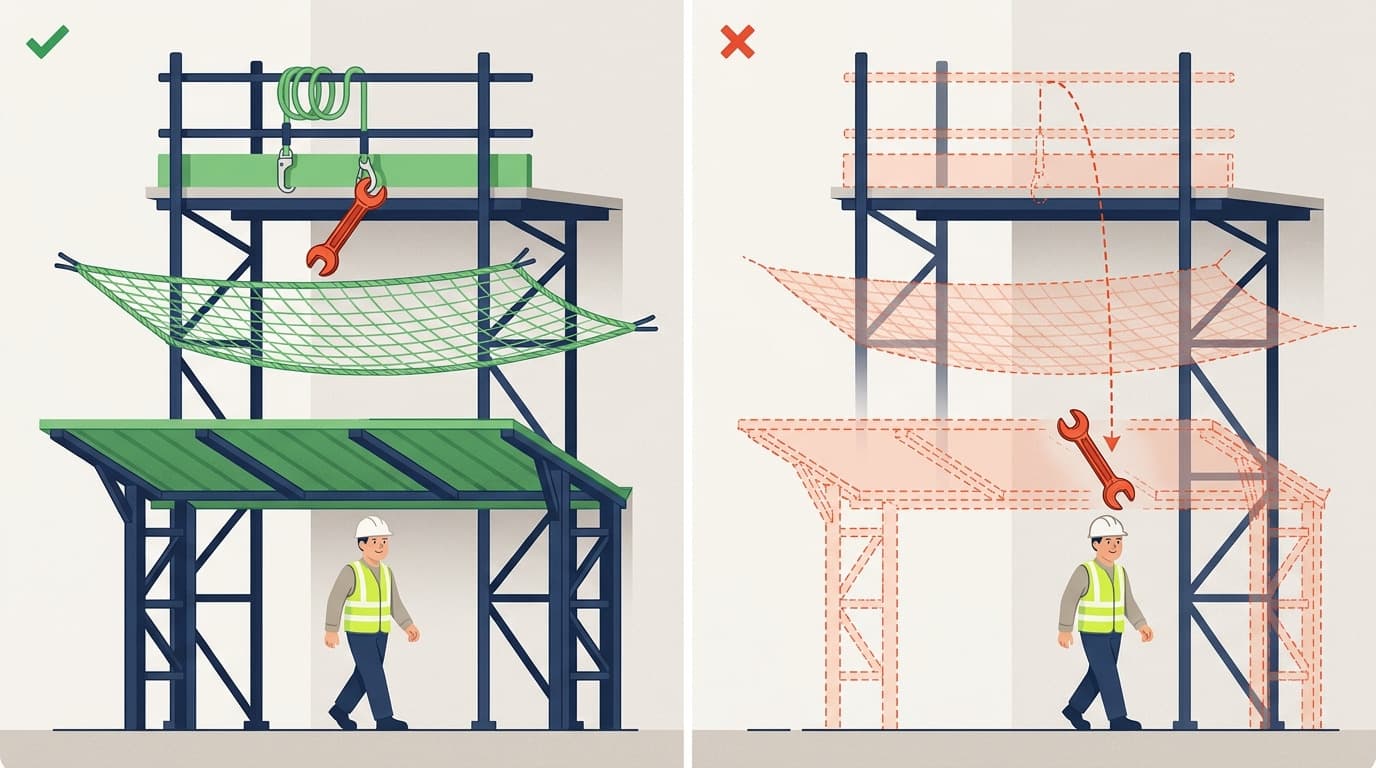
PPE substituting for a missing control. A crew wearing hard hats under an area with no toeboards. A worker in a harness at an edge with no guardrail because the harness "covers it." This is the failure that matters most, because PPE is being used to justify not fixing something.
Not worn at the moment it counts. Glasses pushed up on the hard hat for a quick cut. Hearing protection removed to hear a conversation. The exposure is brief, so the protection comes off — and briefness has nothing to do with whether a fragment reaches an eye.
Contaminated or shared equipment. Respirators and hearing protection shared between workers, gloves saturated with the chemical they were meant to exclude, and clothing contaminated with silica or lead taken home to families.
How do we use PPE correctly?#
Fix the hierarchy first. Before selecting PPE, ask what could eliminate the hazard, substitute something safer, engineer it out, or control it administratively. PPE is what remains when those are genuinely exhausted — not the first answer.
Assess the hazard, then select the PPE. The selection follows from a documented look at what is actually present: impact, penetration, compression, chemical, heat, harmful dust, light radiation, noise. Generic PPE issued site-wide will be wrong for some tasks.
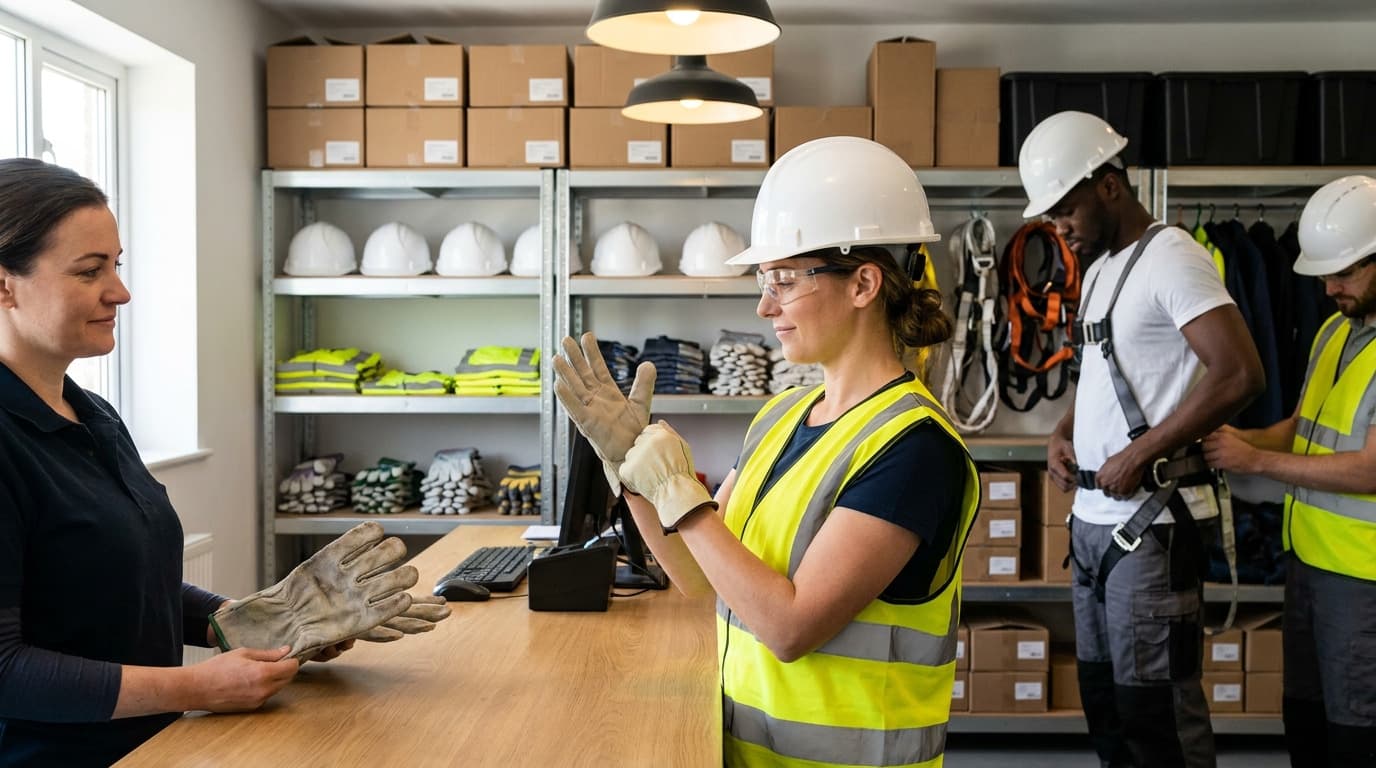
Confirm fit for each person — this is now explicit. Under the amended 1926.95(c), PPE must be selected to properly fit each affected employee. That means sizes stocked for the actual workforce, including workers whom standard sizing does not fit, and respirator fit testing where respirators are used.
Know who pays. Under 1926.95(d)(1), required PPE is provided by the employer at no cost. The only exceptions are non-specialty safety-toe footwear and non-specialty prescription safety eyewear that may be worn off site. Nobody should be buying their own required protection.
Inspect before every use:
- Hard hat — shell cracks, deformation, damaged suspension, correct orientation
- Eye protection — scratches obscuring vision, cracks, missing side shields
- Gloves — holes, tears, chemical degradation, correct type for the hazard
- Harness — cut or frayed webbing, chemical burns, corroded hardware, deployed indicators
- Respirator — seal condition, valve function, cartridge service life
Wear it for the whole exposure. Not most of it. The quick cut without glasses and the brief conversation without hearing protection are where the injuries land.
Keep it clean, stored, and personal. Respirators and hearing protection are individually assigned. Contaminated clothing does not leave site or go home. Damaged PPE is replaced, not repaired.
Train on limits as well as use. Every worker should know what their PPE does not protect against — that a hard hat has finite impact capacity, that safety glasses are not a face shield, that leather gloves offer no chemical protection.
Before you start#
- Ask what could eliminate or engineer out this hazard before accepting PPE as the answer.
- Identify every exposure for this specific task: impact, chemical, dust, noise, heat, light radiation.
- Confirm your PPE matches those exposures — not just what is generally issued on this site.
- Check the fit of every item, and raise it if something does not fit properly.
- Inspect each piece: cracks, tears, scratches, degraded webbing, expired cartridges or test dates.
- Confirm you are not wearing PPE in place of a control that should be there.
- Confirm nothing loose — gloves, sleeves, straps — near rotating equipment.
- Know what your PPE does not protect against.
Talk it over#
- Look at what everyone is wearing right now. Does it match the hazards of today's task, or yesterday's?
- Is there anything here where we are relying on PPE because a guardrail, a guard, or a barrier is missing?
- Does everyone's PPE actually fit? Who has been putting up with something too big or too small?
The bottom line#
PPE is the most visible control and the least reliable, because it does not remove the hazard — it only changes what happens when the hazard reaches you. Fix the hierarchy first, then select PPE from a real assessment of the exposures. Since January 2025, OSHA explicitly requires PPE that properly fits each worker, and the employer pays for required PPE with only narrow exceptions. Inspect before every use, wear it for the whole exposure rather than most of it, and never let PPE become the reason a missing guardrail stays missing.
Frequently asked questions about PPE#
Does OSHA require employers to pay for PPE?
Yes. Under 29 CFR 1926.95(d)(1), PPE used to comply with the standard must be provided by the employer at no cost to employees. The exceptions under 1926.95(d)(2) are narrow: non-specialty safety-toe footwear and non-specialty prescription safety eyewear, provided the employer permits those items to be worn off the jobsite.
Does construction PPE have to fit properly?
Yes — and this is now explicit. OSHA amended 29 CFR 1926.95(c) effective January 13, 2025 to require that PPE is "selected to ensure that it properly fits each affected employee." The construction standard previously lacked an explicit fit requirement, unlike general industry. Improperly fitting PPE may provide no protection or create new hazards.
Why is PPE considered the last line of defence?
Because it does not remove the hazard. Elimination, substitution, engineering controls, and administrative controls all reduce or separate the exposure. PPE lets the hazard reach the worker and only changes the outcome. It also depends on correct use every single time, and it fails silently when it is not worn, does not fit, or is damaged.
What are the most cited PPE standards?
On OSHA's Top 10 for Fiscal Year 2025, Respiratory Protection (1910.134) ranked fifth, Eye and Face Protection (1926.102) ranked ninth, and Machine Guarding (1910.212) ranked tenth (National Safety Council, preliminary data). Penalties are $16,550 per serious violation and up to $165,514 for willful or repeated violations.
Can I use my own PPE from home?
Only if the employer assures its adequacy. Under 29 CFR 1926.95(b), where employees provide their own protective equipment, the employer remains responsible for assuring it is adequate, including proper maintenance and sanitation. The employer cannot avoid the payment obligation by relying on worker-supplied equipment.
Do safety glasses protect against grinding?
Not adequately on their own. Grinding produces high-velocity fragments and requires a face shield worn over safety glasses, not instead of them. Under 29 CFR 1926.102, eye and face protection must match the specific hazard, and the protector must fit snugly without unduly interfering with movement.
Download the PPE toolbox talk PDF#
Get this PPE toolbox talk as a print-ready PDF — available in English, Spanish, Portuguese, and Turkish. Print it, hand it to the crew, and collect signatures on the included attendance sheet.
Download the PDF — free account required. New members get 3 free downloads.
Related toolbox talks#
Sources#
- OSHA, 29 CFR 1926.95 — Criteria for personal protective equipment: https://www.osha.gov/laws-regs/regulations/standardnumber/1926/1926.95
- OSHA, Personal Protective Equipment in Construction, final rule, December 12, 2024: https://www.osha.gov/laws-regs/federalregister/2024-12-12
- OSHA, Top 10 Most Frequently Cited Standards: https://www.osha.gov/top10citedstandards
- CPWR, Fatal and Nonfatal Focus Four Injuries in Construction, Data Bulletin March 2023: https://www.cpwr.com/wp-content/uploads/DataBulletin-March2023.pdf