Scaffolding Safety
Updated 2026-07-23
In this bundle Fall Protection & Heights
Print-ready PDF
Download this talk as a print-ready PDF, available in 4 languages.
You did not build the scaffold you are about to work on. Somebody else erected it, possibly on a different shift, possibly weeks ago, and other trades have been on it since. You are going to stand on their work, twenty feet up, and trust it with your life based on a green tag and a glance. This Scaffolding Safety Toolbox Talk (Safety Talk / Tailgate Talk) is about the one work platform you inherit rather than create.
Here is the distinction that carries this whole talk: with almost every other hazard on this site, you control your own exposure. You choose your anchor, you set your own ladder, you inspect your own harness. A scaffold is different — the decisions that determine whether it holds were made by someone you may never meet, before you arrived, and the consequences land on you. That changes what your job is. You are not the builder, but you are the last person who can catch a problem before it costs someone. The tag tells you a competent person signed off at a moment in time. It does not tell you what happened to the scaffold since.
How dangerous is scaffolding work?#
The numbers say this is not a marginal hazard. According to the Bureau of Labor Statistics Census of Fatal Occupational Injuries, cited by OSHA's Directorate of Construction, 52 workers died from falls to a lower level from scaffolding in 2020.
Those fatalities sit inside a much larger pattern:
- BLS recorded 1,075 construction fatalities in 2023, and 421 of them — 39.2 percent — were falls, slips, and trips (BLS Census of Fatal Occupational Injuries, 2023).
- Scaffolds and staging were the primary source of 2,500 nonfatal construction injuries in 2021–2022 (CPWR Data Bulletin, March 2024, from BLS data).
- Scaffolding (29 CFR 1926.451) appears on OSHA's Top 10 Most Frequently Cited Standards for Fiscal Year 2025, as it has for decades (National Safety Council, preliminary FY2025 data).
Scaffolding safety is not an area where the rules are unclear or the risk is theoretical. It is an area where known requirements are routinely not met — and where the person who suffers is frequently not the person who made the decision.
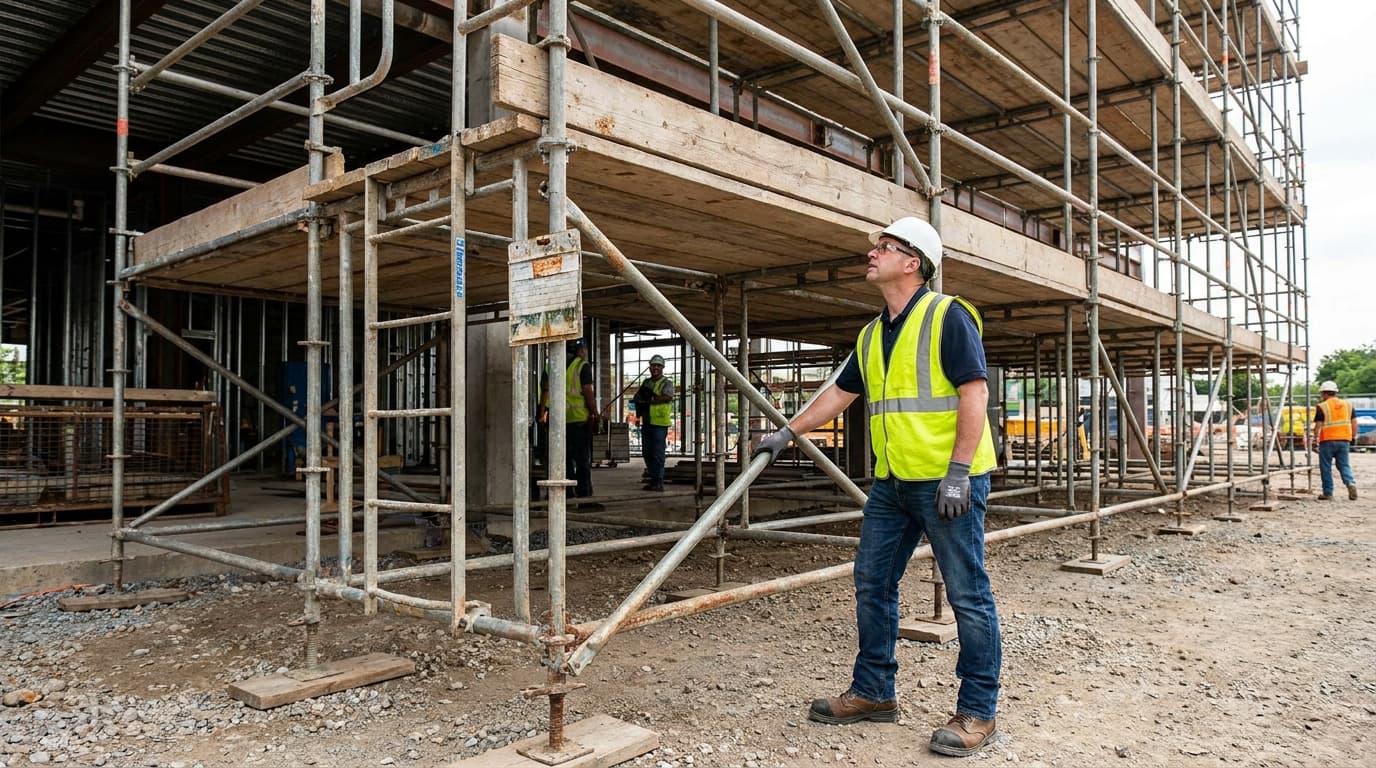
OSHA scaffolding requirements (29 CFR 1926 Subpart L)#
Scaffolding is governed by 29 CFR 1926 Subpart L, sections 1926.450 through 1926.454. These are the provisions that matter most on a working scaffold:
- Capacity — 1926.451(a)(1). Each scaffold and scaffold component must support its own weight plus at least 4 times the maximum intended load. Suspension ropes and connecting hardware must support at least 6 times the intended load.
- Platform width — 1926.451(b)(2). Platforms and walkways must be at least 18 inches wide.
- Platform gaps — 1926.451(b). Platforms must be fully planked or decked, with the front edge no more than 14 inches from the work face for most work.
- 4:1 height-to-base ratio — 1926.451(c)(1). Supported scaffolds with a height-to-base-width ratio greater than 4:1 must be restrained from tipping by guying, tying, or bracing. Ties repeat vertically every 20 feet for scaffolds 3 feet wide or less, and every 26 feet for scaffolds wider than 3 feet, at horizontal intervals not exceeding 30 feet.
- Fall protection — 1926.451(g)(1). Each employee more than 10 feet above a lower level must be protected by guardrails or a personal fall arrest system. Note this differs from the 6-foot trigger under Subpart M for most other construction work.
- Guardrail height — 1926.451(g)(4)(ii). For scaffolds manufactured or placed in service after January 1, 2000, the top rail must be between 38 and 45 inches above the platform.
- Inspection — 1926.451(f)(3). A competent person must inspect the scaffold and its components for visible defects before each work shift, and after any occurrence which could affect structural integrity.
- Supervision — 1926.451(f)(7). A competent person must be on site directing and supervising all erecting, dismantling, altering, and moving.
- Housekeeping — 1926.451(f)(13). Work is prohibited on platforms cluttered with debris.
- Deflection — 1926.451(f)(16). A platform must not deflect more than 1/60 of its span when loaded.
- Training — 1926.454. Every employee who erects, disassembles, moves, operates, repairs, maintains, or inspects a scaffold must be trained by a competent person.
On USACE and NAVFAC projects, EM 385-1-1 applies and is more restrictive in several places.
What can go wrong on a scaffold?#
Collapse is almost always foundation or capacity. A scaffold set on soft ground, on mud that dried and shrank, on a single unsecured plank, or on stacked blocks and scrap instead of proper mudsills and base plates will settle unevenly and fail. Overloading does the same from the other direction — material stacked beyond the rated capacity, or a load landed onto a bay never designed to take it.
Falls are more common than collapses. They come from:
- Missing or incomplete guardrails on open sides and ends
- Incomplete planking — a platform decked at one end and short at the other is a hole at working height
- Gaps between the platform and the structure
- Planks with too little overhang, which tip when a worker steps on the end
- Planks with too much overhang, which create a diving board
Access is its own category. Workers climb the frame instead of using the ladder or stair tower, because the access is at the far end and the work is right here. Climbing cross braces is routine on many sites and produces routine injuries.
Other trades change your scaffold without telling you. Guardrails and planks get removed to land material or run a hoist, and not replaced. Ties and braces get removed because they were in the way of a duct run. Components get borrowed from one scaffold to complete another. None of this is visible from the ground, and none of it updates the tag hanging at the access point.
Struck-by is the exposure for everyone below. Tools, offcuts, and material fall from platforms that lack toeboards, and the people at risk never went near the scaffold.
Environmental conditions change everything without changing the appearance. Wind loads a scaffold heavily, particularly when sheeted or netted, turning the structure into a sail. Ice, rain, and mud make platforms slick. And scaffolds erected near overhead lines put metal components and long tools within reach of energized conductors.
How do we prevent scaffolding accidents?#
Erect, alter, and dismantle under a competent person. Scaffold work is not general labour. It is performed by trained erectors under the supervision of a competent person, following the manufacturer's or a qualified person's design, as required by 1926.451(f)(7).
Build the foundation properly. Base plates and mudsills on firm, level, compacted ground. No blocks, bricks, scrap timber, or drums as improvised bases. If the ground is questionable or the scaffold is tall, the foundation is engineered rather than judged.
Tie it in at the 4:1 ratio. Once height exceeds four times the minimum base width, the scaffold must be restrained per 1926.451(c)(1). Ties are not optional and not removable at the convenience of whoever finds them inconvenient.
Plank fully and correctly. Platforms fully planked across the working area, planks of the right grade and condition, secured against uplift, with correct overhang at both ends. No gaps a foot or a tool can go through.
Guardrail every open side. Top rail between 38 and 45 inches, midrail, and toeboard on every open side and end above the trigger height. Toeboards protect the crew below, and on many scaffolds that crew is the reason the toeboard matters more than anything else on the platform.
Use the tag system honestly:
- Green tag — a competent person inspected it and it is safe for use as erected
- Yellow tag — specific restrictions apply, and you need to know what they are before you climb
- Red tag — do not use
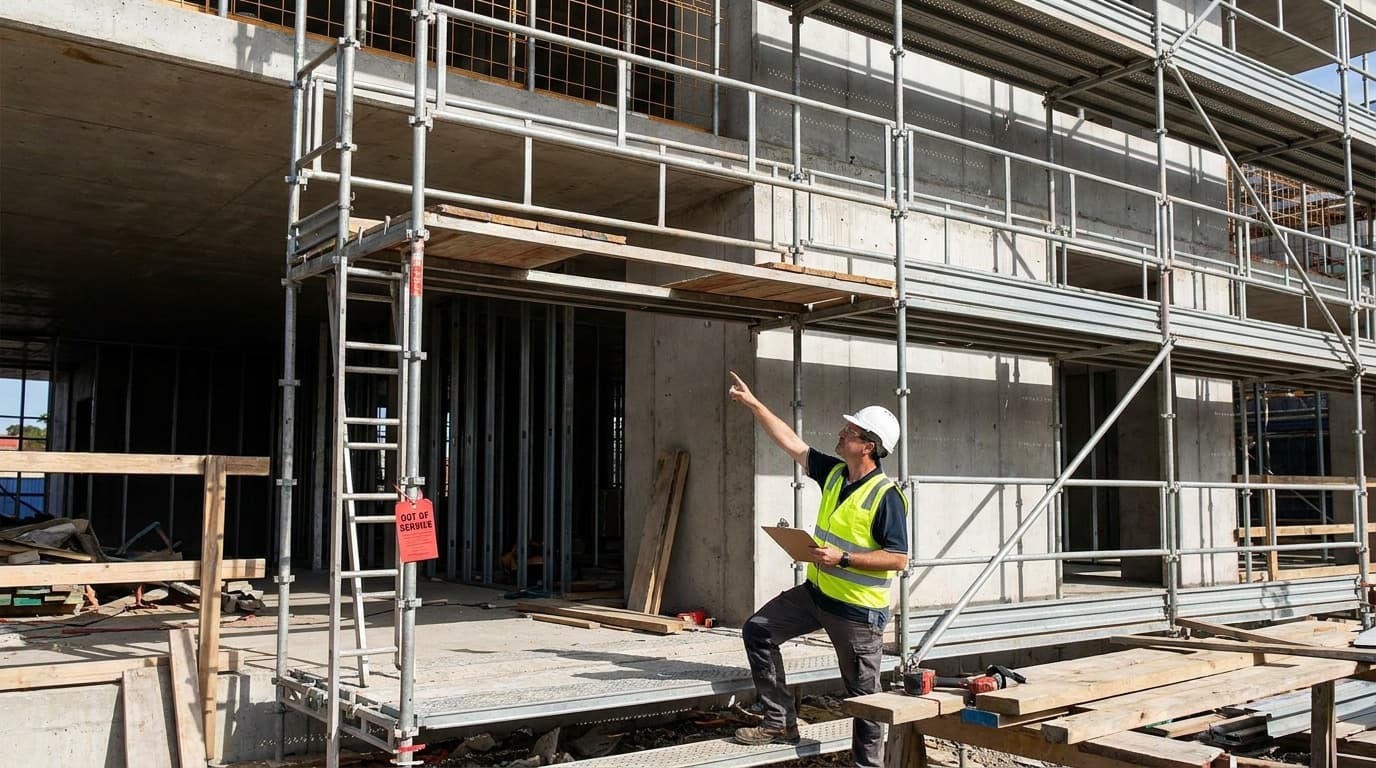
The tag is checked before each work shift and after any event that could affect the structure: weather, impact, alteration, or a load landed on it.
Inspect it yourself anyway. The tag is a starting point, not a guarantee. Look at the base, the ties, the planking, the guardrails, and the access before you climb. You are checking whether anything changed since the tag was signed.
Never modify or remove components. If a guardrail, plank, tie, or brace is in the way of your work, that is a request to the scaffold crew, not a decision you make with a hammer. Anything removed for material handling goes back before that crew leaves the area, and the scaffold is re-inspected.
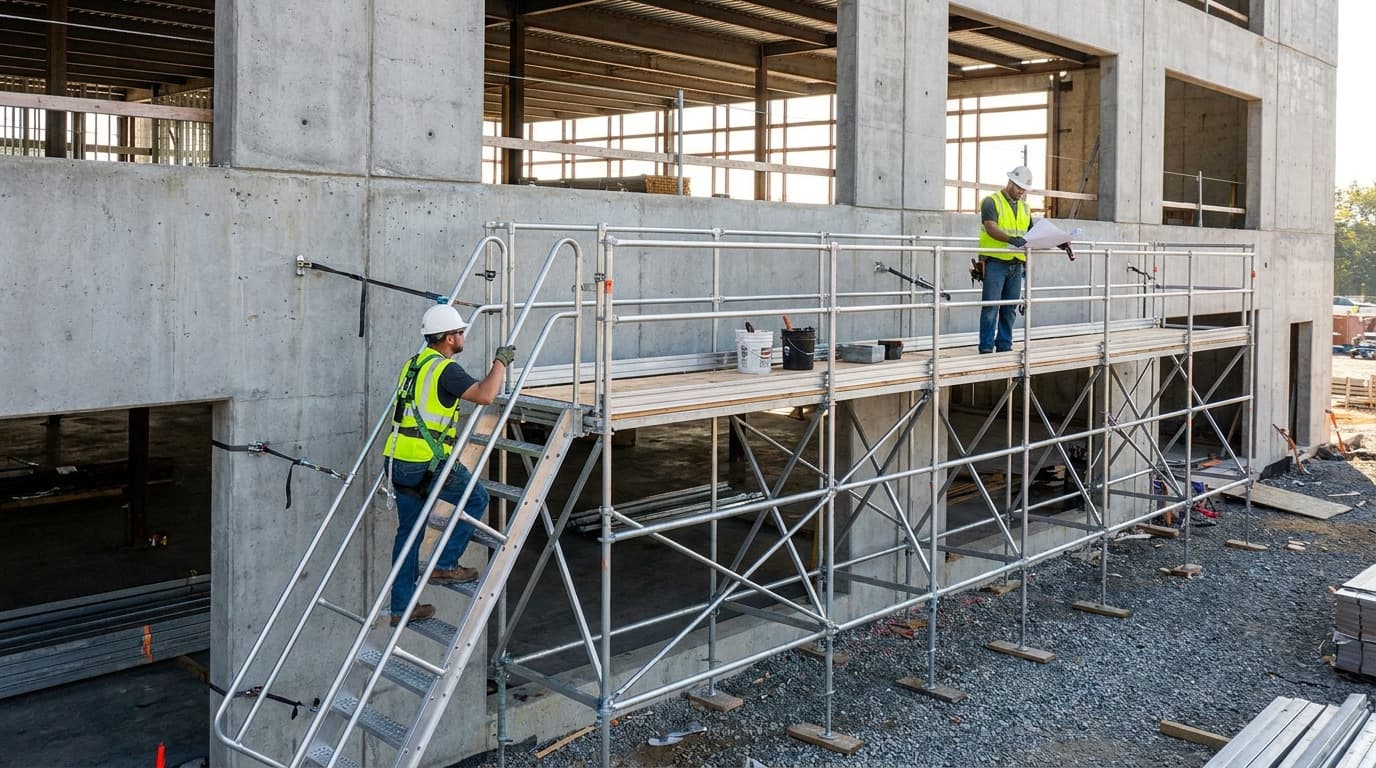
Use the access provided. Ladders, stair towers, or integral ladders. Never climb the frame or the cross braces.
Control loading. Know the scaffold's rated duty and stay within it. Distribute material rather than concentrating it. Do not land a crane or hoist load onto a platform not designed for it.
Stop for weather. Set wind limits, particularly for sheeted or netted scaffolds, and stop conditions for ice and lightning. Re-inspect after any severe weather before anyone climbs.
Maintain clearance from power lines. Treat every overhead line as energized, maintain minimum approach distances during erection and use, and have lines de-energized or covered by the utility where clearance cannot be maintained.
Before you start#
- Read the tag at the access point. Green, yellow, or red — and if yellow, know exactly what the restriction is.
- Check the base: proper base plates and mudsills, firm level ground, nothing improvised, no settlement or washout.
- Look for ties and braces and confirm none appear to have been removed.
- Check the platform: fully planked, no gaps, planks sound and secured, correct overhang.
- Confirm guardrails and toeboards are present and complete on every open side.
- Confirm the access is a ladder or stair tower and that you can reach it without climbing the frame.
- Check the platform surface for ice, water, mud, or debris.
- Look up for overhead power lines and confirm clearance.
- Know the scaffold's rated capacity and what is already staged on it.
Talk it over#
- Who built this scaffold, and when was the tag last signed? What has been on it since?
- Walk the base with me — is that foundation what you would have built, or what was available that morning?
- If a guardrail is in your way today, what are you actually going to do about it?
The bottom line#
A scaffold is the one work platform you inherit rather than build, which means the decisions that determine whether it holds were made by someone else, before you got there. The tag tells you it was safe when it was signed — not what happened since. Read the tag, then inspect the base, ties, planking, guardrails, and access yourself before you climb. Never modify components, never climb the frame, and never assume the scaffold you worked on yesterday is the same one today.
Frequently asked questions about scaffolding safety#
How often must a scaffold be inspected?
Under 29 CFR 1926.451(f)(3), a competent person must inspect the scaffold and its components for visible defects before each work shift and after any occurrence which could affect structural integrity — severe weather, impact from equipment, alteration, or a load being landed on it. Users should also perform their own visual check before climbing.
What is the 4:1 rule for scaffolding?
29 CFR 1926.451(c)(1) requires supported scaffolds with a height-to-base-width ratio greater than 4:1 to be restrained from tipping by guying, tying, or bracing. Ties repeat vertically every 20 feet for scaffolds 3 feet wide or less and every 26 feet for wider scaffolds, at horizontal intervals not exceeding 30 feet.
At what height is fall protection required on a scaffold?
29 CFR 1926.451(g)(1) requires fall protection for each employee more than 10 feet above a lower level — a different trigger from the 6-foot threshold in Subpart M for most other construction work. Guardrail top rails must be between 38 and 45 inches for scaffolds placed in service after January 1, 2000.
How much weight must a scaffold support?
Under 29 CFR 1926.451(a)(1), each scaffold and component must support its own weight plus at least 4 times the maximum intended load. Suspension ropes, hardware, and connections on suspension scaffolds must support at least 6 times the intended load.
What do the scaffold tag colours mean?
Green means a competent person inspected the scaffold and it is safe for use as erected. Yellow means it may be used only with specific restrictions, which you must understand before climbing. Red means do not use. Tags are checked before each work shift and after any event that could affect the structure.
Can I climb the cross braces to reach the platform?
No. Cross braces are structural members, not a ladder, and climbing them is a routine cause of injury. Access must be by a ladder, stair tower, integral ladder, or other designed means, positioned so workers can reach the platform without climbing the frame.
Download the scaffolding safety toolbox talk PDF#
Get this scaffolding safety toolbox talk as a print-ready PDF — available in English, Spanish, Portuguese, and Turkish. Print it, hand it to the crew, and collect signatures on the included attendance sheet.
Download the PDF — free account required. New members get 3 free downloads.
Related toolbox talks#
Sources#
- OSHA, Scaffolding — Overview (BLS CFOI data via OSHA Directorate of Construction): https://www.osha.gov/scaffolding
- OSHA, 29 CFR 1926 Subpart L — Scaffolds: https://www.osha.gov/laws-regs/regulations/standardnumber/1926
- CPWR, Fatal and Nonfatal Falls in the U.S. Construction Industry, 2011–2022, Data Bulletin March 2024: https://www.cpwr.com/wp-content/uploads/DataBulletin-March2024.pdf
- Bureau of Labor Statistics, Census of Fatal Occupational Injuries: https://www.bls.gov/iif/
Written by FieldSafetyTalk's safety professional — a CSP, ASP, CHST and OSHA Authorized Outreach Trainer with 14+ years of international construction safety experience across federal, heavy civil, and industrial projects.