Extreme Weather Conditions
Updated 2026-07-28
In this bundle Health & Environmental Exposure
Print-ready PDF
Download this talk as a print-ready PDF, available in 4 languages.
There is no OSHA standard called "weather." Search for one and you will not find it — which is why weather is usually treated as background rather than as a condition anyone has to act on. But the rules are there. They are just distributed, sitting inside the standard for whatever you happen to be doing, and most crews have never read the one that applies to them. This extreme weather conditions talk collects them.
Here is the distinction that carries this whole talk: weather is rarely the hazard — it is the multiplier on the hazards you already have. Wind does not hurt anyone by itself; it changes what a scaffold, a sheet of ply or a suspended load will do. Rain does not hurt anyone; it changes traction, visibility, electrical risk and the soil holding an excavation wall open. Every control on site has a condition attached to it, and weather is what moves that condition without anyone deciding to.
The weather rules are inside other standards#
Scaffolds — 1926.451(f)(12). The clearest stop-work provision in the construction rules:
Work on or from scaffolds is prohibited during storms or high winds unless a competent person has determined that it is safe for employees to be on the scaffold and those employees are protected by a personal fall arrest system or wind screens. Wind screens shall not be used unless the scaffold is secured against the anticipated wind forces imposed.
Note the structure. The default is prohibited. The exception requires a named role — a competent person — to make a determination, and the protection to be in place. And the sting is in the last sentence: wind screens themselves increase wind load, so the scaffold must be secured against the forces they impose. Sheeting or tarping a scaffold to keep the weather out is not a weather control; it is a structural change.
Hoisting personnel — 1926.1431(k)(8)(i). One of the few actual numbers: when wind speed (sustained or gusts) exceeds 20 mph at the personnel platform, a qualified person must determine whether, in light of the wind conditions, it is safe to lift personnel. Twenty miles an hour is not a storm — it is a breezy day — and above it, somebody with a defined role has to make a decision.
Excavations — 1926.651(k)(1). Daily inspections by a competent person, and inspections shall also be made after every rainstorm or other hazard-increasing occurrence. Rain does not just make an excavation unpleasant; it changes the soil, and the standard treats a rainstorm as an event that resets the inspection.
Everything else — 1926.21(b)(2). The employer must instruct each employee in the recognition and avoidance of unsafe conditions. Weather-changed conditions are unsafe conditions, and the duty to brief them lands here.
The pattern is worth stating plainly: the weather rule you have to follow is inside the standard for the work you are doing. Look for it there rather than for a weather standard that does not exist.
What each condition actually changes#
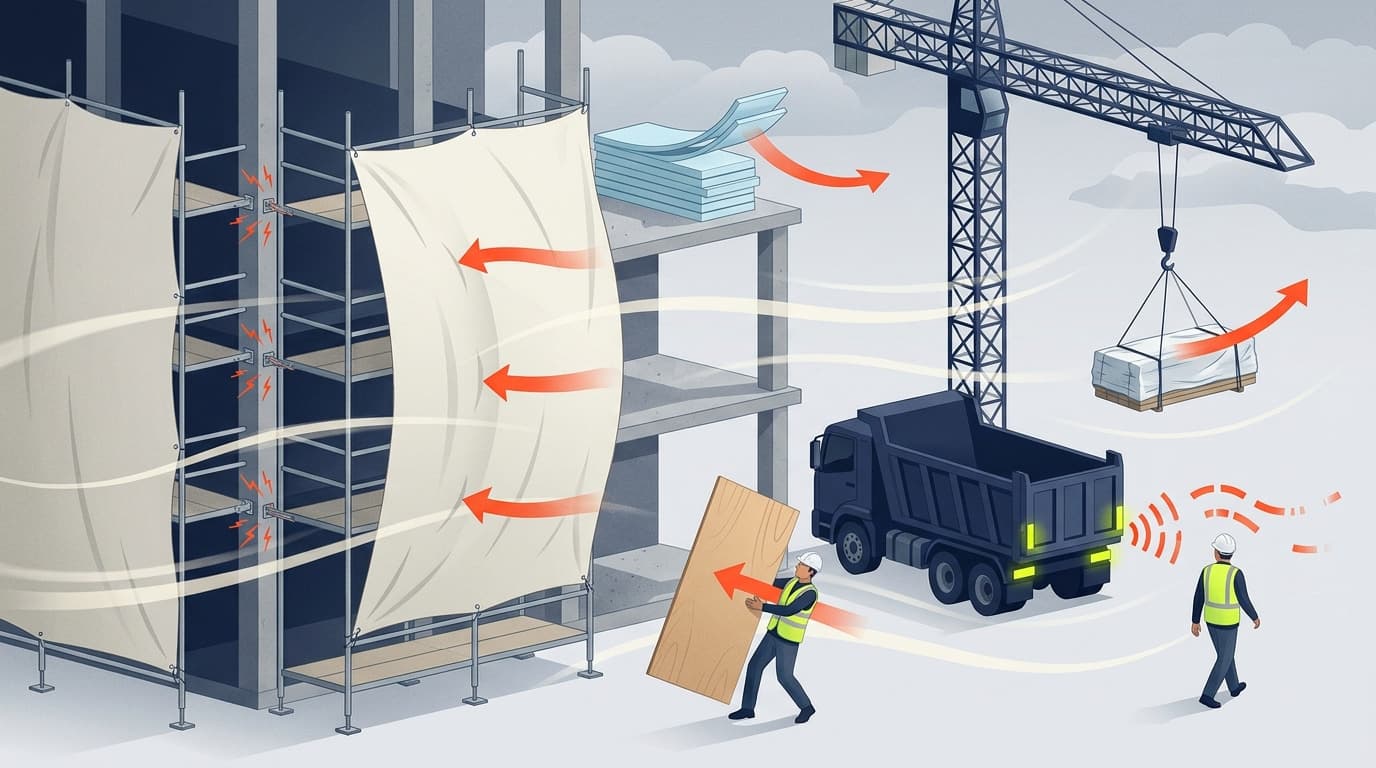
Wind changes surface area into load. Sheet material, formwork panels, plywood, insulation boards, scaffold sheeting and empty skips all become sails. It changes how a suspended load behaves, how a ladder or a panel behaves in a lift, and how far debris travels from an edge. It also removes hearing — wind noise buries reversing alarms and shouted warnings.
Rain changes traction on every surface a person or a machine uses: steel, formwork, scaffold boards, ramps, ladder rungs, mud. It changes electrical risk on temporary supplies and hand tools. It changes soil — which is why excavations get re-inspected — and it fills anything with a low point.
Mud and saturated ground change the stability of everything bearing on it: scaffold base plates, outriggers, mobile plant, stacked material. A crane or lift that was level yesterday may not be after a wet night.
Snow and ice add load to roofs, temporary structures and scaffolds, hide edges and openings, and make every walking surface a slip hazard. Ice also hides the condition of what is underneath it.
Poor visibility — fog, driving rain, blowing dust, early darkness — changes plant and pedestrian interaction more than anything else on this list, and it does it silently.
Prolonged heat and cold change the person rather than the site — judgement, grip, reaction and endurance — and those are covered in the heat stress and cold stress talks.
What can go wrong?#
Work continues on a scaffold because nobody called it a storm. The provision says "storms or high winds," and nobody has defined either for the site, so the default prohibition never triggers.
Sheeting goes up to keep the rain off. The scaffold now has a wind load it was not designed for, and nobody checked whether it is secured against it.
A lift proceeds at 25 mph gusts. Nobody measured, so the 20 mph determination point passed without a decision being made.
The excavation is entered the morning after heavy rain. No re-inspection, and the wall that stood for a week has changed.
Material is stacked as usual before a windy night. Sheet goods, formwork and light material left unsecured at height or near an edge.
Plant sinks or shifts on softened ground. Outriggers on pads that worked when the ground was dry.
Nobody can hear. Wind buries alarms and voices, and everyone carries on using hand signals that half the crew cannot see either.
The decision is made by whoever wants to finish. No named role, no threshold, no record — so it is made by momentum.
How do we manage this properly?#
Name the thresholds before the day starts. Wind speed for lifting, for working at height, for handling sheet material; rain for excavations and for electrical work. A threshold nobody has written down is a threshold nobody will apply.
Measure the wind rather than judging it. An anemometer reading at the work position — not at ground level, not by feel — because 20 mph at the personnel platform is a real trigger and gusts are what exceed it.
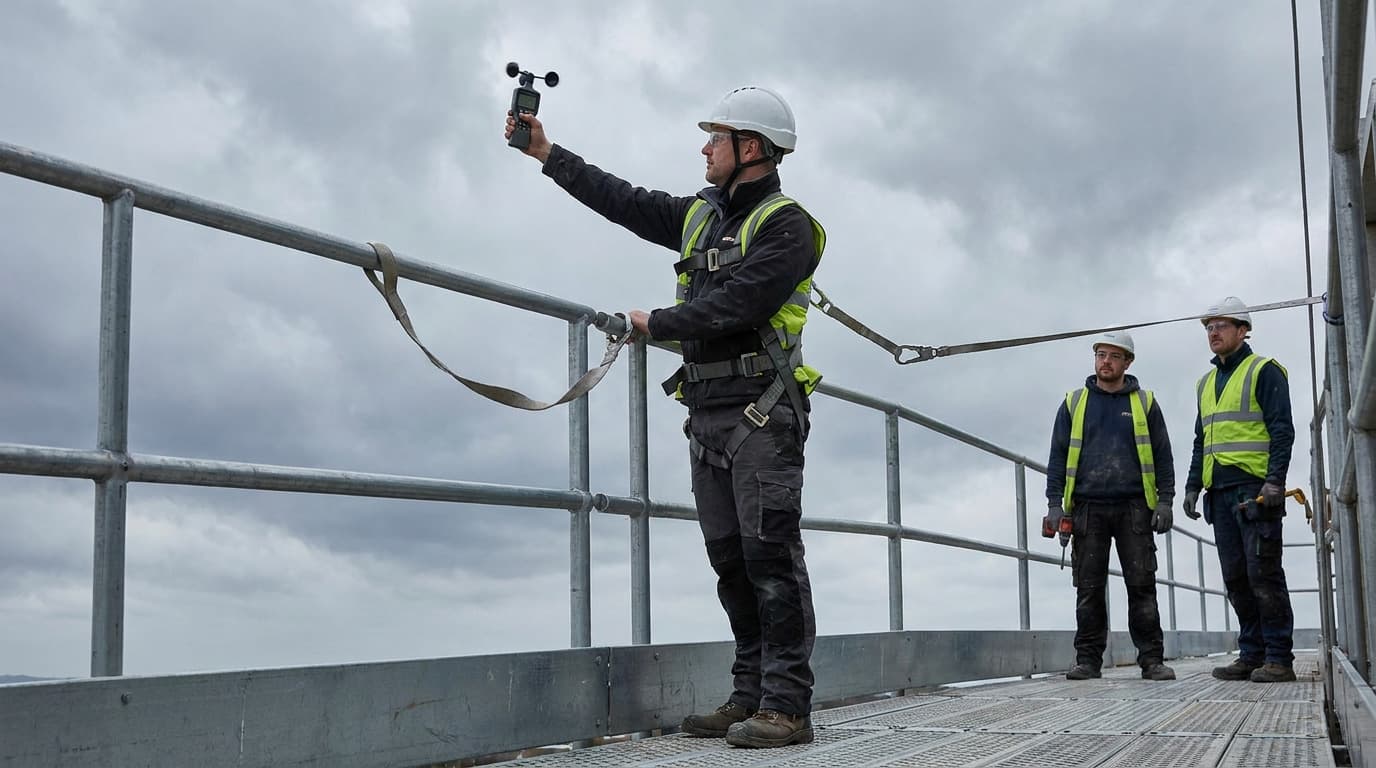
Give the decision to a named person. The standards do this deliberately: a competent person for the scaffold, a qualified person for lifting personnel. Match that on site so the call is not made by whoever is keenest to carry on.
Re-inspect after the weather, not before it. Excavations after every rainstorm, scaffolds and temporary structures after wind, ground conditions after rain, and anything that could have shifted overnight.
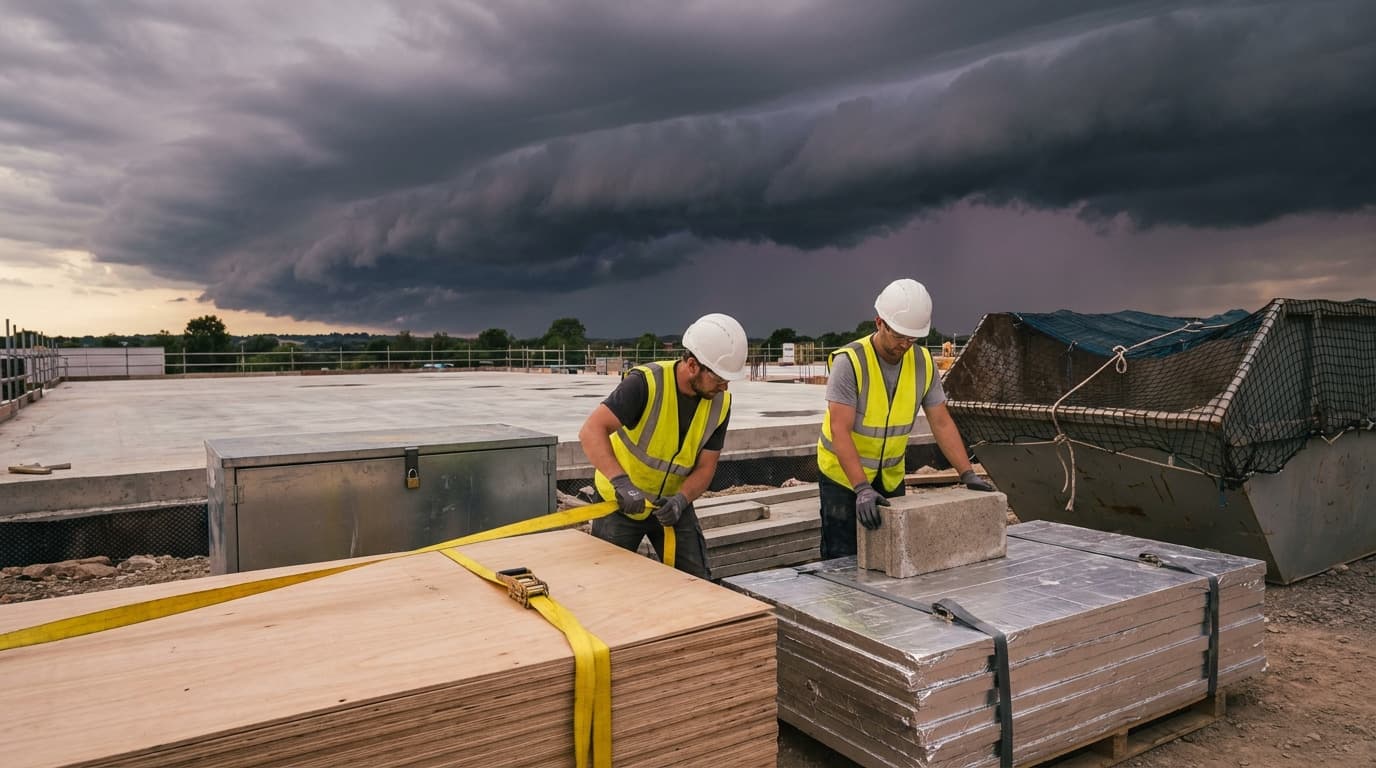
Secure before you leave, not when it starts. Sheet material tied or removed, loose items cleared from edges and openings, skips and drums weighted, and lifting equipment left in its stowed condition.
Treat sheeting as a structural change, because it is — the scaffold must be secured against the wind forces the screens impose.
Reassess the whole route. Traction and visibility affect access and egress as much as the work position, and most weather injuries happen while moving, not while working.
Write down what you decided and why. A weather decision without a record is a decision that gets remade differently every time.
Before you start#
- Confirm today's wind speed and forecast, measured at the work position where it matters.
- Confirm whether any task today has a defined weather threshold — lifting, scaffold, height, excavation.
- Confirm who the competent or qualified person is for any determination that may be needed.
- Confirm whether it has rained since the excavation was last inspected.
- Confirm ground conditions under plant, outriggers and scaffold base plates.
- Confirm what sheet material or loose items are exposed, and whether they are secured.
- Confirm traction and visibility along the access route, not just at the work face.
- Confirm what will stop work, and who has the authority to call it.
Talk it over#
- What wind speed stops the work you are doing today — and how would you know you had reached it?
- Has it rained since anyone last looked at that excavation?
- What is the lightest thing on this site, and where would it end up tonight?
- Who decides when the weather is too bad — and has anyone ever done it?
The bottom line#
There is no weather standard, but there are weather clauses, and they live inside the standards for the work. 1926.451(f)(12) makes work on or from scaffolds prohibited during storms or high winds unless a competent person determines it is safe and employees have a personal fall arrest system or wind screens — with wind screens themselves requiring the scaffold to be secured against the forces they impose. 1926.1431(k)(8)(i) requires a qualified person to determine whether lifting personnel is safe when wind (sustained or gusts) exceeds 20 mph at the personnel platform. 1926.651(k)(1) requires excavation inspections after every rainstorm or other hazard-increasing occurrence. And 1926.21(b)(2) requires employees to be instructed in recognising and avoiding unsafe conditions — which is what changed weather creates. Weather is the multiplier: it moves the condition attached to every control you have, without anyone deciding that it should.
Frequently asked questions about working in extreme weather#
Does OSHA have a weather standard for construction?
No single one. The requirements are distributed through the standards for particular work — scaffolds, hoisting personnel, excavations and the general training duty — so the weather rule that applies to you is inside the standard for whatever you are doing rather than in a standard called weather.
Can we work on a scaffold in high wind?
Only under conditions. 1926.451(f)(12) provides that work on or from scaffolds is prohibited during storms or high winds unless a competent person has determined that it is safe for employees to be on the scaffold and those employees are protected by a personal fall arrest system or wind screens. The default is prohibition; the exception requires a named role to make a determination.
Is there a wind speed limit for lifting people?
There is a decision point. 1926.1431(k)(8)(i) provides that when wind speed — sustained or gusts — exceeds 20 mph at the personnel platform, a qualified person must determine whether, in light of the wind conditions, it is safe to lift personnel. It is not an automatic prohibition, but above 20 mph somebody with a defined role has to decide.
Do wind screens make a scaffold safer in wind?
Not by themselves — they add load. 1926.451(f)(12) states that wind screens shall not be used unless the scaffold is secured against the anticipated wind forces imposed. Sheeting or tarping a scaffold changes its structural loading, so it is an engineering decision rather than a weather-proofing decision.
Does an excavation need re-inspecting after rain?
Yes. 1926.651(k)(1) requires daily inspections by a competent person and provides that inspections shall also be made after every rainstorm or other hazard-increasing occurrence. Rain changes the soil, so the inspection resets — the wall that held for a week is not evidence about the wall this morning.
What does wind actually do to a construction site?
It converts surface area into load. Sheet materials, formwork panels, insulation boards, scaffold sheeting and empty containers all behave as sails; suspended loads swing and rotate; debris travels further from edges and openings. It also masks sound, so reversing alarms and shouted warnings stop working at exactly the moment they matter.
Who should make the call to stop work for weather?
Someone with a defined role and the authority to use it. The standards themselves point that way — a competent person for scaffolds, a qualified person for lifting personnel — and matching that on site keeps the decision away from whoever is most motivated to finish. Thresholds and the person who applies them should both be agreed before the weather arrives.
Download the extreme weather toolbox talk PDF#
Get this extreme weather conditions toolbox talk as a print-ready PDF — available in English, Spanish, Portuguese, and Turkish. Print it, hand it to the crew, and collect signatures on the included attendance sheet.
Download the PDF — free account required. New members get 3 free downloads.
Related toolbox talks#
Sources#
- OSHA, 29 CFR 1926.451 — Scaffolds, general requirements: https://www.osha.gov/laws-regs/regulations/standardnumber/1926/1926.451
- OSHA, 29 CFR 1926.1431 — Hoisting personnel: https://www.osha.gov/laws-regs/regulations/standardnumber/1926/1926.1431
- OSHA, 29 CFR 1926.651 — Specific excavation requirements: https://www.osha.gov/laws-regs/regulations/standardnumber/1926/1926.651