Filing Cabinet Safety
Updated 2026-08-06
In this bundle Manual Handling & Body Mechanics
Print-ready PDF
Download this talk as a print-ready PDF, available in 4 languages.
A filing cabinet is the last thing most people would name as a serious hazard. It sits in the corner of the site trailer or the office, does nothing, and gets used a dozen times a day without a second thought. But a loaded four-drawer cabinet can weigh two to three hundred pounds, and every year they fall on people — pinning, crushing, and occasionally killing someone who did nothing more than open a drawer. The reason it surprises people is exactly the reason it is dangerous: the cabinet is not a hazard while it stands there, and it is not a hazard while you walk past it. It becomes a hazard only at the one moment you interact with it, which is precisely when your body is closest to it. This Filing Cabinet Safety Toolbox Talk (Safety Talk / Tailgate Talk) is about that narrow, easy-to-miss window where a piece of office furniture turns into a falling weight.
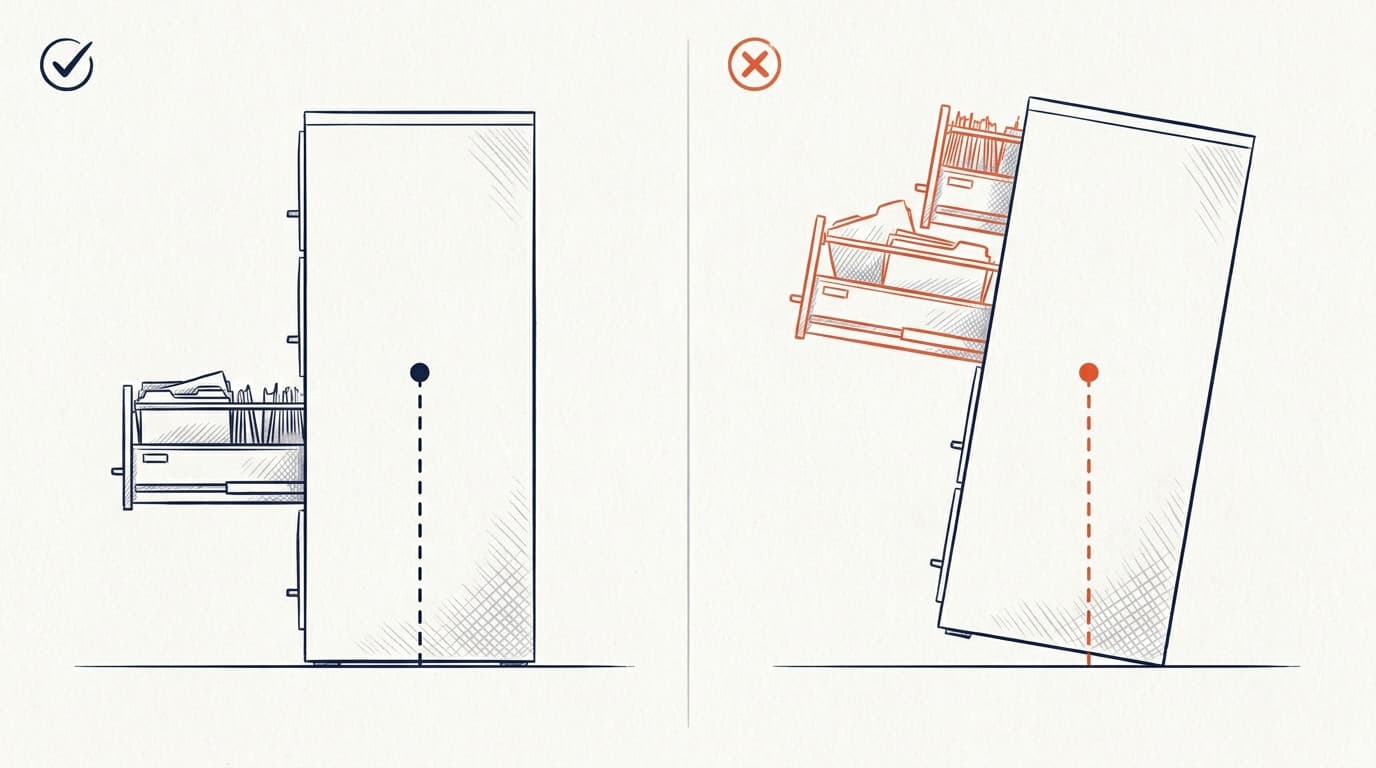
Here is the distinction that carries this whole talk: a filing cabinet is stable right up until the moment you use it — pulling open a drawer is the act of walking its weight out past its own base, so the thing that makes it tip is the same thing you came to it to do. Most heavy objects are dangerous when you move them. A filing cabinet is different: it does not move, you do not lift it, and yet the ordinary act of opening a drawer shifts its center of gravity forward, out over the front edge of its footprint. Open one drawer and the cabinet usually holds. Open a second, especially an upper one, and the combined weight can push the center of gravity past the front of the base entirely — at which point nothing is holding the cabinet up, and two or three hundred pounds pitches forward onto whoever is standing at it. The drawer is not how you get to the hazard; the drawer is the hazard.
Where the boundary of this talk sits#
This talk sits next to a few others and borrows one idea directly. The stacking and storing talk owns the stability of material piles you build — and the physics here is the same idea, center of gravity over the base, applied to a cabinet instead of a stack. The office ergonomics talk owns the posture and repetitive-strain side of desk work. The housekeeping talk owns general order and clear space. This talk owns the filing cabinet specifically: the tip-over that happens when a drawer moves the center of gravity past the base, and the handful of controls — one drawer at a time, heavy low, anchored, nothing on top — that keep it from happening. Where the question is stacked material, posture, or general tidiness, those talks own it; this one owns the moment a drawer comes open.
The stability triangle, and how a drawer breaks it#
The physics is worth understanding because it makes every rule obvious. An object stays upright as long as its center of gravity sits somewhere over its base — the footprint it stands on. A filing cabinet standing closed has its weight centered nicely over that footprint, which is why it is rock solid. Pull a loaded drawer out and you extend a large mass forward, away from the base, and the whole cabinet's center of gravity shifts toward the front edge. One drawer of files, on most cabinets, still leaves the center of gravity over the base — so it holds. But open a second drawer, or open a heavy upper drawer on a lightly loaded cabinet, and the center of gravity crosses the front line of the base. Past that line there is no base underneath the weight anymore, and the cabinet rotates forward around its front edge and falls. It does not lean and warn you; it goes, fast, and a two-hundred-pound cabinet reaches the floor at highway speed.
One drawer at a time#
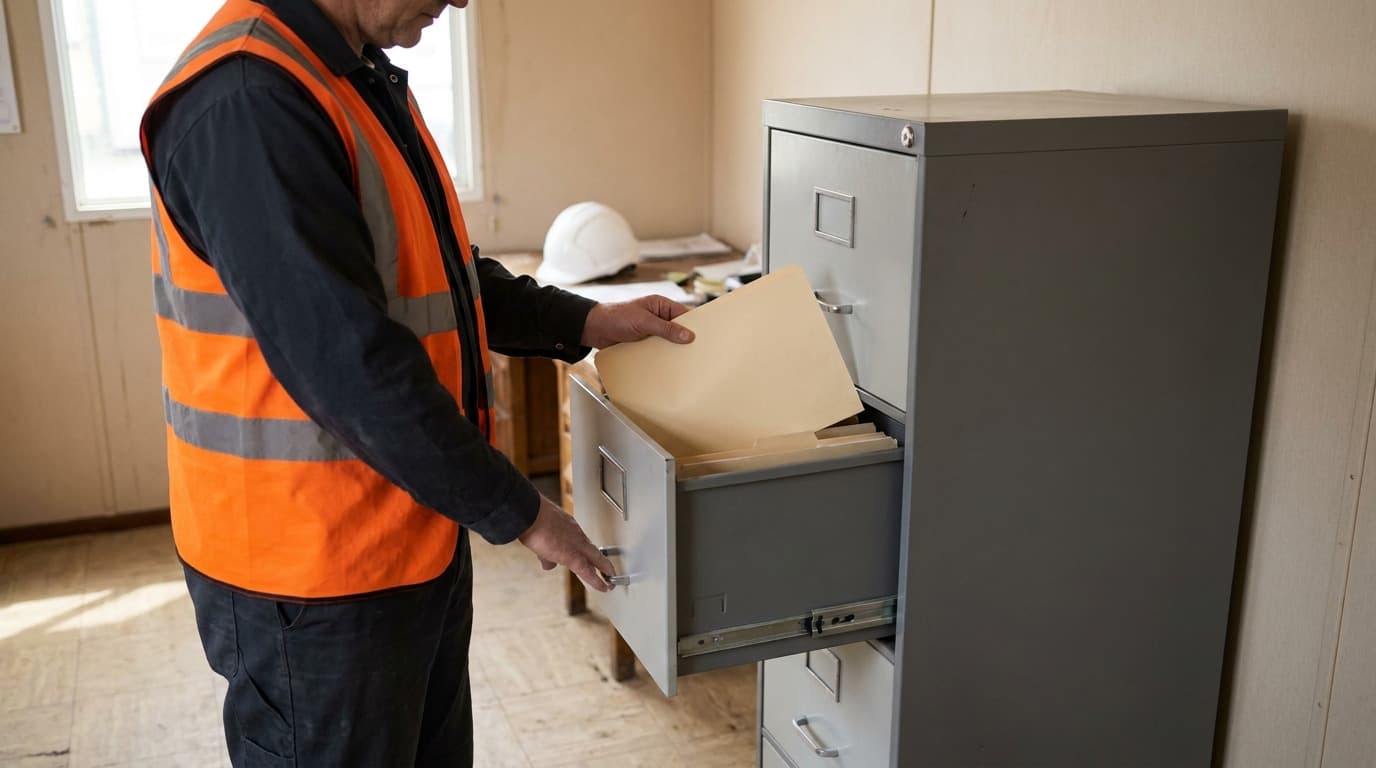
This is why the single most important rule is one drawer at a time, and why good cabinets enforce it mechanically. A drawer interlock is a device inside the cabinet that physically locks all the other drawers the moment one is opened, so it is impossible to have two out at once no matter how hard someone pulls. Interlocks and counterweighting are what make a modern cabinet safe, and they exist for exactly the failure described above — they keep the center of gravity from ever crossing the base line. Two things follow. First, if your cabinets have working interlocks, do not defeat them or prop them, because that mechanism is the safety device. Second, if your cabinets are older, cheap, or damaged and do not interlock, then the one-drawer rule is entirely on the person: close each drawer before opening the next, every time, no exceptions. A cabinet without an interlock is only as safe as the discipline of the last person who used it.
Keep the weight low and the cabinet anchored#
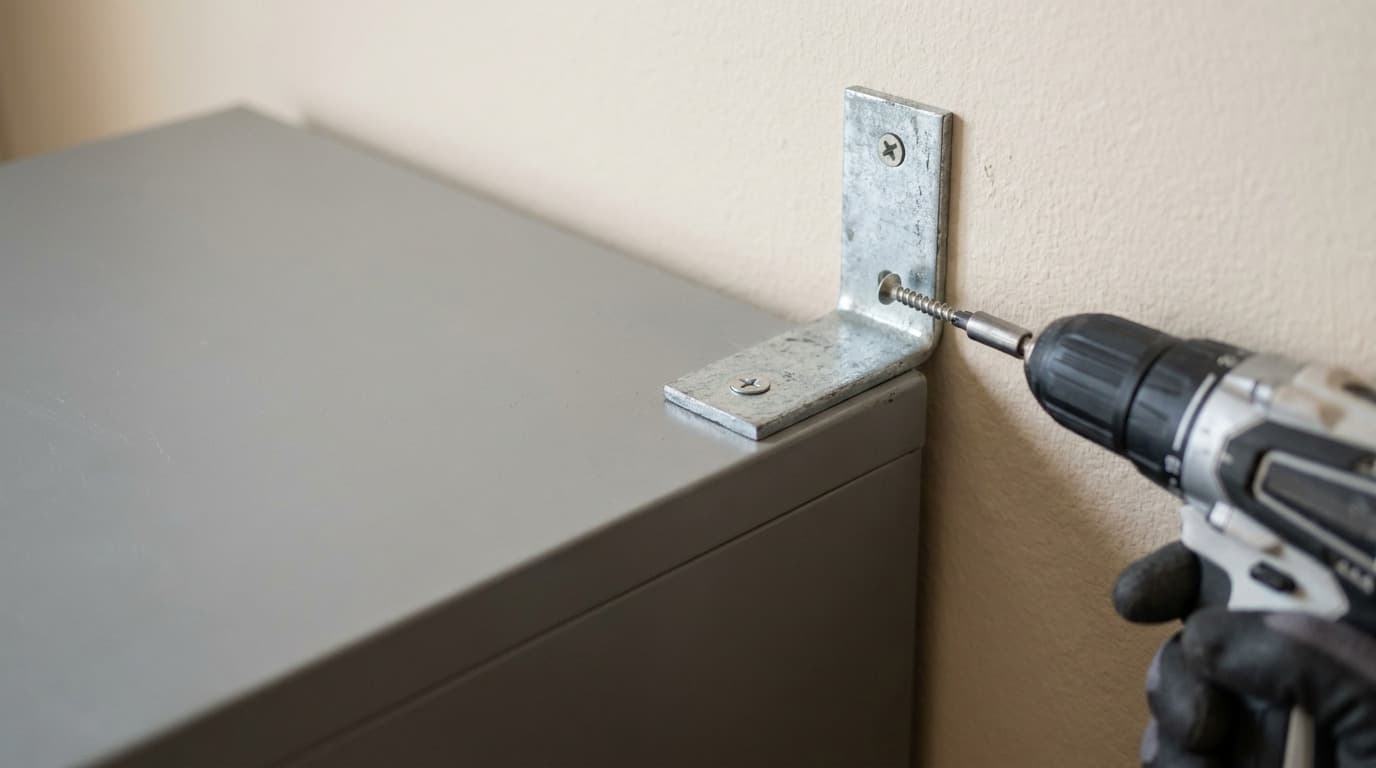
Two more controls keep the center of gravity where it belongs. The first is loading: put the heaviest files in the bottom drawers and the lighter contents up top. This keeps the resting center of gravity low, and it means the drawers most likely to be yanked wide — and to swing the weight forward — are the lighter ones. It also sets the safe habit of loading a cabinet from the bottom up and emptying it from the top down. The second is anchoring: a cabinet bolted or bracketed to the wall cannot pitch forward no matter what the drawers do, which is why wall-anchoring is the surest single fix, and why it is essential for taller units, lightly loaded units, and anything in a seismic area. And never store anything heavy on top of a cabinet — it raises the center of gravity in the worst possible place and can slide or fall off when a drawer is slammed. A low, anchored, evenly loaded cabinet is one that stays put even when someone forgets the drawer rule.
The everyday habits around it#
A few ordinary habits round out the picture, all of them about not adding force or clutter to the system. Close drawers fully when you are done, because an open drawer at knee or shin height is a trip and impact hazard for the next person walking past, and a cabinet with a drawer left out is one open drawer away from the tip-over condition. Open and close drawers by the handle, deliberately, rather than yanking — violent pulling on a stuck drawer is itself a common cause of instability and of pinched fingers. Keep the drawer slides clean so drawers do not stick and tempt that yank. Keep the area in front of the cabinet clear so you have stable footing and are not reaching awkwardly. And use the handles, not the top edge of an open drawer, so fingers stay out of the closing path. None of these are dramatic, which is the point — filing cabinet injuries come from ordinary moments, so the controls are ordinary habits.
Where the duty sits#
There is no OSHA standard written specifically for filing cabinets, and on a construction project a filing cabinet is an office-and-trailer item rather than a field hazard — but the duty to control it is real. In general industry, the closest standards are 1910.176(b), which requires stored materials to be stacked and secured to prevent sliding, falling, or collapse, and 1910.22, the housekeeping and walking-working-surface rules; a top-heavy, unanchored cabinet that can tip is squarely the kind of recognized hazard those rules address. On a construction site, the general safety-program and housekeeping duties in 1926.20(b) apply, and across the board the General Duty Clause, Section 5(a)(1) requires an employer to protect workers from a recognized hazard like a tipping cabinet, with training under 1926.21(b)(2). The practical controls — interlocks, anchoring, loading heavy-low, one drawer at a time — are how that duty is met. Where a manufacturer's instruction or a workplace rule sets a specific requirement, such as anchoring all cabinets, that requirement governs.
What can go wrong?#
- Two drawers are opened at once and the cabinet tips forward onto the person.
- A heavy top drawer is pulled out on a lightly loaded cabinet and it pitches over.
- An old cabinet with no working interlock relies on memory, and someone forgets.
- A cabinet is not anchored, and a fully extended drawer is enough to tip it.
- Heavy items stored on top raise the center of gravity and fall when a drawer slams.
- A drawer left open at shin height trips the next person walking past.
- A stuck drawer is yanked hard, rocking the cabinet or pinching fingers.
- Files are loaded top-heavy, leaving the cabinet unstable before anyone opens a drawer.
How do we manage this properly?#
- Open one drawer at a time — close each before opening the next, every time.
- Never defeat or prop a drawer interlock; it's the safety device.
- Load the heaviest files in the bottom drawers, lighter contents up top.
- Anchor cabinets to the wall — essential for tall, light, or seismic-area units.
- Never store heavy items on top of a cabinet.
- Close drawers fully when done, and open and close them by the handle, not by yanking.
- Keep the slides clean so drawers don't stick and tempt a hard pull.
- Keep the floor in front clear and level for stable footing.
Before you start#
- Confirm whether the cabinet has a working one-drawer interlock — and don't defeat it.
- Confirm the heaviest files are in the bottom drawers, not the top.
- Confirm the cabinet is anchored, especially if it's tall or lightly loaded.
- Confirm nothing heavy is stored on top of the cabinet.
- Confirm the drawer slides move smoothly and don't require a hard yank.
- Confirm the floor in front is clear and the cabinet sits level.
- Confirm you'll close each drawer before opening another.
- Confirm no drawer is left open where someone could trip on it.
Talk it over#
- Do our cabinets interlock to one drawer, or is it on us to remember?
- Are any of our cabinets loaded top-heavy or storing something on top?
- Which cabinets are anchored to the wall, and which could tip today?
- Has anyone here felt a cabinet start to rock when they opened a drawer?
The bottom line#
A filing cabinet is stable right up until the moment you use it — pulling open a drawer is the act of walking its weight out past its own base, so the thing that makes it tip is the same thing you came to it to do. A closed cabinet keeps its center of gravity over its footprint and is rock solid; a pulled drawer moves that weight forward, and a second open drawer — or a heavy upper one — pushes the center of gravity past the front of the base, at which point two or three hundred pounds pitches forward with no warning. Every control is the same instruction as the stacking talk's, keep the center of gravity over the base: one drawer at a time, enforced by an interlock you never defeat; heaviest files low so the resting weight stays down; the cabinet anchored to the wall so it cannot pitch forward at all; and nothing heavy on top. There is no OSHA standard just for filing cabinets — 1910.176(b) and 1910.22 in general industry, 1926.20(b) on a site, and the 5(a)(1) duty against a recognized tipping hazard are what require the controls. The question to carry is the one nobody asks about the quietest object in the room: is this cabinet anchored and loaded low — and am I about to open a second drawer before the first one is closed?
Frequently asked questions about filing cabinet safety#
How can a filing cabinet just standing there be dangerous?
It is not dangerous standing there — it becomes dangerous the moment you open a drawer, which is the trap. A closed cabinet has its weight centered over its base and is very stable. When you pull a loaded drawer out, you move a large mass forward, shifting the whole cabinet's center of gravity toward the front edge of its footprint. One drawer usually still leaves the center of gravity over the base, so it holds. But a second open drawer, or a heavy top drawer on a light cabinet, can push the center of gravity past the front of the base, and then there is nothing under the weight and the cabinet falls forward. Because this only happens at the moment of use — when you are standing right at it — the hazard and your body arrive at the same place at the same time.
Why is "one drawer at a time" the main rule?
Because opening a second drawer is what most often pushes the center of gravity past the tipping point. One open drawer typically keeps the weight over the base; two, especially upper drawers, move it far enough forward that the base can no longer hold the cabinet up. Good cabinets enforce this with a drawer interlock — a mechanism that locks every other drawer the instant one is opened, so two can never be out at once regardless of how hard someone pulls. If your cabinets have that interlock, the rule is automatic and you must not defeat it. If they do not, the rule falls entirely to the person: close each drawer before opening the next, without exception. It is the single habit that prevents the most common tip-over.
Does it really matter which drawers the heavy files go in?
Yes, though the reason is a little more subtle than it is often stated. Putting the heaviest files in the bottom drawers keeps the cabinet's resting center of gravity low, and it means the drawers you fling wide open are the lighter ones, which shift less weight forward when opened. It also sets the right routine: load a cabinet from the bottom up and empty it from the top down, so it is never briefly top-heavy. The physics is not that a bottom drawer cannot contribute to tipping — a heavy drawer at any height adds to the forward pull when it is open — but keeping the mass low and loading in the right order gives you the most stable cabinet and the safest habits. Combined with anchoring and the one-drawer rule, it is a core part of keeping the weight where the base can hold it.
Should filing cabinets be anchored to the wall?
Anchoring is the single most reliable fix, because a cabinet bolted or bracketed to the wall physically cannot pitch forward no matter what the drawers do or how many are open. It is essential for taller units, for lightly loaded cabinets that tip more easily than full ones, and for anything in a seismic area. If your cabinets are not anchored, they depend entirely on loading and drawer discipline to stay upright, which works until someone forgets. Anchoring removes that dependence and makes the safe outcome the automatic one. It is inexpensive and permanent, and for tall vertical cabinets in a busy office or trailer it is the control most worth insisting on. Where a workplace rule requires anchoring all cabinets, that rule governs for good reason.
Why can't I store things on top of a filing cabinet?
Because it raises the center of gravity in the worst place and adds a second hazard. Weight on top of a tall cabinet lifts its overall center of gravity higher, which makes it easier to tip when a drawer comes out. On top of that, anything stored up there can slide or fall off when a drawer is slammed shut or yanked open, striking whoever is standing at the cabinet. A filing cabinet is designed to hold its load inside its drawers, low and centered, not stacked on its top surface. Keeping the top clear preserves the low center of gravity the cabinet was built around, and removes the falling-object hazard entirely. It is one of the easiest controls to follow and one of the most commonly ignored.
Is a filing cabinet really a construction safety issue?
It is a real hazard, though usually a trailer-and-office one rather than a field one. On a construction project the heavy hazards are out in the work area, but the site trailer, the office, and records storage all have filing cabinets, and they tip over and injure people the same way they do in any office. There is no OSHA standard written specifically for filing cabinets, so the controls come from the general storage and housekeeping rules — 1910.176(b) and 1910.22 in general industry, 1926.20(b) on a site — and from the General Duty Clause requirement to protect workers from a recognized hazard. Treating a top-heavy, unanchored cabinet as a recognized tip-over hazard, and applying the same center-of-gravity thinking used for stacked material, is what keeps it from being the injury nobody saw coming.
Download the filing cabinet safety toolbox talk PDF#
Get this filing cabinet safety toolbox talk as a print-ready PDF — available in English, Spanish, Portuguese, and Turkish. Print it, hand it to the crew, and collect signatures on the included attendance sheet.
Download the PDF — free account required. New members get 3 free downloads.
Related toolbox talks#
Sources#
- OSHA, Handling materials — general — 29 CFR 1910.176(b) (stored materials must be stacked, racked, blocked, interlocked, or otherwise secured to prevent sliding, falling, or collapse — the storage-stability duty a tip-prone cabinet falls under): https://www.osha.gov/laws-regs/regulations/standardnumber/1910/1910.176
- OSHA, Walking-working surfaces — 29 CFR 1910.22 (general housekeeping and safe-condition requirements applicable to office and storage areas): https://www.osha.gov/laws-regs/regulations/standardnumber/1910/1910.22
- OSHA, General safety and health provisions — 29 CFR 1926.20 (employer's duty to initiate and maintain programs and to provide for frequent and regular inspections, under which jobsite office and storage hazards are controlled): https://www.osha.gov/laws-regs/regulations/standardnumber/1926/1926.20
This talk is general awareness guidance for training purposes. It does not replace your employer's safety program, the OSHA storage and housekeeping standards, the OSH Act General Duty Clause, the cabinet manufacturer's instructions, or a competent person's duties, and it is not legal advice. Where a manufacturer's instruction or a workplace rule sets a specific requirement — such as anchoring all cabinets — that requirement governs.
Written by FieldSafetyTalk's safety professional — a CSP, ASP, CHST and OSHA Authorized Outreach Trainer with 14+ years of international construction safety experience across federal, heavy civil, and industrial projects.