Temporary Lighting
Updated 2026-08-01
In this bundle Jobsite Fundamentals & Compliance
Print-ready PDF
Download this talk as a print-ready PDF, available in 4 languages.
Every control on a site announces its own failure. A guardrail comes off and you can see the gap. A extinguisher goes missing and the bracket is empty. A machine guard is removed and the hazard is right there. Temporary lighting is the exception, and it is the reason a site that was properly lit in week one can be underlit by month six with nobody having noticed anything at all. This Temporary Lighting Toolbox Talk (Safety Talk / Tailgate Talk) is about a control that degrades in silence.
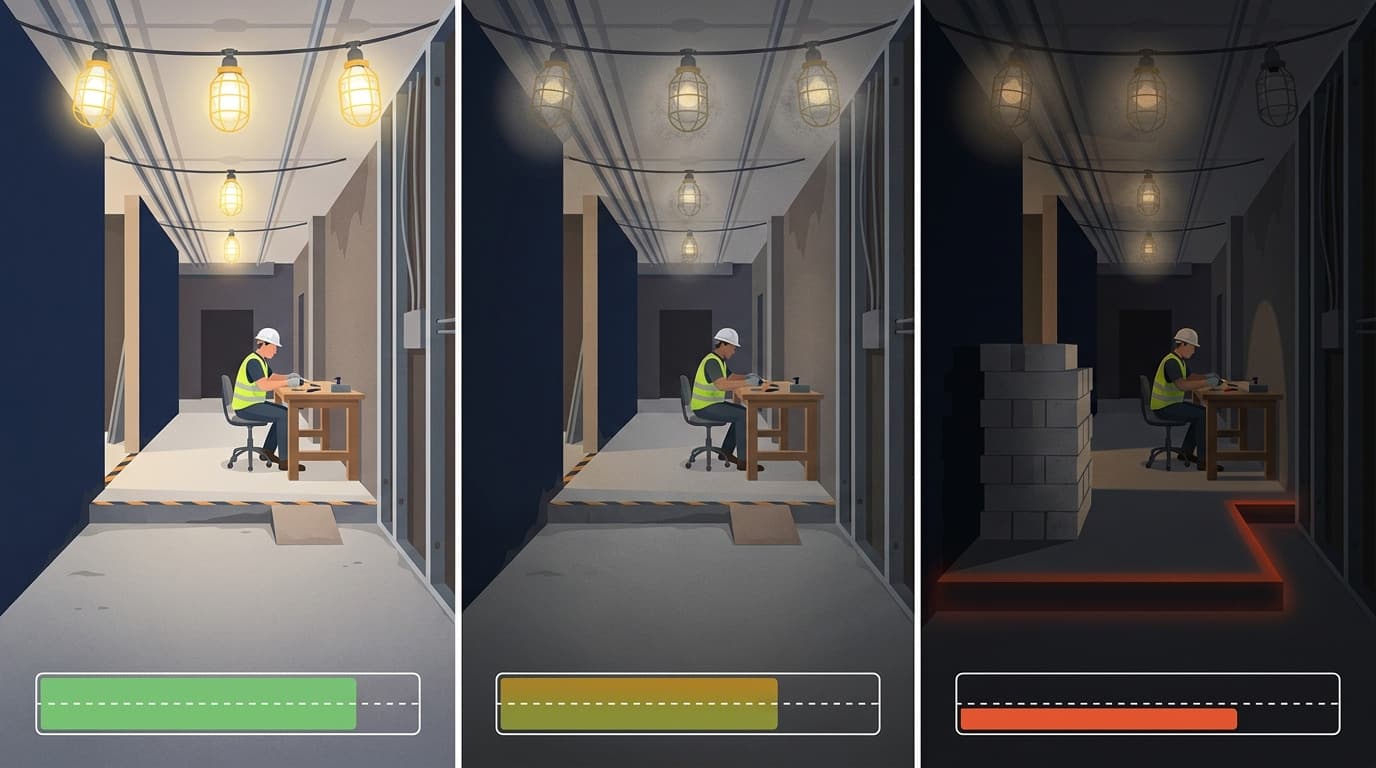
Here is the distinction that carries this whole talk: temporary lighting is the only safety control on site that fails without ever going out. It does not break. It fades — lamps dim, fittings film over with dust, and units burn out one at a time — while the crew's eyes adapt smoothly to every stage of the decline. The light level drops below the standard and nobody experiences a moment when anything changed.
Where the boundary of this talk sits#
The illumination minimums themselves — 1926.56 and its Table D-3 — are owned by the eye strain talk, which sets out the whole table and the visual-fatigue argument that goes with it. The electrical provisions for temporary lighting circuits — 1926.405(a)(2), the 12-volt requirement in wet and conductive locations, lamp guarding, and keeping other receptacles off lighting branch circuits — are owned by the temporary power talk. Night work as an operating condition, and glare toward traffic, are owned by the working at night talk in this same pair. This talk owns the installation over time: how it decays, why nobody sees it, and how to check.
The three ways light disappears#
Lighting engineers have a name for this, and it is used in every properly designed installation. It is the Light Loss Factor — the fraction of the initial light output the system is expected to still be delivering later in life.
The IES Lighting Handbook lists three recoverable light loss factors — recoverable meaning they can be fixed by maintenance:
Lamp lumen depreciation. Lamps produce less light as they age. Fluorescent lamps can lose 20 to 30% of their initial output over their rated life.
Luminaire dirt depreciation. Dust and grime on the fitting absorb and scatter light. On a construction site — which is the dustiest environment most fittings will ever see — this is not a minor factor.
Lamp burnout. Units fail individually. Five per cent of fittings out is another loss factor on top of the other two, and on a temporary installation nobody is tracking it.
And the sting is in how the design works. An LLF below 1.0 means the installation is deliberately over-lit at handover, because the designer knows it will decline. So the system starts above the target and travels toward — and potentially below — it. An LLF of 0.8 means only 80% of the initial level is expected to remain.
Your lighting was designed to get worse. The question is only whether anybody checks where it has got to.
LEDs made this quieter, not better#
Most temporary site lighting is now LED, and there is a widespread assumption that this solved the problem. It changed its shape.
An incandescent or fluorescent lamp gives you a clear failure: it goes out, somebody notices a dark patch, somebody replaces it. An LED does not have a filament to fail. What it does instead is exactly the thing this talk is about: it dims gradually to the point where the light becomes unusable, rather than burning out.
The industry measures this as L70 — the number of operating hours before output falls to 70% of initial. A fitting rated L70 at 50,000 hours producing 20,000 lumens is expected to be producing about 14,000 after those hours, and still working. Still on. Still looking fine. Delivering just over two-thirds of the light it was installed to deliver.
So the more modern the installation, the less likely it is to tell you anything.
Why the crew cannot see the problem#
This is the mechanism that makes the anchor true, and it is physiological rather than technical.
The eye is not an instrument. It is an adaptive system with an enormous working range, and it adjusts continuously to whatever light is available. A decline spread across weeks and months is exactly the kind of change adaptation absorbs completely. There is no moment of noticing because at every point along the way, vision feels normal.
That produces two field consequences worth stating out loud.
Nobody will report it. A worker will report a lamp that is out, because that is an event. Nobody reports "the whole area seems to have gradually got a bit dimmer since spring."
Asking the crew does not work. "Is there enough light in here?" is not a usable question, because the person answering has adapted to whatever is there. It is the one safety question where the honest answer of an experienced worker is unreliable.
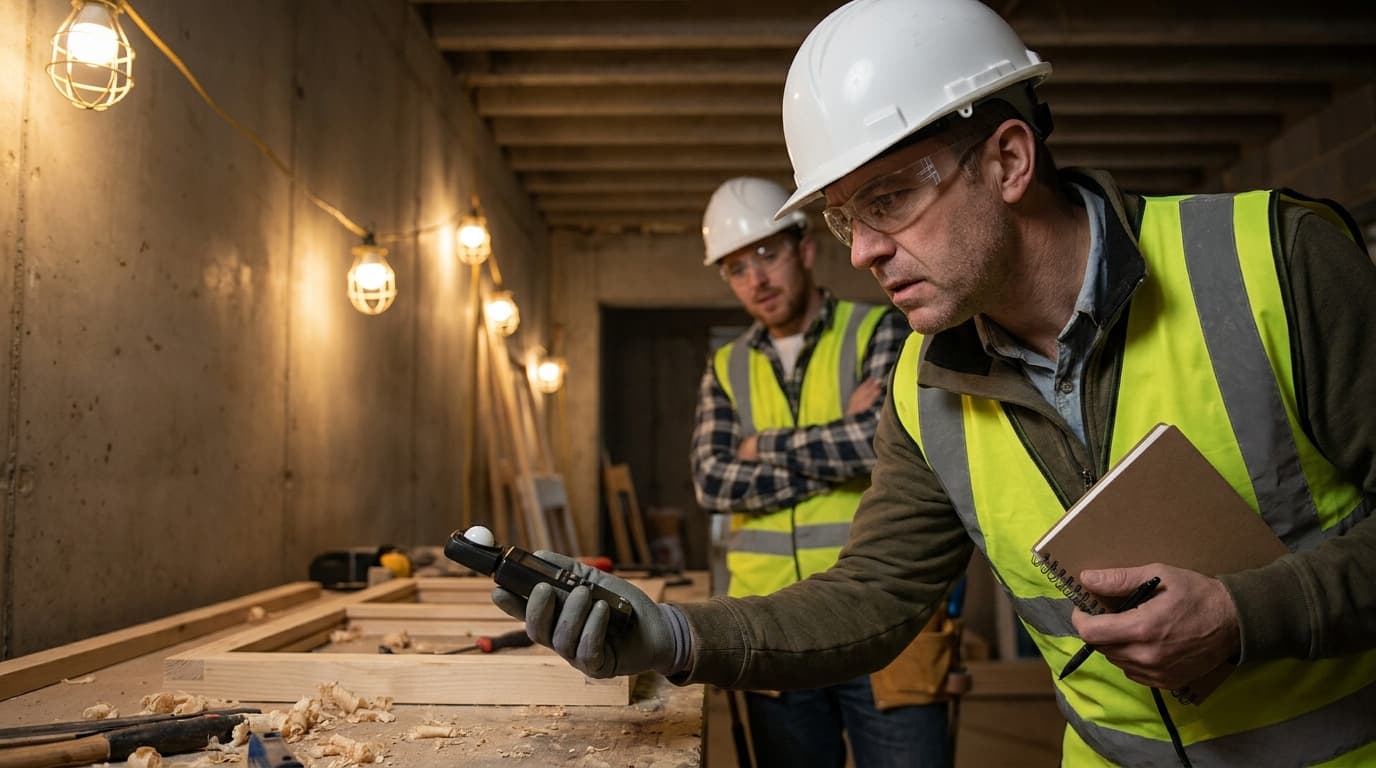
The only way to know is to measure it. A light meter is inexpensive, and the reading either meets the figure in the table or it does not.
What else goes wrong with the installation#
Beyond the fade, temporary lighting has failure modes that come from being temporary.
It becomes permanent. Temporary installations are put in fast, for a specific phase, and then stay for the job — moved, extended, patched into and never redesigned for what the area is now used for. The lighting suits a task that finished months ago.
The layout stops matching the work. Walls go up, partitions go in, plant moves, material gets stacked. The fitting that lit a walkway is now behind a stack of block. Shadow is created by the works, not by the lamp failing.
Task lighting goes missing. General area lighting to a minimum figure is not lighting for detailed work, and the gap gets filled by hand lamps, phone torches and machine work lights aimed at whatever is being done.
Access covers get lit and edges do not. Openings, edges, stair nosings, changes of level and trip hazards need light aimed at them, and a uniform ceiling grid does not do that.
And it takes the same abuse as everything else — knocks, water, dust, cable damage. The electrical side of that sits in the temporary power talk, and it is a serious part of the picture.
Where the duty sits#
1926.56(a) requires construction areas to be lighted to not less than the minimums in Table D-3 while work is in progress, and 1926.56(b) refers anything not listed to ANSI A11.1-1965 (R1970), Practice for Industrial Lighting. The eye strain talk sets out the table itself; the point that matters here is one of enforcement logic: the duty is a level, and a level is a measurement, not an opinion.
Around it: 1926.405(a)(2) carries the temporary wiring and lighting electrical provisions, covered in the temporary power talk. 1926.25 covers housekeeping, which is what stops materials blocking the lighting you already have. 1926.21(b)(2) requires instruction in recognising and avoiding unsafe conditions — and an area that has quietly fallen below its design level is exactly that. Section 5(a)(1) applies where nothing specific reaches.
Note the vintage: the whole table rests on a 1965 lighting practice. Treat Table D-3 as a floor for seeing hazards, not as a target for doing work.
What can go wrong?#
Assuming a lit site is a compliant site, when the level has fallen below the table.
Waiting for lamps to go out, when modern fittings dim instead of failing.
Never cleaning the fittings, on the dustiest site most of them will ever see.
Asking the crew whether there is enough light, when their eyes have adapted to whatever there is.
Leaving a phase-one lighting layout in place for work it was never designed for.
Letting stacked material and new partitions shadow the walkways the lighting was arranged around.
Lighting the area but not the edges, openings and changes of level.
Filling the gap with phone torches and machine work lights instead of fixing the installation.
How do we manage this properly?#
Buy a light meter and use it. This is the whole talk in one action. Measure at the working positions, not at the fitting.
Put lighting on a scheduled inspection with the same seriousness as any other control — level measured, fittings cleaned, failed units replaced, results recorded.
Clean the fittings on a cycle, because dirt depreciation on a construction site is not a rounding error.
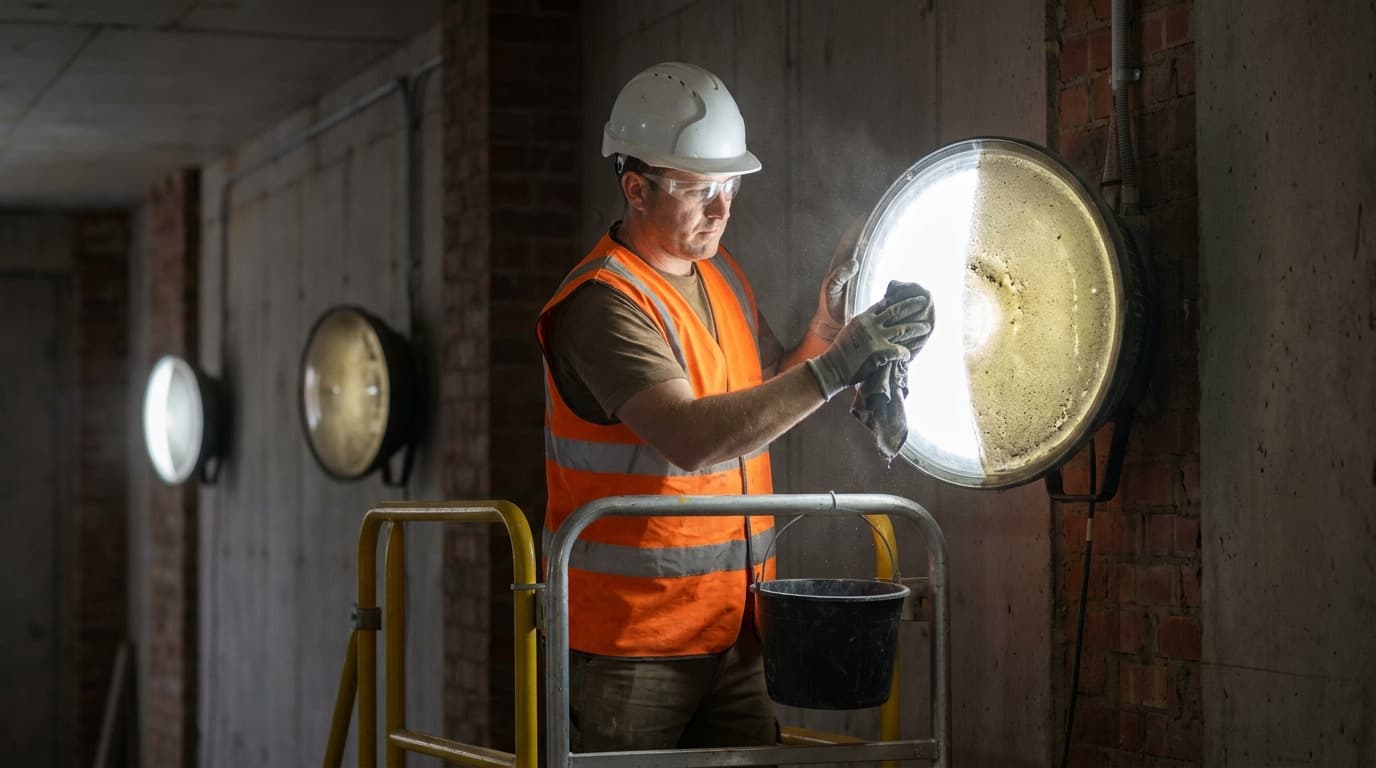
Relamp in groups rather than one at a time where the installation allows it, since the whole batch has aged together.
Re-survey the lighting whenever the works change the space — new partitions, stacked material, plant repositioned, phase change.
Light the hazards, not just the area: edges, openings, stair nosings, changes of level, access routes.
Provide proper task lighting where detailed work is done, rather than leaving people to improvise.
Treat "we're using torches here" as a defect report, because that is what it is.
Never assume LED means maintenance-free — check output, not whether it is on.
Before you start#
- Confirm when the lighting in this area was last measured, and what the reading was.
- Confirm a light meter is available on this site and who uses it.
- Confirm the fittings have been cleaned within a defined interval.
- Confirm the layout still matches the work — nothing new shadowing the walkways.
- Confirm edges, openings and changes of level are specifically lit.
- Confirm there is task lighting for any detailed work, not just area lighting.
- Confirm nobody is relying on phone torches or machine work lights as the arrangement.
- Confirm failed units are being reported and replaced, not just noted.
Talk it over#
- When did anybody last measure the light in the area we are working in?
- Has anything been built or stacked here since the lighting went in?
- Who is using a torch to see what they are doing, and why?
- Which of us would notice if this area got twenty per cent darker over a month?
The bottom line#
Temporary lighting is the only safety control on site that fails without ever going out. It does not break, it fades — and the crew's eyes adapt smoothly to every stage, so the level drops below the standard with no moment at which anything appeared to change. The mechanism is standard lighting engineering: the Light Loss Factor, with the IES Lighting Handbook listing three recoverable factors — lamp lumen depreciation, luminaire dirt depreciation, and lamp burnout. Fluorescent lamps can lose 20 to 30% of initial output over their rated life, dust on fittings absorbs and scatters light in the dirtiest environment they will ever see, and units fail individually with nobody tracking the count. Crucially, an LLF below 1.0 means the installation is deliberately over-lit at handover, so it starts above the target and travels toward and potentially below it — an LLF of 0.8 leaves 80% of the initial level. LEDs made this quieter rather than better: an LED has no filament to fail and instead dims gradually to the point where the light becomes unusable, measured as L70 — the hours until output falls to 70% of initial — so a fitting can be still on, still looking fine, and delivering just over two-thirds of its design output. The eye hides all of it, which produces two field consequences: nobody reports a gradual decline, because it is not an event; and asking the crew is not a usable check, because the person answering has adapted to whatever is there. The only way to know is to measure, and a light meter is cheap. On top of the fade, temporary installations become permanent, their layout stops matching the work as partitions go up and material is stacked, task lighting goes missing, and edges and openings get shadowed while the area stays lit. On duties, 1926.56(a) requires construction areas to be lighted to not less than the Table D-3 minimums while work is in progress and 1926.56(b) refers anything unlisted to ANSI A11.1-1965 — so the duty is a level, and a level is a measurement, not an opinion — with 1926.405(a)(2) carrying the electrical provisions, 1926.25 housekeeping, 1926.21(b)(2) instruction, and 5(a)(1) behind them. The table rests on a 1965 lighting practice: treat it as a floor for seeing hazards, not a target for doing work.
Frequently asked questions about temporary lighting#
The lights are all on — doesn't that mean the site is properly lit?
No, and this is the central point. The duty at 1926.56(a) is a level, not a state of being switched on. Installations decline through three recoverable light loss factors — lamp lumen depreciation, luminaire dirt depreciation and lamp burnout — and modern fittings dim rather than fail, so everything can look normal while the measured level has fallen below the minimum. The only way to know is to measure at the working position.
Why don't LEDs solve this?
Because they changed the failure mode rather than removing it. An LED has no filament to burn out; instead it dims gradually to the point where the light becomes unusable. The industry measures this as L70 — the operating hours until output falls to 70% of initial. A fitting rated L70 at 50,000 hours and producing 20,000 lumens initially would be delivering around 14,000 after that period, and still be lit. Still on is not the same as still adequate.
Why won't the crew just tell us it's too dark?
Because the eye is adaptive, not an instrument. It adjusts continuously to whatever light is present, and a decline spread over weeks or months is exactly the kind of change adaptation absorbs completely — at every point along the way, vision feels normal. Workers will report a lamp that is out, because that is an event. Nobody reports a gradual fade. "Is there enough light?" is not a usable question, because the person answering has already adapted.
What is a light loss factor?
It is the fraction of the initial light output an installation is expected to still deliver later in life, and it is built into the design. The IES Lighting Handbook lists three recoverable factors: lamp lumen depreciation, luminaire dirt depreciation, and lamp burnout. Because the factor is below 1.0, the system is deliberately over-lit at handover and declines toward the target — an LLF of 0.8 means 80% of the initial level is expected to remain. Your lighting was designed to get worse.
How often should fittings be cleaned?
On a defined cycle, set to the environment rather than the calendar you happen to like — because luminaire dirt depreciation is one of the three recoverable losses and a construction site is the dirtiest place most fittings will ever hang. Dust and grime absorb and scatter light, and unlike lamp ageing it is fully reversible for the cost of cleaning. Group relamping is also worth considering where the installation allows, since the whole batch has aged together.
Do we need lighting beyond the general area level?
Usually yes, in two directions. Hazards need light aimed at them — edges, openings, stair nosings, changes of level and access routes — which a uniform area arrangement does not achieve. And detailed work needs task lighting, because Table D-3 is a floor for seeing hazards rather than a level for doing work; the table's own basis is ANSI A11.1-1965. If people are working by phone torch, that is a defect report about the installation.
What does OSHA actually require?
1926.56(a) requires construction areas, ramps, runways, corridors, offices, shops and storage areas to be lighted to not less than the minimums in Table D-3 while work is in progress, and 1926.56(b) refers anything not listed to ANSI A11.1-1965 (R1970), Practice for Industrial Lighting. The table itself is covered in the eye strain talk. Electrical provisions for temporary lighting sit at 1926.405(a)(2); housekeeping at 1926.25; instruction at 1926.21(b)(2); and Section 5(a)(1) behind them.
Download the temporary lighting toolbox talk PDF#
Get this temporary lighting toolbox talk as a print-ready PDF — available in English, Spanish, Portuguese, and Turkish. Print it, hand it to the crew, and collect signatures on the included attendance sheet.
Download the PDF — free account required. New members get 3 free downloads.
Related toolbox talks#
Sources#
- OSHA, 29 CFR 1926.56 — Illumination: https://www.osha.gov/laws-regs/regulations/standardnumber/1926/1926.56
- PNNL, Lumen Maintenance and Light Loss Factors: Consequences of Current Design Practices for LEDs: https://www.pnnl.gov/main/publications/external/technical_reports/PNNL-22727.pdf
- OSHA, 29 CFR 1926.405 — Wiring methods, components, and equipment for general use: https://www.osha.gov/laws-regs/regulations/standardnumber/1926/1926.405
This talk is general awareness guidance for training purposes. Design, installation and alteration of temporary lighting and its supply is electrical work for competent persons, and the levels required for a given area must be confirmed against the standard and measured, not estimated.
Written by FieldSafetyTalk's safety professional — a CSP, ASP, CHST and OSHA Authorized Outreach Trainer with 14+ years of international construction safety experience across federal, heavy civil, and industrial projects.