Crane Lifting
Updated 2026-07-23
In this bundle Rigging & Lifting
Working in California? See the Cal/OSHA edition → California (Cal/OSHA)Working in Washington? See the WA DOSH edition → Washington (WA DOSH)
Print-ready PDF
Download this talk as a print-ready PDF, available in 4 languages.
Ask a crew who is most at risk during a crane lift and most will point at the operator. The data says otherwise. The person most likely to die on a crane job is standing on the ground with a hand on the load. This crane lifting talk is about the gap between where we think the danger sits and where it actually sits.
Here is the distinction that carries this whole talk: with most equipment, the hazard belongs to whoever is operating it. A crane is different — it moves a hazard through space that other people occupy. The operator sits in a cab, restrained, insulated, with the best view of the machine. The riggers, signal persons, and everyone working nearby are on foot, in contact with the load, and frequently unable to see what the operator sees or see the power line the boom is approaching. That is why crane safety is not primarily about operating skill. It is about controlling the volume of space the load and the boom will pass through, and about who is allowed to be in it.
How dangerous is crane work?#
According to the Bureau of Labor Statistics, an average of 44 crane-related fatalities occur in the United States each year, based on the most recent dedicated analysis covering 2011 to 2017. BLS now reports crane deaths within broader construction categories, so this remains the clearest figure available.
The most thorough breakdown of how those deaths happen comes from CPWR, the Center for Construction Research and Training, which analysed 632 crane-related construction worker deaths between 1992 and 2006 — an average of 42 per year (CPWR, revised analysis, 2009, from BLS Census of Fatal Occupational Injuries). The distribution is worth reading carefully:
- Overhead power line electrocutions — 157 deaths (25 percent). The leading cause.
- Struck by crane loads — 132 deaths (21 percent).
- Struck by the crane or crane parts — 125 deaths (20 percent).
- Crane collapses — 89 deaths (14 percent).
- Falls — 56 deaths (9 percent). Caught in or between — 30 deaths (5 percent).
Two findings inside that data should change how this talk lands:
Most electrocution victims were not operating the crane. Of the 157 electrocution deaths, 81 — more than half — were workers on foot touching or guiding the load or cables when the crane contacted a power line. Another 20 were on foot touching the crane itself. Seven were operators electrocuted after jumping from the machine.
A third of struck-by-load victims had nothing to do with the lift. 32 percent of workers killed by crane loads were not involved in crane work at all — they were simply within reach of a load that came loose, shifted, or was dropped.
Two more patterns worth knowing: construction laborers accounted for more crane deaths than any other trade, including operating engineers — 191 deaths, 30 percent of the total. And 63 percent of crane deaths occurred at employers with fewer than 100 employees, with 30 percent at establishments of 10 or fewer.
OSHA crane requirements (29 CFR 1926 Subpart CC)#
Cranes and derricks in construction are governed by 29 CFR 1926 Subpart CC, sections 1926.1400 through 1926.1442, published in August 2010 — the most comprehensive revision of crane rules in a generation.
Power line safety — 1926.1408. For lines up to 350 kV, the employer must either de-energize and ground the line, or maintain at least 20 feet of clearance between the line and any part of the equipment, load line, or load. For lines over 350 kV, the minimum clearance is 50 feet under 1926.1409. Where the 20-foot clearance cannot be maintained, the employer must implement additional encroachment-prevention measures.
Work area control — 1926.1424. The employer must prevent employees from entering the area where they could be struck by the rotating superstructure — the swing radius — by erecting barricades, defining the area with warning lines and signage, or training each employee to stay clear.
Keeping clear of the load — 1926.1425. Employees must be kept out from under the load, and where the load is being landed, only employees essential to the operation may be in the fall zone. Loads must not be hoisted over employees except in tightly defined circumstances.
Operator training, certification, and evaluation — 1926.1427. The employer must ensure each operator is trained, certified or licensed, and evaluated before operating covered equipment. An uncertified employee may operate only as an operator-in-training under continuous monitoring by a qualified operator's trainer. The evaluation and documentation requirement took effect 7 February 2019. Exceptions apply to derricks (1926.1436), sideboom cranes (1926.1440), and equipment rated at 2,000 pounds or less (1926.1441).
Signal person qualifications — 1926.1428. Signal persons must be qualified by a third-party evaluator or the employer's qualified evaluator, and must know and understand the signal type used, be competent in their application, understand the operations and limitations of the equipment, and know the requirements of 1926.1419 through 1926.1422.
Other key provisions:
- 1926.1402 — ground conditions must be firm, drained, and graded sufficiently to support the equipment
- 1926.1412 — inspections, including a shift inspection by a competent person
- 1926.1413 and 1926.1414 — wire rope inspection, selection, and installation
- 1926.1417 — operation, including compliance with load charts and manufacturer procedures
- 1926.1418 — any employee has the authority to stop the operation on safety grounds
- 1926.1431 — hoisting personnel, which is permitted only when other means would be more hazardous or infeasible
- Appendix A — standard hand signals
On USACE and NAVFAC projects, EM 385-1-1 applies and is more prescriptive on lift planning and critical lifts.
What can go wrong on a lift?#
The boom finds a power line. This is the leading killer, and the mechanism is consistent: the boom, load line, or load contacts an overhead conductor and the current travels to whoever is touching the load on the ground. The operator is often unhurt. The rigger holding the tag line is not.
The load comes off the rigging. Loads slip from slings, straps break, shackles fail, latches release. CPWR's data on struck-by-load deaths found the load came loose from the rigging in 19 percent of cases and a cable or strap broke in 14 percent.
The load swings or the crane loses control of it. A load struck the worker when the crane turned, tilted, or lost control in 11 percent of cases, and shifted or rotated in another 10 percent. The arc of a suspended load is far wider than most people judge.
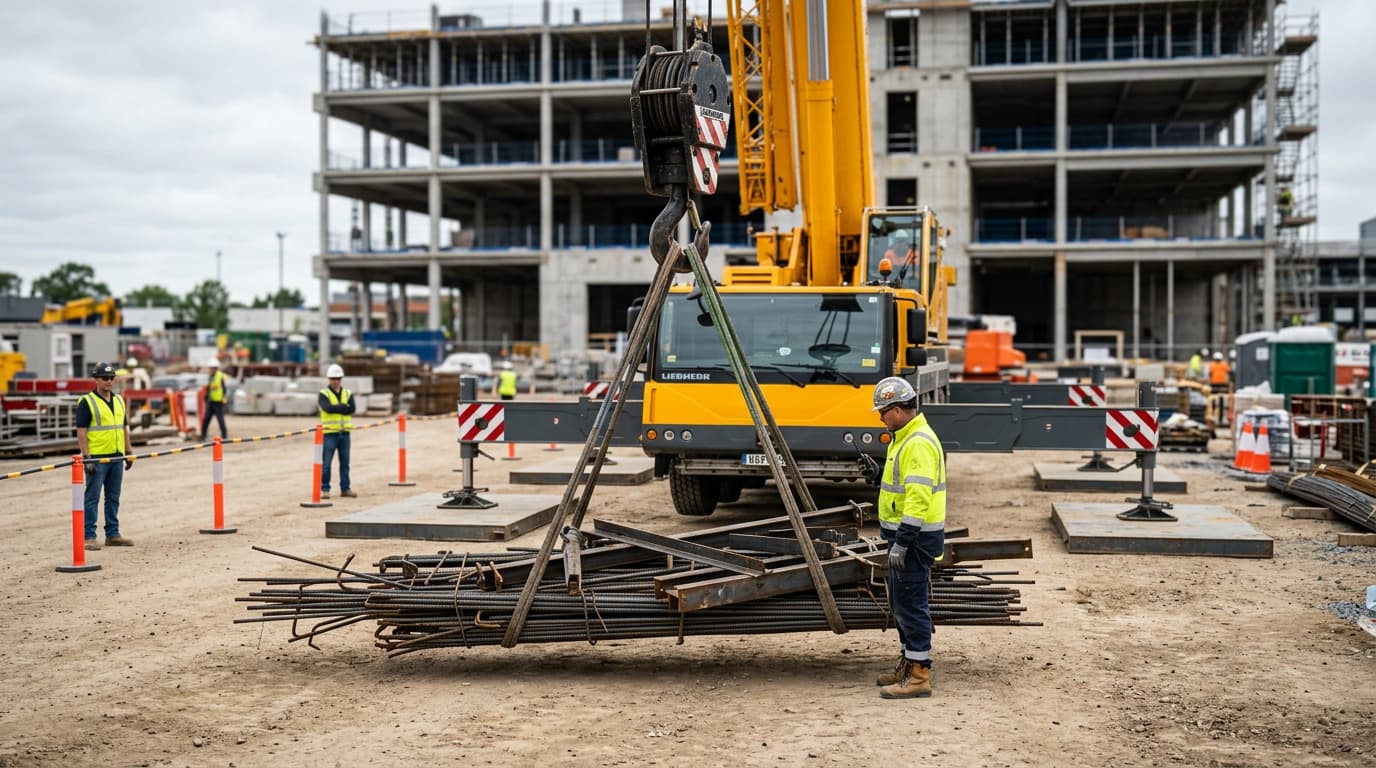
Somebody is in the swing radius. The rotating superstructure and counterweight sweep a full circle with no clearance, and workers on foot are crushed against whatever is behind them.
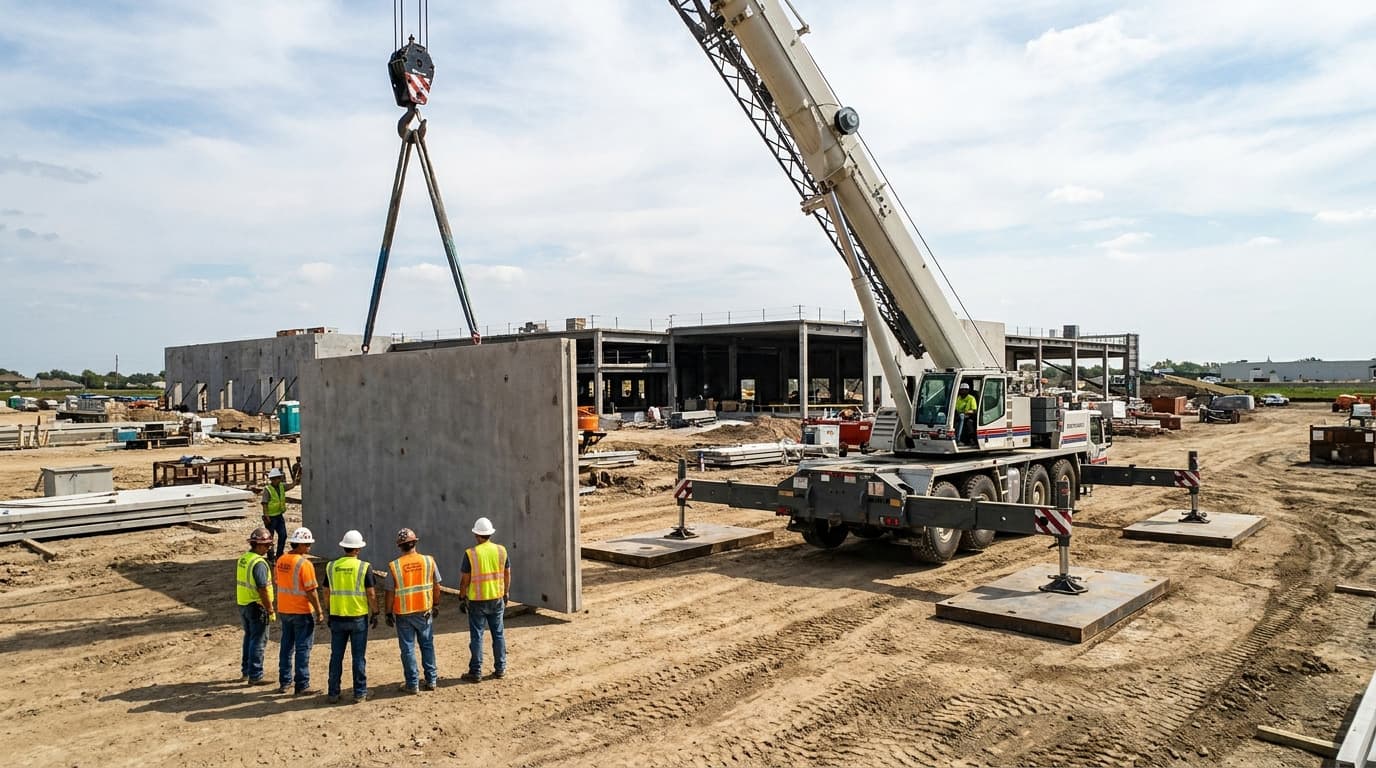
The crane collapses. Ground conditions, overloading, and configuration errors. Boom dismantling is a specific danger: of 64 deaths from falling booms and jibs, 36 — 56 percent — occurred while the boom was being dismantled.
Communication fails. Signals are misread, radios cut out, the signal person moves out of the operator's sight, or two people give conflicting instructions.
And the failures that precede all of these: no lift plan, no ground assessment, uncertified operators, unqualified signal persons, rigging that was never inspected, load charts ignored, and a crane set up close to a line that nobody de-energized because it would have delayed the pour.
How do we prevent crane incidents?#
Treat every overhead line as energized and plan around it. Under 1926.1408, either de-energize and ground the line, or maintain 20 feet of clearance for lines up to 350 kV — 50 feet above that. Where clearance cannot be maintained, additional measures are required. Identify lines during planning, not when the boom is already up.
Keep people off the ground contact point when lines are near. Since more than half of crane electrocution deaths were workers touching the load or cables, use non-conductive tag lines and keep hands off the load entirely wherever lines are in play.
Barricade the swing radius. Under 1926.1424, physically prevent access to the area swept by the rotating superstructure. Not a warning — a barrier.
Nobody under the load, and nobody in the fall zone who is not essential. Under 1926.1425, keep employees out from under the load and limit the landing area to those the operation requires. This protects the third of struck-by-load victims who had no part in the lift.
Confirm operator certification and evaluation. Under 1926.1427, the operator must be trained, certified or licensed, and evaluated. Operators-in-training are continuously monitored. Check this before the lift, not after an incident.
Use a qualified signal person and one voice. One signal person, qualified under 1926.1428, using signals both parties understand. If the signal person loses sight of the load or the operator, the lift stops.
Inspect the rigging before every lift. Slings, shackles, hooks with functioning latches, and wire rope inspected per 1926.1413. Rigging failures caused roughly a third of struck-by-load deaths between them.
Assess and prepare the ground. Under 1926.1402, ground must be firm, drained, and graded. Outriggers fully extended on adequate cribbing, and the machine level.
Plan the lift before the crane arrives. Weight, radius, configuration, load chart capacity at that radius, ground bearing, obstructions, exclusion zones, and the roles of every person involved. Critical lifts get a written plan.
Stop the lift if anything changes. Under 1926.1418, any employee can stop the operation on safety grounds. Wind, visibility, an unplanned person in the zone, a signal you did not understand — all of them are reasons to stop rather than to hope.
Before you start#
- Identify every overhead power line in the working radius and confirm the clearance you must maintain, or that the line is de-energized and grounded.
- Confirm the operator is certified or licensed and evaluated for this equipment.
- Confirm the signal person is qualified and that everyone agrees on the signals being used.
- Walk the swing radius and confirm it is barricaded, not just marked.
- Confirm the ground is firm, drained, and level, with outriggers fully extended on adequate cribbing.
- Check the load weight against the load chart at the radius you will actually be working.
- Inspect all rigging: slings, shackles, hooks and latches, and wire rope.
- Identify the fall zone and confirm only essential people will be in it.
- Confirm you have non-conductive tag lines where power lines are anywhere near the work.
- Agree the stop signal, and confirm everyone knows they can use it.
Talk it over#
- Point to every power line within reach of that boom at full radius. What is our clearance, and who is watching it?
- When that load swings, where exactly will you be standing — and who else will be within reach of it?
- If you lost sight of the signal person mid-lift, what would you do?
The bottom line#
The most likely crane fatality is not the operator — it is a worker on foot with a hand on the load, because more than half of crane electrocution deaths happened exactly that way. Nearly a third of workers killed by crane loads were not even part of the lift. So the controls that matter most are about space and people rather than machine skill: maintain 20 feet from power lines or get them de-energized, barricade the swing radius, keep everyone non-essential out of the fall zone, use non-conductive tag lines, and confirm the operator and signal person are actually qualified before the hook comes off the ground.
Frequently asked questions about crane lifting#
How much clearance is required between a crane and a power line?
Under 29 CFR 1926.1408, for lines up to 350 kV the employer must either de-energize and ground the line, or maintain at least 20 feet of clearance between the line and any part of the equipment, load line, or load. For lines over 350 kV, 1926.1409 requires 50 feet. Where clearance cannot be maintained, additional encroachment-prevention measures are required.
Who is most likely to be killed in a crane incident?
Workers on foot, not operators. Of 157 crane electrocution deaths analysed by CPWR, 81 — more than half — were workers touching or guiding the load or cables. Construction laborers accounted for more crane-related deaths than any other trade, including operating engineers.
Does OSHA require crane operators to be certified?
Yes. Under 29 CFR 1926.1427, the employer must ensure each operator is trained, certified or licensed, and evaluated before operating covered equipment. The evaluation and documentation requirement took effect 7 February 2019. Exceptions apply to derricks, sideboom cranes, and equipment rated at 2,000 pounds or less.
What is the swing radius and why does it matter?
The swing radius is the area swept by the crane's rotating superstructure and counterweight, which travels a full circle with no clearance. Under 29 CFR 1926.1424, employers must prevent employees from entering it — by barricades, defined warning lines and signage, or training each worker to stay clear.
Can a load be lifted over workers?
No, other than in tightly defined circumstances. Under 29 CFR 1926.1425, employees must be kept out from under the load, and where a load is being landed, only employees essential to the operation may be in the fall zone. This matters because 32 percent of workers killed by crane loads were not involved in the crane work at all.
When is boom assembly and dismantling most dangerous?
Dismantling. Of 64 deaths caused by falling booms and jibs in CPWR's analysis, 36 — 56 percent — occurred during dismantling, compared with 9 percent while lengthening the boom. Assembly and disassembly must follow manufacturer procedures under the supervision of a qualified person.
Download the crane lifting toolbox talk PDF#
Get this crane lifting toolbox talk as a print-ready PDF — available in English, Spanish, Portuguese, and Turkish. Print it, hand it to the crew, and collect signatures on the included attendance sheet.
Download the PDF — free account required. New members get 3 free downloads.
Related toolbox talks#
Sources#
- OSHA, 29 CFR 1926 Subpart CC — Cranes and Derricks in Construction: https://www.osha.gov/laws-regs/regulations/standardnumber/1926/1926SubpartCC
- OSHA, 29 CFR 1926.1427 — Operator training, certification, and evaluation: https://www.osha.gov/laws-regs/regulations/standardnumber/1926/1926.1427
- McCann M, Gittleman J, Watters M, Crane-Related Deaths in Construction and Recommendations for Their Prevention, CPWR, revised November 2009: https://www.cpwr.com/wp-content/uploads/CPWR-Crane-Rept-Recmmdtns-Nov-2009-BLS-UPDATED.pdf
- Bureau of Labor Statistics, Census of Fatal Occupational Injuries: https://www.bls.gov/iif/