Safe Use of Cutting Tools
Updated 2026-07-28
In this bundle Tools & Machinery
Print-ready PDF
Download this talk as a print-ready PDF, available in 4 languages.
Cutting tools are the ones nobody briefs. Nobody signs a knife out, nobody inspects it, nobody records who has one — and yet a utility knife will put more people in a first aid room over a year than most of the machines that get a full method statement. This safe use of cutting tools talk is about the tool nobody supervises, and about how little the regulation says.
Here is the distinction that carries this whole talk: the blade is not the hazard — the path it takes after it leaves the material is. Almost nobody is cut by the part of the stroke that goes through the cardboard, the strapping or the insulation. They are cut by the part after, when the resistance disappears, the blade accelerates, and it arrives at whatever was on the other side. Which is usually a thigh, a forearm or the hand steadying the work.
The whole hand tool standard is four sentences#
Here is 29 CFR 1926.301 in its entirety:
(a) Employers shall not issue or permit the use of unsafe hand tools. (b) Wrenches, including adjustable, pipe, end, and socket wrenches shall not be used when jaws are sprung to the point that slippage occurs. (c) Impact tools, such as drift pins, wedges, and chisels, shall be kept free of mushroomed heads. (d) The wooden handles of tools shall be kept free of splinters or cracks and shall be kept tight in the tool.
That is all of it. Read it again and notice what is missing: there is no mention of a knife, a blade, a cutting edge or a cut. The most frequently used cutting tool on any construction site has no provision of its own in the construction hand tool standard.
That absence does not mean there is no duty. It means the duty sits in the general clauses instead, and those are broader than the specific ones:
- 1926.301(a) — employers shall not issue or permit the use of unsafe hand tools. Two verbs, and the first one lands before anyone picks the tool up.
- 1926.300(a) — all hand and power tools and similar equipment, whether furnished by the employer or the employee, shall be maintained in a safe condition.
- 1926.300(c) — employees using hand and power tools who are exposed to falling, flying, abrasive and splashing objects, or to harmful dusts, fumes, mists, vapours or gases, shall be provided with the personal protective equipment necessary to protect them.
"Issue or permit" — and the knife from home#
1926.301(a) is the sentence to build a site rule on, because of where it puts the duty. It is not "employees shall not use unsafe hand tools." It is that the employer shall not issue them, and shall not permit their use. The obligation attaches at the store, at the toolbox, at the moment of handing something over — before any worker has made any decision at all.
And 1926.300(a) closes the loophole everyone assumes exists: tools are covered whether furnished by the employer or the employee. The knife somebody brought from home, the blade they prefer, the old chisel that has been in the bag for years — all of it is inside the standard, and all of it is the employer's problem. "It's his own knife" is not an answer.
The two provisions that do bite on cutting and struck-by work are worth stating plainly:
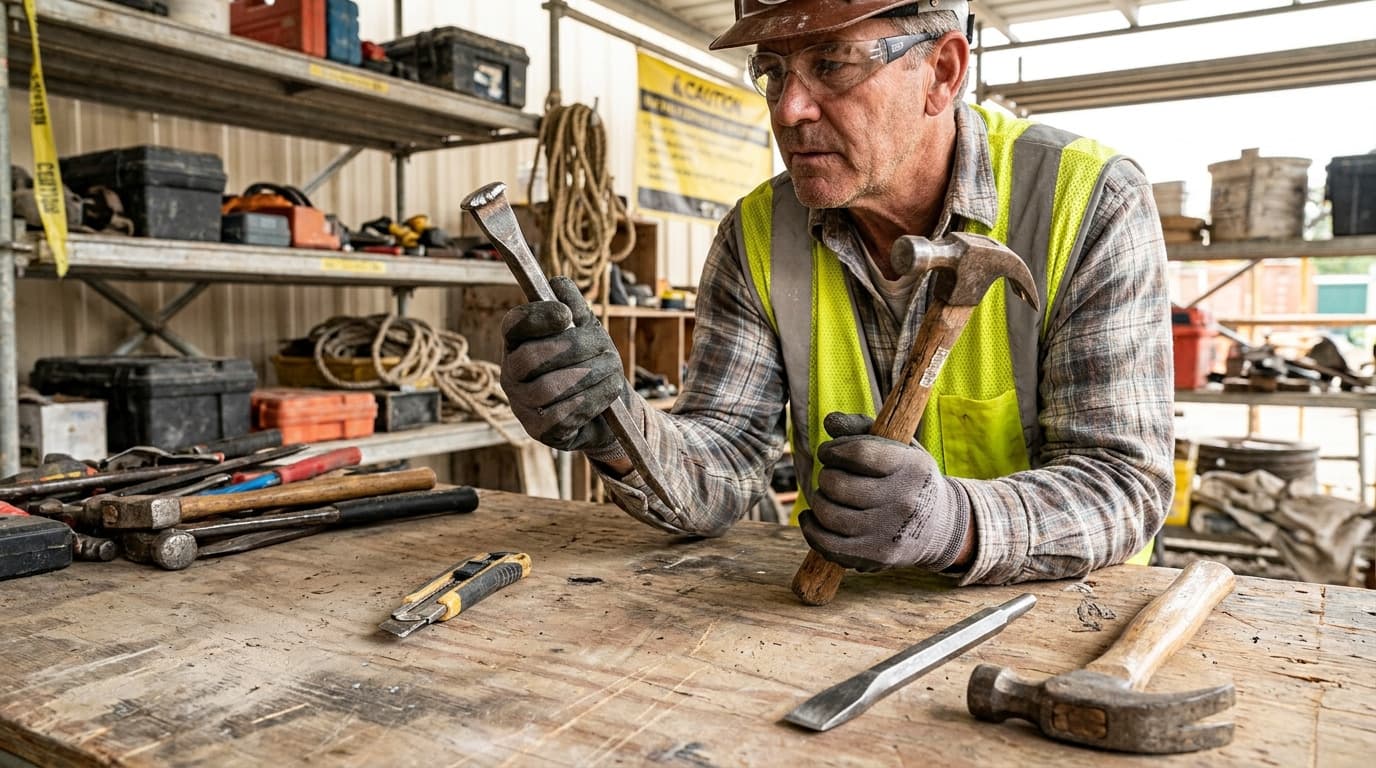
Mushroomed heads — 1926.301(c). Drift pins, wedges and chisels must be kept free of mushroomed heads. A struck tool spreads and work-hardens at the head; the flared edge then breaks off under the next blow and leaves at speed. This is a specific, checkable defect on a tool that lives in every steel fixer's and mason's bag.
Wooden handles — 1926.301(d). Handles must be kept free of splinters or cracks and tight in the tool. A loose head on a hammer or hatchet is a projectile with a schedule.
Where the blade actually goes#
Because the standard is silent on knives, the controls come from the work rather than the text. The mechanics are consistent enough to teach:
Cut away from the body, and know what is behind the stroke. Not "be careful" — actually look at what the blade reaches if the material gives way. Most serious cutting injuries are in the thigh, the non-dominant forearm and the hand holding the work.
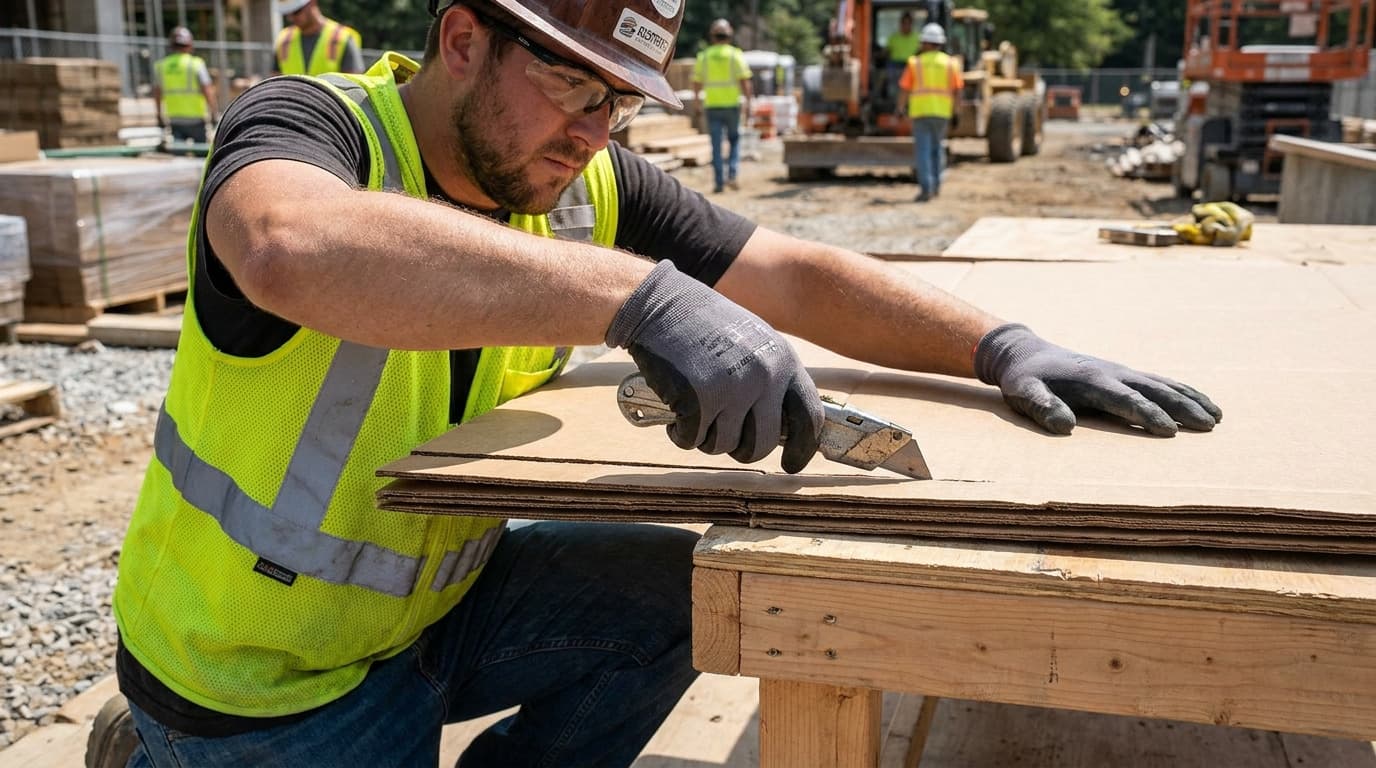
The non-dominant hand is the one that gets cut. It is holding, steadying and stabilising, and it is directly in the path. Clamp, brace or reposition the work so that hand is not the fixture.
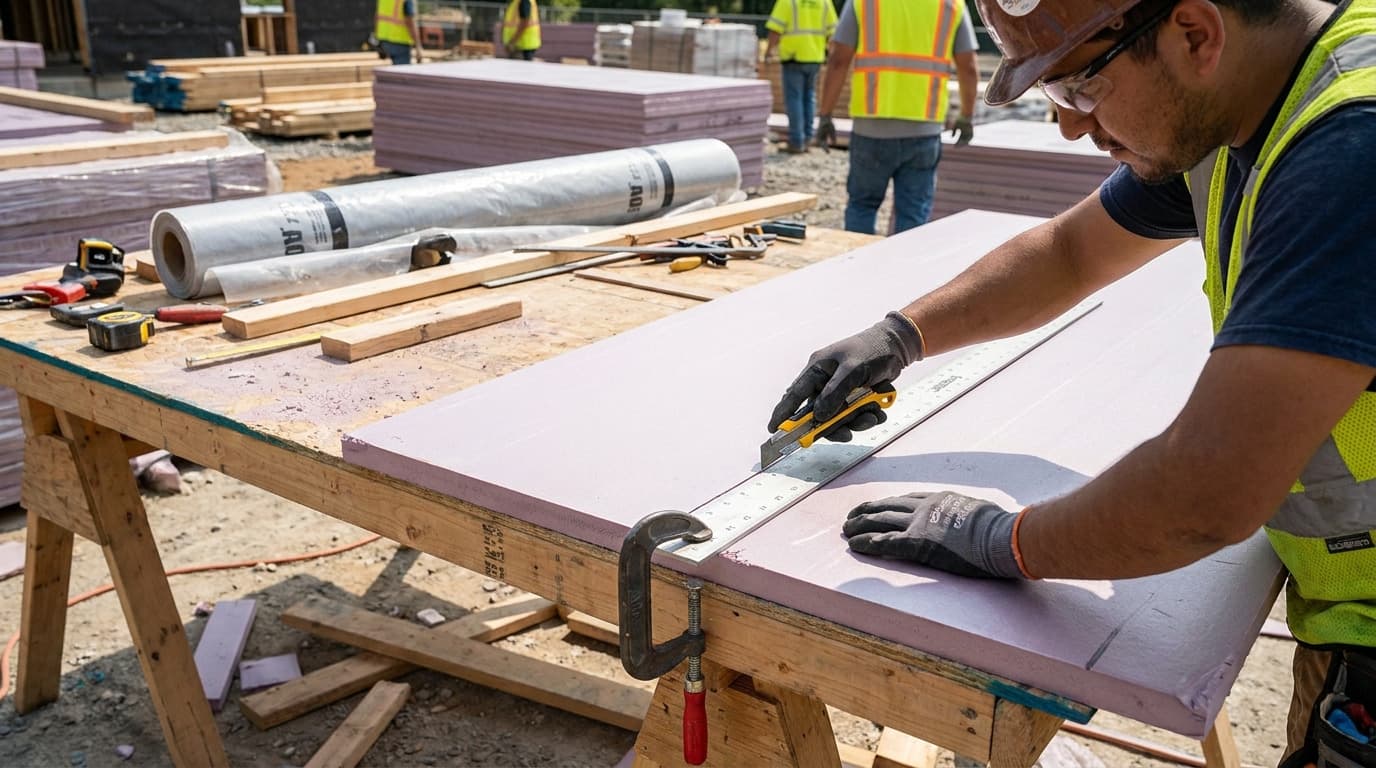
Blade exposure is the variable you control. Set the blade to the minimum depth that cuts the material and no more. Depth beyond the material is exposure with no purpose.
Dull blades cut people. A blunt blade needs more force, and force is what turns a slip into a wound. Changing a blade is not downtime; it is the control.
Self-retracting and safety-blade knives exist for a reason. Where the task allows, a blade that retracts the moment it leaves the material removes the entire post-cut exposure — which is where the injuries happen.
Never leave a blade exposed between cuts. Retract it, sheath it, or put the tool down closed — not on a plank, not in a pocket, not on the top of the ladder.
Dispose of blades in a purpose-made container. Used blades in a bin bag cut cleaners, labourers and whoever empties it.
Glove selection against cut hazards — the ANSI/ISEA 105 levels and what they do and do not mean — is covered in the hand injuries talk, and it is a control that sits after everything above has failed.
What can go wrong?#
The stroke pulls through. The material gives, the blade accelerates, and the leg or forearm behind it is in the path.
The work is held in the free hand. No clamp, no bench, nothing but the hand that is about to be cut.
A blunt blade gets forced. More pressure, a slip, and the force that was aimed at the material goes into a person.
A blade snaps. Snap-off blades used past their length, or a blade twisted in the cut, and a piece leaves at speed toward the face.
The tool is put down open. On a plank, in a bag, in a pocket — and someone reaches for it.
A mushroomed chisel is struck. The flared head fragments and the piece travels faster than anyone can react.
A hatchet or hammer head is loose. The wooden handle has dried and shrunk, and the head separates on the swing.
Used blades in the general waste. Somebody else's hand finds them.
How do we do this properly?#
Inspect at issue, not at use. 1926.301(a) puts the duty on issuing the tool — so the check happens when the tool is handed over, and unsafe tools do not leave the store.
Cover employee-owned tools in the same system. 1926.300(a) applies to them, so they get inspected, accepted or rejected the same way.
Use the right tool for the cut. A utility knife is not a saw, a chisel is not a pry bar, and a screwdriver is not a chisel — misuse is a leading cause of both breakage and slips.
Set minimum blade exposure, and change blades the moment they stop cutting cleanly.
Take the free hand out of the path. Clamp or brace the work; if you cannot, change the position of the cut rather than accepting the exposure.
Choose safety-blade or self-retracting knives for repetitive cutting tasks — strapping, packaging, membrane, insulation.
Retract and sheath every time, including for the short walk to the next cut.
Keep struck tools dressed. No mushroomed heads on drift pins, wedges or chisels; handles tight, unsplintered and uncracked.
Provide a blade disposal container and use it, everywhere blades are changed.
Eye protection when striking or when a blade can snap — 1926.300(c) covers flying objects, and a broken blade is exactly that.
Before you start#
- Confirm the cutting tool is sharp, undamaged, and the right tool for the material.
- Confirm blade exposure is set to the minimum that will cut the material.
- Confirm the work is clamped or braced so your free hand is not the fixture.
- Confirm you know what is behind the stroke if the material gives way.
- Confirm no struck tool you are using has a mushroomed head.
- Confirm handles are tight, unsplintered and uncracked.
- Confirm there is a container for used blades within reach of where you change them.
- Confirm eye protection is on if you are striking a tool or a blade could snap.
Talk it over#
- What is behind the last cut you made today, if the blade had run on?
- Which hand was holding the work, and could it have been a clamp instead?
- When did you last change a blade — and how long had it been dull before that?
- Where do used blades go on this site, and would you put your hand in that bin?
The bottom line#
The construction hand tool standard is four sentences long. 1926.301(a) — employers shall not issue or permit the use of unsafe hand tools; (b) sprung wrench jaws; (c) impact tools kept free of mushroomed heads; (d) wooden handles free of splinters and cracks and kept tight in the tool. None of it mentions a knife or a blade. What fills that gap is 1926.300(a) — all hand and power tools, whether furnished by the employer or the employee, maintained in a safe condition — and 1926.300(c) for the PPE. Because the text is thin, the site rules do the work: minimum blade exposure, sharp blades changed on time, the free hand out of the path, retract and sheath every time, and a proper container for used blades. The blade going through the material is not what cuts people. What happens next is.
Frequently asked questions about cutting tool safety#
What does OSHA require for hand tools in construction?
29 CFR 1926.301 contains four requirements: employers shall not issue or permit the use of unsafe hand tools; wrenches shall not be used when jaws are sprung to the point that slippage occurs; impact tools such as drift pins, wedges and chisels shall be kept free of mushroomed heads; and wooden handles shall be kept free of splinters or cracks and kept tight in the tool.
Is there an OSHA standard specifically for knives or cutting tools?
Not in the construction hand tool standard. 1926.301 does not mention knives, blades or cutting edges at all. The duties that apply come from the general provisions — 1926.301(a) on issuing and permitting unsafe tools, 1926.300(a) on maintaining tools in safe condition, and 1926.300(c) on personal protective equipment for employees exposed to flying and abrasive objects.
Does OSHA cover tools that workers bring themselves?
Yes, explicitly. 1926.300(a) requires that all hand and power tools and similar equipment, whether furnished by the employer or the employee, be maintained in a safe condition. A personally owned knife, chisel or hammer is inside the standard and inside the employer's responsibility.
What does "shall not issue or permit the use of" actually mean?
It places the duty before the work starts. 1926.301(a) is directed at the employer at the point the tool is issued, as well as at the point its use is permitted — so a tool inspection regime that only happens at the point of use is addressing the second half of the sentence and ignoring the first.
Why are mushroomed heads dangerous?
Because struck tools work-harden and spread at the head, and the flared metal eventually fractures and leaves at high speed under the next blow. 1926.301(c) requires impact tools such as drift pins, wedges and chisels to be kept free of mushroomed heads — a defect that is visible in a second and correctable by dressing the head or scrapping the tool.
How should a blade be set on a utility knife?
To the minimum exposure that cuts the material. Blade beyond the thickness of the material is exposure with no benefit, and it is what reaches the leg or hand when the material gives way. Where the task is repetitive, a self-retracting or safety-blade knife removes the exposure at the point where most cutting injuries actually happen.
Do cut-resistant gloves solve the problem?
They reduce severity; they do not remove the hazard, and they are the last control rather than the first. Glove cut levels under ANSI/ISEA 105 are covered in the hand injuries talk, including the point that a rating is task-specific and that higher is not automatically better. Blade exposure, blade sharpness and the position of the free hand all act before a glove ever does.
Download the cutting tools toolbox talk PDF#
Get this safe use of cutting tools toolbox talk as a print-ready PDF — available in English, Spanish, Portuguese, and Turkish. Print it, hand it to the crew, and collect signatures on the included attendance sheet.
Download the PDF — free account required. New members get 3 free downloads.
Related toolbox talks#
Sources#
- OSHA, 29 CFR 1926.301 — Hand tools: https://www.osha.gov/laws-regs/regulations/standardnumber/1926/1926.301
- OSHA, 29 CFR 1926.300 — General requirements (Subpart I, Tools — Hand and Power): https://www.osha.gov/laws-regs/regulations/standardnumber/1926/1926.300
- OSHA, 29 CFR 1910.242 — Hand and portable powered tools and equipment, general (general industry): https://www.osha.gov/laws-regs/regulations/standardnumber/1910/1910.242