Hoist and Winch Safety
Updated 2026-08-06
In this bundle Rigging & Lifting
Print-ready PDF
Download this talk as a print-ready PDF, available in 4 languages.
A powered hoist or winch is a different animal from the manual tools next to it in the rigging conversation. A hand-chain hoist or a come-along is limited by the person on the handle; a base-mounted drum hoist, an electric or air overhead hoist, a powered winch is not. They pull until they reach their own mechanical limit or something in the load path fails, without the one feedback signal that keeps a manual hoist honest. This Hoist and Winch Safety Toolbox Talk (Safety Talk / Tailgate Talk) is about what changes when the power stops coming from a person, and where the real rules for these machines live.
Here is the distinction that carries this whole talk: a manual hoist has a person's strength as a built-in limit; a powered hoist and winch has none — so the load that stops a manual hoist is exactly the load a winch will keep dragging into failure. With a come-along, when the load is too heavy, you cannot move the handle, and that resistance is a warning. A winch feels nothing. It applies the same torque to a free-running line and to a line snagged on an immovable object, and it keeps applying it — spooling on, building tension, until the wire rope parts, the anchor tears loose, or the load breaks free and swings. The human effort gauge that protects a manual hoist is simply gone, and everything about operating a powered hoist safely is about replacing that missing limit with something else: the machine's own devices, the rated capacity, and the manufacturer's manual.
Where the boundary of this talk sits#
The chain hoist safety talk owns the manual hoist — the hand-chain hoist and the lever hoist / come-along, powered by one person. The wire rope inspection talk owns the wire rope and its removal criteria; the synthetic sling protection talk owns web and round slings; the rigging inspections talk owns the general daily rigging inspection; the crane and lifting talk owns crane operation under Subpart CC. This talk owns the powered hoist and winch as a machine — base-mounted drum hoists, electric and air overhead hoists, and powered winches — the devices that replace the missing human limit, the operator's position, and the manufacturer's manual as the enforceable standard. Material and personnel hoists (the tower hoists moving people and materials vertically) are their own regulation and topic; this talk is about the hoisting and pulling machine, and says so where they could be confused.
OSHA's rule points back to the manual#
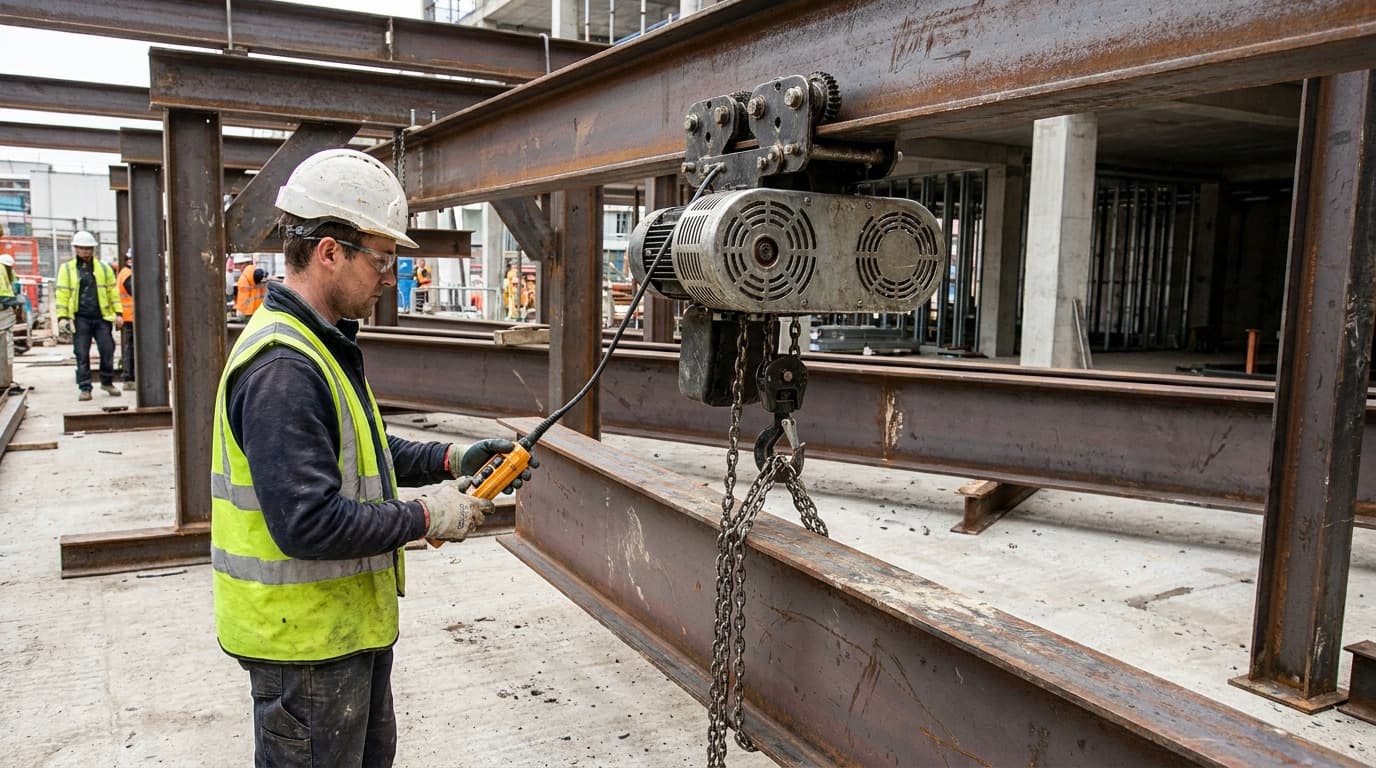
Read the two short OSHA sections that govern these machines and a pattern jumps out. 1926.553 (base-mounted drum hoists) and 1926.554 (overhead hoists) each prescribe a handful of structural things — and then hand almost everything else to the manufacturer.
What OSHA prescribes directly is narrow. Under 1926.553, exposed moving parts — gears, screws, setscrews, chains, cables, sprockets, rotating and reciprocating parts — that constitute a hazard must be guarded; controls used in the normal cycle must be within easy reach of the operator's station; and electric-motor hoists must have a device that disconnects all motors on power failure and will not let a motor restart until the controller is back to "off," an overspeed device where applicable, and a means for a remotely operated hoist to stop when any control is ineffective. Under 1926.554, the manufacturer's safe working load must be marked on the hoist and not exceeded, the supporting structure rated for at least the hoist's load, the support must let the hoist line itself up with the load freely, and — the one everyone should carry — the hoist installed only where the operator can stand clear of the load at all times. Air hoists get sufficient air and positively connected hoses so they cannot whip loose.
Then both sections close with the same sentence, and it is the most important one: all hoists in use must meet the applicable requirements for design, construction, installation, testing, inspection, maintenance, and operation as prescribed by the manufacturer. That is OSHA making the manufacturer's manual the enforceable standard. It is not guidance you can set aside — the regulation adopts it by reference. Which means the manual that lives in the cab, or that got lost two jobs ago, is not paperwork. It is the actual legal requirement for that machine: the inspection intervals, the rated capacity chart, the operating limits, the maintenance schedule. "We don't have the manual" is not a small gap; it is the loss of the standard the law points to.
The winch has no feel — so the machine's devices are the limit#
Because a powered winch cannot feel an overload, the protections that would be a person's judgment on a manual tool have to be built into the machine and the setup. This is why the devices in 1926.553 matter: the power-failure disconnect stops a winch lurching back into motion when power returns with a load hanging; the "stop when any control is ineffective" requirement stops a runaway control becoming a runaway load; the overspeed device exists because a powered drum can pay out faster than anything human can catch. None would be needed on a come-along; all are needed the moment the power stops coming from a person.
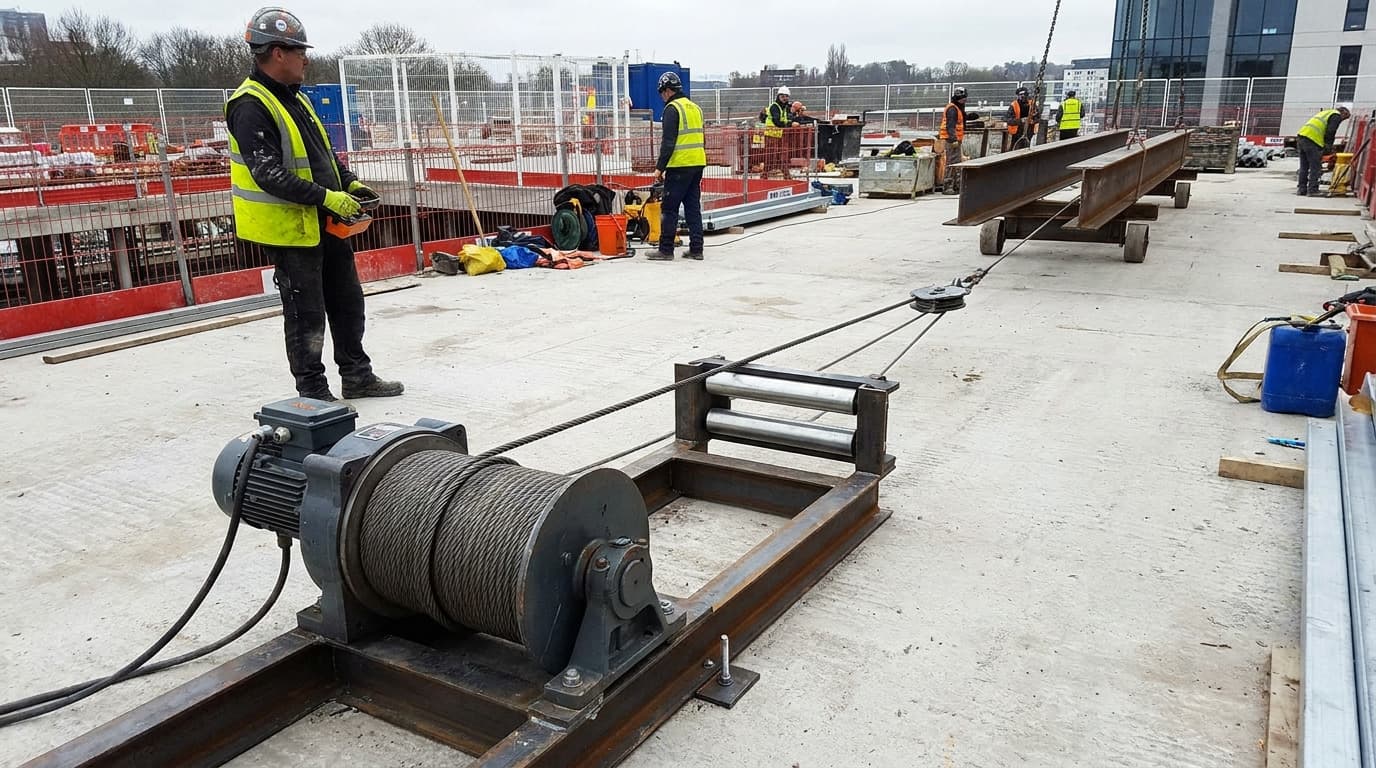
The operator's side of that same problem is line management, and it is where powered winches hurt people. A drum applies enormous force to the wire rope, and the failure modes are specific: never let the line run out to the bare drum — the wire rope's anchor to the drum is not rated to hold the load, and the manufacturer specifies a minimum number of wraps that must remain on the drum (commonly at least three) so the load is held by friction, not by the end fitting. Keep the rope spooling evenly — a line that piles up on one side and then slips across the drum shock-loads the whole system. And never side-pull off a drum not designed for it: a fairlead is what keeps the rope aligned, and pulling at an angle without one crushes and cross-winds the rope and overloads the drum flange.
Stand clear — because the energy has nowhere good to go#
The single most life-saving line in these regulations is the plainest: the hoist must be positioned so the operator can stand clear of the load at all times. It reads like common sense, but it is written into the standard because a powered pull stores enormous energy, and when something in the line lets go, that energy is released along the line of pull — instantly.
A tensioned wire rope that parts does not just drop. It recoils along its axis with lethal force, and a winch line under heavy pull can whip a distance far beyond what anyone standing near it expects. This is why the danger zone of a winch is the line of pull and its recoil path, on both sides of every sheave and snatch block, and why nobody stands in it, straddles a tensioned line, or steps over one. The same principle governs the hoisted load: stand clear, never under, never in the swing path. A powered hoist gives no warning tremble before a failure the way a straining human might — the first sign is the failure itself, which is exactly why position, not reaction, is the protection.
Where the duty sits#
Powered hoists and winches sit under Subpart N and lean on the manufacturer and the ASME standards.
1926.553 governs base-mounted drum hoists — guarding, controls in reach, the electric-motor safety devices, and the manufacturer-conformance requirement — though it does not apply to a drum hoist used with a derrick, which follows 1926.1436(e) instead. 1926.554 governs overhead hoists — marked and un-exceeded SWL, rated support structure, free line-up, operator clear, air-hoist connections, and the same manufacturer-conformance requirement. 1926.552 governs material hoists, personnel hoists and elevators — the tower hoists — which are a separate machine with far more prescriptive rules (rope counts, overhead protection, gate interlocks) and are not this talk's subject. Wire rope on the drum is inspected under the rigging and wire-rope rules already covered, and the load rigging follows 1926.251.
The consensus and contract layers fill in the operating detail: ASME B30.7 covers base-mounted drum hoists and B30.16 powered overhead hoists, carrying the inspection classes, the rated-load discipline and the line-management rules the OSHA text delegates. On federal contract work, EM 385-1-1 carries its own hoist and winch inspection, rated-capacity, operator-qualification and rigging requirements, generally at least as strict; where the manufacturer's manual or the contract is stricter, it governs. Across all of it, the through-line is the same: for a powered hoist, the manufacturer's manual is not optional reading — OSHA made it the requirement.
What can go wrong?#
- A winch keeps pulling on a snagged or overloaded line because nothing gives it the resistance feedback a manual hoist would.
- The manufacturer's manual is missing, so the machine is run with no rated-capacity chart, inspection interval or operating limit — the standard OSHA points to.
- A wire rope parts under tension and recoils along the line of pull, striking someone standing in the danger zone.
- The line runs out to the bare drum and the end anchor — not rated to hold the load — lets go.
- The rope spools unevenly, piles up, then slips across the drum and shock-loads the system.
- A worker stands under the load, in the swing path, or straddling a tensioned line.
- An electric hoist restarts on its own when power returns because the power-failure disconnect was defeated or absent.
- Exposed gears, sprockets or a rotating drum with no guard catch a hand, glove or sleeve.
How do we manage this properly?#
- Treat the manufacturer's manual as the enforceable standard — rated capacity, inspection intervals, operating limits — and do not run the machine without it.
- Remember a powered winch has no overload feel; rely on the machine's devices and the rated capacity, never on how the pull "seems."
- Keep the required minimum wraps on the drum; never run the line out to the bare drum or its end anchor.
- Keep the rope spooling evenly and use a fairlead for any angled pull; never side-pull off a drum not built for it.
- Stand clear of the load and out of the line of pull and its recoil path — never under, never straddling, never over a tensioned line.
- Confirm the power-failure disconnect, overspeed and control-failure devices are present and working on electric hoists.
- Confirm the marked SWL and that the supporting structure is rated for at least the hoist's load.
- Keep guards on exposed gears, sprockets, drums and rotating parts, and keep the controls within reach of a clear operator position.
Before you start#
- Confirm the manufacturer's manual, rated-capacity chart and inspection record are on hand for this machine.
- Confirm the marked SWL and that today's load and line-pull are genuinely under it.
- Confirm the supporting structure or anchor is rated for at least the hoist's or winch's load.
- Confirm the required minimum wraps will stay on the drum and the rope is spooling evenly through a fairlead.
- Confirm the power-failure, overspeed and control-failure devices work on an electric hoist.
- Confirm guards are in place on gears, sprockets and the drum, and controls are within reach.
- Confirm everyone knows the line of pull and recoil path, and that nobody stands in it or under the load.
- On federal work, confirm the EM 385-1-1 hoist, winch and operator requirements are met.
Talk it over#
- On this winch, what is the rated line pull, and do we actually have the manual that states it?
- Where is the recoil path if this line parts under tension — and who is standing in it right now?
- How many wraps have to stay on the drum, and how will we know before we run out?
- If the power drops with a load hanging, what stops this hoist from restarting on its own?
The bottom line#
A manual hoist has a person's strength as a built-in limit; a powered hoist and winch has none — so the load that stops a manual hoist is exactly the load a winch will keep dragging into failure. A winch feels nothing: it applies the same force to a free line and a snagged one, spooling on until the rope parts, the anchor tears loose, or the load swings. That missing limit is why OSHA's rules for these machines — 1926.553 for base-mounted drum hoists, 1926.554 for overhead hoists — prescribe the structural essentials (guarding, controls in reach, the electric power-failure disconnect, overspeed and control-failure devices, a marked SWL that must not be exceeded, a rated support structure, and the operator positioned to stand clear) and then make the manufacturer's manual the enforceable standard by requiring every hoist to meet the design, testing, inspection, maintenance and operation requirements the manufacturer prescribes. So a missing manual is not a paperwork gap — it is the loss of the rated-capacity chart, inspection interval and operating limit the law points to. Because the machine has no feel, the protections are the machine's devices and the operator's line management: keep the minimum wraps on the drum (the end anchor is not rated to hold the load), keep the rope spooling evenly through a fairlead, and never side-pull a drum not built for it. And the plainest rule is the one that saves lives: stand clear of the load and out of the line of pull and its recoil path, because a parted wire rope recoils instantly and far, with no warning tremble first. The test for any powered hoist or winch is one question: do we have the manual that states this machine's limits, and is anyone standing where the energy will go if the line lets go?
Frequently asked questions about hoist and winch safety#
How is a powered winch more dangerous than a manual hoist?
A manual hoist is limited by the person on the handle — when the load is too heavy, you cannot move it, and that resistance warns you. A powered winch has no such feel. It applies the same force to a free line and a snagged or overloaded one, and keeps applying it until the rope parts, the anchor fails, or the load breaks loose. The human overload gauge that protects a manual tool is simply gone.
Why does the manufacturer's manual matter so much for a hoist?
Because OSHA makes it the enforceable standard. Both 1926.553 and 1926.554 require every hoist in use to meet the design, construction, installation, testing, inspection, maintenance and operation requirements the manufacturer prescribes. The manual holds the rated-capacity chart, inspection intervals and operating limits — so running a hoist without it means running it without the standard the law actually points to.
What does "stand clear of the load" really mean for a winch?
It means staying out of the line of pull and its recoil path, not just out from under the hook. A tensioned wire rope that parts recoils along its axis with lethal force and can whip far beyond where anyone expects. The danger zone is the whole line of pull on both sides of every sheave and snatch block — nobody stands in it, straddles a tensioned line, or steps over one.
Why can't the line run out to the bare drum?
Because the wire rope's anchor to the drum is not rated to hold the load — it just secures the rope end. The load is meant to be held by the friction of the wraps around the drum, so the manufacturer specifies a minimum number of wraps (commonly at least three) that must always remain. Run out to the bare drum and the end fitting takes the full load it was never designed for.
What are the power-failure and overspeed devices for?
They replace judgment a person would supply on a manual tool. The power-failure disconnect stops a powered hoist from lurching back into motion when power returns with a load hanging, and requires the controller to be returned to "off" before restart. The overspeed device stops a powered drum from paying out faster than anyone could catch. On electric hoists these are required, and they should be confirmed working before use.
Does this talk cover the personnel and material hoists on the tower?
No. Material hoists, personnel hoists and elevators are governed separately under 1926.552, with far more prescriptive rules — rope counts, overhead protection, gate interlocks and more — because they move people and materials vertically in a hoistway. This talk is about the hoisting and pulling machine — drum hoists, overhead hoists and winches — not the tower hoist.
How often should a powered hoist or winch be inspected?
On the schedule the manufacturer prescribes, because OSHA adopts that schedule as the requirement, backed by the ASME B30 inspection classes (frequent and periodic). Rigging is also inspected before use on each shift under 1926.251, and any hoist that fails an inspection or is missing a required safety device comes out of service until it is corrected.
Download the hoist and winch safety toolbox talk PDF#
Get this hoist and winch safety toolbox talk as a print-ready PDF — available in English, Spanish, Portuguese, and Turkish. Print it, hand it to the crew, and collect signatures on the included attendance sheet.
Download the PDF — free account required. New members get 3 free downloads.
Related toolbox talks#
Sources#
- OSHA, 29 CFR 1926.553 — Base-mounted drum hoists: https://www.ecfr.gov/current/title-29/subtitle-B/chapter-XVII/part-1926/subpart-N/section-1926.553
- OSHA, 29 CFR 1926.554 — Overhead hoists: https://www.ecfr.gov/current/title-29/subtitle-B/chapter-XVII/part-1926/subpart-N/section-1926.554
- OSHA, 29 CFR 1926.552 — Material hoists, personnel hoists, and elevators: https://www.osha.gov/laws-regs/regulations/standardnumber/1926/1926.552
This talk is general awareness guidance for training purposes. It does not replace your employer's rigging and hoisting program, the hoist or winch manufacturer's manual, ASME B30.7 or B30.16, or a competent or qualified person's inspection duties, and it is not legal advice. Where the manufacturer's instruction or a contract sets a specific limit, that limit governs.
Written by FieldSafetyTalk's safety professional — a CSP, ASP, CHST and OSHA Authorized Outreach Trainer with 14+ years of international construction safety experience across federal, heavy civil, and industrial projects.