Eye Strain
Updated 2026-07-28
In this bundle Health & Environmental Exposure
Print-ready PDF
Download this talk as a print-ready PDF, available in 4 languages.
Lighting is the only hazard control on a construction site that people judge entirely by feel. Nobody guesses at a wind speed or a noise level any more, but "is there enough light?" is still answered by looking around and shrugging. There is a table with numbers in it, most people have never seen it, and the numbers are lower than you would expect. This Eye Strain Toolbox Talk (Safety Talk / Tailgate Talk) is about what the standard actually requires and what it leaves to you.
Here is the distinction that carries this whole talk: the standard sets a floor for seeing hazards, not a level for working comfortably. Table D-3 exists so that people can move around and recognise danger. It was never written to prevent visual fatigue, and meeting it in full can still leave a crew squinting at detailed work all afternoon. Compliance and comfort are two different questions here, and only one of them has a number.
Table D-3 — the numbers nobody quotes#
1926.56(a) requires that construction areas, ramps, runways, corridors, offices, shops and storage areas be lighted to not less than the minimum illumination intensities listed in Table D-3 while any work is in progress:
| Foot-candles | Area or operation |
|---|---|
| 3 | General construction areas, concrete placement, excavation and waste areas, access ways, active storage areas, loading platforms, refueling, and field maintenance areas |
| 5 | Indoors: warehouses, corridors, hallways, and exitways |
| 5 | Tunnels, shafts, and general underground work areas — except a minimum of 10 foot-candles at the tunnel and shaft heading during drilling, mucking and scaling (Bureau of Mines approved cap lights acceptable in the tunnel heading) |
| 10 | General construction plant and shops — batch plants, screening plants, mechanical and electrical equipment rooms, carpenter shops, rigging lofts and active store rooms, mess halls, and indoor toilets and workrooms |
| 30 | First aid stations, infirmaries, and offices |
Two things jump out.
A general construction area needs 3 foot-candles. An office needs 30. A tenfold difference — and the reason is that the site figure is about seeing where you are going and what might hurt you, while the office figure is about reading and sustained visual work. Most of the eye strain on a construction project happens in the gap between those two purposes: detailed work being done at site lighting levels.
Be careful which figure you are quoting. Several widely circulated summaries put general construction areas at 5 foot-candles. OSHA's own table puts them in the 3 foot-candle row, with 5 reserved for indoor warehouses, corridors and exitways and for tunnels and shafts. If you are writing a site specification, use the table rather than a summary of it.
And for anything not listed — 1926.56(b) refers you to American National Standard A11.1-1965, R1970, Practice for Industrial Lighting for recommended values. That is the reference point behind the whole table: a lighting practice from 1965. Modern lighting design has moved a long way past it, which is another reason to treat Table D-3 as a floor rather than a target.
What actually tires eyes#
Illumination level is only one of four things, and the other three are not in any table.
Contrast. The eye adapts to the brightest thing in view. A bright task light against a dark background, or a doorway from a lit interior into a dark stair, forces constant re-adaptation — which is fatiguing and briefly blinding.
Glare. Direct glare from an unshielded lamp, and reflected glare off wet concrete, glass, steel, laminated drawings and screens. Glare does not reduce the amount of light; it reduces what you can actually see with it.
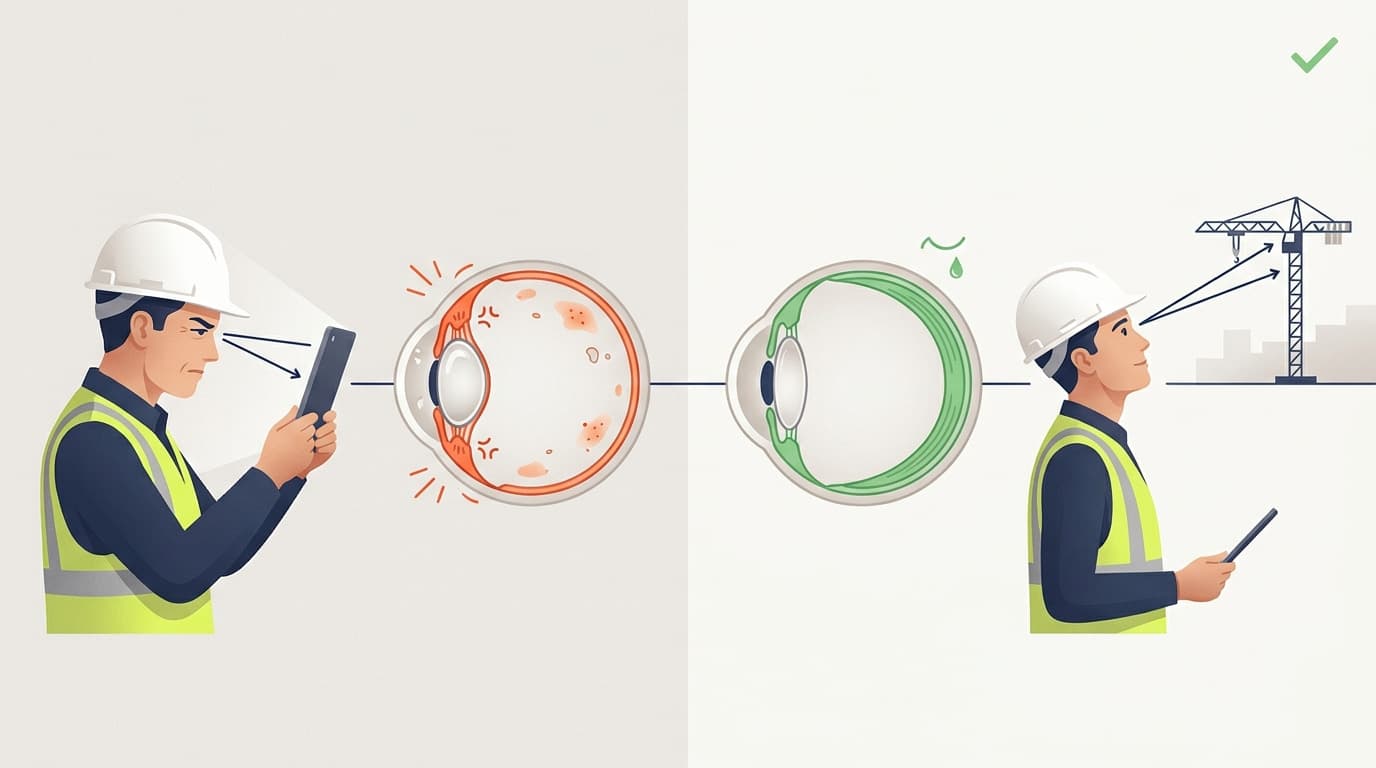
Sustained near focus. Screens, tablets, drawings, laser levels and setting-out work all hold the eye at a fixed near distance. The muscles doing that do not rest, blink rate drops sharply, and the result is the dryness, ache and blurring people call eye strain.
Duration and darkness. Night shifts and winter afternoons mean hours of artificial light and repeated adaptation between lit and unlit zones — plus the fatigue that comes with the hour itself.
Screens deserve their own note, because they have quietly arrived on every site: tablets for drawings and permits, phones for everything, laser and total-station displays, and site offices full of monitors. The standard practical control is the 20-20-20 habit — every 20 minutes, look at something about 20 feet (6 m) away for 20 seconds. It works because it lets the focusing muscles release and restores the blink rate.
What can go wrong?#
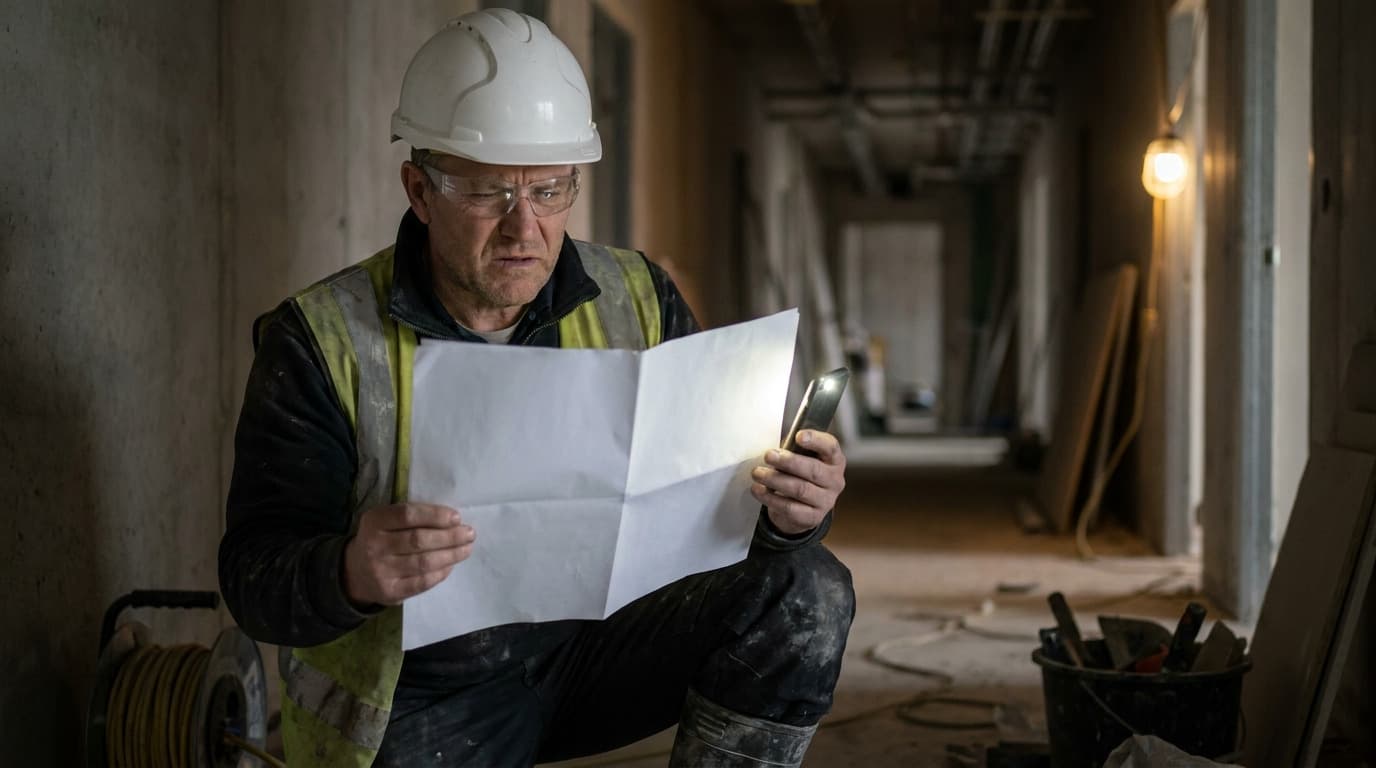
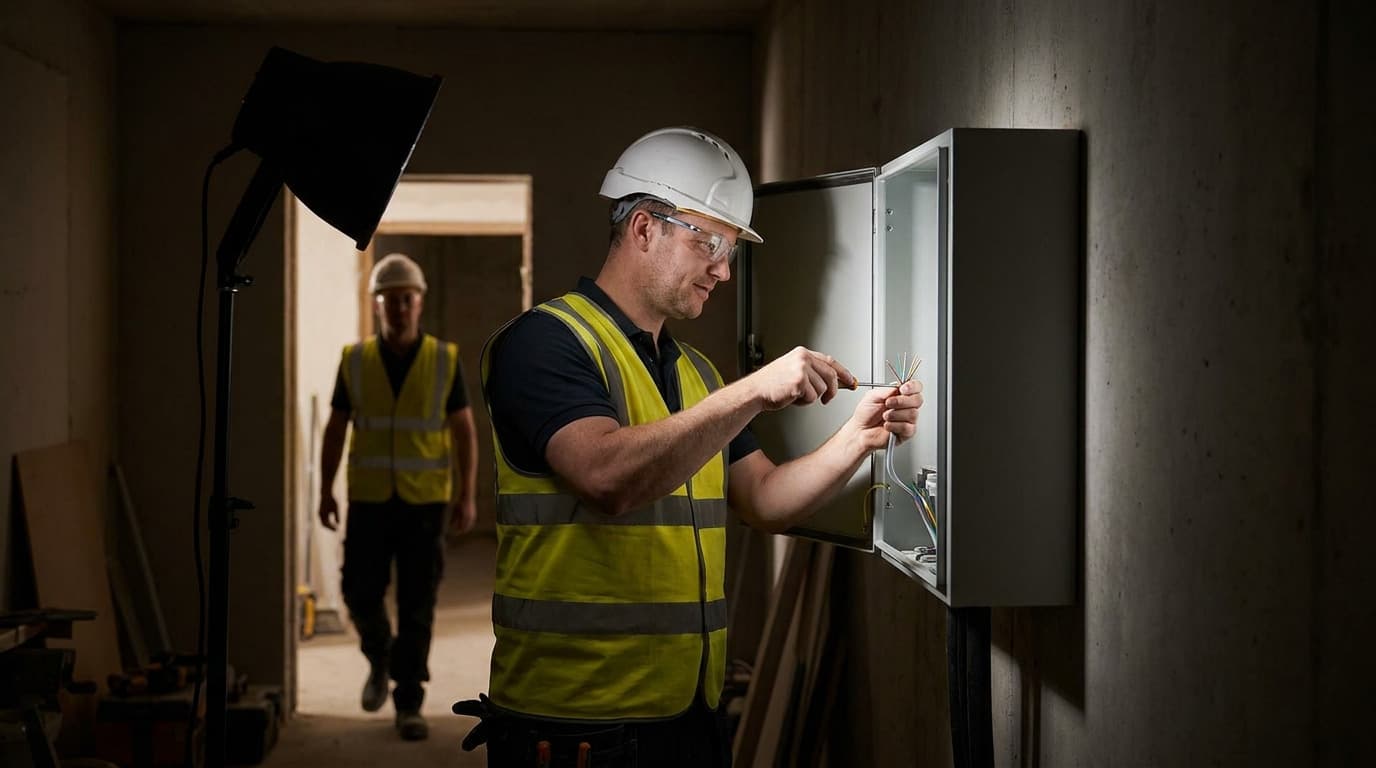
Detailed work at site lighting levels. Reading a drawing, setting out or terminating cable at 3 to 5 foot-candles.
Task lighting that blinds everyone else. A tower light aimed across the working area rather than at the work.
Nobody measures. No light meter on site, so the 3, 5, 10 and 30 figures are never actually tested.
Dark transitions. Coming out of a lit container into an unlit stair core, or driving from a floodlit area into darkness.
Dirty and failed fittings. Illumination falls quietly as lamps age and lenses foul, and nobody notices because the change is gradual.
Screens all day, in daylight. Maximum brightness against sunlight, held at arm's length, for hours.
Uncorrected vision. Prescriptions years out of date, or safety glasses worn over the wrong prescription.
Headaches treated as tiredness. End-of-shift headache, blurring and dry eyes are symptoms, not personality.
How do we manage this properly?#
Get a light meter and use it. A reading turns an argument into a number, and the table then tells you whether the number is acceptable.
Light the task, not the area — and shield it. Local task lighting positioned so the lamp is out of the line of sight, aimed at the work rather than at people's eyes.
Design out glare. Diffuse where you can, avoid pointing fittings at reflective surfaces, and remember wet concrete and glass are mirrors.
Soften transitions. Light the route between bright and dark zones so the eye is not adapting from one extreme to the other.
Maintain the fittings. Clean lenses, replace failed lamps promptly, and treat gradual dimming as a planned maintenance item.
Use 20-20-20 for screen and close work, and get people away from small screens for drawings where a larger display exists.
Support eye tests. An out-of-date prescription is a hazard control that has quietly expired, and prescription safety eyewear is a real solution rather than a perk.
Treat symptoms as information. Persistent headaches, blurring, dryness and difficulty refocusing are worth acting on — for the individual and as a signal about the lighting.
Before you start#
- Confirm what Table D-3 requires for the area you are working in today.
- Confirm whether anyone has actually measured the light level there.
- Confirm detailed or close work is not being done at general construction area levels.
- Confirm task lighting is positioned so the lamp is not in anyone's line of sight.
- Confirm reflective surfaces are not throwing glare into the work position.
- Confirm the route in and out is lit, not just the work area.
- Confirm anyone on screens for long periods knows the 20-20-20 habit.
- Confirm anyone reporting headaches, blurring or dry eyes has somewhere to raise it.
Talk it over#
- How many foot-candles do you think there are where you are standing — and has anyone checked?
- What is the darkest part of your route on and off this job?
- Who is reading drawings on a phone, and how long for?
- When did you last have an eye test?
The bottom line#
1926.56(a) requires construction areas, ramps, runways, corridors, offices, shops and storage areas to be lighted to not less than the minimum intensities in Table D-3 while any work is in progress: 3 foot-candles for general construction areas, concrete placement, excavation and waste areas, access ways, active storage, loading platforms, refueling and field maintenance; 5 indoors for warehouses, corridors, hallways and exitways, and for tunnels, shafts and general underground work areas — with 10 at the tunnel and shaft heading during drilling, mucking and scaling; 10 for construction plant and shops; and 30 for first aid stations, infirmaries and offices. For anything not listed, (b) points to ANSI A11.1-1965, R1970. Note the gap that causes most of the problem: an office needs ten times the light of a general construction area, and detailed work done at site levels sits in between. And note what the table does not cover at all — contrast, glare, sustained near focus and duration, which is where eye strain actually comes from.
Frequently asked questions about lighting and eye strain#
What lighting does OSHA require on a construction site?
1926.56(a) requires construction areas, ramps, runways, corridors, offices, shops and storage areas to be lighted to not less than the minimum illumination intensities in Table D-3 while any work is in progress. The table runs from 3 foot-candles for general construction areas up to 30 foot-candles for first aid stations, infirmaries and offices.
How many foot-candles for a general construction area?
3. That row also covers concrete placement, excavation and waste areas, access ways, active storage areas, loading platforms, refueling and field maintenance areas. Some widely circulated summaries say 5 — but OSHA's own table reserves 5 for indoor warehouses, corridors, hallways and exitways, and for tunnels, shafts and general underground work areas.
Are there higher requirements underground?
Yes, at the working face. Tunnels, shafts and general underground work areas are 5 foot-candles, with an exception requiring a minimum of 10 foot-candles at the tunnel and shaft heading during drilling, mucking and scaling. Bureau of Mines approved cap lights are acceptable for use in the tunnel heading.
What if my area is not in the table?
1926.56(b) covers that: for areas or operations not listed, refer to American National Standard A11.1-1965, R1970, Practice for Industrial Lighting for recommended values of illumination. It is worth knowing that the reference behind the whole table is a 1965 lighting practice, which is one reason to treat Table D-3 as a minimum rather than a design target.
Does meeting Table D-3 prevent eye strain?
No. The table sets a floor for seeing hazards and moving safely, not a level for comfortable sustained work. Eye strain comes mostly from things the table does not address — contrast, glare, sustained near focus and duration — so a fully compliant area can still leave people with headaches and blurred vision after detailed work.
What is the 20-20-20 rule?
A practical habit for screen and close work: every 20 minutes, look at something about 20 feet (6 m) away for 20 seconds. It gives the focusing muscles a break and restores a normal blink rate, which is what dries out during concentrated near work on tablets, phones and drawings.
Should we worry about glare as well as light levels?
Yes — glare reduces what you can see without reducing how much light there is. Direct glare comes from unshielded lamps in the line of sight; reflected glare comes off wet concrete, glass, steel, laminated drawings and screens. Positioning and shielding fittings usually does more for visibility than simply adding more light.
Download the eye strain toolbox talk PDF#
Get this eye strain toolbox talk as a print-ready PDF — available in English, Spanish, Portuguese, and Turkish. Print it, hand it to the crew, and collect signatures on the included attendance sheet.
Download the PDF — free account required. New members get 3 free downloads.
Related toolbox talks#
Sources#
- OSHA, 29 CFR 1926.56 — Illumination: https://www.osha.gov/laws-regs/regulations/standardnumber/1926/1926.56
- OSHA, 29 CFR 1926.21 — Safety training and education: https://www.osha.gov/laws-regs/regulations/standardnumber/1926/1926.21
This talk summarises published regulatory guidance. It is not medical advice. Persistent headaches, blurred vision, eye pain or any change in sight should be assessed by an optometrist, physician or other qualified health professional.
Written by FieldSafetyTalk's safety professional — a CSP, ASP, CHST and OSHA Authorized Outreach Trainer with 14+ years of international construction safety experience across federal, heavy civil, and industrial projects.