Hydrogen Sulfide (H2S) Awareness
Updated 2026-08-06
In this bundle Health & Environmental Exposure
Print-ready PDF
Download this talk as a print-ready PDF, available in 4 languages.
Hydrogen sulfide, H2S, is one of the deadliest gases a construction worker can run into, and it turns up in more ordinary places than people expect: sewers and manholes, sanitary lines, trenches and excavations in certain soils, tank bottoms and vaults, wastewater and lift stations, and anywhere organic material is breaking down without air. It is famous for smelling like rotten eggs, and that reputation is exactly what gets people killed — because the smell is a warning that switches off right when you need it most. H2S kills quickly, it kills at concentrations that are easy to reach in an enclosed space, and it very often kills the person who runs in to help, because the gas that dropped the first worker is still there. This Hydrogen Sulfide (H2S) Awareness Toolbox Talk (Safety Talk / Tailgate Talk) is about the one hazard where trusting your own senses is the mistake that gets you.
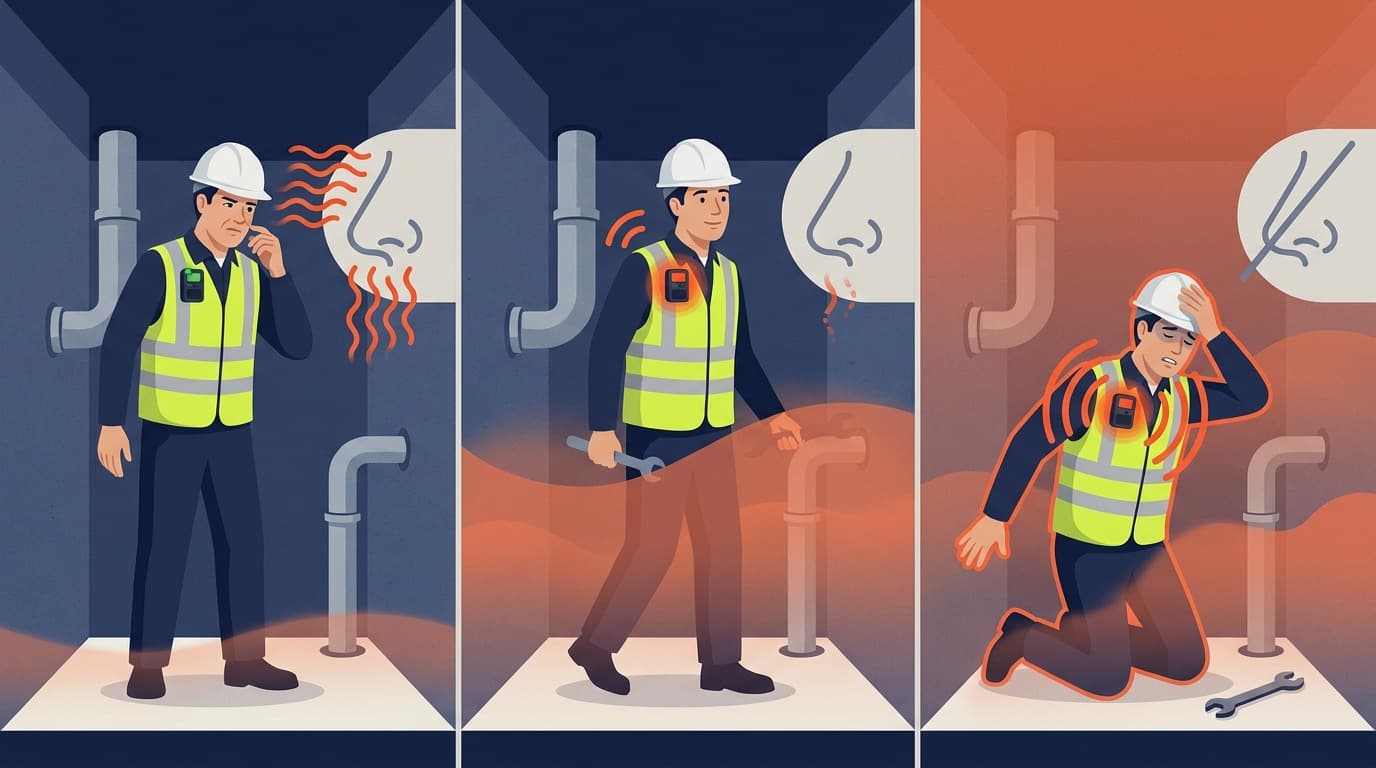
Here is the distinction that carries this whole talk: hydrogen sulfide is the hazard that disables your only built-in warning at the exact moment it turns deadly — it smells like rotten eggs at harmless levels, then paralyzes the very nerve that smells it right as the concentration becomes lethal, so the rule "if you can still smell it, it's fine" is exactly backwards. At very low levels, far below anything harmful, most people can smell H2S easily. But as the concentration climbs, the gas fatigues and then deadens the olfactory nerve, so the smell fades and disappears — and it disappears right around the levels that become immediately dangerous to life. The result is a hazard whose warning system is calibrated backwards: your nose works when you do not need it and fails when you do. A worker who notices the smell is gone often thinks the danger has passed, when in fact they may be moments from collapse.
Where the boundary of this talk sits#
This talk works alongside a few others. The confined space talk owns the permit-entry system, atmospheric testing, and the attendant, and H2S is one of the main reasons that system exists. The respiratory protection talk owns respirator selection and fit. This talk owns the gas itself: why you cannot smell your way to safety, how fast H2S incapacitates, where it collects, and why an electronic monitor is the only thing you can trust. Where the question is how to run a permit space or fit a respirator, those talks own it; this one owns the specific, backwards-behaving gas that makes those systems life-or-death.
Why your nose is the wrong detector#
The reason the smell fails is physiological, and it is worth understanding so nobody talks themselves out of the danger. The rotten-egg odor is detectable at extremely low concentrations, well under the level where H2S starts to harm you — which is exactly why people trust it. But olfactory fatigue sets in with continued exposure, and at higher concentrations the gas rapidly deadens the sense of smell altogether. By around the concentration where H2S becomes immediately dangerous to life and health, a worker may smell nothing at all. So the two things a person naturally concludes from their nose are both wrong at the worst time: "I don't smell it, so it's gone" can mean the level just climbed past where you can smell it, and "the smell got weaker" can mean the concentration got stronger. There is an old wellsite saying that captures it: if you can smell it, you have already been exposed — and if you suddenly cannot smell it anymore, that is not good news. The only honest reading of your nose with H2S is that it cannot be trusted to tell you when you are safe.
How fast it works, and why rescuers die#
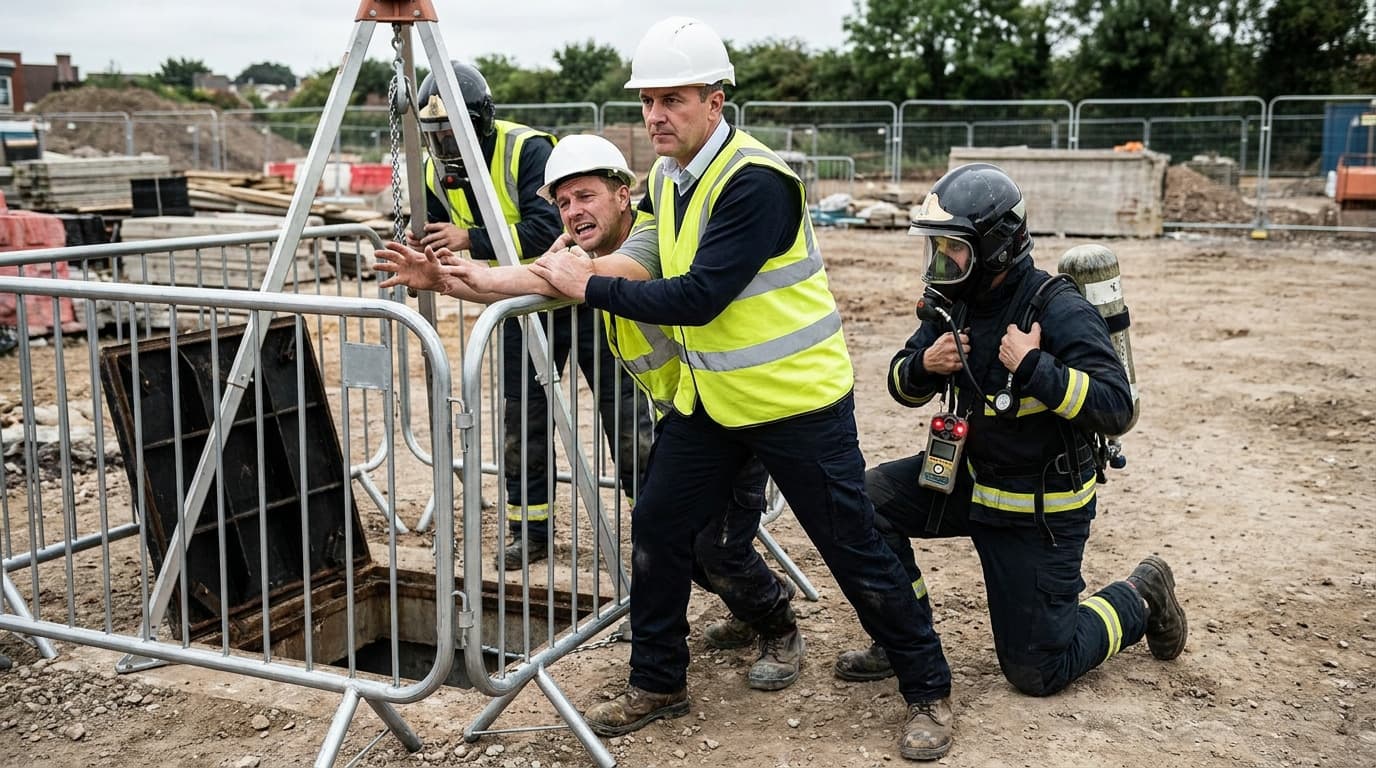
H2S does not give you the time that most hazards do. At the exposure limits, it causes eye and respiratory irritation and headaches. As concentrations climb into the low hundreds of parts per million, it brings dizziness, nausea, and confusion. Higher still, it causes what the industry calls knockdown — near-instant collapse and loss of consciousness, sometimes within a breath or two — followed by respiratory paralysis and death within minutes. This speed is why H2S is a leading killer in confined and enclosed spaces, and it is why it kills rescuers. The scene looks like a person who simply fell down, and the natural human response is to rush in and pull them out. But the same invisible gas that dropped the first worker is still filling that space, and the would-be rescuer goes down beside them, often faster because they are exerting themselves and breathing hard. Multiple-fatality H2S incidents almost always follow this pattern: one down, then a second and third who went in to help without air. Never enter to rescue without a monitor and supplied air — the person you cannot save is not worth the two more who die trying.
Where it hides: low, enclosed, and invisible#
H2S is heavier than air, and that single physical fact shapes where it kills. Being denser than air, it sinks and pools in low points — the bottom of a trench or excavation, a sump, a tank bottom, a vault, a manhole, a cellar, the low end of a sewer line. These are exactly the low, enclosed spaces workers climb down into, which is why H2S and confined-space entry are so tightly linked. A space can read as perfectly fine at the top and be lethal at the bottom, and the gas is usually there waiting before anyone enters, not created by the work. That is the whole logic behind testing the atmosphere before entry and continuing to monitor during the work: the danger is invisible, odorless once it is concentrated, and already present. H2S is also flammable, so at higher concentrations it adds a fire and explosion hazard on top of the toxic one, which is another reason these spaces are treated with the caution they are.
The one thing you can trust: the monitor#
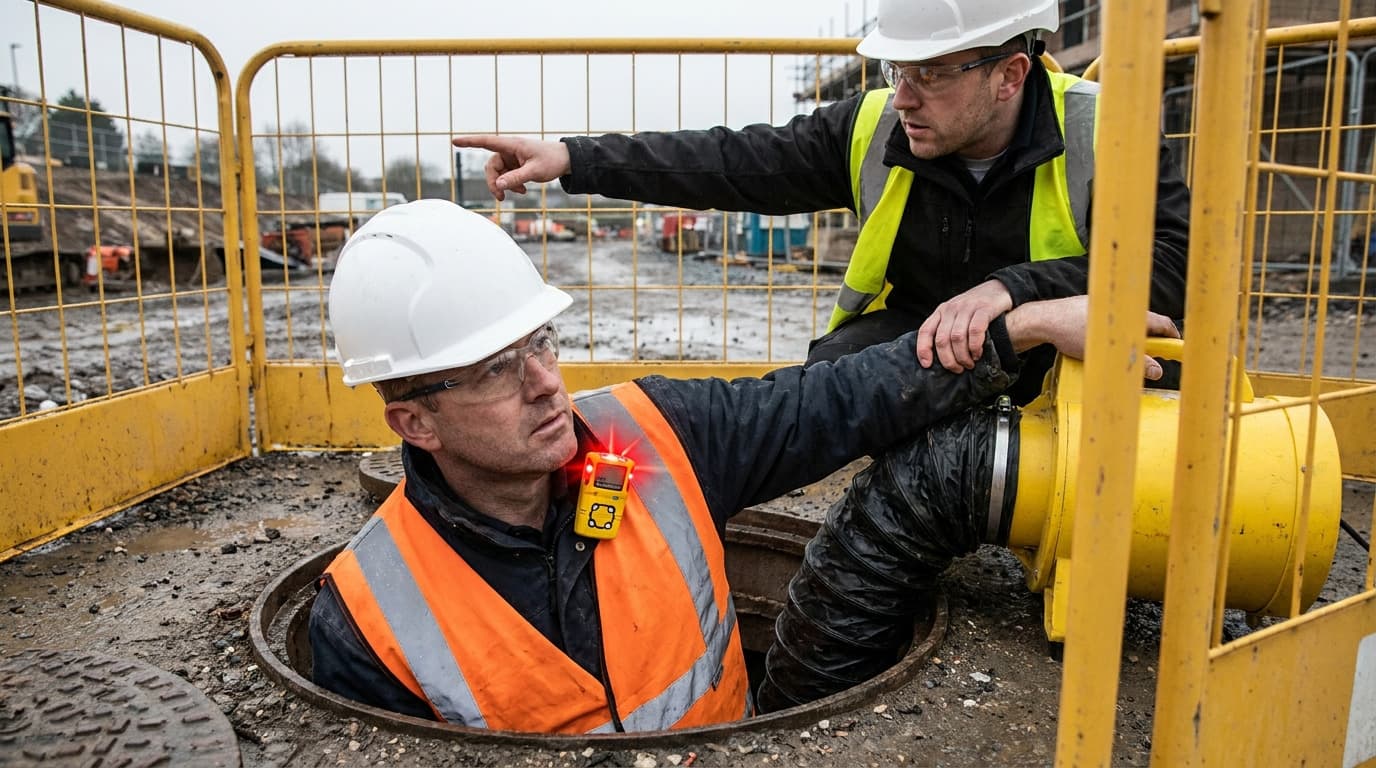
Because your senses fail you, the electronic gas monitor is not optional equipment — it is your actual sense of the hazard, the way a dosimeter is for radiation. A calibrated H2S monitor, whether a personal unit clipped to your gear or a device lowered into a space, detects the gas at levels well below where it harms you and alarms before you are in danger, which is the warning your nose stops giving. For this to protect you, the monitor has to be bump-tested and calibrated on schedule, worn or placed in the breathing zone or the space being tested, and actually heeded when it alarms — an alarm is a leave-now signal, not a nuisance to acknowledge and keep working through. Any low point or enclosed space on a site where H2S is possible gets tested before entry and monitored continuously during the work. And where the atmosphere can reach dangerous levels, the protection is atmosphere-supplying respirators — supplied air or SCBA — because an ordinary cartridge respirator does nothing against a gas at these concentrations.
Where the duty sits#
OSHA does not have a single standard dedicated to hydrogen sulfide, so the duty comes from several standards together. The exposure limits are set in 1926.55 for construction, which establishes a permissible exposure limit of 10 ppm as an 8-hour time-weighted average; general industry under 1910.1000 Table Z-2 uses a 20 ppm ceiling with a 50 ppm peak allowed for a single 10-minute period per shift if no other exposure occurs. NIOSH sets the level immediately dangerous to life and health at 100 ppm. Where H2S may be present in a low or enclosed space, the construction confined spaces standard 1926 Subpart AA governs entry, testing, and rescue; respirator use runs through 1910.134; hazard communication and training run through 1910.1200; and the General Duty Clause, Section 5(a)(1) requires control of the recognized hazard even below the PEL. The consensus training standard ANSI Z390.1 is widely used for H2S programs. Where a site's H2S program, a permit, or a manufacturer's instruction sets a specific requirement, that requirement governs.
What can go wrong?#
- A worker enters a trench or vault, smells nothing, and is overcome by H2S pooled at the bottom.
- The rotten-egg smell fades, a worker assumes the gas cleared, and the level has actually climbed.
- Someone rushes in to rescue a collapsed coworker without air and goes down beside them.
- A space is tested at the top, reads clean, and is lethal at the low end where the work happens.
- A monitor alarms and is silenced and ignored as a nuisance instead of triggering evacuation.
- A cartridge respirator is worn against a concentration only supplied air can handle.
- A monitor is out of calibration or never bump-tested and gives false reassurance.
- Work in a sewer, lift station, or sour-soil excavation proceeds with no atmospheric testing at all.
How do we manage this properly?#
- Never trust your nose — a fading or absent smell can mean rising, not falling, gas.
- Use a calibrated H2S monitor, bump-tested on schedule, in the breathing zone or the space.
- Test the atmosphere before entry and monitor continuously during the work.
- Treat any monitor alarm as leave-now, not a nuisance to acknowledge and work through.
- Remember H2S is heavier than air — it pools in trenches, sumps, vaults, and tank bottoms.
- Never rescue without a monitor and supplied air — the gas that dropped them is still there.
- Where levels can be dangerous, use supplied air or SCBA, never a cartridge respirator.
- Follow the confined space entry program wherever H2S is possible in an enclosed space.
Before you start#
- Confirm whether H2S is possible in your work area — sewers, sour soil, tanks, vaults, wastewater.
- Confirm you have a calibrated, bump-tested H2S monitor and know its alarm points.
- Confirm the atmosphere has been tested before any entry into a low or enclosed space.
- Confirm continuous monitoring is set up for the duration of the work.
- Confirm the rescue plan uses monitors and supplied air — nobody enters to rescue on breath alone.
- Confirm supplied-air respirators or SCBA are available where levels could be dangerous.
- Confirm everyone knows an alarm means evacuate immediately, not acknowledge and continue.
- Confirm the confined space permit and attendant are in place where required.
Talk it over#
- Does anyone know where H2S could show up on this job — and is any of it in a space we enter?
- Have you ever noticed a bad smell fade and assumed it got better? What might that really mean?
- If a coworker collapsed in a trench or vault, what would we do — and what would we NOT do?
- Are our monitors calibrated and bump-tested, and does everyone know the alarm means leave?
The bottom line#
Hydrogen sulfide is the hazard that disables your only built-in warning at the exact moment it turns deadly — it smells like rotten eggs at harmless levels, then paralyzes the very nerve that smells it right as the concentration becomes lethal, so the rule "if you can still smell it, it's fine" is exactly backwards. Your nose detects H2S at harmless levels and then goes silent as the gas climbs into the range that causes knockdown and death within minutes, so a fading smell can mean rising gas, not falling. Because your senses are calibrated backwards, the electronic monitor is your real sense of the hazard — calibrated, bump-tested, worn in the breathing zone, and obeyed the instant it alarms. H2S is heavier than air, so it pools invisibly in the trenches, vaults, tanks, and low points workers climb into, which is why it is tested before entry and monitored throughout, and why it kills rescuers who rush in without air. The limits live in 1926.55 (10 ppm TWA in construction), the entry rules in 1926 Subpart AA, respirators in 1910.134, and the recognized-hazard duty in 5(a)(1). The question to carry is the one your nose will lie to you about: is H2S possible where I'm working — and am I trusting a calibrated monitor instead of my own sense of smell?
Frequently asked questions about hydrogen sulfide (H2S)#
Why can't I rely on the rotten-egg smell?
Because the smell switches off right when the gas becomes deadly. At very low, harmless concentrations most people can smell H2S easily, which is why it feels like a reliable warning. But as the concentration rises, the gas fatigues and then deadens the olfactory nerve, and the smell fades and disappears — right around the levels that become immediately dangerous to life. So the two conclusions your nose leads you to are both wrong at the worst moment: "I don't smell it anymore, so it's gone" can actually mean the concentration climbed past where you can smell it, and "the smell got weaker" can mean the gas got stronger. The saying on wellsites is that if you can smell it you have already been exposed, and if you suddenly cannot smell it, that is a warning, not an all-clear. With H2S your nose simply cannot be trusted to tell you when you are safe.
How quickly does H2S hurt someone?
Very quickly — far faster than most hazards give you time for. Around the exposure limits it causes eye and respiratory irritation and headaches. In the low hundreds of parts per million it brings dizziness, nausea, and confusion. Higher still, it causes knockdown: near-instant collapse and loss of consciousness, sometimes within a breath or two, followed by respiratory paralysis and death within minutes. That speed is the whole reason H2S is so dangerous in enclosed spaces — there is often no time to recognize the problem and climb out once you are in a high concentration. It is also why the protection has to be in place before entry, through testing and monitoring, rather than something you react to once you feel symptoms, because by the time you feel the serious symptoms you may already be unable to escape.
Why does H2S kill the people who try to rescue?
Because the gas that dropped the first worker is still there, and a collapsed person does not look like a gas hazard. When someone goes down in a trench, vault, or tank, the instinctive human response is to rush in and pull them out. But H2S is invisible and, at these levels, no longer something you can smell, so the rescuer runs straight into the same lethal atmosphere — often going down faster because they are exerting themselves and breathing hard. This is why multiple-fatality H2S incidents so often involve two or three victims: one who collapsed and the would-be rescuers who followed without air. The rule is absolute: never enter to rescue without a monitor and supplied air. It feels wrong to pause when a coworker is down, but entering unprotected does not save them — it just adds your body to the count.
Where does H2S collect on a site?
In low, enclosed spaces, because it is heavier than air. H2S is denser than air, so it sinks and pools at low points — the bottom of a trench or excavation, a sump, a tank bottom, a vault, a manhole, a cellar, the low end of a sewer or lift station. These are exactly the spaces workers climb down into, which is why H2S and confined-space entry are so tightly connected. A dangerous consequence of this is that a space can read fine at the top and be lethal at the bottom, so testing only where you stand is not enough — the atmosphere has to be checked at the depth where the work happens. And because the gas is usually there before anyone enters rather than produced by the work, testing the atmosphere before entry and monitoring continuously during it is the only way to know what you are climbing into.
What kind of monitor and respirator do I need?
A calibrated electronic H2S monitor, and, where levels can be dangerous, an atmosphere-supplying respirator — not a cartridge one. The monitor is your real sense of the hazard: it detects H2S well below harmful levels and alarms before you are in danger, which is the warning your nose stops giving. It has to be bump-tested and calibrated on schedule, worn in the breathing zone or placed in the space being tested, and obeyed the instant it alarms — an alarm means leave, not acknowledge and keep working. For respiratory protection at dangerous concentrations, only supplied air or SCBA works, because an ordinary cartridge respirator does essentially nothing against a gas at these levels. Matching the protection to the concentration is critical, and it is one of the things the confined space and respiratory protection programs exist to get right.
Is H2S a fire hazard too?
Yes — on top of being toxic, hydrogen sulfide is flammable, so at higher concentrations it adds a fire and explosion risk to the poisoning risk. This is one more reason the enclosed spaces where H2S collects are treated so carefully: the same atmosphere that can incapacitate a worker can also ignite. In practice the toxic hazard is what threatens workers first, because H2S becomes immediately dangerous to life at concentrations well below the range of its main fire concern, so the poisoning is usually the controlling risk for personal safety. But the flammability is a real reason to control ignition sources around spaces where H2S may accumulate, and to treat those atmospheres as the serious dual hazard they are. It is part of why atmospheric testing checks for flammable gas as well as toxic gas and oxygen level before anyone enters.
Download the hydrogen sulfide (H2S) awareness toolbox talk PDF#
Get this hydrogen sulfide awareness toolbox talk as a print-ready PDF — available in English, Spanish, Portuguese, and Turkish. Print it, hand it to the crew, and collect signatures on the included attendance sheet.
Download the PDF — free account required. New members get 3 free downloads.
Related toolbox talks#
Sources#
- OSHA, Hydrogen Sulfide — Standards (construction 29 CFR 1926.55 sets a 10 ppm 8-hour TWA exposure limit; general industry 29 CFR 1910.1000 Table Z-2 sets a 20 ppm ceiling with a 50 ppm peak for a single 10-minute period per shift if no other exposure occurs; ACGIH TLV 1 ppm TWA / 5 ppm STEL): https://www.osha.gov/hydrogen-sulfide/standards
- NIOSH, Hydrogen sulfide — Immediately Dangerous to Life or Health (IDLH) (IDLH established at 100 ppm; olfactory fatigue reported at approximately 100 ppm; higher concentrations cause rapid unconsciousness, cessation of respiration, and death): https://www.cdc.gov/niosh/idlh/7783064.html
- OSHA, Confined Spaces in Construction — 29 CFR 1926 Subpart AA (permit-required confined space entry, atmospheric testing before and during entry, and rescue provisions applicable where H2S may accumulate in low or enclosed spaces): https://www.osha.gov/laws-regs/regulations/standardnumber/1926/1926SubpartAA
This talk is general awareness guidance for training purposes. It does not replace your employer's H2S program, the OSHA air contaminant, confined space, and respiratory protection standards, the OSH Act General Duty Clause, a site's atmospheric monitoring procedures, or a competent person's duties, and it is not legal advice. Where a site H2S program, a confined space permit, or a manufacturer's instruction sets a specific requirement, that requirement governs.
Written by FieldSafetyTalk's safety professional — a CSP, ASP, CHST and OSHA Authorized Outreach Trainer with 14+ years of international construction safety experience across federal, heavy civil, and industrial projects.