Machine Guarding
Updated 2026-07-28
In this bundle Tools & Machinery
Print-ready PDF
Download this talk as a print-ready PDF, available in 4 languages.
Guards go missing for reasons that sound sensible at the time. It slowed the job down. It kept catching. It was broken and there was no replacement. It came off for a repair and nobody put it back. Every one of those is an explanation, and none of them is a defence. This Machine Guarding Toolbox Talk (Safety Talk / Tailgate Talk) is about what the standard actually asks, and about how little room it leaves for that conversation.
Here is the distinction that carries this whole talk: the standard's trigger is the design of the tool, not your assessment of the risk. Most safety rules ask you to evaluate a hazard and then choose a control. This one does not. If a power-operated tool was designed to accommodate a guard, the guard is required when the tool is in use — no exposure analysis, no feasibility argument, no experience exemption. The decision was made by the manufacturer, and the regulation simply holds you to it.
The design test — 1926.300(b)(1)#
It is one sentence long:
When power operated tools are designed to accommodate guards, they shall be equipped with such guards when in use.
Notice what is absent. There is no "where practicable," no "unless the operator is trained," no "where the hazard warrants it." The test is whether the tool was designed to take a guard. If it was, and it does not have one fitted, the tool is not usable — not by an apprentice and not by the person who has run it for twenty years.
That single sentence answers most of the arguments on site. A grinder with the guard removed does not become compliant because the operator is skilled. A saw with the lower guard wedged back does not become compliant because the cut is awkward. A tool missing the guard it shipped with is out of service until the guard is back.
What actually has to be guarded#
1926.300(b)(2) names the parts, and the list is longer than most people would guess:
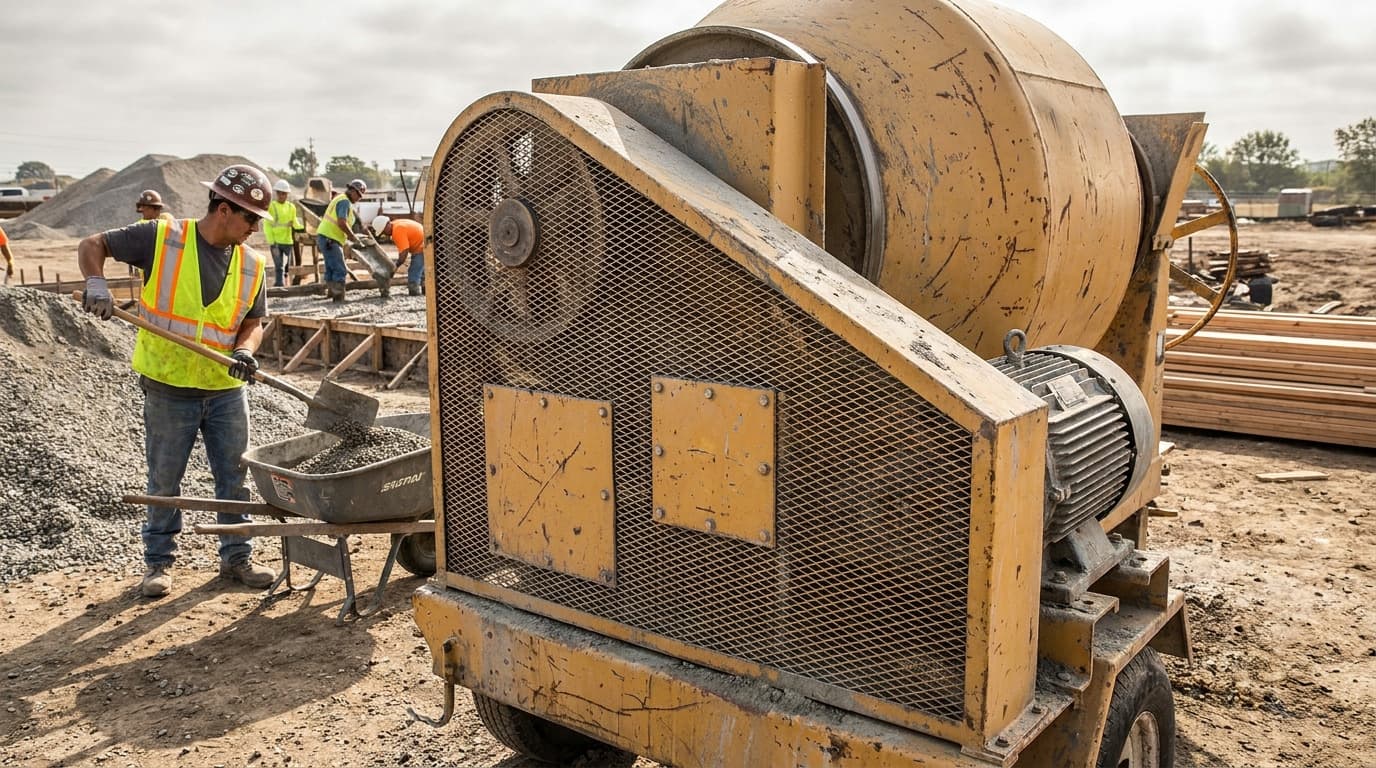
Belts, gears, shafts, pulleys, sprockets, spindles, drums, fly wheels, chains, or other reciprocating, rotating or moving parts of equipment shall be guarded if such parts are exposed to contact by employees or otherwise create a hazard.
The paragraph then requires that guarding meet ANSI B15.1-1953 (R1958), the safety code for mechanical power-transmission apparatus. Read the list against the plant standing on this site — the drive belt on a compressor, the exposed shaft on a pump, the sprocket on a conveyor, the flywheel on a mixer. Those are power-transmission parts, and they are covered whether or not anybody works close to them, if they are exposed to contact or otherwise create a hazard.
1926.300(b)(3) then defines what guarding is for:
One or more methods of machine guarding shall be provided to protect the operator and other employees in the machine area from hazards such as those created by point of operation, ingoing nip points, rotating parts, flying chips and sparks. Examples of guarding methods are — barrier guards, two-hand tripping devices, electronic safety devices, etc.
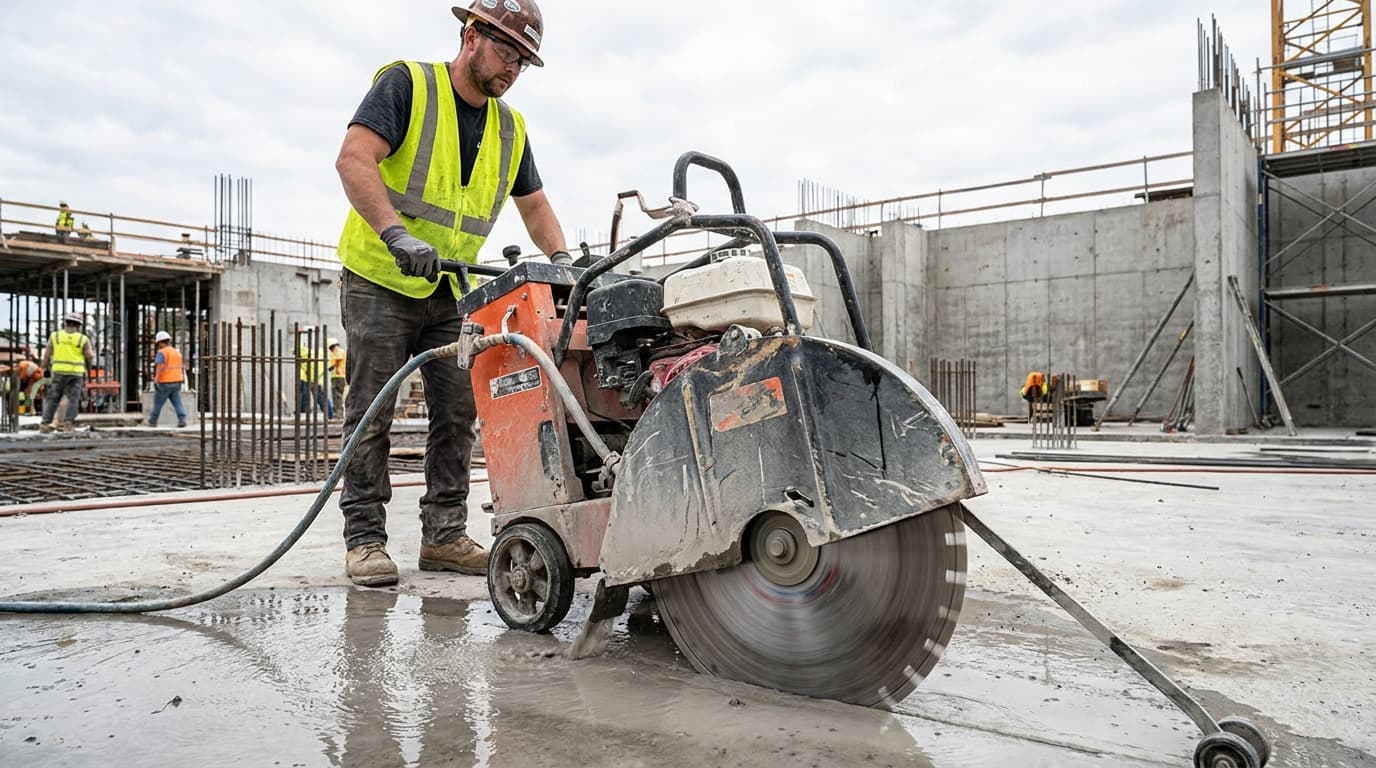
Two things in that sentence get missed. First, guarding protects other employees in the machine area, not only the operator — the person walking past, the labourer clearing offcuts, the apprentice watching. Second, the hazards named include flying chips and sparks, so a guard is not only about contact with the machine; it is also about what the machine throws.
1926.300(b)(4)(iv) goes on to list machines that usually require point-of-operation guarding, including guillotine cutters, shears, alligator shears, power presses, milling machines, power saws, portable power tools, and forming rolls and calenders. And where special hand tools are used for placing and removing material, the standard is explicit that they shall not be in lieu of other guarding — they supplement it, they do not replace it.
Two provisions nobody quotes#
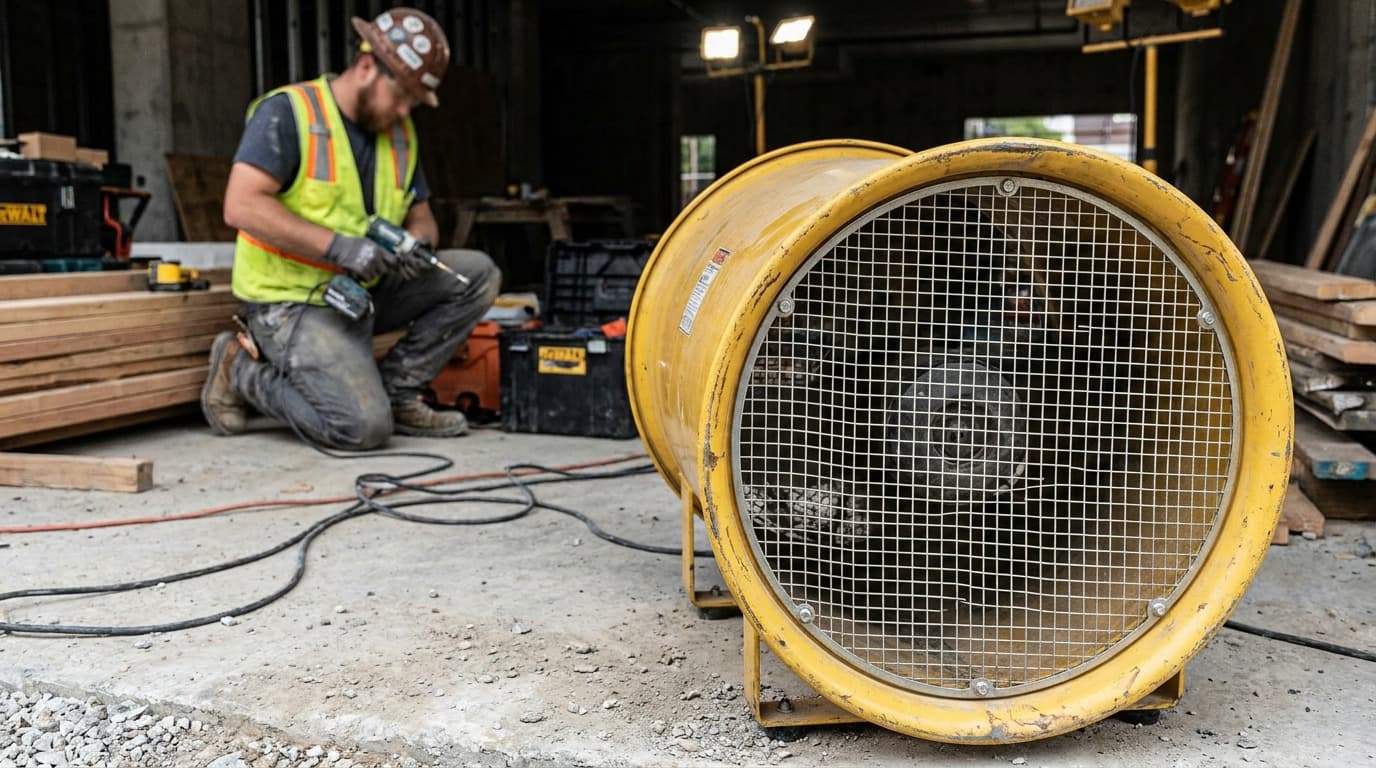
Fan blades — 1926.300(b)(5). When the periphery of the blades of a fan is less than 7 feet (2.128 m) above the floor or working level, the blades shall be guarded. The guard shall have openings no larger than 1/2 inch (1.27 cm). Every temporary ventilation fan, drying fan and air mover on a site is caught by this, and the specification is not "a cage" — it is an opening size a finger cannot pass.
Anchoring — 1926.300(b)(6). Machines designed for a fixed location shall be securely anchored to prevent walking or moving. A bench grinder or a bandsaw that walks across the floor under load takes the operator's hand position with it, and this is the provision people forget exists.
What can go wrong?#
The guard is removed for a task and never refitted. The single most common sequence. It comes off for a blade change, a jam or a repair, the job resumes, and the tool goes back on the rack without it.
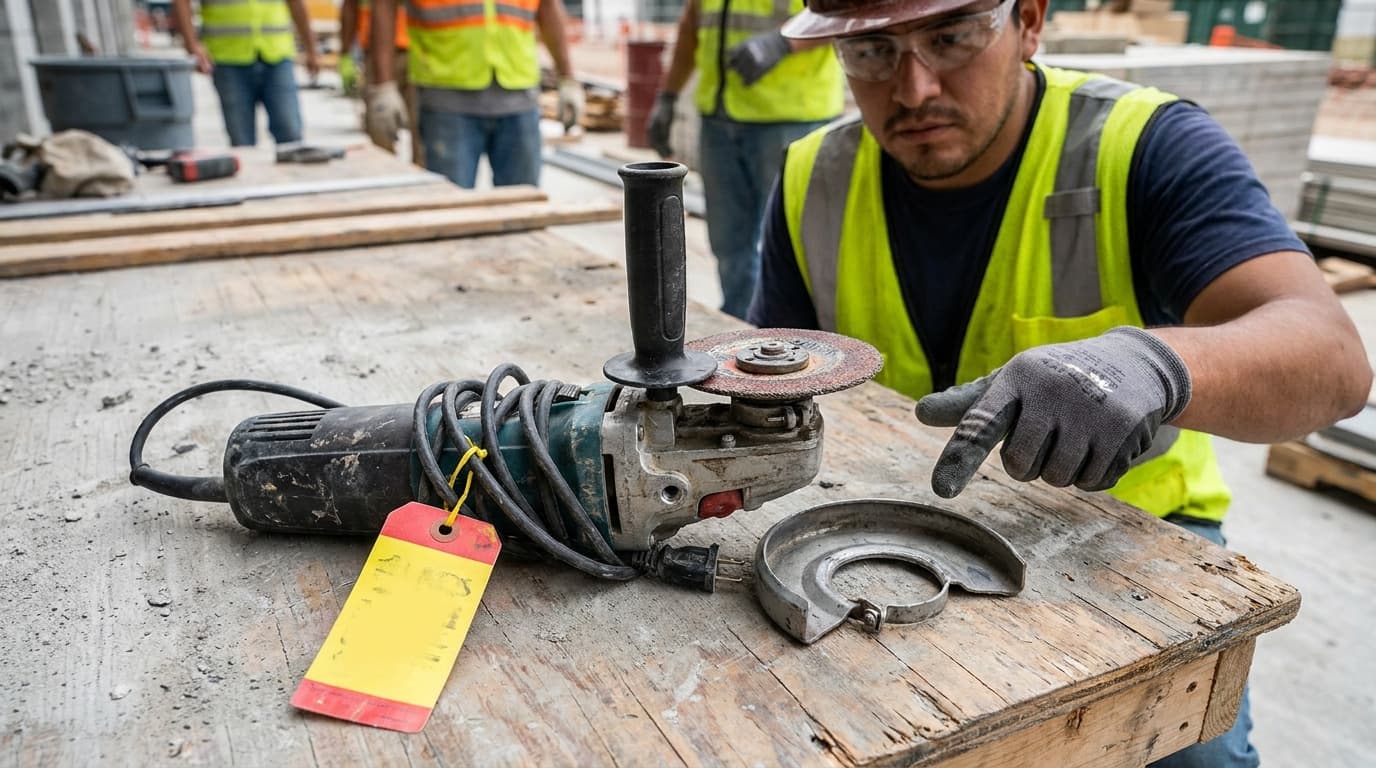
The guard is defeated in place. Wedged, taped, tied back or held open. The guard is present at inspection and absent in use.
Point-of-operation guarding is confused with power-transmission guarding. Two different sets of parts. Guarding the belt does nothing for the blade, and guarding the blade does nothing for the belt.
Only the operator is considered. The guard is judged from the operator's position while somebody else stands in the discharge path of chips and sparks.
The wrong guard is fitted. A guard from a different model, or one modified to clear the work. A guard that no longer aligns or no longer contains is not a guard.
The tool walks. Fixed machinery not anchored, moving under load, with hands already committed to the work.
Nobody owns the missing guard. Everyone notices it, nobody tags the tool, and it stays in circulation for weeks.
How do we get this right?#
Ask the design question first. Was this tool designed to accommodate a guard? If yes, no guard means no use — that is the whole test, and it takes five seconds.
Tag and remove, don't work around. A tool missing its guard goes out of service with a tag, not into someone else's hands with a warning.
Refit before you restart. Whoever removes a guard owns putting it back, and the machine does not run again until it is on, aligned and secured.
Guard the transmission parts as well as the point of operation. Walk the compressor, the pump, the mixer, the conveyor. Belts, sprockets, shafts, flywheels.
Look from where other people stand. Check the path of chips, sparks and offcuts, not only the operator's hands.
Guard the fans. Openings no larger than 1/2 inch (1.27 cm) wherever the blade periphery is under 7 feet (2.128 m).
Anchor fixed machines. Bolted or otherwise secured so they cannot walk.
Isolate before you open anything. Removing a guard for maintenance is not a guarding question, it is an energy-isolation question — covered in the lockout/tagout talk.
Before you start#
- Confirm every tool you will use today has the guard it was designed to accept, fitted and functioning.
- Confirm no guard is wedged, taped, tied or held back.
- Confirm belts, sprockets, shafts and flywheels on nearby plant are covered.
- Confirm nobody else is standing in the path of chips, sparks or ejected offcuts.
- Confirm any fan with blades below 7 feet (2.128 m) has a guard with openings no larger than 1/2 inch (1.27 cm).
- Confirm fixed machines are anchored and cannot move under load.
- Confirm that if a guard has to come off for maintenance, the machine will be isolated first.
Talk it over#
- What tool on this site is running right now without the guard it came with?
- Has anyone here removed a guard to get a job done? What made that seem like the right call?
- Who else stands close enough to be hit by what your machine throws?
- If you tagged a tool out today, what would happen to the schedule — and who would you tell?
The bottom line#
1926.300(b)(1) sets a design test, not a risk test: if a power-operated tool was designed to accommodate a guard, it must be equipped with that guard when in use. (b)(2) requires belts, gears, shafts, pulleys, sprockets, spindles, drums, flywheels, chains and other reciprocating, rotating or moving parts to be guarded where exposed to contact or otherwise hazardous, to ANSI B15.1-1953 (R1958). (b)(3) says guarding protects the operator and other employees in the machine area from point of operation, ingoing nip points, rotating parts and flying chips and sparks. (b)(5) requires fan blades below 7 feet (2.128 m) to be guarded with openings no larger than 1/2 inch (1.27 cm), and (b)(6) requires fixed machines to be anchored. None of it is discretionary, and a missing guard is a tag, not a discussion.
Frequently asked questions about machine guarding#
When is a machine guard legally required?
Under 29 CFR 1926.300(b)(1), whenever a power-operated tool was designed to accommodate a guard, it must be equipped with that guard while in use. The trigger is the tool's design rather than an assessment of the risk, which means there is no exposure threshold to argue about and no exemption for experienced operators.
Which machine parts have to be guarded?
1926.300(b)(2) names belts, gears, shafts, pulleys, sprockets, spindles, drums, fly wheels, chains, or other reciprocating, rotating or moving parts of equipment, where those parts are exposed to contact by employees or otherwise create a hazard. Guarding must meet ANSI B15.1-1953 (R1958), the safety code for mechanical power-transmission apparatus.
What is the difference between point-of-operation guarding and power-transmission guarding?
Point-of-operation guarding protects the place where the machine acts on the work — the blade, the die, the wheel. Power-transmission guarding protects the parts that deliver power to it — belts, shafts, sprockets, flywheels. They are separate obligations, and a machine can be fully guarded at one and completely open at the other.
Does a guard only protect the operator?
No. 1926.300(b)(3) requires guarding to protect the operator and other employees in the machine area, and lists the hazards as including point of operation, ingoing nip points, rotating parts and flying chips and sparks. The person walking past or clearing waste is inside the scope of the requirement.
Do fans on a construction site need guards?
Yes, with a specification. 1926.300(b)(5) requires that where the periphery of a fan's blades is less than 7 feet (2.128 m) above the floor or working level, the blades be guarded with a guard having openings no larger than 1/2 inch (1.27 cm).
Can special hand tools be used instead of a guard?
No. Where special hand tools are used for placing and removing material, 1926.300(b)(4) provides that such tools shall not be in lieu of other guarding required by the section — they may only be used to supplement the protection provided.
What should I do if I find a tool with a missing guard?
Take it out of service and tag it, rather than passing it on with a warning. The requirement in (b)(1) is not conditional on who is using the tool, so a missing guard makes the tool unusable by anyone until it is replaced. If the guard was removed for maintenance, the machine should also be isolated before any further work — see the lockout/tagout talk.
Download the machine guarding toolbox talk PDF#
Get this machine guarding toolbox talk as a print-ready PDF — available in English, Spanish, Portuguese, and Turkish. Print it, hand it to the crew, and collect signatures on the included attendance sheet.
Download the PDF — free account required. New members get 3 free downloads.
Related toolbox talks#
Sources#
- OSHA, 29 CFR 1926.300 — General requirements (Subpart I, Tools — Hand and Power): https://www.osha.gov/laws-regs/regulations/standardnumber/1926/1926.300
- OSHA, 29 CFR 1926.303 — Abrasive wheels and tools: https://www.osha.gov/laws-regs/regulations/standardnumber/1926/1926.303
- OSHA, 29 CFR 1926.302 — Power operated hand tools: https://www.osha.gov/laws-regs/regulations/standardnumber/1926/1926.302
Written by FieldSafetyTalk's safety professional — a CSP, ASP, CHST and OSHA Authorized Outreach Trainer with 14+ years of international construction safety experience across federal, heavy civil, and industrial projects.