Tie-Off Procedures
Updated 2026-07-24
In this bundle Fall Protection & Heights
Print-ready PDF
Download this talk as a print-ready PDF, available in 4 languages.
Your lanyard is rated at 5,000 pounds. It has a label, a date, an inspection history, and it passed this morning's check. Then you tie a knot in it to get the length right, and it is now rated at 2,500 pounds — and nothing about it looks any different. This tie-off procedures talk is about the fact that how you connect can destroy more strength than any defect an inspection would ever find.
Here is the distinction that carries this whole talk: an inspection asks whether the equipment is still what the manufacturer built. A tie-off asks something different — whether the way you attached it lets the equipment stay what the manufacturer built. Those are separate questions, and the second one is answered in about four seconds by a worker at height with one free hand. There is no label on a knot. There is no rating stamped on a beam edge. The strength is gone the moment the connection is made, and the only person who could have caught it is the person who made it.
How much strength does a bad tie-off cost?#
There is no national dataset isolating deaths caused by connection method — they are recorded as falls to a lower level like everything else. What exists instead is better: OSHA has published the actual numbers, in the regulation, and they are startling.
Appendix C to Subpart M quantifies what specific tie-off practices do to a rope lanyard or lifeline:
- A knot — anywhere in the line — reduces lanyard or lifeline strength by 50 percent or more (Appendix C, paragraph (h)(3)). Not a bad knot. Any knot, at any location.
- Tying a rope lanyard or lifeline around an "H" or "I" beam can reduce its strength as much as 70 percent, from the cutting action of the beam edges (Appendix C, paragraph (h)(4)).
- A line passing over or around rough or sharp surfaces reduces strength drastically (Appendix C, paragraph (h)(5)).
- A sliding hitch knot — the prusik — can cut strength by as much as 70 percent, and OSHA says it should not be used for lifeline or lanyard connections except in emergencies where nothing else is practical (Appendix C, paragraph (h)(8)).
Put those next to 1926.502(d)(9), which requires lanyards and vertical lifelines to have a minimum breaking strength of 5,000 pounds (22.2 kN). A single knot takes that to roughly 2,500. A bare wrap around a steel beam can take it to about 1,500. The equipment still carries its 5,000 pound label, still passes inspection, and has already lost most of its margin before anyone leaves the ground.
There is a second family of failures here that has nothing to do with strength at all. Roll-out is when a snaphook works its way off the thing it is connected to, under load, without breaking. Appendix C paragraph (j) lists six conditions that can cause it, and none of them involve a damaged component.
OSHA tie-off requirements (29 CFR 1926 Subpart M)#
- Locking snaphooks only — 1926.502(d)(5). Since January 1, 1998, only locking-type snaphooks may be used. A locking hook adds a positive locking mechanism on top of the spring-loaded keeper, and Appendix C (j)(1) says that feature, properly designed, effectively prevents roll-out.
- The prohibited connections — 1926.502(d)(6). Unless the snaphook is a locking type and specifically designed for that connection, snaphooks must not be engaged:
- (i) directly to webbing, rope, or wire rope;
- (ii) to each other;
- (iii) to a D-ring to which another snaphook or connector is already attached;
- (iv) to a horizontal lifeline; or
- (v) to any object incompatibly shaped or dimensioned such that the object could depress the keeper and release itself.
- Lanyard and lifeline strength — 1926.502(d)(9). Minimum breaking strength 5,000 pounds (22.2 kN) — which is the number your tie-off method is spending.
- Protect the line — 1926.502(d)(11). Lifelines must be protected against being cut or abraded. This is a requirement, not a recommendation, and it is the one that edges and beam flanges violate.
- Two-way locking on suspended scaffolds — 1926.502(d)(7). On suspended scaffolds or similar platforms with horizontal lifelines that may become vertical, the connecting device must be capable of locking in both directions on the lifeline.
- One worker per vertical lifeline — 1926.502(d)(10)(i). Each employee on a separate vertical lifeline. Appendix C (i) explains why: on a shared line, the movement of the line as one fall is arrested can pull the other workers' lanyards and drag them off too.
- Synthetic fibre — 1926.502(d)(14). Ropes and webbing in lanyards, lifelines, and harness strength components must be synthetic — which is exactly why heat, chemicals, and abrasion at a tie-off point matter so much.
Appendix C adds three more that catch experienced crews:
- (h)(2) If the means of attachment reduces the strength of the system, that component must be replaced with a stronger one that still maintains the correct maximum arresting force. You do not get to accept the loss.
- (c) A lanyard must not be connected between the harness and a self-retracting device. It adds free fall the system was never designed for. This is one of the most common "sensible-looking" improvisations on a jobsite.
- (n) Heavy self-retracting devices should be secured overhead, so the worker is not carrying the weight of the device. And an SRL connected to a horizontal lifeline needs the sag minimised, or the device slides down the line into a position that creates a swing hazard during arrest.
On USACE and NAVFAC projects, EM 385-1-1 applies and is more prescriptive on connector compatibility and tie-off documentation in several places.
What can go wrong#
The knot tied to shorten a lanyard. The most common and most expensive error on this list. A worker with a 6-foot lanyard on a 4-foot working position ties a knot to take up slack — a sensible instinct that costs half the rated strength under Appendix C (h)(3), and does nothing to reduce free fall because the knot does not change where the anchor is.
Wrapping the lanyard around a beam and clipping it back on itself. Two separate failures at once. It loads the snaphook in a direction it was never designed for, and it puts the rope directly on the beam's cut edges — up to 70 percent gone under (h)(4). It is also explicitly named in Appendix C (h)(1)(ii) as a practice to avoid.
Snaphook straight onto a horizontal lifeline. Prohibited by 1926.502(d)(6)(iv) unless the hook is a locking type designed for it, and listed in Appendix C (j)(2)(i) as a roll-out condition. The lifeline can work into the throat of the hook and depress the keeper.
Two hooks on one D-ring. Prohibited by (d)(6)(iii) and listed at (j)(2)(ii). The two hooks lever against each other and one can be pushed open by the other.
Hook clipped to hook. Prohibited by (d)(6)(ii) and at (j)(2)(iii). Convenient when someone wants to extend reach, and a textbook roll-out geometry.
Hook onto a webbing loop or webbing lanyard. Prohibited by (d)(6)(i) and at (j)(2)(v). Soft goods deform under load and can walk the keeper open.
An incompatibly sized connection point. (d)(6)(v) and (j)(2)(vi). Rebar, an oversized ring, a fitting the hook can rotate on — a turning motion depresses the keeper and the hook releases itself, all while the equipment stays intact.
The line over an edge. A parapet, a beam flange, deck edge, a cut steel plate. Under 1926.502(d)(11) lifelines must be protected against cutting and abrasion, and under (h)(5) the strength loss is described as drastic. Under shock load, a sharp edge does not wear a rope — it cuts it.
A lanyard added to an SRL. Appendix C (c) prohibits it in plain terms. Adding a lanyard to reach the anchor introduces free fall that the retracting device's arresting values never accounted for.
Horizontal lifeline sag. Appendix C (h)(6): below 30 degrees of sag the force imparted to the line is greatly amplified. At 15 degrees the amplification is about 2:1; at 5 degrees it is about 6:1. A line pulled visually tight is the worst case, not the best one — and every additional person tied to it raises the required strength again.
The prusik and other improvised knots. (h)(8) caps this at up to 70 percent strength loss, restricts the sliding hitch to genuine emergencies, and states that the "one-and-one" sliding hitch should never be used because it is unreliable in stopping a fall.
And the failure underneath all of them: the connection was made one-handed, at height, in the last thirty seconds before the work started. Nobody watched it. Nobody checked it. And it looked exactly like a correct one.
How do we tie off correctly?#
Never put a knot in a lanyard or lifeline. If the length is wrong, the equipment is wrong. Use an adjustable lanyard, a shorter one, or an SRL. Appendix C (h)(3) is unambiguous about the cost, and (h)(2) says that when the attachment method reduces system strength, you replace the component rather than accept the reduction.
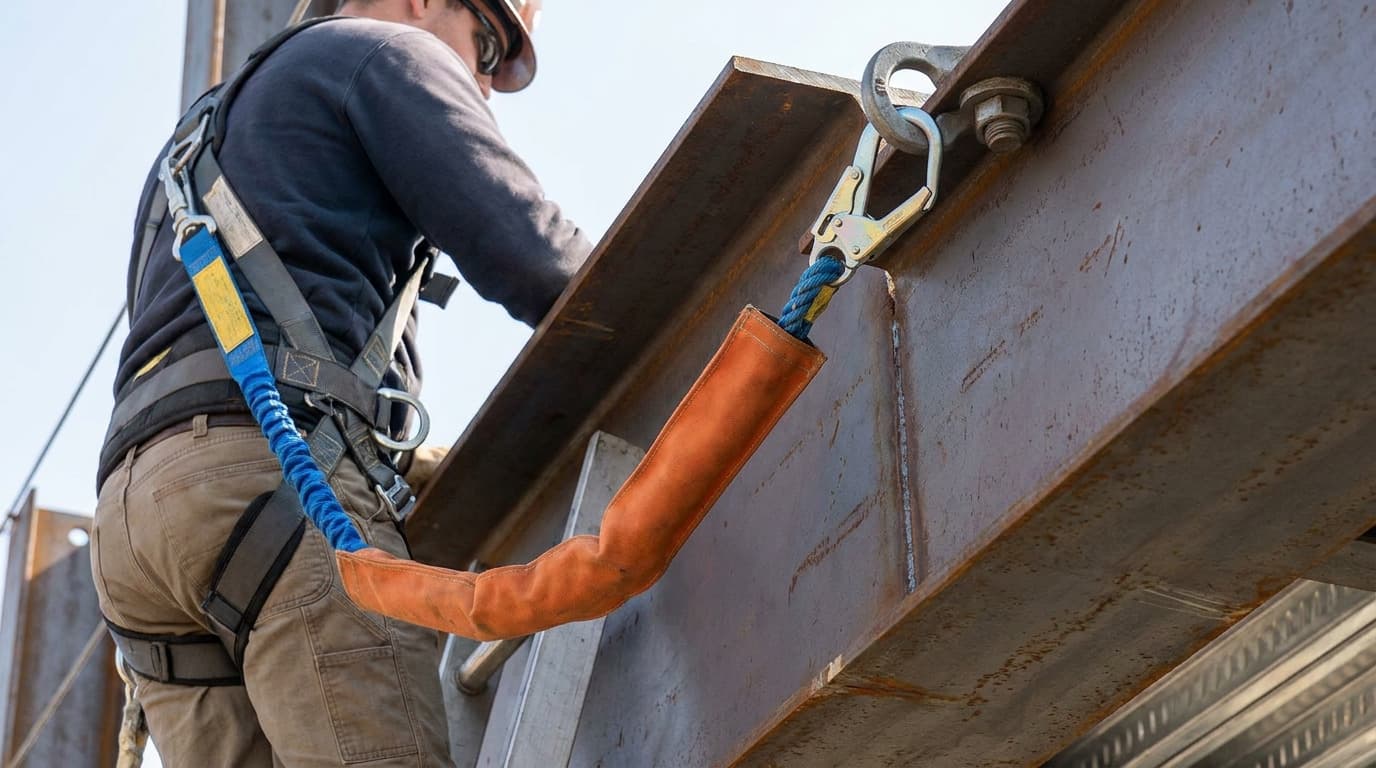
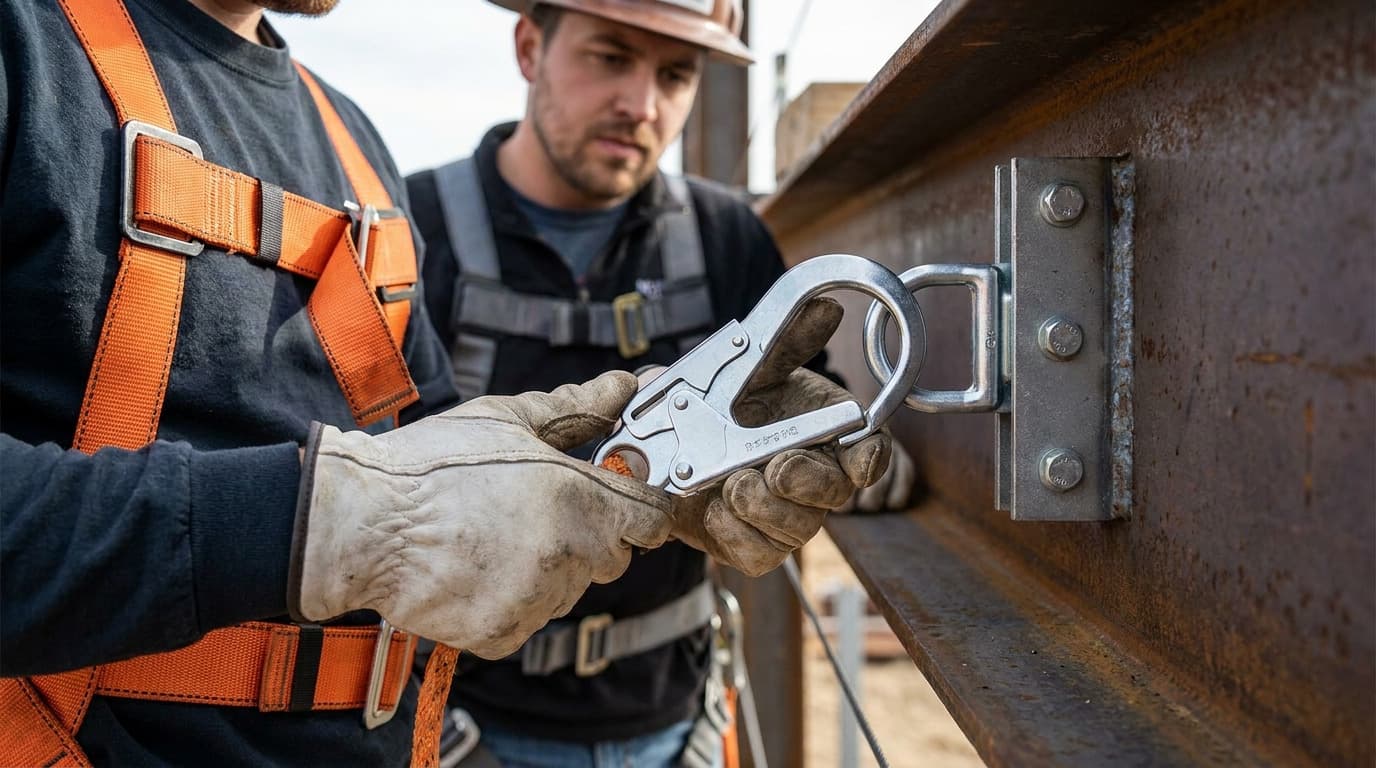
Use a rated anchorage connector on steel. A beam strap, beam clamp, or engineered anchorage connector — never rope or webbing directly on the flange, and never a snaphook clipped back onto its own lanyard.
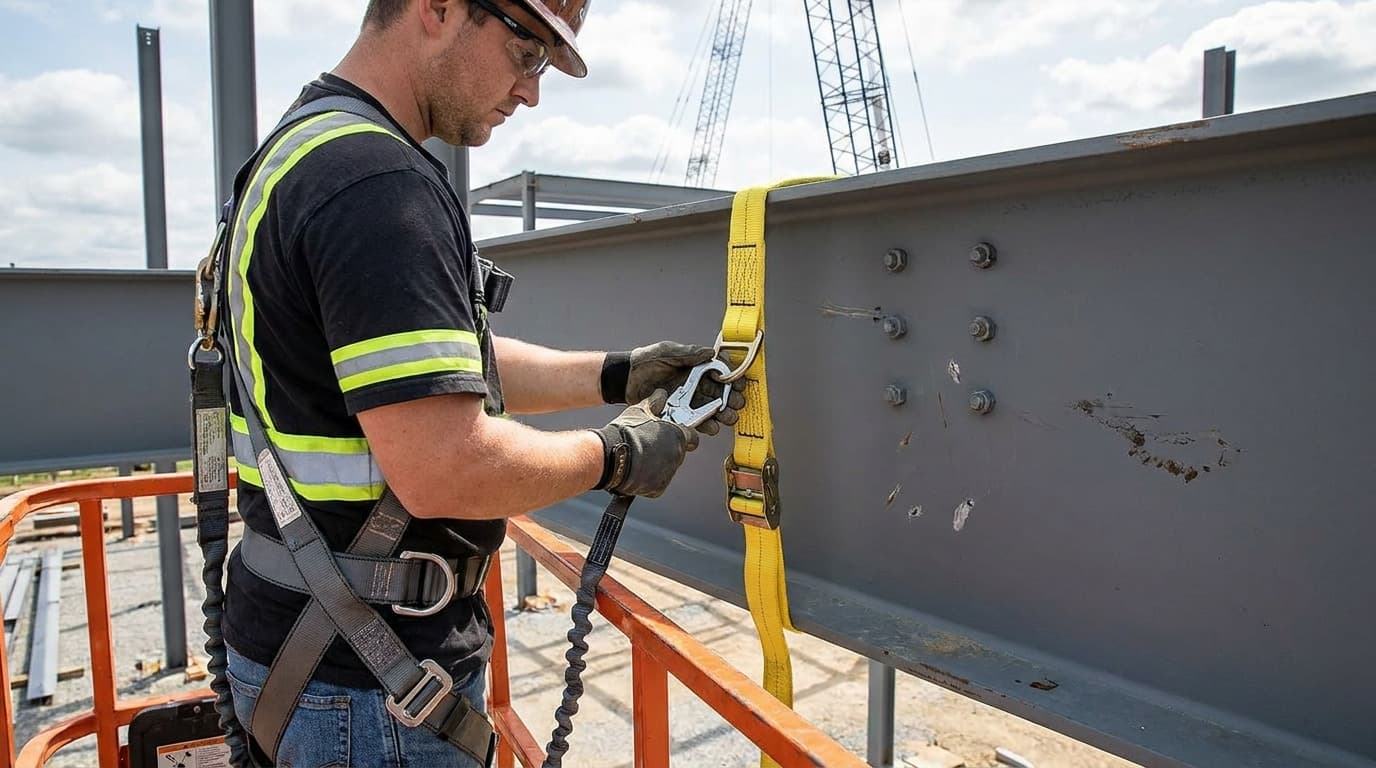
Check the connection against the five prohibited engagements before you clip. Not to webbing or rope, not hook-to-hook, not onto an occupied D-ring, not directly to a horizontal lifeline, and not to anything the hook can rotate on and release itself from.
Look at the hook and the connection point together. Compatibility is a relationship, not a property. The right hook on the wrong-sized ring is still a roll-out waiting to happen. Confirm the keeper closes and locks under its own spring, without help.
Protect the line wherever it bears. Edge protection, an abrasion sleeve, a padded corner, or reposition the anchor so the line does not bear at all. This satisfies 1926.502(d)(11) and removes the (h)(5) loss.
Keep the connection overhead and in line. An overhead anchor cuts free fall; working in line with the anchor cuts swing. Both reduce the load the connection has to survive.
Never add a lanyard to a self-retracting device. If the SRL will not reach, move the SRL — do not extend it.
Secure heavy SRLs overhead so the worker is not carrying the device, and where an SRL is used on a horizontal lifeline, minimise the sag so it cannot slide into a swing position.
Treat horizontal lifelines as engineered systems. Ask for the design, the permitted sag, and the maximum number of simultaneous users. Sag is not a comfort setting — it is a load multiplier.
One worker, one vertical lifeline. Sharing a line means one person's arrest can pull the next person off.
Watch each other clip. This is the one control that costs nothing. The person making the connection cannot see the geometry of their own snaphook as well as the person standing beside them can.
Before you start#
- Confirm your lanyard length suits the working position — and that nobody has knotted it to fit.
- Confirm you are using a rated anchorage connector on steel, not rope or webbing on the flange.
- Check the connection against the five prohibited engagements in 1926.502(d)(6).
- Confirm every snaphook is a locking type and the keeper closes and locks unaided.
- Check hook-to-connection-point compatibility for size and shape, not just strength.
- Trace where the line will bear under load, and fit edge protection or move the anchor.
- Confirm no lanyard has been added to an SRL.
- If a horizontal lifeline is in use, confirm the permitted sag and the user limit.
- Confirm you are on your own vertical lifeline.
- Have someone look at your connection before you load it.
Talk it over#
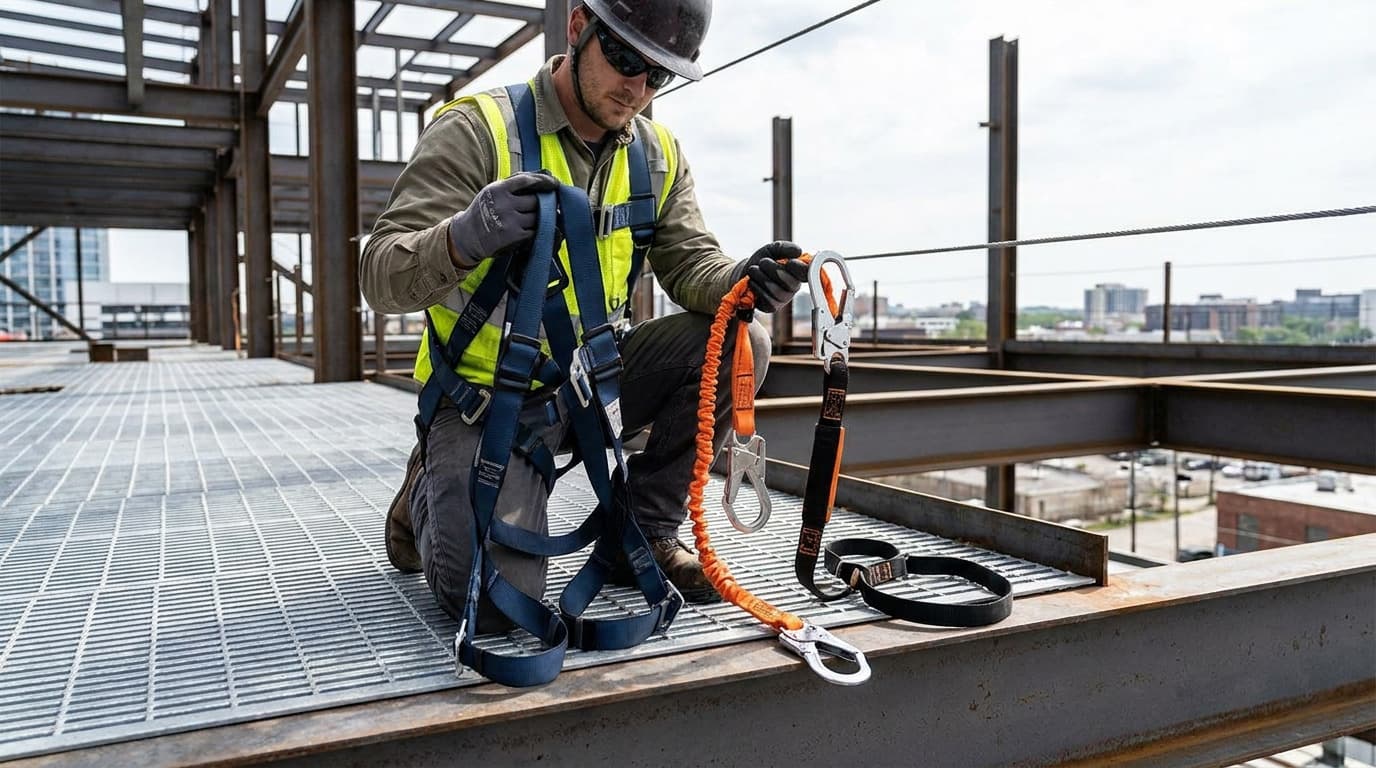
- Look at the lanyard in your hand. Is there a knot in it — and if so, who tied it and why?
- Where exactly will your line lie once you are hanging on it? What is it lying across?
- Point at your snaphook. Could that connection point turn inside the hook and push the keeper open?
The bottom line#
A knot takes 50 percent or more of your lanyard's strength, a bare wrap around an I-beam takes as much as 70 percent, and a prusik takes up to 70 percent — all figures OSHA published in Appendix C to Subpart M, and none of them visible on the equipment afterwards. Then there is roll-out, which needs no damage at all: 1926.502(d)(6) prohibits five specific snaphook connections precisely because the hook can release itself while staying perfectly intact. So use rated anchorage connectors instead of rope on steel, never knot a lanyard, protect the line where it bears, never add a lanyard to an SRL, keep one worker per vertical lifeline, and have somebody look at your connection before you trust it. The equipment was rated at 5,000 pounds. What you do in the last four seconds decides how much of that you actually get.
Frequently asked questions about tie-off procedures#
Can I tie a knot in my lanyard to shorten it?
No. Appendix C to Subpart M, paragraph (h)(3) states that a knot in a rope lanyard or lifeline — at any location — can reduce its strength by 50 percent or more. Paragraph (h)(2) adds that where the means of attachment reduces system strength, the component must be replaced with a stronger one rather than the loss accepted. Use an adjustable lanyard, a shorter lanyard, or a self-retracting lifeline instead.
What is snaphook roll-out?
Roll-out is a snaphook disengaging from its connection point under load without any component breaking. Appendix C, paragraph (j)(2) lists the conditions that cause it: connecting directly to a horizontal lifeline, two or more hooks on one D-ring, two hooks connected to each other, a hook clipped back on its own lanyard, a hook on a webbing loop or webbing lanyard, and a connection point whose dimensions let a turning motion depress the keeper. Locking snaphooks, required since January 1, 1998 under 1926.502(d)(5), are the control.
What connections does OSHA specifically prohibit?
Under 29 CFR 1926.502(d)(6), unless the snaphook is a locking type designed for the connection, snaphooks must not be engaged: directly to webbing, rope or wire rope; to each other; to a D-ring that already has another connector attached; to a horizontal lifeline; or to any object so incompatibly shaped or dimensioned that it could depress the keeper and release itself.
How much strength is lost tying off around a steel beam?
As much as 70 percent, according to Appendix C, paragraph (h)(4), caused by the cutting action of the beam edges on the rope. Use a rated beam strap or anchorage connector rather than passing the lanyard or lifeline directly around the steel.
Can I connect a lanyard to a self-retracting lifeline to reach the anchor?
No. Appendix C, paragraph (c) states that a lanyard should not be connected between the harness and a self-retracting type deceleration device, because it introduces additional free fall for which the system was not designed. If the SRL will not reach the work position, relocate the SRL rather than extending it.
Why does horizontal lifeline sag matter?
Because sag multiplies the load. Appendix C, paragraph (h)(6) states that when the sag angle is less than 30 degrees, the force imparted to the lifeline is greatly amplified — at 15 degrees roughly 2:1, and at 5 degrees roughly 6:1. The strength of the lifeline and its anchorages must be increased accordingly, and again for each additional worker tied to it, which is why horizontal lifelines must be designed by a qualified person.
Is a prusik or sliding hitch acceptable for tying off?
Only in a genuine emergency where nothing else is practical. Appendix C, paragraph (h)(8) notes strength reductions of as much as 70 percent, states that the "one-and-one" sliding hitch should never be used because it is unreliable in stopping a fall, and adds that where a "two-and-two" or "three-and-three" knot is used in an emergency, free fall distance must be kept to a minimum because of the reduced strength.
Download the tie-off procedures toolbox talk PDF#
Get this tie-off procedures toolbox talk as a print-ready PDF — available in English, Spanish, Portuguese, and Turkish. Print it, hand it to the crew, and collect signatures on the included attendance sheet.
Download the PDF — free account required. New members get 3 free downloads.
Related toolbox talks#
- Anchor Point Selection
- Fall Clearance Awareness
- How to Inspect a Safety Harness
- Correct Usage of Safety Harness
Sources#
- OSHA, 29 CFR 1926.502 — Fall protection systems criteria and practices: https://www.osha.gov/laws-regs/regulations/standardnumber/1926/1926.502
- OSHA, 1926 Subpart M Appendix C — Personal Fall Arrest Systems, Non-Mandatory Guidelines: https://www.osha.gov/laws-regs/regulations/standardnumber/1926/1926SubpartMAppC