Noise
Updated 2026-07-28
In this bundle Health & Environmental Exposure
Print-ready PDF
Download this talk as a print-ready PDF, available in 4 languages.
Noise is the only exposure on a construction site that people describe as normal. Nobody says the dust is normal or the fall risk is normal, but a loud site is just a site. The damage it does is permanent, painless and gradual, and by the time anyone notices it, none of it can be given back. This Noise Toolbox Talk (Safety Talk / Tailgate Talk) is about the numbers the standard actually uses — and one of them behaves very differently from how people assume.
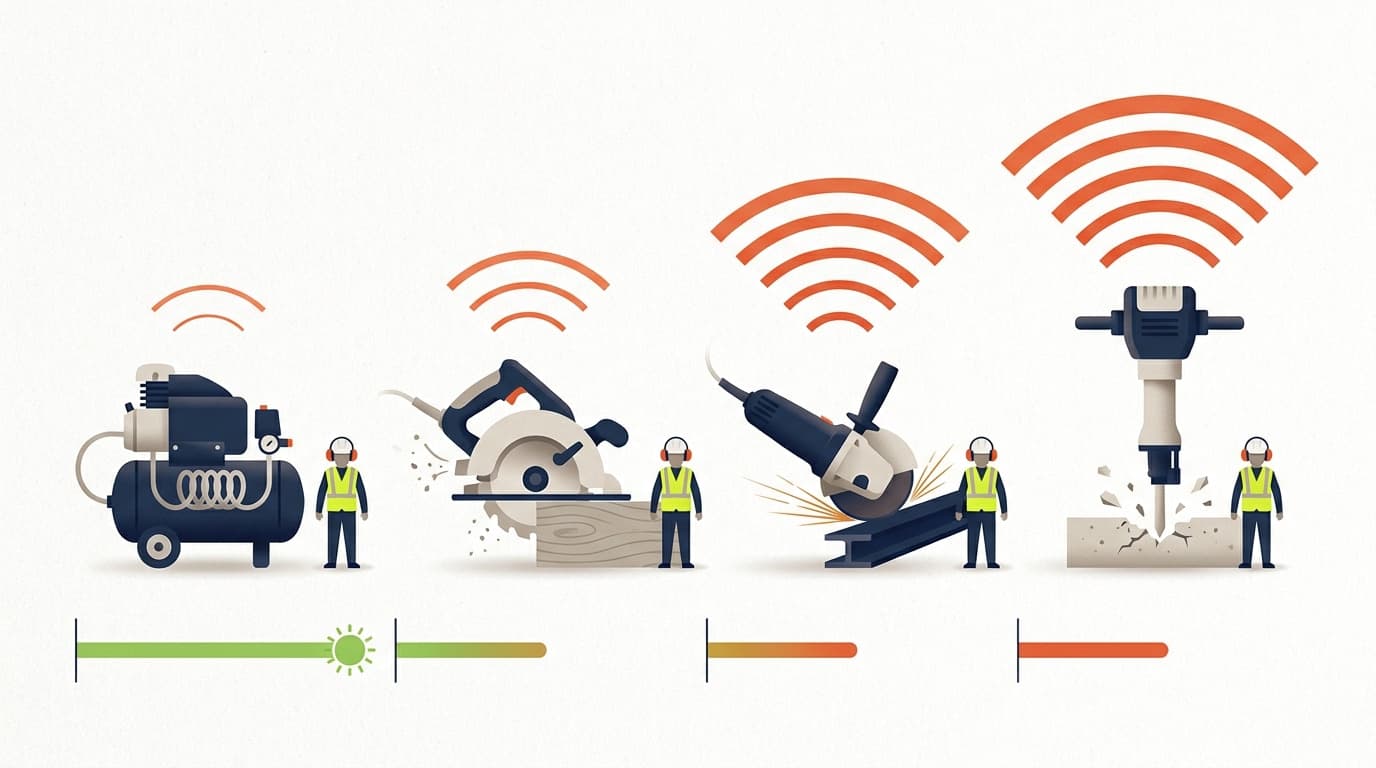
Here is the distinction that carries this whole talk: the standard limits a dose, not a volume. Nothing in it says a noise level is forbidden. What it says is that a given level is permitted for a given length of time, and the louder it gets, the faster that time runs out. So the question on any task is never "is this too loud?" It is "how long can we be in it?"
Table D-2 — the whole limit in nine rows#
1926.52(a) requires protection against the effects of noise exposure when sound levels exceed those in Table D-2, measured on the A-scale of a standard sound level meter at slow response. The table itself:
| Duration per day, hours | Sound level, dBA slow response |
|---|---|
| 8 | 90 |
| 6 | 92 |
| 4 | 95 |
| 3 | 97 |
| 2 | 100 |
| 1½ | 102 |
| 1 | 105 |
| ½ | 110 |
| ¼ or less | 115 |
Read down the column and the pattern appears: every 5 dBA halves the permitted time. 90 dBA for 8 hours, 95 for 4, 100 for 2, 105 for 1. That is the 5 dB exchange rate, and it is the thing most people get wrong, because decibels are logarithmic — a small-looking number is a large change in energy. "Only a few dB louder" is not a small difference; it is half your day.
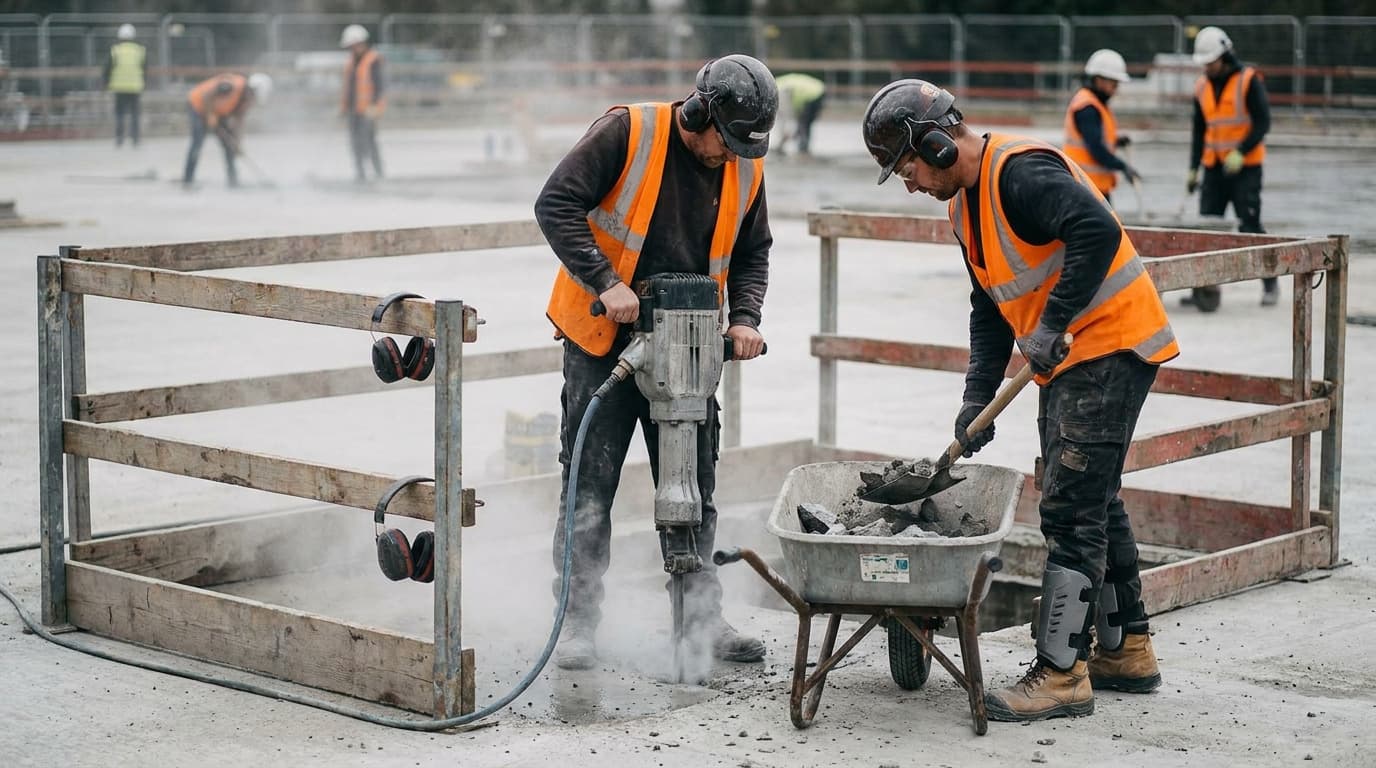
The bottom of the table is where construction actually lives. 115 dBA is permitted for a quarter of an hour or less. A jackhammer, a chipping gun, a demolition saw or a powder-actuated tool can put you there, and the allowance is fifteen minutes.
The day adds up — 1926.52(d)(2)#
Crews reason about the loudest task. The standard reasons about the whole shift.
(d)(2)(i) states that when the daily noise exposure is composed of two or more periods of noise exposure of different levels, their combined effect should be considered, rather than the individual effect of each. And (d)(2)(ii) gives the arithmetic:
Fe = (T₁/L₁) + (T₂/L₂) + … + (Tₙ/Lₙ)
where Fe is the equivalent noise exposure factor, T is the period of noise exposure at any essentially constant level, and L is the duration of permissible exposure at that level from Table D-2. If the value of Fe exceeds unity (1), the exposure exceeds permissible levels.
In plain terms: each noisy task uses up a fraction of your day's allowance, and the fractions add. Two hours at 100 dBA is your entire day on its own — 2 divided by 2 equals 1. Add anything else and you are over, even though no single task looked excessive.
This is why "I only used the breaker for an hour" is not an answer. An hour at 105 dBA is the whole allowance. The rest of the shift has to be quiet for that to work, and on a construction site it never is.
Two more provisions worth knowing#
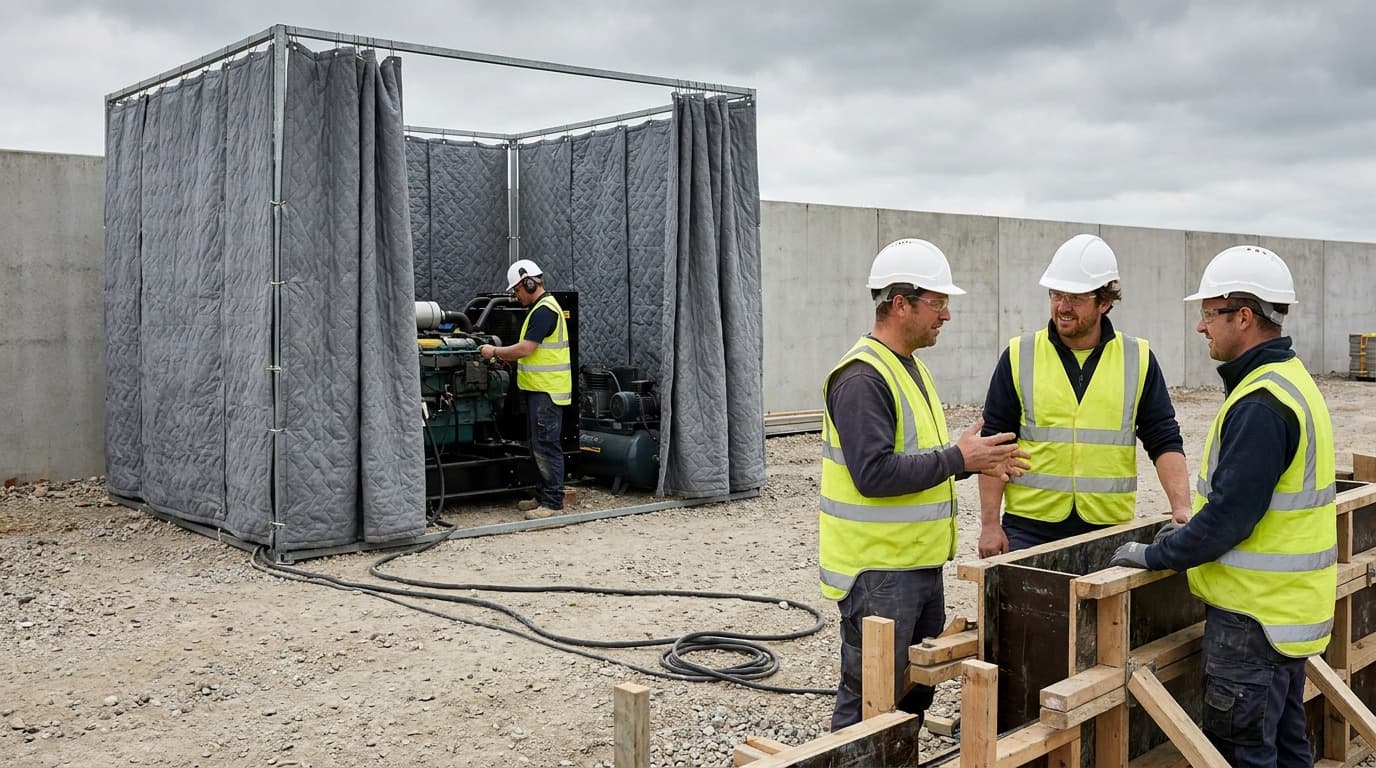
Controls come before protection — 1926.52(b). Where employees are subjected to sound levels exceeding Table D-2, feasible administrative or engineering controls shall be utilised. Only if such controls fail to bring levels within the table is personal protective equipment provided and used to do it. The hierarchy is in the text: quieter equipment, isolation, screening, distance and scheduling come first, and hearing protection is what covers the gap that remains.
Impulse noise has its own ceiling — 1926.52(e). Exposure to impulsive or impact noise should not exceed 140 dB peak sound pressure level. This is a different quantity from the dBA figures above — it is a peak pressure, not a time-weighted average — and it matters because impact noise is the kind construction produces constantly: powder-actuated tools, hammering on steel, pile driving, dropped material. A single impulse can do damage that no amount of averaging will show.
And a definition that decides which rule applies: 1926.52(c) — if the variations in noise level involve maxima at intervals of one second or less, it is to be considered continuous. A rattling breaker is not a series of impacts; it is continuous noise.
One benchmark that is not OSHA's: NIOSH recommends a more protective exposure limit of 85 dBA over an 8-hour shift. It is not the construction compliance figure — 90 dBA is — but many employers adopt 85 dBA as an internal action level, and it is worth knowing which number someone is quoting.
What can go wrong?#
The loudest hour is treated as the whole story. Nobody adds the fractions, so a compliant-looking day is over the limit.
Protection comes off between tasks. Ten minutes in the plume of somebody else's saw is still exposure, and it counts.
Impulse noise is discounted because it is brief. A single peak above 140 dB is not brief in its effects.
Distance is assumed to fix it. It helps, but not as much as people think, and reflective surfaces and enclosures give it back.
Controls are skipped straight to plugs. 1926.52(b) puts feasible engineering and administrative controls first, and going straight to PPE inverts the standard.
Nobody has measured anything. Without a level, there is no duration, and without a duration the table cannot be applied at all.
Hearing loss is noticed at home, not at work. Turning the television up, missing the start of sentences, ringing after a shift — these are the early signals, and none of them appear on site.
How do we control this properly?#
Measure, then decide. A sound level reading turns "it's loud" into a permitted duration. Without one, every other control is guesswork.
Attack the source first. Quieter tools, well-maintained equipment, damping, enclosures and screens — and remember worn tools are louder tools.
Use distance and scheduling deliberately. Move noisy tasks away from other crews, and away from each other, so one trade's noise is not everyone's dose.
Rotate to spend the allowance, not to blow it. If a task is 105 dBA, an hour is the whole day for that person — so plan the rest of their shift quiet, or share the task.
Count everyone in the area, not just the operator. Exposure follows the ear, not the tool.
Treat impulse noise separately. Powder-actuated tools, pile driving and hammering on steel need protection regardless of how short the burst is, because the ceiling is a peak.
Wear the protection continuously in the zone. Removing it for a short conversation undoes a disproportionate share of the benefit.
Watch for the early signs — ringing, muffling and having to raise your voice at arm's length are all telling you something.
Before you start#
- Confirm the sound level of the task, and how long it will run.
- Confirm what that duration allows under Table D-2, and what is left of the day.
- Confirm whether an engineering or administrative control could bring it inside the table first.
- Confirm who else is in the area and what their exposure will be.
- Confirm whether the noise is continuous or impulsive — the 140 dB peak ceiling is separate.
- Confirm hearing protection is available, correct and will stay on for the whole task.
- Confirm nobody is stacking two noisy tasks back to back without checking the total.
- Confirm anyone reporting ringing or muffled hearing has somewhere to raise it.
Talk it over#
- How loud is the noisiest thing on this site — has anyone actually measured it?
- Add up yesterday: how many hours were you inside noise, and at what levels?
- Who works next to the breaker without holding it?
- Has anyone noticed ringing after a shift, or turning the TV up at home?
The bottom line#
Table D-2 in 1926.52(d)(1) permits 90 dBA for 8 hours and runs down to 115 dBA for a quarter of an hour or less, on a 5 dB exchange rate — every 5 dBA halves the time you are allowed. 1926.52(d)(2) makes the day additive: Fe = (T₁/L₁) + (T₂/L₂) + …, and if Fe exceeds unity, the exposure exceeds permissible levels. Before protection, 1926.52(b) requires feasible administrative or engineering controls, with PPE used where those fail to bring levels within the table. Impulse noise carries its own ceiling — 140 dB peak sound pressure level under 1926.52(e) — and under (c), level variations with maxima at intervals of one second or less count as continuous. NIOSH's more protective 85 dBA recommendation is a benchmark, not the construction compliance figure.
Frequently asked questions about noise exposure#
What is the OSHA noise limit in construction?
There is no single limit — there is a table of permitted durations. 1926.52(a) requires protection when sound levels exceed Table D-2, measured on the A-scale at slow response, and the table permits 90 dBA for 8 hours, 95 dBA for 4 hours, 100 dBA for 2 hours, 105 dBA for 1 hour, 110 dBA for half an hour and 115 dBA for a quarter of an hour or less.
What is the 5 dB exchange rate?
The relationship built into Table D-2: every increase of 5 dBA halves the permitted exposure time. Because decibels are logarithmic, a change that sounds modest is a large change in sound energy — which is why 95 dBA is allowed for half as long as 90 dBA, and 100 dBA for half as long again.
Do short noisy tasks really matter?
Yes, because they add up. 1926.52(d)(2) requires the combined effect of two or more periods of exposure at different levels to be considered rather than each individually, using Fe = (T₁/L₁) + (T₂/L₂) + … — and if Fe exceeds unity, the exposure exceeds permissible levels. Each task consumes a fraction of the day's allowance.
Is hearing protection the first control?
No. 1926.52(b) requires that where employees are subjected to sound levels exceeding Table D-2, feasible administrative or engineering controls shall be utilised — and only if those controls fail to bring levels within the table is PPE provided and used to do so. Going straight to earplugs skips the step the standard puts first.
What about hammering, pile driving and powder-actuated tools?
They fall under a separate ceiling. 1926.52(e) provides that exposure to impulsive or impact noise should not exceed 140 dB peak sound pressure level. That is a peak pressure rather than a time-weighted average, so the brevity of the burst does not reduce it.
When is noise "continuous" rather than impulsive?
1926.52(c) settles it: if the variations in noise level involve maxima at intervals of one second or less, the noise is to be considered continuous. A rapidly cycling breaker is therefore continuous noise assessed against Table D-2, not a string of separate impacts.
Why do some people quote 85 dBA?
Because NIOSH recommends a more protective exposure limit of 85 dBA over an 8-hour shift, and many employers adopt it as an internal action level. For federal OSHA construction compliance the table figure is 90 dBA for 8 hours — so it is always worth establishing which of the two numbers is being used.
Download the noise toolbox talk PDF#
Get this noise toolbox talk as a print-ready PDF — available in English, Spanish, Portuguese, and Turkish. Print it, hand it to the crew, and collect signatures on the included attendance sheet.
Download the PDF — free account required. New members get 3 free downloads.
Related toolbox talks#
Sources#
- OSHA, 29 CFR 1926.52 — Occupational noise exposure: https://www.osha.gov/laws-regs/regulations/standardnumber/1926/1926.52
- OSHA, 29 CFR 1926.101 — Hearing protection: https://www.osha.gov/laws-regs/regulations/standardnumber/1926/1926.101
This talk summarises published regulatory guidance. It is not medical advice. Persistent ringing, muffled hearing or any suspected hearing loss should be assessed by a qualified health professional — noise-induced hearing loss is permanent.
Written by FieldSafetyTalk's safety professional — a CSP, ASP, CHST and OSHA Authorized Outreach Trainer with 14+ years of international construction safety experience across federal, heavy civil, and industrial projects.