Demolition Hazards
Updated 2026-08-06
In this bundle Jobsite Fundamentals & Compliance
Working in Washington? See the WA DOSH edition → Washington (WA DOSH)
Print-ready PDF
Download this talk as a print-ready PDF, available in 4 languages.
Demolition looks like the simplest work on a site — you are tearing something down, not building it up, and it can feel like the rules matter less because the structure is coming apart anyway. That impression is exactly what makes demolition one of the most dangerous operations in construction. A building being demolished is not the controlled, documented thing a new structure is. It may have been built decades ago, modified over and over without records, weakened by age, fire, water, or corrosion, and loaded in ways nobody on the crew can see. And every single piece you remove changes how the rest of it stands up. This demolition hazards talk is about why the hazard in demolition is almost never the piece you are working on — it is the collapse you did not see coming.
Here is the distinction that carries this whole talk: demolition is the one job where the structure is fighting you the whole way down — you're taking apart something you didn't build, whose real condition nobody fully knows, and every piece you remove changes how the rest holds up, so the danger isn't the wall you're pulling, it's the collapse you didn't see coming. Building is the opposite of this. When you build, you start from known materials, follow documented plans, and add strength as you go, so the structure gets more stable with every step. Demolition runs that film backwards: you start with an unknown structure and take strength away with every step, so it gets less stable as the work goes on. A load path that held for fifty years can be quietly carrying weight you cannot see, and the moment you cut or pull the wrong element, that weight goes somewhere — usually down, fast, onto whoever is nearby. The work is not dangerous because it is destructive; it is dangerous because it is destructive to something nobody fully understands.
Where the boundary of this talk sits#
Demolition pulls in hazards that have their own talks, and this one ties them to the demolition context. The fall protection talk owns work at height, which demolition has in abundance on partially removed structures. The struck-by talk owns flying and falling debris in general. The excavation talk owns below-grade collapse. This talk owns what is specific to demolition: that you are dismantling an unknown structure that becomes less stable as you work, why the pre-work engineering survey is the whole safety case, and the sequence and preparation that keep a planned takedown from becoming an unplanned collapse. Where the hazard is a fall, a struck-by, or a trench, those talks own the detail; this one owns the reason demolition concentrates all of them into one high-risk operation.
The survey before the first swing#
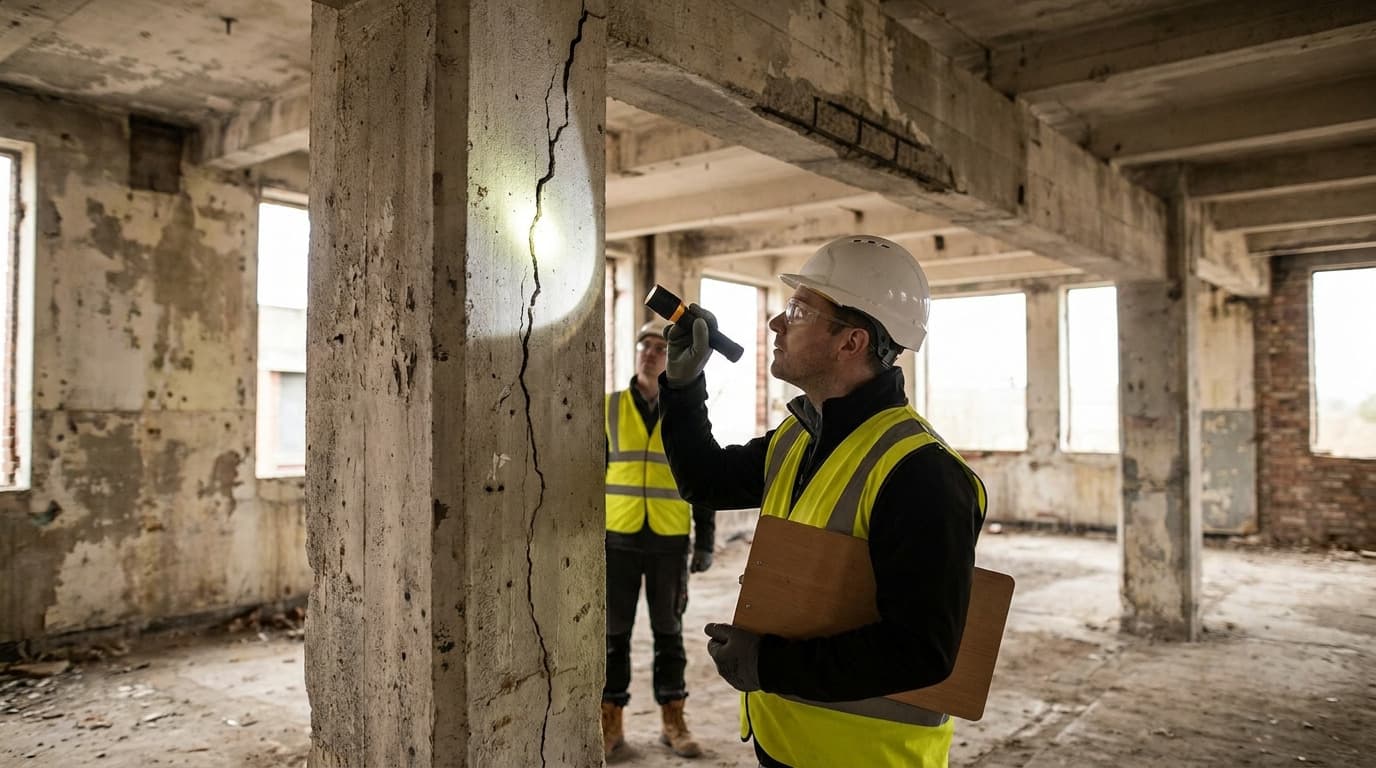
Because the structure is unknown and only gets less stable, demolition safety is almost entirely front-loaded into knowing the building before anyone touches it. This is not a philosophy — it is the law and the single most cited demolition requirement. Before demolition begins, an engineering survey of the structure must be made by a competent person to determine the condition of the framing, floors, and walls and the possibility of unplanned collapse of any part of the structure, and the employer must have written evidence that the survey was done. Any adjacent structure where workers could be exposed has to be checked the same way, because pulling one building down can destabilize the one attached to it. This survey is the whole safety case: it is where someone qualified figures out how the building is actually holding itself up, what could collapse unexpectedly, and therefore how it has to come down. Everything the crew does afterward should trace back to what that survey found. Where a structure has already been damaged by fire, flood, or explosion, the walls or floors must be shored or braced before anyone works inside it, because a damaged structure has already lost the strength the original design assumed.
Take it down in the right order#
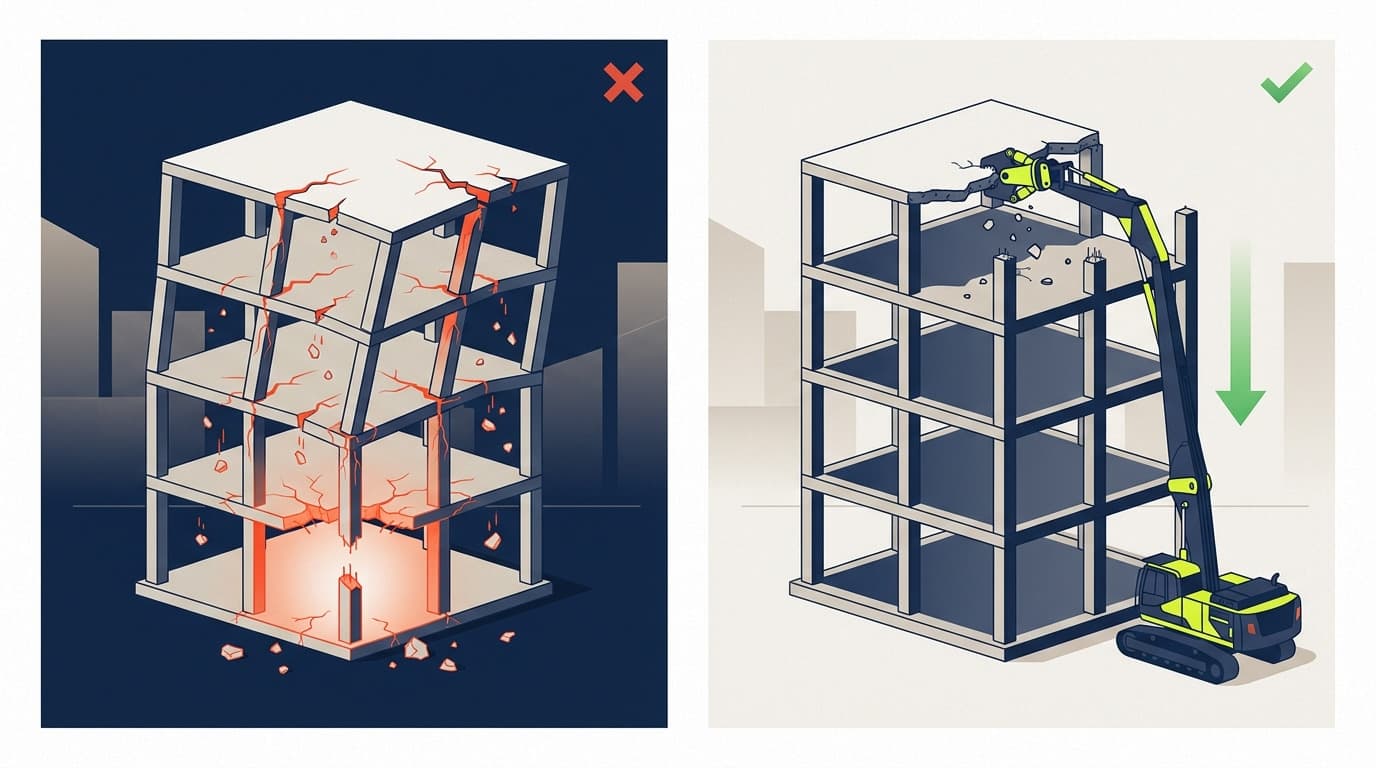
The survey drives the method and the sequence, and the sequence is what keeps the takedown controlled. For manual demolition, the rule is top-down: exterior walls and floors come down from the top of the structure and proceed downward, one story removed before starting the story below it. This is not arbitrary — it keeps you from removing something low that is still holding up everything above it. The most dangerous version of getting this wrong is removing a load-bearing element out of sequence: a column, a bearing wall, a beam that is quietly carrying the floors above, pulled or cut before the load it carries has been taken down or supported. When that happens, the structure does exactly what an unplanned collapse is — it fails in a way nobody planned for, all at once. Whether the method is manual, mechanical with an excavator or high-reach, or controlled explosive, the principle is the same: the order of removal has to preserve stability at every step, and that order comes from the survey, not from whatever is easiest to reach.
Kill the utilities and find what's hiding#
Two kinds of hidden hazards have to be dealt with before structural work starts. The first is the utilities. Electric, gas, water, sewer, steam, and telecommunications lines all have to be located and shut off, capped, or otherwise controlled outside the building line before demolition begins — a live electrical service, a charged gas line, or a pressurized steam line inside a structure being torn apart is a fire, explosion, electrocution, or scalding hazard waiting for a bucket or a saw to find it. The second is hazardous materials. Older buildings routinely contain asbestos, lead paint, PCBs, and chemical residues that were legal when the building went up, and disturbing them during demolition releases them. Asbestos in particular carries a separate federal obligation under the EPA's NESHAP rule, which requires a thorough inspection for asbestos by an accredited inspector and abatement before demolition disturbs it. Both of these — dead utilities and identified, abated hazardous materials — belong in the preparation, before the structure starts coming down, not discovered in the middle of it.
Keep people out of the reach of the work#
The last piece is controlling who is where while the structure comes down. The consensus principle in demolition is blunt: no worker should be in any area that can be adversely affected by the demolition, and only the workers actually needed for the operation should be in those areas at all. That means real exclusion zones around and below the work, sized to where material could fall or the structure could collapse, not just where people happen to be standing. It means protecting entrances to multi-story demolition with sidewalk sheds or canopies. It means keeping the ground crew clear of the drop zone and clear of mechanical equipment reaching into the structure. Debris dropped through floor openings goes into planned chutes or enclosed areas, not wherever it lands. The whole idea is that during active demolition the structure is unpredictable, so the protection is distance — keeping people out of the area the collapse or the debris could reach, because you cannot count on predicting exactly how an unknown structure will come apart.
Where the duty sits#
Demolition has its own dedicated OSHA standard, 1926 Subpart T, sections 1926.850 through 1926.860, because the risk is different enough from ordinary structural work to need its own rules. The cornerstone is 1926.850(a): the engineering survey by a competent person before demolition begins, with written evidence that it was performed, plus the check of adjacent structures — this is the most frequently cited demolition provision, and it is the one that prevents the collapses. 1926.850(b) requires shoring or bracing of structures already damaged by fire, flood, or explosion. The rest of Subpart T covers stairs and passageways, chutes, removal of walls and floors, steel and concrete removal, and mechanical demolition. Asbestos is governed separately by the EPA's NESHAP rule at 40 CFR part 61 Subpart M and by OSHA's asbestos standards. Across all of it, the General Duty Clause, Section 5(a)(1) and training under 1926.21(b)(2) apply, and the consensus standard ANSI A10.6 underpins the practice. Where the engineering survey, a site demolition plan, or a competent person sets a specific requirement, that requirement governs.
What can go wrong?#
- A load-bearing wall, column, or beam is removed out of sequence and the structure collapses.
- Demolition starts with no engineering survey, so nobody knew how the building was holding up.
- A fire- or flood-damaged structure is entered without shoring and gives way.
- A live gas, electric, or steam line inside the structure is struck during demolition.
- Asbestos or lead is disturbed without a survey or abatement, exposing the crew.
- A worker is in the drop zone or below the work when material or the structure comes down.
- An adjacent building is destabilized because it was never checked in the survey.
- Manual demolition is done from the bottom up, pulling support out from under the floors above.
How do we manage this properly?#
- Confirm the engineering survey by a competent person was done and is in writing before work starts.
- Let the survey drive the method and sequence — not cost, schedule, or what's easiest to reach.
- Demolish top-down in manual work — one story fully down before the one below it.
- Never remove a load-bearing element until the load it carries is down or supported.
- Isolate all utilities — electric, gas, water, sewer, steam, telecom — before structural work.
- Survey and abate hazardous materials — asbestos, lead, PCBs — before demolition disturbs them.
- Shore or brace any structure already damaged by fire, flood, or explosion before entering.
- Keep everyone out of the drop zone and collapse area — only essential workers in the work area.
Before you start#
- Confirm the written engineering survey exists and you know what it found.
- Confirm the demolition method and removal sequence come from that survey.
- Confirm all utilities are located and shut off, capped, or controlled outside the building line.
- Confirm hazardous materials have been surveyed and abated — especially asbestos.
- Confirm fire-, flood-, or explosion-damaged areas are shored or braced before entry.
- Confirm adjacent structures were assessed and protected if they could be affected.
- Confirm the exclusion zone, drop zones, chutes, and entrance canopies are set up.
- Confirm only the workers needed for the operation are in the affected area.
Talk it over#
- Has anyone actually seen the engineering survey for this job, and do we know what it flagged?
- Which elements here are load-bearing, and does our removal order protect what's above?
- Are we certain every utility into this structure is dead and confirmed, not just switched off somewhere?
- Where's the drop zone and collapse area today, and is everyone clear of it who doesn't need to be there?
The bottom line#
Demolition is the one job where the structure is fighting you the whole way down — you're taking apart something you didn't build, whose real condition nobody fully knows, and every piece you remove changes how the rest holds up, so the danger isn't the wall you're pulling, it's the collapse you didn't see coming. Building adds strength step by step from a known plan; demolition takes strength away step by step from an unknown structure, so it gets less stable as you go and a hidden load path can drop everything at once. That is why the protection is front-loaded into knowing the building first: the engineering survey by a competent person, in writing, before the first swing, is the whole safety case and OSHA's most-cited demolition rule. From it come the controlled top-down sequence, the rule never to pull a load-bearing element before its load is down, the isolation of every utility, the survey and abatement of asbestos and other hazardous materials, the shoring of fire- and flood-damaged structures, and the exclusion zones that keep people out of the collapse's reach. It all lives in 1926 Subpart T, anchored by 1926.850(a), with asbestos under the EPA's NESHAP rule and the recognized-hazard duty in 5(a)(1). The question to carry is the one the building will not answer on its own: do we actually know how this structure is holding itself up — and is everything we're about to do coming from that survey, not from what's easiest to reach?
Frequently asked questions about demolition hazards#
Why is demolition more dangerous than building?
Because you are working on an unknown structure that gets weaker as you go, instead of a known one that gets stronger. When you build, you start from documented plans and known materials and add strength with every step, under controlled conditions. Demolition is the reverse: the building may be decades old, modified without records, weakened by age or fire or corrosion, and carrying loads along paths nobody can see — and every element you remove changes how the rest stands up. So the structure becomes less stable as the work proceeds, and a load path that has held for years can drop its weight the instant you cut or pull the wrong piece. The destructiveness is not the danger; the danger is that you are being destructive to something nobody fully understands, which is why demolition has its own OSHA standard and its own heavy emphasis on planning before anyone touches the building.
What is the engineering survey and why does it matter so much?
It is a survey of the structure, made by a competent person before demolition begins, to determine the condition of the framing, floors, and walls and the possibility of unplanned collapse of any part of the structure — and OSHA requires the employer to have written evidence that it was done. It matters so much because it is the entire safety case for the job. Since the building is unknown and gets less stable as it comes down, everything depends on someone qualified figuring out, before the first swing, how the structure is actually holding itself up, what could collapse unexpectedly, and therefore how it has to be taken down and in what order. It is the single most frequently cited demolition standard, which tells you both how important it is and how often it gets skipped. Adjacent structures have to be surveyed the same way, because taking one building down can destabilize the one next to it.
Why does the order of demolition matter?
Because removing elements in the wrong order pulls support out from under parts of the structure that are still relying on it, which is exactly how an unplanned collapse happens. For manual demolition the rule is top-down: exterior walls and floors come down from the top and proceed downward, one story fully removed before the story below it is started. The reason is that lower elements are often holding up everything above them, so taking them out first drops the upper structure. The same logic applies to any load-bearing element — a column, a bearing wall, a beam quietly carrying the floors above must not be removed until the load it carries has been taken down or supported. The sequence is not about tidiness; it is about keeping the structure stable at every step of a process that is continuously reducing its strength, and the right sequence comes from the engineering survey, not from what is easiest to reach with the equipment.
What has to happen to utilities and hazardous materials first?
Both have to be dealt with in preparation, before structural demolition starts. Every utility serving the building — electric, gas, water, sewer, steam, and telecommunications — must be located and shut off, capped, or otherwise controlled outside the building line, because a live service inside a structure being torn apart is a fire, explosion, electrocution, or scalding hazard waiting for a bucket or blade to find it. Hazardous materials are the other hidden danger: older buildings commonly contain asbestos, lead paint, PCBs, and chemical residues, and demolition releases them. Asbestos carries a separate federal requirement under the EPA's NESHAP rule for a thorough inspection by an accredited inspector and abatement before demolition disturbs it. Neither of these is something to discover mid-demolition — both belong in the preparation phase so the crew is not exposed to an energized line or a cloud of asbestos partway through the job.
Who is allowed in the demolition area?
Only the workers actually needed for the operation, and no one in any area that could be adversely affected by the demolition. This is the consensus principle in demolition, and it drives the exclusion zones: real barriers around and below the work, sized to where material could fall or the structure could collapse, not just where people happen to stand. Entrances to multi-story demolition are protected with sidewalk sheds or canopies, the ground crew is kept clear of the drop zone and out of the reach of mechanical equipment, and debris is dropped through planned chutes or into enclosed areas rather than wherever it lands. The logic is that during active demolition the structure is unpredictable, so the reliable protection is distance — keeping people out of the area a collapse or falling debris could reach. Fewer people in the affected area means fewer people exposed when something comes down in a way nobody predicted.
Does a small demolition job — like an interior wall — need all this?
The scale changes what applies, but the core thinking does not. A competent person still needs to know whether what you are removing is load-bearing before the first swing, because an interior wall that looks non-structural can be carrying the floor or roof above it, and knocking it out can drop a load nobody accounted for. Utilities in and behind that wall — electrical, plumbing, sometimes gas — still have to be identified and made safe first. And in an older building, that wall may still contain asbestos or lead that requires a survey before it is disturbed. The full engineering survey and elaborate exclusion zones of a whole-building takedown scale down for a small job, but the questions they answer do not disappear: is this load-bearing, what is behind it, what is it made of, and what happens to the structure when it is gone. Skipping those questions because the job is small is how small demolition jobs cause serious injuries.
Download the demolition hazards toolbox talk PDF#
Get this demolition hazards toolbox talk as a print-ready PDF — available in English, Spanish, Portuguese, and Turkish. Print it, hand it to the crew, and collect signatures on the included attendance sheet.
Download the PDF — free account required. New members get 3 free downloads.
Related toolbox talks#
Sources#
- OSHA, Demolition — 29 CFR 1926 Subpart T, § 1926.850 Preparatory operations (before demolition begins, an engineering survey by a competent person of the condition of framing, floors, and walls and the possibility of unplanned collapse; written evidence required; adjacent structures checked; fire/flood/explosion-damaged walls or floors shored or braced; exterior walls and floors demolished top-down story by story): https://www.osha.gov/laws-regs/regulations/standardnumber/1926/1926.850
- OSHA, 29 CFR 1926 Subpart T — Demolition (1926.850–1926.860) (the dedicated construction demolition standard covering preparatory operations, stairways and passageways, chutes, removal of walls, floors, and steel, and mechanical demolition): https://www.ecfr.gov/current/title-29/subtitle-B/chapter-XVII/part-1926/subpart-T
- EPA, National Emission Standards for Hazardous Air Pollutants (NESHAP) — Asbestos, 40 CFR part 61 Subpart M (thorough inspection for regulated asbestos-containing materials by an accredited inspector and abatement required before demolition disturbs them): https://www.epa.gov/asbestos/asbestos-neshap
This talk is general awareness guidance for training purposes. It does not replace your employer's demolition program, OSHA Subpart T, the EPA asbestos NESHAP rule, the OSH Act General Duty Clause, the project engineering survey and demolition plan, or a competent person's duties, and it is not legal advice. Where the engineering survey, a site demolition plan, or a competent person sets a specific requirement, that requirement governs.