Lead Exposure
Updated 2026-07-28
In this bundle Health & Environmental Exposure
Working in California? See the Cal/OSHA edition → California (Cal/OSHA)
Print-ready PDF
Download this talk as a print-ready PDF, available in 4 languages.
Lead is the exposure where the standard does something most standards do not: it assumes the worst about your job until you prove otherwise. Not "assess the hazard and act accordingly" — treat the worker as though the exposure is fifty times the limit, starting now, and keep doing so until air monitoring says different. This Lead Exposure Toolbox Talk (Safety Talk / Tailgate Talk) is about why the burden sits that way, and what it means on the day.
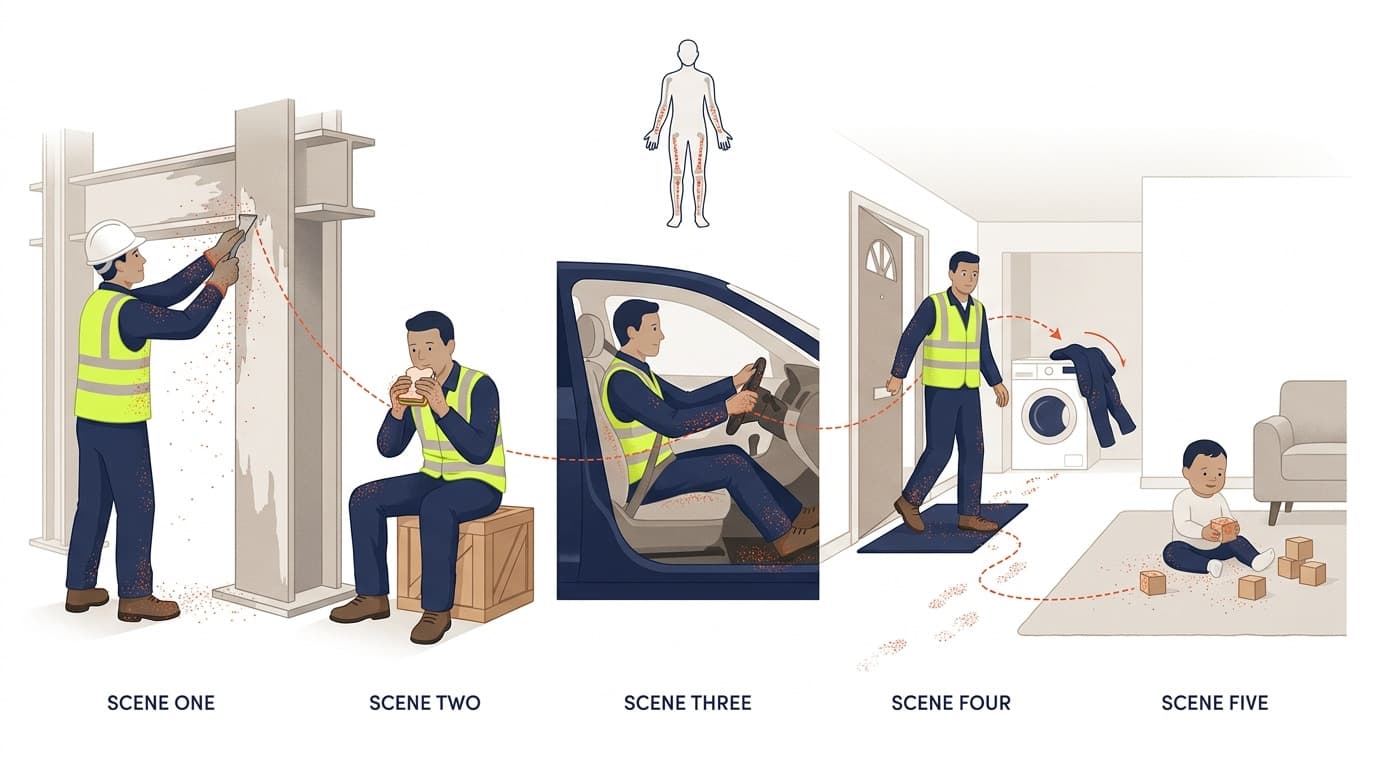
Here is the distinction that carries this whole talk: lead does not hurt you where it lands, it hurts you where it accumulates. There is no burn, no cough, no immediate signal. The dust settles on hands, on a sandwich, on a cigarette, in a vehicle, and the body stores what it absorbs in bone and soft tissue over months and years. That is why the standard's controls are as much about eating, washing and clothing as about respirators — and why its endpoint is a blood test rather than an air sample.
The presumption runs against you — 1926.62(d)(2)#
The limits first. The permissible exposure limit is 50 µg/m³ of lead in air averaged over an 8-hour day, and the action level is 30 µg/m³ as an 8-hour TWA — the level that switches on exposure monitoring, medical surveillance and training regardless of respirator use. For context, that PEL replaced an earlier limit of 200 µg/m³.
Then comes the part that is unusual. Under paragraph (d)(2), where lead is present and specified tasks are being performed, the employer must provide interim protection — treating the employee as exposed above a presumed level — until an exposure assessment is done and documents otherwise. The presumption is tiered by how aggressive the task is, and the top tier is severe:
With respect to the tasks listed in this paragraph (d)(2)(iv), where lead is present, until the employer performs an employee exposure assessment ... and documents that the employee performing any of the listed tasks is not exposed to lead in excess of 2,500 µg/m³ (50 × PEL), the employer shall treat the employee as if the employee were exposed in excess of 2,500 µg/m³ and shall implement employee protective measures ...
The tasks that carry that presumption, where lead-containing coatings or paint are present on structures, are abrasive blasting, welding, cutting, and torch burning.
Read what that means on site. Nobody has to prove the exposure is high. The employer has to prove it is not — and until that documentation exists, the protective measures for fifty times the permissible limit apply. Torch-cutting a painted steel beam in an older structure is inside that presumption on the first cut, not after somebody gets a monitoring result back.
The limit moves with the shift#
Most exposure limits are a single number. This one is not, and the detail gets missed constantly.
The PEL is 50 µg/m³ averaged over an 8-hour workday. Where employees are exposed for more than 8 hours in a workday, the standard reduces the limit — the permissible exposure for the day becomes 400 divided by the number of hours worked.
Work a 10-hour shift and the limit is 40 µg/m³. Work 12 and it is roughly 33. The dose is what matters, so extending the day tightens the number rather than leaving it alone. Any crew running long shifts on lead work is being measured against a stricter limit than the one on the poster.
Where it actually gets into people#
Hand to mouth. Eating, drinking, smoking or applying cosmetics in the work area. This is the dominant ingestion route on construction sites, and it is why hygiene provisions sit in the standard alongside respirators.
Clothing. Contaminated overalls worn home, taken home to wash, or worn in a shared vehicle. Lead brought home reaches families, and children absorb it far more readily than adults.
Poorly controlled hot work. Welding, cutting and torch burning on coated steel generate lead fume, which is respirable and does not respect the distance a spark travels.
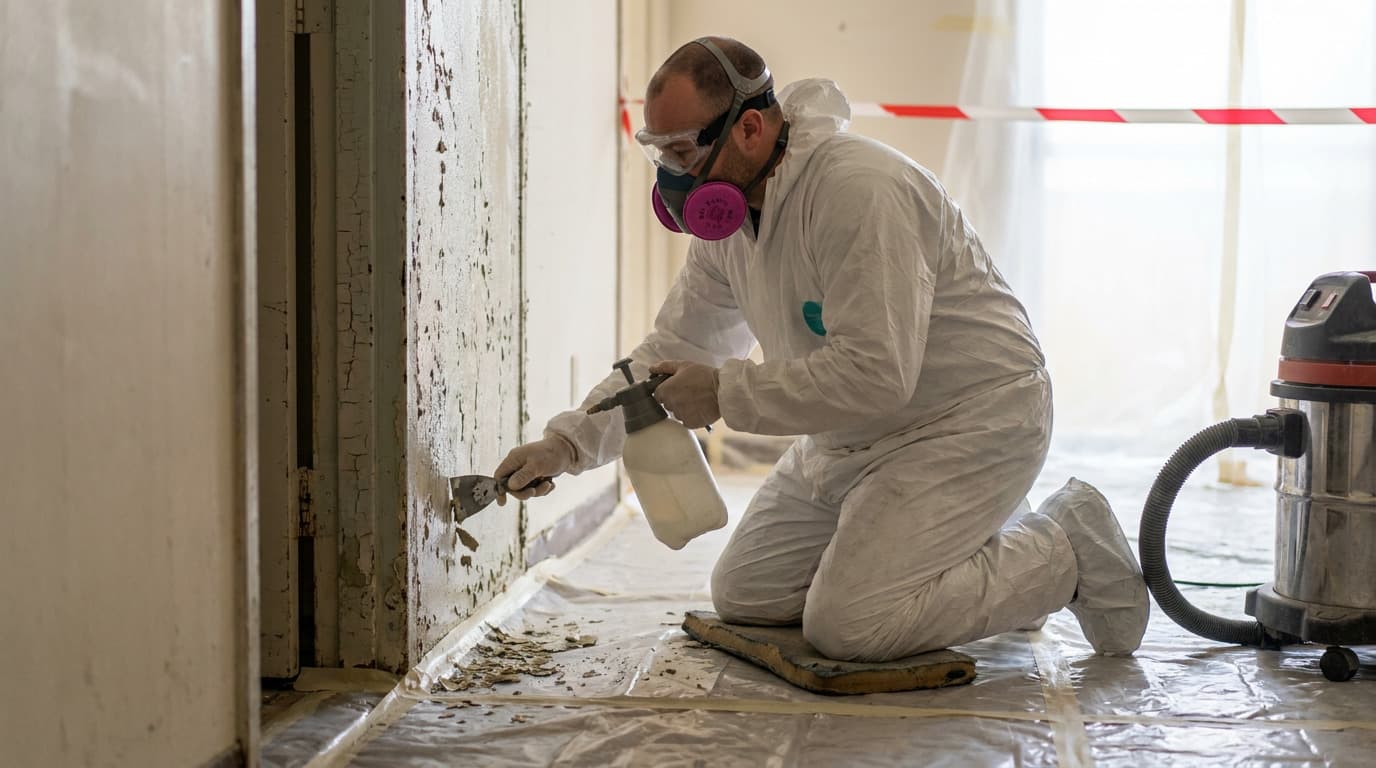
Dry methods. Sanding, scraping, grinding or dry sweeping lead paint puts settled contamination back into the breathing zone.
Assuming a coating is clean. Age is the tell — but a modern topcoat over old paint tells you nothing about what is underneath.
The endpoint is a blood test — 1926.62(k)#
Air monitoring measures the workplace. Biological monitoring measures the person, and the standard sets its removal criteria in blood lead level rather than in air concentration.
Under the medical surveillance and medical removal provisions, a worker is to be removed from work having an 8-hour TWA exposure to lead of 30 µg/m³ when the blood lead level reaches 50 µg/dl, confirmed by a second follow-up test performed within two weeks of the employer receiving the first result. Return to the former job status depends on the blood lead level declining to 40 µg/dl.
Two things follow that matter more than the numbers.
First, removal is a benefit, not a penalty. The standard provides medical removal protection benefits — the worker keeps earnings, seniority and other rights during removal. A crew that believes a high blood lead result costs someone their job will avoid the test, which defeats the entire mechanism.
Second, removal takes the person away from the exposure, not the exposure away from the site. If somebody hits 50 µg/dl, the controls failed for everyone doing that task — the blood result is a lagging indicator of a job that needs fixing.
What can go wrong?#
Work starts before the assessment. The presumption in (d)(2) exists precisely for that gap, and it is routinely ignored.
Lunch happens in the work area. Gloves off, sandwich in hand, dust everywhere. The most reliable exposure route on any lead job.
Overalls go home. In a car seat, into a domestic washing machine, onto a child's floor.
Dry sanding or scraping of painted surfaces, or dry sweeping the debris afterwards.
Respirators without the rest. Respiratory protection is provided and hygiene facilities are not, so the intake route left open is the one nobody is watching.
Blood testing is skipped or feared. No biological monitoring, or workers avoiding it because they think a result costs them work.
Nearby trades are unprotected. The person torch-cutting has the PPE; the labourer holding the light does not.
How do we control this properly?#
Assume the presumption applies and work to it. Where lead may be present and the task is abrasive blasting, welding, cutting or torch burning on coated structures, the protective measures apply from the first minute — until an assessment documents otherwise.
Get the assessment done. It is the only way out of the presumption, and it is also the only way to size the controls correctly.
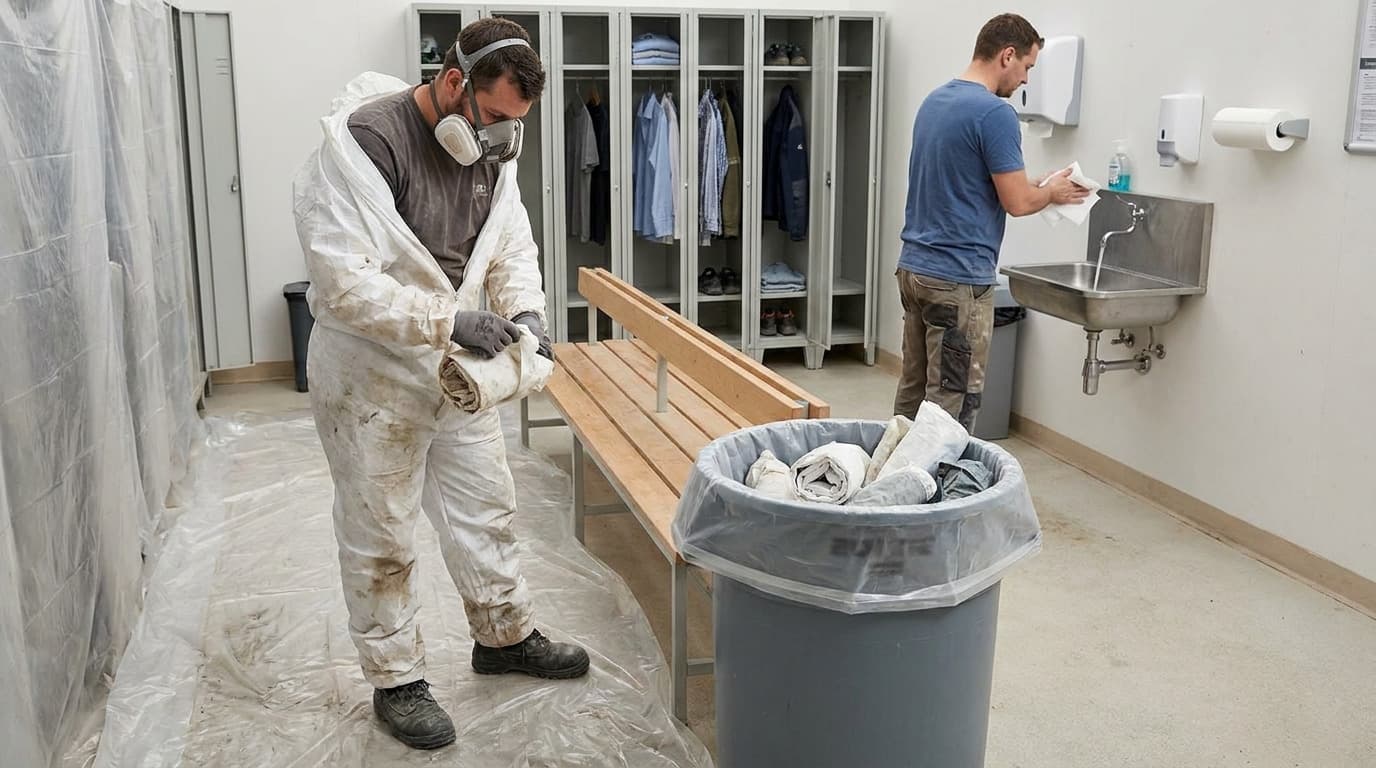
Separate eating from working, physically. No food, drink, tobacco or cosmetics in the work area; washing facilities before breaks; a clean area to eat in.
Control the clothing. Change out of work clothing on site, keep contaminated clothing separate, and never launder it at home.
Use wet methods and HEPA vacuums. No dry sanding, dry scraping or dry sweeping of lead-containing surfaces or debris.
Ventilate and isolate hot work on coatings, and keep everyone not doing the task out of the fume.
Support the blood monitoring. Make it routine, explain that removal carries protection benefits, and treat a high result as a failure of the controls rather than of the person.
Extend the controls to the shift length, remembering that beyond 8 hours the permissible limit itself comes down.
Before you start#
- Confirm whether lead is or may be present in the coating, paint or material being disturbed.
- Confirm whether the task is one of the trigger tasks — abrasive blasting, welding, cutting or torch burning on coated structures.
- Confirm whether an exposure assessment exists, and what it documented.
- Confirm the protective measures required in the meantime are in place and being used.
- Confirm hygiene facilities are available and that nobody will eat, drink or smoke in the work area.
- Confirm the method is wet or HEPA — never dry sanding, scraping or sweeping.
- Confirm how work clothing will be changed, stored and laundered.
- Confirm who is inside the fume or dust zone besides the person doing the task.
Talk it over#
- Where on this job is there old paint, and does anybody actually know what is in it?
- Where did you eat lunch yesterday, and what were your hands like?
- Has anyone here had a blood lead test? What happened after it?
- If your overalls went home tonight, what would they touch?
The bottom line#
The lead standard sets a PEL of 50 µg/m³ as an 8-hour TWA and an action level of 30 µg/m³ — and where the shift runs longer than 8 hours it reduces the limit to 400 divided by the hours worked. Its most distinctive feature is 1926.62(d)(2): where lead is present, the employer must treat employees on the listed tasks as if exposed above a presumed level until an assessment documents otherwise, with the top tier at 2,500 µg/m³ — fifty times the PEL — for abrasive blasting, welding, cutting and torch burning on lead-coated structures. The endpoint is biological: medical removal when the blood lead level reaches 50 µg/dl, confirmed by a follow-up test, and return when it declines to 40 µg/dl, with medical removal protection benefits so nobody loses out by being tested. And because lead is swallowed as often as it is inhaled, hygiene and clothing controls are not the soft part of the programme — they are the part that works.
Frequently asked questions about lead exposure#
What is the OSHA lead exposure limit in construction?
The permissible exposure limit is 50 µg/m³ of lead in air averaged over an 8-hour workday, and the action level — which triggers exposure monitoring, medical surveillance and training regardless of respirator use — is 30 µg/m³ as an 8-hour TWA.
Does the limit change on a long shift?
Yes. Where employees are exposed for more than 8 hours in a workday, the permissible exposure limit is reduced to 400 divided by the number of hours worked that day. A 10-hour shift therefore carries a limit of 40 µg/m³ rather than 50.
What are the trigger tasks and why do they matter?
Under 1926.62(d)(2), where lead is present, specified tasks require interim protection until an exposure assessment documents actual exposures. For the tasks in (d)(2)(iv) — abrasive blasting, welding, cutting and torch burning where lead-containing coatings or paint are present on structures — the employer must treat the employee as if exposed in excess of 2,500 µg/m³, fifty times the PEL, until documented otherwise.
Do we have to test the paint before starting?
The presumption operates on whether lead is present, so the practical sequence is to establish that first — and where lead is or may be present and a trigger task is being performed, the interim protective measures apply while the exposure assessment is arranged. Starting work and sorting out the assessment later is exactly the gap paragraph (d)(2) was written to cover.
When is a worker removed from lead work?
Under the medical removal provisions, a worker is removed from work having an 8-hour TWA exposure of 30 µg/m³ when the blood lead level reaches 50 µg/dl, confirmed by a second follow-up blood test performed within two weeks after the employer receives the first result. Return to former job status depends on the blood lead level declining to 40 µg/dl.
Does a worker lose pay when removed?
No — the standard provides medical removal protection benefits, under which the worker retains earnings, seniority and other rights during the removal period. This matters practically as well as legally: if a crew believes a blood test can cost someone their income, they will avoid the test, and the surveillance system stops working.
Why does the standard care so much about eating and clothing?
Because lead is ingested as well as inhaled. Hand-to-mouth transfer during eating, drinking or smoking in the work area is a major route on construction sites, and contaminated clothing carries lead into vehicles and homes, where children absorb it far more readily than adults. Hygiene facilities, separate eating areas and controlled laundering are core controls, not extras.
Download the lead exposure toolbox talk PDF#
Get this lead exposure toolbox talk as a print-ready PDF — available in English, Spanish, Portuguese, and Turkish. Print it, hand it to the crew, and collect signatures on the included attendance sheet.
Download the PDF — free account required. New members get 3 free downloads.
Related toolbox talks#
Sources#
- OSHA, 29 CFR 1926.62 — Lead: https://www.osha.gov/laws-regs/regulations/standardnumber/1926/1926.62
- OSHA, 29 CFR 1926.62 App A — Substance Data Sheet for Occupational Exposure to Lead: https://www.osha.gov/laws-regs/regulations/standardnumber/1926/1926.62AppA
- OSHA, 29 CFR 1926.62 App C — Medical Surveillance Guidelines: https://www.osha.gov/laws-regs/regulations/standardnumber/1926/1926.62AppC
This talk summarises published regulatory guidance. It is not medical advice. Blood lead testing, interpretation of results and any decision about removal or return to work are matters for a physician or other licensed health care professional.
Written by FieldSafetyTalk's safety professional — a CSP, ASP, CHST and OSHA Authorized Outreach Trainer with 14+ years of international construction safety experience across federal, heavy civil, and industrial projects.