Forklift / Powered Industrial Truck Safety
Updated 2026-08-06
In this bundle Vehicle Safety
Print-ready PDF
Download this talk as a print-ready PDF, available in 4 languages.
A forklift looks like a small truck, and that is the most dangerous thing about it — because it invites every operator to drive it using the instincts they built up behind the wheel of a car, and almost all of those instincts are wrong. A car is a stable box on four wheels, with its balance point sitting comfortably inside the wheelbase; it takes an extreme maneuver to tip one. A forklift is built on the opposite principle. It carries a heavy load out in front, cantilevered past the front wheels, and balances it with a heavy counterweight built into the back end — and the whole machine pivots not on four corners but on a triangle. This forklift / powered industrial truck safety talk is about the single fact that every forklift rule comes from: it is a counterweight machine balanced on a triangle, and it tips in ways a car never would.
Here is the distinction that carries this whole talk: a forklift isn't a small truck — it's a counterweight machine balanced on a triangle, and every rule about it comes from that one fact: the load in front and the weight in back balance over three points, not four wheels, so the moment you lift, turn, or overload, the balance point walks toward the edge, and once it crosses, the machine tips faster than you can react. Picture the stability triangle OSHA describes: the two front wheels and a single pivot point at the center of the rear axle. The combined center of gravity of the truck and its load has to stay inside that triangle, or the machine goes over. When you raise a load, the center of gravity rises and the truck becomes easier to tip sideways. When you turn, especially with a raised load, momentum pushes that center of gravity toward one edge of the triangle. When you overload the forks or carry a load too far out, the center of gravity moves forward past the front wheels. Every one of those is the same event: the balance point leaving the triangle. Understanding that is understanding the forklift.
Where the boundary of this talk sits#
Forklift work touches several other talks, and this one owns the machine itself. The loading dock talk owns the dock and trailer interface — the surface the forklift drives onto and the truck that can pull away or creep. The blind spots and struck-by talks own the pedestrian side — the worker on foot who gets hit by a truck they didn't see or who wasn't seen. The stacking talk owns how material is piled once it is placed. This talk owns the powered industrial truck as a machine: its stability triangle and tip-over behavior, its load capacity, and the training and certification that OSHA requires before anyone operates one. Where the hazard is the dock, the pedestrian, or the stack, those talks own the detail; this one owns the counterweight machine and the operator driving it.
The capacity plate is a load chart, not a number#
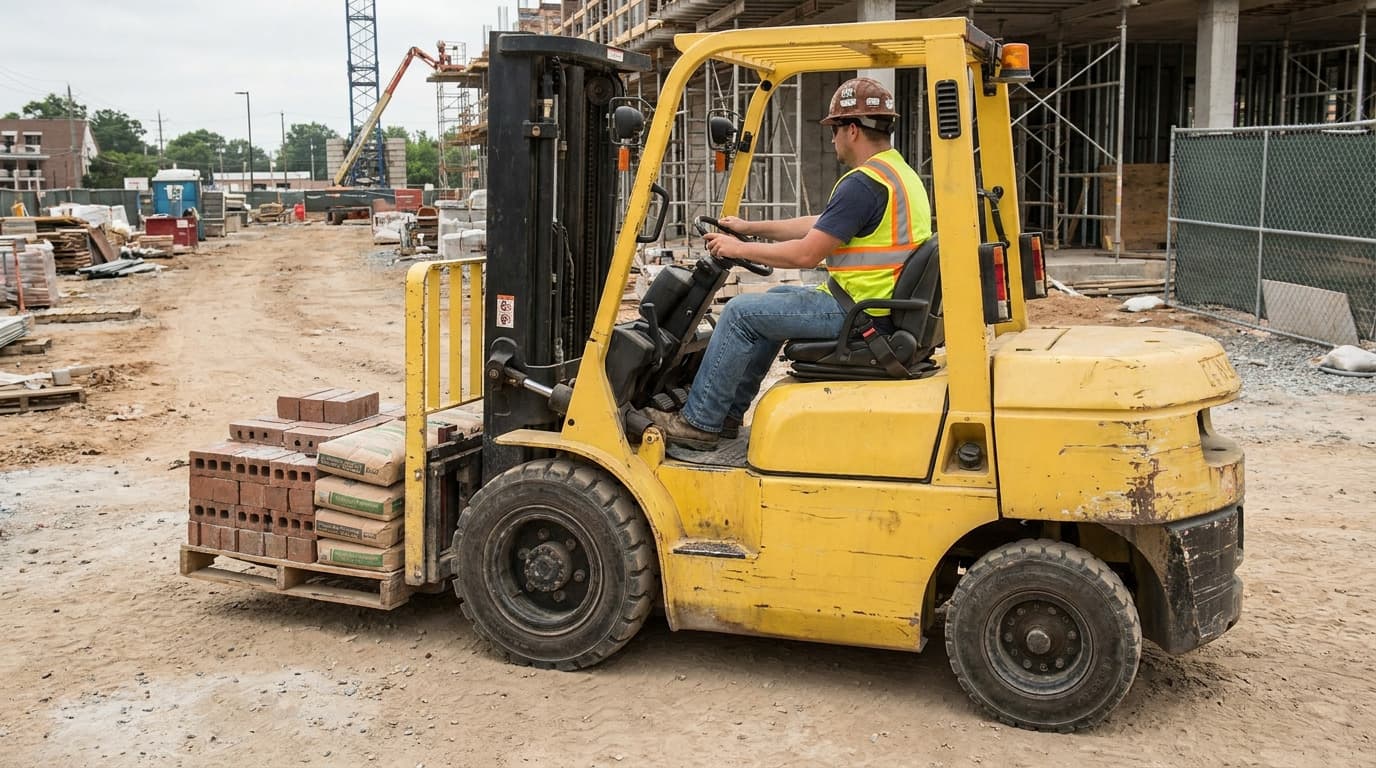
The most misunderstood thing about a forklift is its rated capacity, because operators treat it as a single number when it is really a chart. A forklift's rated capacity — stamped on the data plate, also called the capacity plate or nameplate — is stated at a specific load center, usually 24 inches, and at a standard height. The moment the load is heavier than rated, carried with its center farther out than the rated load center, or lifted higher, the safe capacity drops, sometimes dramatically. Attachments change it again: a side-shifter, a clamp, or extended forks add weight and move the load center, and the plate has to reflect the truck as configured. This is why a forklift that lifts a given pallet safely at floor level can tip forward lifting the same pallet high, and why "it fit on the forks" is never the same as "it's within capacity." The operator has to read the plate for the truck as it is actually set up, and respect what it says at the height and reach the job actually requires.
Keep the load low, and don't turn with it up#
Because raising the load raises the center of gravity and makes the truck easier to tip sideways, the safest way to travel is with the load low — just high enough to clear the ground — and tilted back to cradle it against the mast. A raised load turns the forklift into a top-heavy machine, and the higher it goes, the smaller the margin before a turn or a bump sends the center of gravity past the edge of the triangle. Turning is where lateral tip-overs happen: the momentum of the turn, combined with a raised or heavy load, pushes the combined center of gravity toward the outside edge of the triangle. So the rules chain together — travel with the load low, slow down before turning, and never turn sharply with a load raised. On ramps and grades the same physics applies with a twist: you keep the load pointed upgrade so it does not slide off or pull the truck over, which for a loaded truck usually means driving up forward and down in reverse. None of this is arbitrary; each rule keeps the center of gravity where it belongs.
When it tips, stay in the seat#
The hardest instinct to train out of a forklift operator is the urge to jump when the machine starts to go over — and it is exactly the wrong instinct, because it is what kills people in tip-overs. A sit-down counterbalanced forklift is built with an overhead guard and, in most cases, an operator restraint, and together those are designed to keep the operator inside the protected zone of the truck if it tips. An operator who stays belted in, braces, and leans away from the direction of the tip rides the machine down inside that protected space. An operator who tries to jump clear almost always jumps toward the ground the truck is falling onto, and is crushed between the overhead guard and the ground — the single most common way a forklift tip-over becomes a fatality. This is why wearing the seat belt is not paperwork compliance; it is the thing that keeps a tip-over survivable. The belt's job is not to keep you from bouncing around in normal driving — it is to keep you in the seat during the two seconds you would otherwise use to jump to your death.
No one operates until they're trained and evaluated#
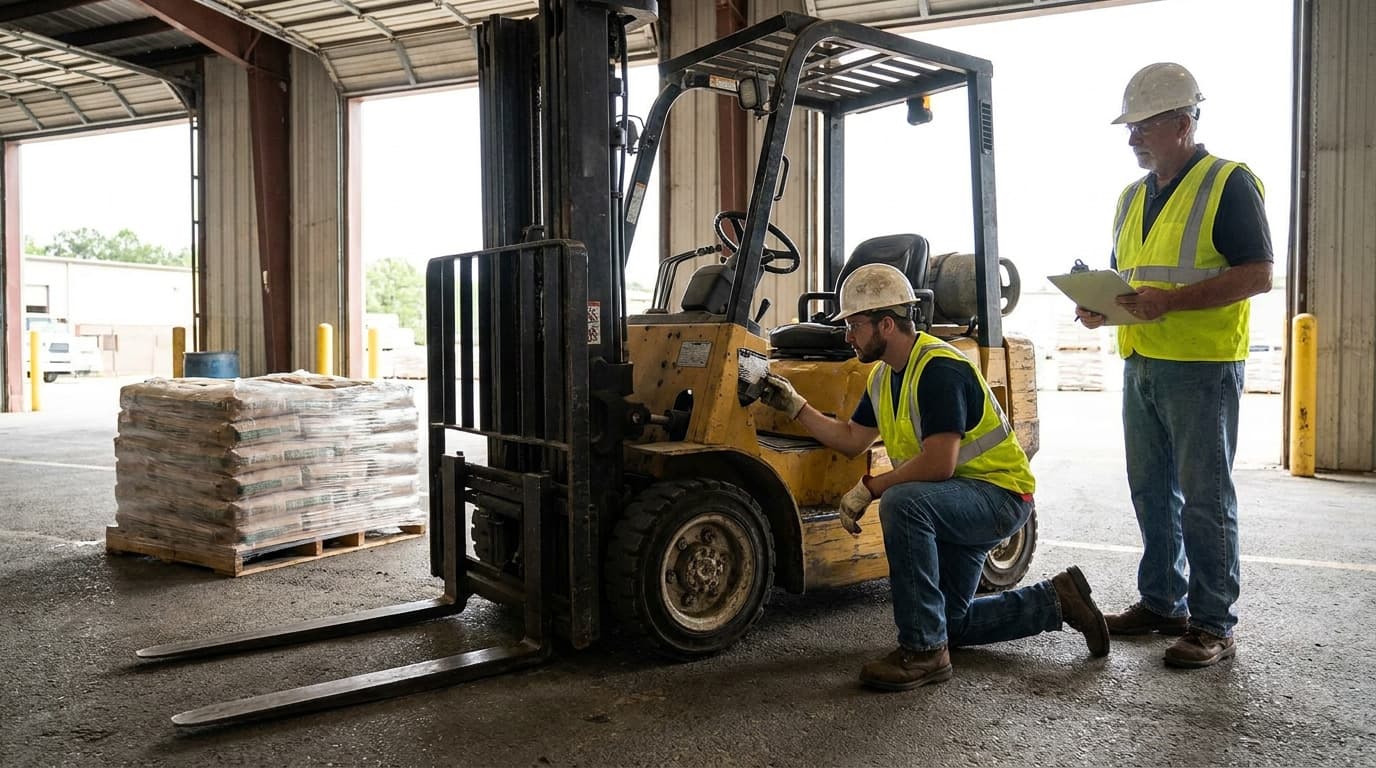
Because a forklift handles so differently from anything an operator drives off the job, OSHA does not let anyone run one until they have been trained and evaluated on it. Under the powered industrial truck standard, an employer must ensure each operator has completed formal instruction, practical hands-on training, and an evaluation of their performance in the actual workplace before operating independently; trainees may operate only under supervision and only where it does not endanger others. The training has to cover both truck-related topics — controls, the capacity plate, the stability triangle, attachments, refueling or charging — and workplace-related topics — surface conditions, pedestrian traffic, ramps, narrow aisles, and any hazardous atmospheres. Certification is the employer's own written record naming the operator, the trainer, and the date, and a missing or undated record is itself a citable condition even when the operator is genuinely skilled. Refresher evaluation is required after an accident or near-miss, whenever an operator is seen driving unsafely, whenever they are assigned a different type of truck, or when workplace conditions change — and independent of any of those, every operator is re-evaluated at least once every three years. And the crucial point: being trained on a sit-down counterbalanced truck does not qualify anyone to run a reach truck, an order picker, or a telehandler, because each type balances and behaves differently.
Where the duty sits#
Powered industrial trucks in general industry are governed by 1910.178, and the training, certification, and evaluation requirements live in 1910.178(l). For construction, 1926.602(d) makes those same 1910.178(l) operator-training requirements applicable, and 1926.602(c) brings in the design, stability, inspection, and operation requirements through the ANSI B56.1 powered-industrial-truck standard. The physics of tip-over is laid out in Appendix A to 1910.178 — Stability of Powered Industrial Trucks, which describes the stability triangle and the longitudinal and lateral stability principles. Pre-use inspection is required, and a truck found unsafe is removed from service. Consensus standards ANSI/ITSDF B56.1 (and B56.6 for rough-terrain and telehandlers) carry the detailed design and operating requirements, and the manufacturer's manual and capacity plate govern the specific truck. The General Duty Clause, Section 5(a)(1) and training under 1926.21(b)(2) apply throughout. Where the manufacturer's manual, the capacity plate, or a site rule sets a specific requirement, that requirement governs.
What can go wrong?#
- The operator turns with a raised load and the forklift tips sideways.
- A load heavier or farther out than the capacity plate allows tips the truck forward.
- An attachment adds weight and moves the load center, and the truck tips lifting a "normal" load high.
- The forklift tips and the operator jumps and is crushed between the overhead guard and the ground.
- An untrained or uncertified worker operates a forklift and loses control.
- An operator trained on one truck type runs a different type that balances differently.
- The load is carried high across the yard, raising the center of gravity the whole way.
- A pedestrian is struck by a forklift the operator could not see around the load.
How do we manage this properly?#
- Treat the forklift as a counterweight machine on a triangle — keep the combined center of gravity inside it.
- Read the capacity plate for the truck as configured — respect it at the actual height, reach, and attachment.
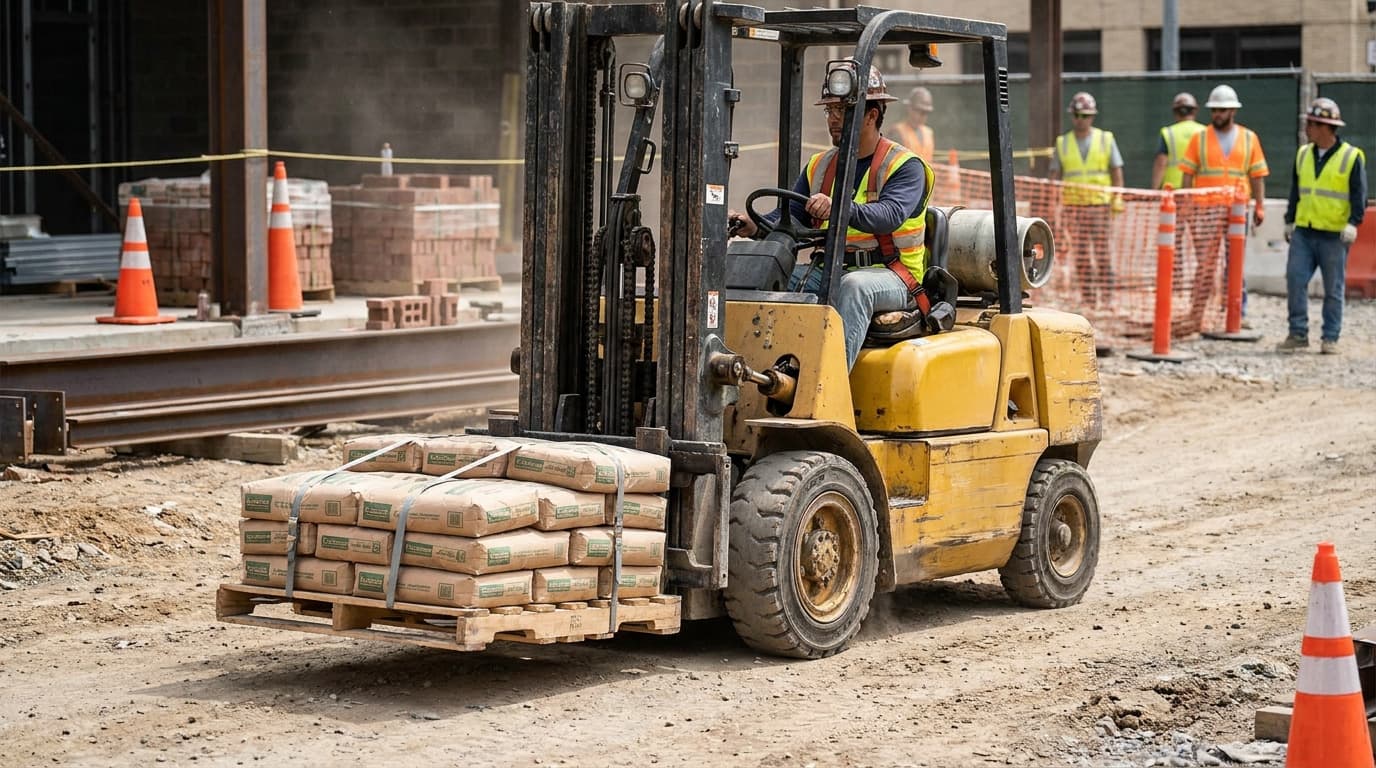
- Travel with the load low and tilted back, just high enough to clear the ground.
- Slow down before turning, and never turn sharply with a raised load.
- Stay belted — if it tips, stay in the seat and ride it down; never jump.
- Keep the load pointed upgrade on ramps — up forward, down in reverse when loaded.
- Only trained, evaluated, and certified operators run a truck — for that specific type.
- Watch for pedestrians, especially where the load blocks the view — a spotter or horn where needed.
Before you start#
- Confirm the operator is trained, evaluated, and certified for this specific type of truck.
- Confirm the pre-use inspection is done and the truck is in safe condition.
- Confirm the operator has read the capacity plate for the truck as configured today.
- Confirm the seat belt or operator restraint works and will be worn.
- Confirm the load is within capacity at the height and reach the job needs.
- Confirm the travel path, ramps, and floor conditions are known and adequate.
- Confirm pedestrians are kept clear, and how the operator will signal at blind corners.
- Confirm the plan for keeping the load low in travel and pointed upgrade on grades.
Talk it over#
- Is everyone running a truck today trained and certified for that exact type of truck?
- What's the heaviest or highest lift planned, and is it within the capacity plate as the truck is set up?
- Where are the pedestrians and blind corners on today's route, and how do we keep them clear?
- Does everyone know that if it tips, you stay belted and ride it down — you never jump?
The bottom line#
A forklift isn't a small truck — it's a counterweight machine balanced on a triangle, and every rule about it comes from that one fact: the load in front and the weight in back balance over three points, not four wheels, so the moment you lift, turn, or overload, the balance point walks toward the edge, and once it crosses, the machine tips faster than you can react. Every control keeps the combined center of gravity inside that triangle: read the capacity plate as a chart that changes with height, reach, and attachment; travel with the load low and tilted back; slow down and don't turn with a raised load; keep the load pointed upgrade on ramps. When it does go over, the belt keeps the tip-over survivable — you stay in the seat and ride it down, you never jump. And no one runs a truck until they are trained, evaluated, and certified for that specific type. It all sits in 1910.178 — training in 1910.178(l), the physics in Appendix A — made applicable to construction by 1926.602(d), with ANSI B56.1 and the manufacturer's plate governing the specific truck. The question to carry is the one a car never makes you ask: where is the combined center of gravity right now — and is it still inside the triangle?
Frequently asked questions about forklift and powered industrial truck safety#
What is the stability triangle?
The stability triangle is the three-point base a sit-down counterbalanced forklift actually balances on: the two front wheels and a single pivot point at the center of the rear axle. Even though the truck has four wheels, the rear axle pivots in the middle so the machine effectively rests on a triangle, not a rectangle. The combined center of gravity of the truck and whatever it is carrying has to stay inside that triangle, or the forklift tips over. This is the core fact that makes a forklift behave so differently from a car: a car's balance point sits well inside its four-wheel base and stays there, but a forklift's combined center of gravity moves constantly as you lift, lower, tilt, turn, and load, and it can leave the triangle quickly. When it does, the truck goes over — forward if the center of gravity crosses the front edge, sideways if it crosses a side edge. Every forklift operating rule exists to keep that center of gravity where it belongs.
What does the capacity plate actually tell me?
The capacity plate — also called the data plate or nameplate — tells you the maximum load the truck can safely handle, but the key thing operators miss is that it is a rated value at a specific load center and height, not a flat maximum. The rated capacity is typically stated at a 24-inch load center, meaning the weight is assumed to be centered a certain distance out on the forks. If the load's center is farther out than that, or if you lift it higher than the rated height, the safe capacity drops. Attachments change the plate too: a clamp, side-shifter, or fork extensions add weight and shift the load center, so the plate must reflect the truck as it is actually configured. This is why the same pallet can be safe at floor level and dangerous lifted high, and why "it fits on the forks" tells you nothing about whether it is within capacity. Read the plate for the truck as set up, at the height and reach the job requires.
Why should I stay in the seat if the forklift tips?
Because jumping is what kills people in tip-overs, and staying belted is what makes them survivable. A sit-down counterbalanced forklift is built with an overhead guard and an operator restraint that together define a protected zone inside the truck. If the machine tips and you stay belted in, brace, and lean away from the direction of the fall, you ride the truck down inside that protected space and the overhead guard takes the impact. If you try to jump clear, you almost always jump toward the ground the truck is falling onto, and you are crushed between the overhead guard and the ground as the several-ton machine comes down — this is the single most common way a forklift tip-over becomes a fatality. The instinct to jump is powerful and completely wrong. The seat belt's real job is not everyday driving; it is to keep you in the seat during the two seconds a tip-over gives you, so you cannot make the fatal jump.
Do I need to travel with the load low?
Yes, whenever you are moving the truck. Raising the load raises the combined center of gravity, and a higher center of gravity makes the forklift much easier to tip sideways, especially in a turn. So the safe way to travel is with the load low — just high enough to clear the ground and any obstacles — and tilted back to cradle it against the mast so it does not slide off. Carrying a load high across a yard keeps the truck top-heavy the entire trip, and a single sharp turn or a bump can push the center of gravity past the edge of the triangle. You raise the load only when you are at the rack or stack and ready to place it, and you lower it again before you travel on. On ramps and grades the load stays pointed upgrade so it does not slide off or pull the truck over, which for a loaded truck usually means driving up the grade forward and down it in reverse. Low in travel, up only to place — that is the pattern.
Does a forklift certification cover every kind of forklift?
No, and this is a common and dangerous misunderstanding. OSHA requires that operators be trained and evaluated on the specific type of powered industrial truck they will operate, because the types balance and behave very differently. A sit-down counterbalanced forklift, a stand-up reach truck, an order picker, and a telehandler each have different controls, different stability characteristics, different visibility, and in the case of an order picker, different fall exposure. Being trained and certified on one does not qualify an operator to run another. When an operator is assigned a different type of truck, that is one of the specific triggers for additional training and a new evaluation. The same is true after an accident or near-miss, after an operator is observed driving unsafely, or when workplace conditions change — and even without any of those triggers, every operator's performance has to be re-evaluated at least once every three years. Certification is not a permanent, universal license; it is truck-type-specific and has to be kept current.
Where does construction get its forklift rules, since 1910.178 is a general-industry standard?
Construction gets the same operator-training requirements through a bridge in the construction standards. The powered industrial truck training, certification, and evaluation requirements live in 1910.178(l), which is part of the general-industry standards — but 1926.602(d) explicitly makes those 1910.178(l) requirements applicable to employers engaged in construction. In addition, 1926.602(c) brings in the design, construction, stability, inspection, testing, and operation requirements by incorporating the ANSI B56.1 powered-industrial-truck standard, the same consensus standard that was the source for 1910.178. So a construction employer running forklifts has to meet the identical operator-training and truck-safety requirements as a general-industry employer. On top of that, the manufacturer's manual and the capacity plate govern the specific truck, and rough-terrain forklifts and telehandlers common on construction sites carry additional considerations under ANSI B56.6. The short version: the rules are the same, they just reach construction through 1926.602 rather than directly.
Download the forklift & powered industrial truck safety toolbox talk PDF#
Get this forklift and powered industrial truck safety toolbox talk as a print-ready PDF — available in English, Spanish, Portuguese, and Turkish. Print it, hand it to the crew, and collect signatures on the included attendance sheet.
Download the PDF — free account required. New members get 3 free downloads.
Related toolbox talks#
Sources#
- OSHA, Powered industrial trucks — 29 CFR 1910.178 and Appendix A, Stability of Powered Industrial Trucks (operator training, certification, and evaluation at 1910.178(l); the stability triangle and longitudinal and lateral stability principles; capacity, refueling, and operating requirements): https://www.osha.gov/laws-regs/regulations/standardnumber/1910/1910.178
- OSHA, Material handling equipment — 29 CFR 1926.602 (1926.602(d) makes the 1910.178(l) operator-training requirements applicable to construction; 1926.602(c) incorporates ANSI B56.1 design, stability, inspection, and operation requirements): https://www.osha.gov/laws-regs/regulations/standardnumber/1926/1926.602
- OSHA, Standard interpretation — Powered industrial truck training content, certification, and record maintenance (Oct 1, 1999) (1910.178(l) requirements are applicable to construction employers through 1926.602(d); refresher training and evaluations under 1910.178(l)(4); training must be truck-type-specific): https://www.osha.gov/laws-regs/standardinterpretations/1999-10-01-0
This talk is general awareness guidance for training purposes. It does not replace your employer's powered industrial truck program, OSHA 1910.178 or 1926.602, the ANSI B56.1 standard, the manufacturer's operating manual and capacity plate, or a qualified trainer's evaluation, and it is not legal advice. Where the manufacturer's manual, the capacity plate, or a site rule sets a specific requirement, that requirement governs.