Skin Hazards
Updated 2026-07-28
In this bundle Health & Environmental Exposure
Print-ready PDF
Download this talk as a print-ready PDF, available in 4 languages.
Skin is the organ most exposed on a construction site and the one nobody briefs. It touches everything — cement, solvents, adhesives, fuel, resins, dust, sunlight — and the damage it takes accumulates quietly over years rather than announcing itself in an incident report. This Skin Hazards Toolbox Talk (Safety Talk / Tailgate Talk) is about the injury that does not hurt at the time.
Here is the distinction that carries this whole talk: pain is not the warning system. With an acid, you know immediately. With an alkali, you do not — and construction is an alkaline industry. As NIOSH-funded guidance for cement workers puts it, alkalies are sneakier than acids: they damage skin slowly, and wet Portland cement can stay on your skin for several hours before you feel the chemical burn. By the time it hurts, the damage is already done.
Wet cement: the numbers behind the burn#
Wet cement has a pH of 12 to 13. Strong alkalies are 12 to 14. Normal skin is mildly acidic — and because the pH scale is logarithmic, like the Richter scale, each whole number is a tenfold change. The published comparison is stark: the pH of wet cement is around a billion times higher than the pH of your skin.
What that does, in order:
It raises skin pH. Skin exposed to wet cement becomes more alkaline, and at higher pH skin is more permeable and absorbs more chemicals — including the chromium in the cement itself. Higher alkalinity may also encourage bacterial growth, so infection compounds the original injury.
It draws moisture out. Cement is hygroscopic — it pulls water from the skin.
It abrades. Cement is physically abrasive, damaging the skin surface and making it a less effective barrier.
It sensitises. Cement contains trace hexavalent chromium (Cr⁶⁺), a sensitising agent and the primary cause of allergic contact dermatitis in cement workers worldwide.
Those four properties are universal across concrete, mortar, grout, plaster, stucco and render, whatever the regional mix.
The four disorders, and which one you cannot undo#
Among Portland cement workers the common skin disorders are dry skin, irritant contact dermatitis, allergic contact dermatitis and cement burns.
Dry skin — irritation, scaling, itchiness, burning and redness. Usually dismissed, and it is where the barrier starts failing.
Irritant contact dermatitis (ICD) — stinging, pain, itching, blisters, dead skin, scabs, scaling, fissures, redness, swelling and watery discharge. It is a direct chemical effect, and it generally improves when exposure stops.
Allergic contact dermatitis (ACD) — the one that matters most, because it is an immune response, not a chemical one. Once a person is sensitised to hexavalent chromium, a tiny future exposure can trigger a full reaction. Published figures put ACD at 5 to 15% of workers in contact with Cr⁶⁺-containing Portland cement — a rate reported as high as 25 times that of the general population — and it may persist in 20 to 40% of workers even after they leave the trade.
That last figure is the reason this talk exists. ICD is a workplace problem. ACD is a life sentence for a proportion of the people who get it, and it is caused by exposure that felt like nothing at the time.
Cement burns — full chemical burns, typically to the extremities. Hands, wrists, forearms, knees, lower legs and feet are most vulnerable, because that is where wet concrete sits inside gloves, boots and knee pads while the worker carries on.
How common is this? In a survey of 442 cement mason apprentices with a 100% response rate, 71% reported one or more skin problems in the previous 12 months — rashes, bumps, blisters, fissures, scaling, redness, oozing, burning and pain. Their mean age was 27 and their mean time in the industry was 3.3 years.
The rest of what skin meets#
Solvents, thinners and degreasers strip the skin's natural oils and drive other chemicals through it. Epoxy adhesives, sealants and admixtures are recognised sensitisers in their own right. Fuels and oils cause irritation and, with prolonged contact, more. Fibreglass and mineral wool cause mechanical irritation. Sunlight is the exposure nobody logs, and outdoor construction is a lifetime of it.
One practical trap worth naming: barrier and softening creams applied to skin that is not thoroughly clean can intensify exposure by sealing contamination against the skin. Clean first, always.
Regulation here is thin. There is no construction skin standard; the duties come from 1926.28(a) and 1926.95 on personal protective equipment, and 1926.21(b)(2) on instructing employees in recognising and avoiding unsafe conditions. Hexavalent chromium has its own construction standard, but it is built around an airborne exposure limit rather than skin contact — so the skin side is left to PPE, hygiene and the general duties.
What can go wrong?#
Concrete inside the boot or glove. It stays against skin for hours, warm and wet, and that is exactly the mechanism.
Kneeling in wet concrete. Knees and lower legs are classic burn sites, and knee pads hold the material in place.
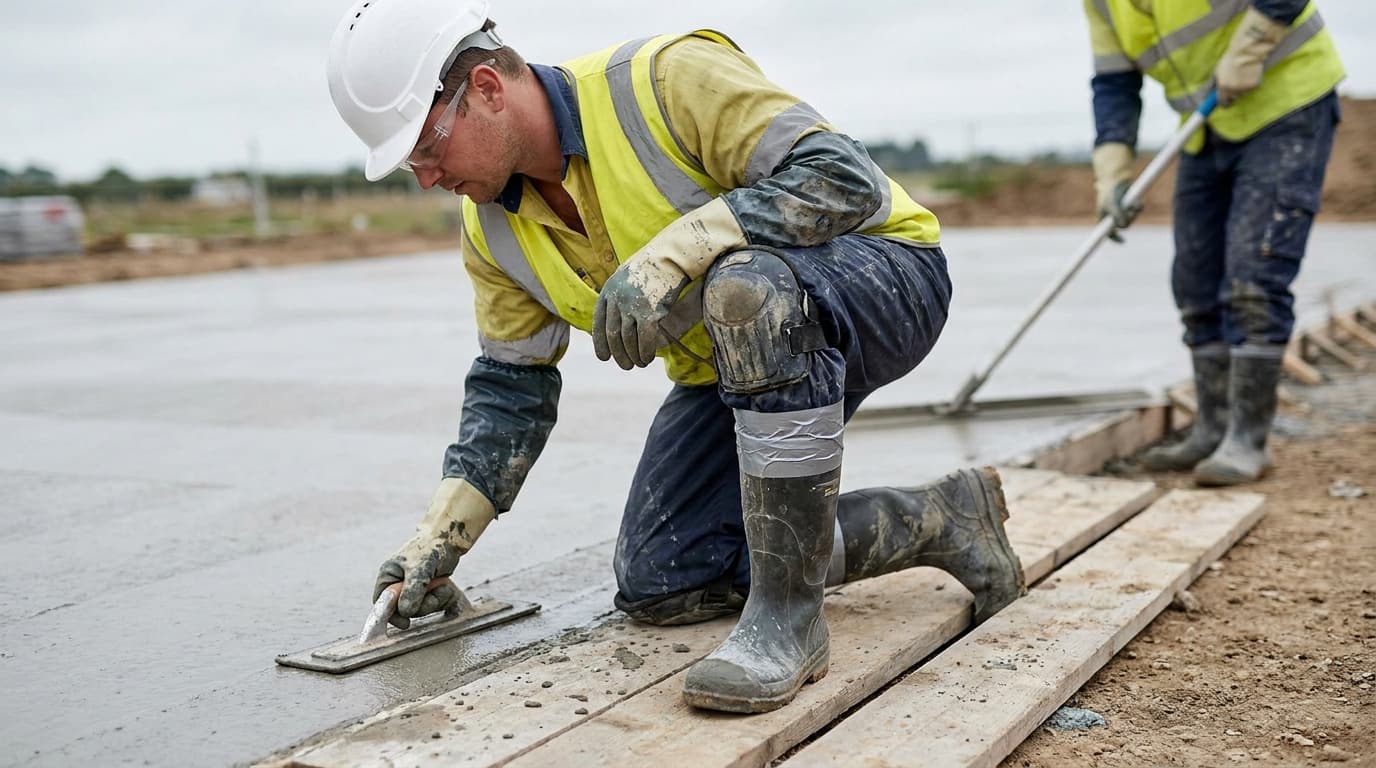
"It didn't hurt, so I carried on." The defining error with alkalies.
Washing with the wrong thing. Harsh or scented soaps, solvents or hand sanitiser on damaged skin make it worse.
Cream on dirty skin. Sealing contamination in rather than keeping it out.
Dry skin ignored. The barrier is already failing, and everything after that is easier.
Gloves reused after contamination. The inside is now the exposure.
Sun exposure treated as weather. Years of it, unrecorded and uncontrolled.
How do we protect skin properly?#
Keep it off in the first place. Waterproof gloves long enough to prevent run-in at the cuff, waterproof boots, knee protection that does not hold material against skin, and sleeves and trousers that cover.
Change wet or contaminated clothing immediately — do not work on in it, and do not let it soak through to skin.
Wash early and thoroughly with clean water and a pH-neutral soap without scent or alcohol, not solvent and not hand sanitiser.
If cement contacts skin: remove contaminated clothing carefully without touching unexposed areas, gently brush off any dry material, and flush the area with clean running water — and keep flushing. For eyes, flush with clean water for at least 20 minutes and get medical attention.
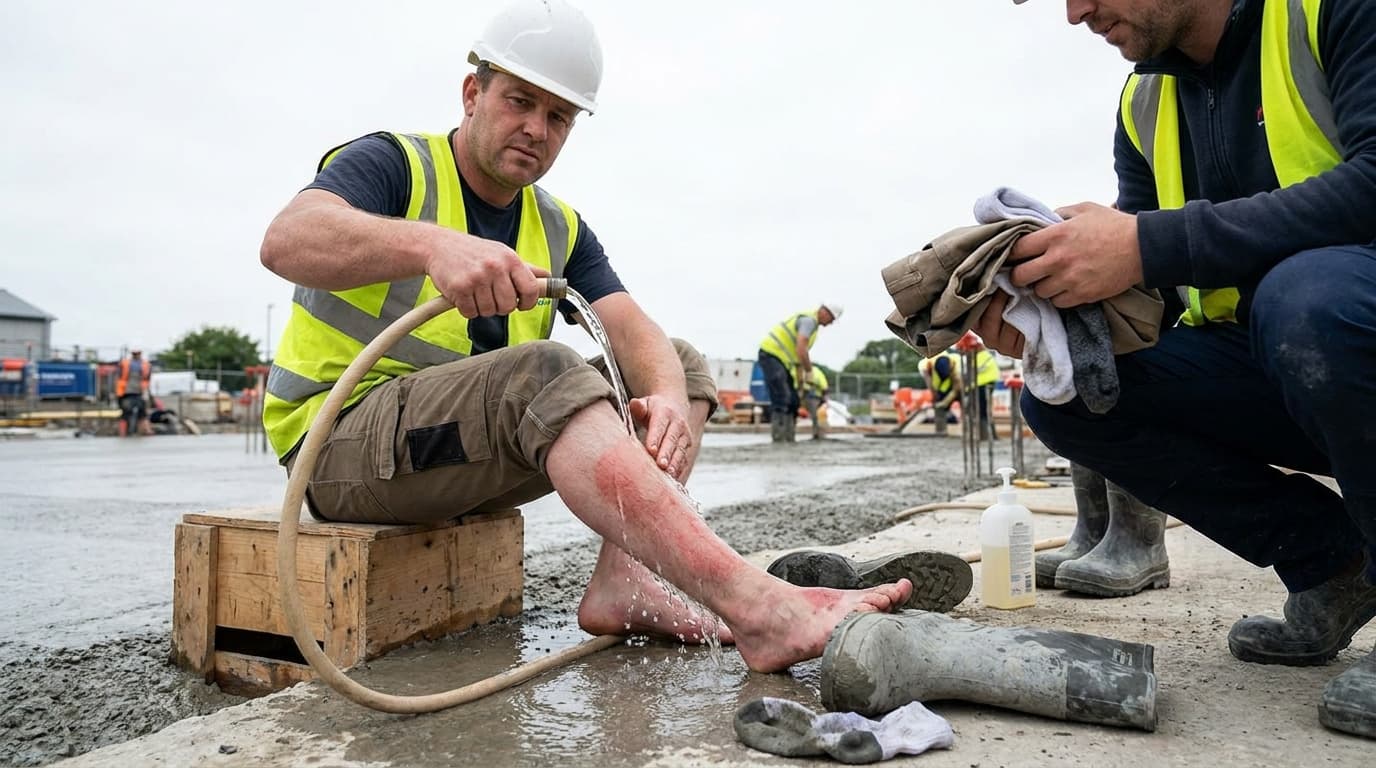
Watch for the delayed burn. Wash exposed areas even if you did not notice contact, because the burn can take hours to appear.
Treat dry skin as an early warning, not a cosmetic issue — and apply emollients only to skin that is properly clean.
Get skin problems assessed early. ICD that keeps recurring is the road to sensitisation, and once ACD is established it may persist for years.
Cover for sun — long sleeves, brim, and sunscreen on what is left exposed.
Before you start#
- Confirm what you will touch today: cement, solvent, adhesive, resin, fuel, fibre or sunlight.
- Confirm gloves are the right type, intact, long enough at the cuff, and clean inside.
- Confirm boots and knee protection will not trap wet material against skin.
- Confirm there is clean running water and pH-neutral soap within reach — not just at the end of the day.
- Confirm you know the flushing routine before anything lands on you.
- Confirm nobody is applying cream to unwashed skin.
- Confirm anyone with existing dry skin, cracking or a rash has raised it.
- Confirm sun cover for anyone outdoors all shift.
Talk it over#
- Has anyone had concrete in a boot and finished the shift anyway? What happened later?
- Where is the nearest clean running water from where you are working today?
- Who here has skin that cracks every winter — and did anyone ever look at it?
- What do you wash your hands with, and what condition are your gloves in inside?
The bottom line#
Pain is not the warning system. Alkalies are sneakier than acids — they damage skin slowly, and wet Portland cement can sit on skin for several hours before the chemical burn is felt. Wet cement is pH 12 to 13 against mildly acidic skin, which raises skin pH, increases permeability and absorption, draws out moisture, abrades the surface, and delivers hexavalent chromium, the main cause of allergic contact dermatitis in cement workers. The four disorders are dry skin, irritant contact dermatitis, allergic contact dermatitis and cement burns — and the one that does not undo is ACD, reported in 5 to 15% of exposed workers and persisting in 20 to 40% even after they leave the trade. In a survey of 442 cement mason apprentices, 71% reported a skin problem in the previous year. The controls are unglamorous: keep it off, change contaminated clothing, wash early with clean water and pH-neutral soap, flush thoroughly on contact, and take dry skin seriously.
Frequently asked questions about skin hazards#
Why are cement burns so often noticed late?
Because alkalies damage skin slowly. Published guidance for cement workers puts it plainly: alkalies are sneakier than acids, and wet Portland cement can stay on skin for several hours before the chemical burn is felt. That is why the absence of pain is not evidence that nothing is happening.
What is the pH of wet cement?
12 to 13, where strong alkalies are 12 to 14. Skin is mildly acidic, and the pH scale is logarithmic — so each whole number is a tenfold change, making the pH of wet cement roughly a billion times higher than that of skin.
What is the difference between irritant and allergic contact dermatitis?
Irritant contact dermatitis (ICD) is a direct chemical effect on the skin — stinging, redness, blistering, scaling, fissures — that generally improves once exposure stops. Allergic contact dermatitis (ACD) is an immune response, most often to the hexavalent chromium in cement; once sensitised, a person can react to very small future exposures.
How long does allergic contact dermatitis last?
Potentially far longer than the job. Published figures report ACD in 5 to 15% of workers in contact with hexavalent-chromium-containing Portland cement, at a rate as high as 25 times that of the general population, and note that it may persist in 20 to 40% of workers even after they leave the trade.
What should we do the moment cement contacts skin?
Remove contaminated clothing carefully without touching unexposed areas, gently brush off any dry material, and flush the area with clean running water. For eye contact, flush with clean water for at least 20 minutes and get medical attention. Wash exposed areas even if you did not notice contact, because the burn can be delayed by hours.
Do barrier creams help?
Only on clean skin. Guidance for cement workers warns that lanolin creams and petroleum-based emollients applied to skin that is not thoroughly clean can intensify exposure by sealing contamination against the skin. Wash first, then apply — and never treat cream as a substitute for gloves.
How common are skin problems in concrete work?
More common than the injury figures suggest, because most of it never gets reported. In a survey of 442 cement mason apprentices with a 100% response rate, 71% reported one or more skin problems in the previous 12 months — including rashes, bumps, blisters, fissures, scaling, redness, oozing, burning and pain.
Download the skin hazards toolbox talk PDF#
Get this skin hazards toolbox talk as a print-ready PDF — available in English, Spanish, Portuguese, and Turkish. Print it, hand it to the crew, and collect signatures on the included attendance sheet.
Download the PDF — free account required. New members get 3 free downloads.
Related toolbox talks#
Sources#
- eLCOSH / CPWR, Save Your Skin Toolbox Talk: https://www.elcosh.org/document/63/d000303/Save+Your+Skin+Toolbox+Talk.html
- eLCOSH / CPWR, An Employer's Guide to Skin Protection: https://elcosh.org/document/59/d000457/an-employers-guide-to-skin-protection.html
- eLCOSH / CPWR, A Safety & Health Practitioner's Guide to Skin Protection: https://www.elcosh.org/document/60/d000458/A+Safety+&+Health+Practitioner's+Guide+to+Skin+Protection.html
This talk summarises published health and regulatory guidance. It is not medical advice. Any suspected chemical burn, persistent rash or worsening skin condition should be assessed by a physician or other licensed health care professional — cement burns can develop hours after contact.
Written by FieldSafetyTalk's safety professional — a CSP, ASP, CHST and OSHA Authorized Outreach Trainer with 14+ years of international construction safety experience across federal, heavy civil, and industrial projects.