Poison Ivy, Oak & Sumac
Updated 2026-08-01
In this bundle Health & Environmental Exposure
Print-ready PDF
Download this talk as a print-ready PDF, available in 4 languages.
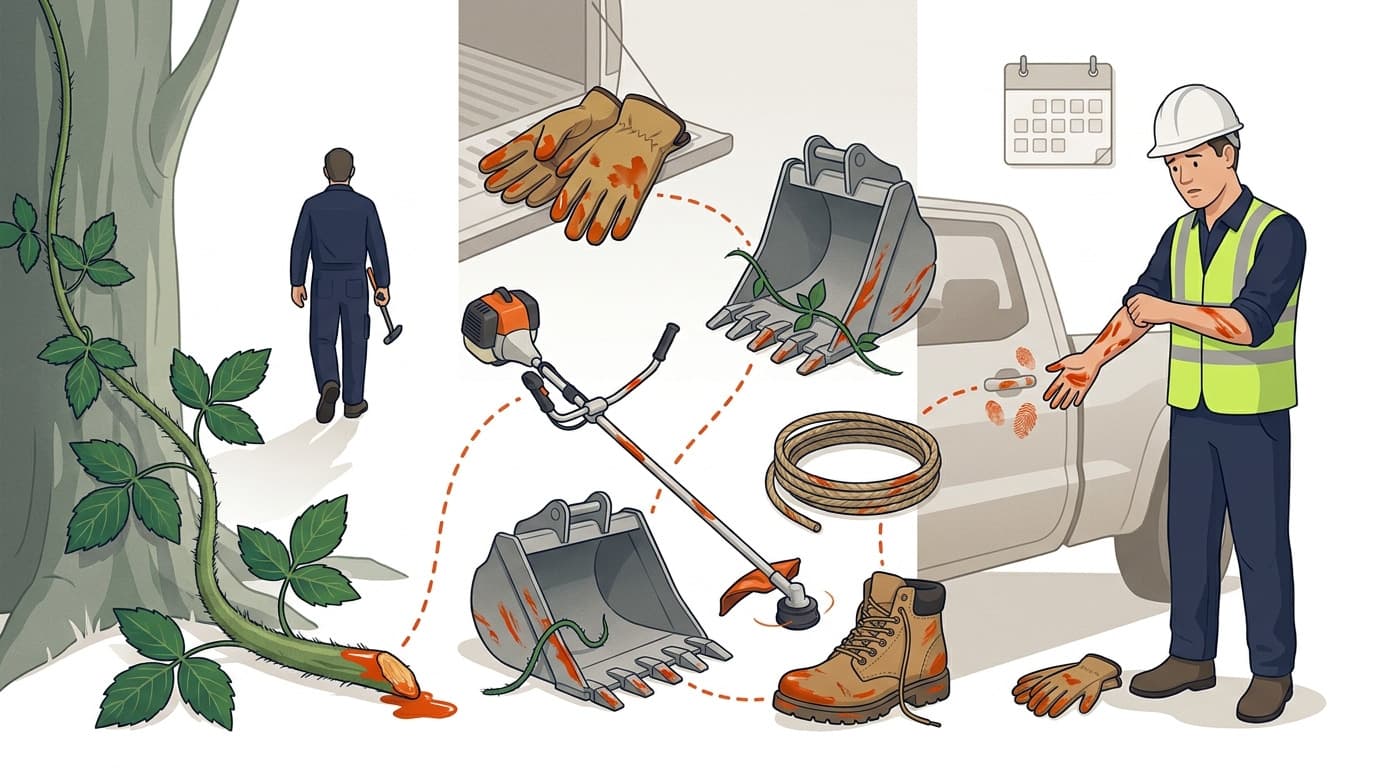
The man with the blistered forearms will tell you he never went near it. He is usually telling the truth. He picked it up off the strimmer handle, or the gloves he wore last Thursday, or a length of vine on the bucket of the machine — and it may not have been this week's work at all. This Poison Ivy, Oak & Sumac Toolbox Talk (Safety Talk / Tailgate Talk) is about how the exposure actually happens on a construction site.
Here is the distinction that carries this whole talk: you do not have to touch the plant, and the plant does not have to be alive. The agent is urushiol, an oily resin rather than a sap — and an oil transfers, sticks and waits. It is present in every part of the plant, all year round, including bare winter stems, roots and the hairy climbing vines on a tree trunk. It transfers to tools, gloves, boots, machinery, ropes and clothing, where it stays active for years. On a site, the usual route is not the plant. It is something the plant touched first.
Where the boundary of this talk sits#
Skin disorders generally — irritant and allergic contact dermatitis, cement burns, the dermatitis picture in construction — belong to the skin hazards talk. Washing facilities and the provision at 1926.51(f) belong to the personal hygiene talk. Sting reactions and anaphylaxis belong to the stinging insects talk. The first aid response system belongs to the first aid and AED talk. This talk owns urushiol: how it moves, how long it lasts, and what to do in the first half hour.
Where the oil goes after you cut the plant#
Take the anchor apart, because each half changes a different site habit.
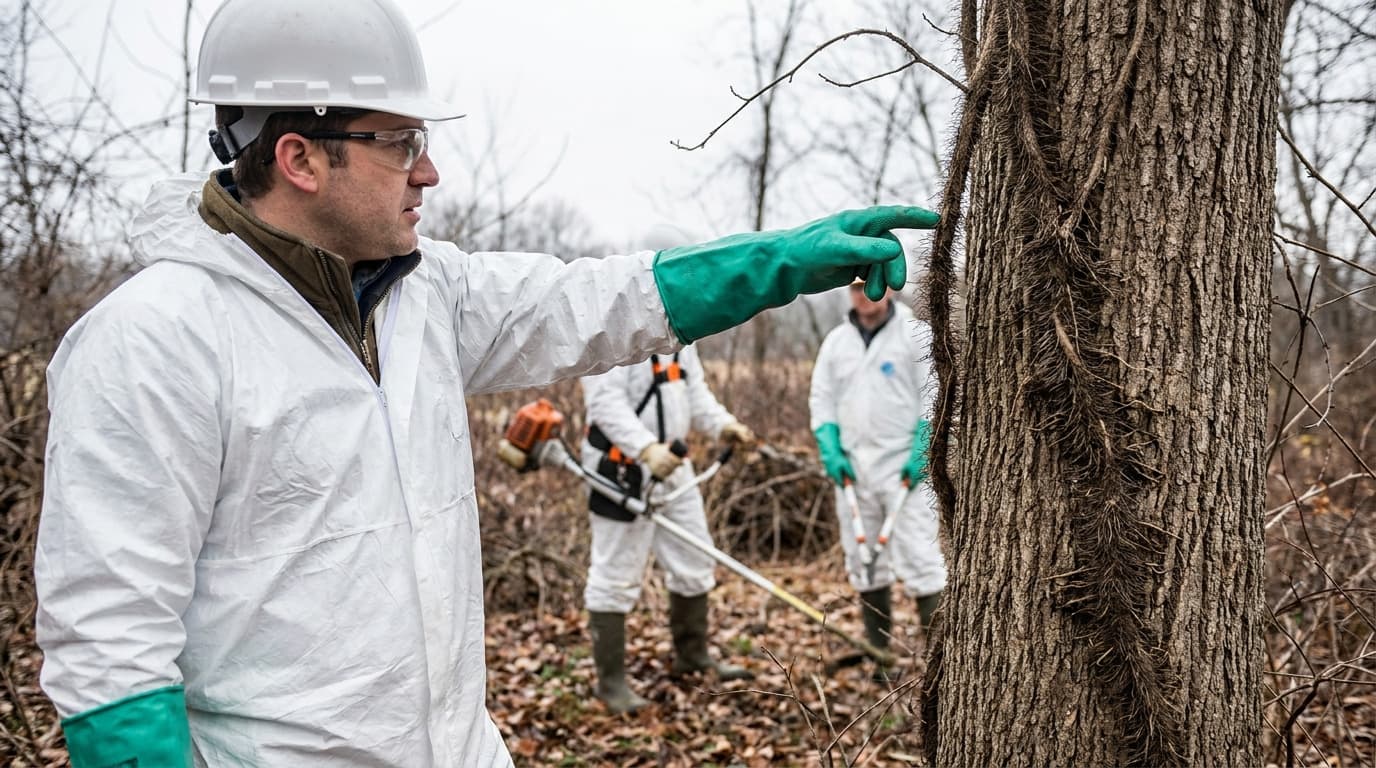
Every part, all year. Leaves, stems, roots and berries all contain urushiol, and it does not go away in winter. Bare vines and roots will still cause a rash. That matters because winter and early spring are exactly when crews do clearance, grubbing and grubbing-out of stumps — and there are no leaves to identify the plant by. The hairy aerial rootlets on a climbing vine are often the only clue.
It survives the plant's death. The plant stops producing urushiol once dead, but the oil already there stays active. Reported persistence on surfaces and objects is commonly up to about five years, with some sources reporting longer. A tool that touched poison ivy two summers ago can still cause a reaction today.
It sticks to things, not into them. Urushiol does not usually soak through fabric, but it binds tightly to fibres — gloves, sleeves, bootlaces, seat covers, tool handles. Which is why the rash appears on a man who never went near the plant, and why it appears on a Monday for something that happened the previous week.
And the quantities are tiny. Reactions are triggered by amounts measured in nanograms, so "there was hardly any on it" is not a defence.
Burning it is the dangerous one#
This is the part that turns a nuisance into a hospital admission, and it is a construction-specific risk because clearing produces piles.
Urushiol is heat stable. Fire does not destroy it — it carries it into the smoke as airborne particles. Inhaling smoke from burning poison ivy, oak or sumac can cause severe inflammation of the airways and lungs, and it is treated as a medical emergency. The CDC warns against burning these plants for this reason.
Two rules follow, and neither has an exception. Never burn cleared vegetation that might contain these plants — dead or alive. And never assume brush from someone else's clearance is safe to burn, including scrap timber and stumps stacked for a site fire.
Bag it and remove it as waste. And note the same logic reaches mowing and strimming, which throw fragments and mist rather than smoke.
The myth that wastes everybody's time#
Crews handle this wrong in a way that is both unkind and useless.
The rash is not contagious. You cannot catch it from another person's rash, and the fluid in the blisters does not contain urushiol and does not spread it — to other people or to other parts of the affected person's own body. The FDA and the American Academy of Dermatology are clear on this.
What looks like spreading is two other things: delayed reaction at different sites, because thinner skin reacts sooner and thicker skin later, and fresh contact with contaminated objects — the gloves, the jacket, the truck door handle.
So isolating the worker achieves nothing. Decontaminating the objects is the entire job. If the crew is treating a rash as infectious while the contaminated gloves are still in the van, they have the problem exactly backwards.
Timing is everything#
The window is short and most crews do not know it exists.
Urushiol binds to skin within roughly 10 to 30 minutes. Wash inside that window and you may avoid a reaction altogether. After it, washing will not stop the rash — but it still matters, because it prevents transfer to other parts of the body and to other people and objects.
Use cool water, not hot — heat opens pores and helps the oil in — with a grease-cutting soap or a purpose-made urushiol wash. Wash under the nails. Shower rather than bathe, because the oil floats and spreads across the water.
Then the reaction itself is delayed: usually 12 to 72 hours after contact, and after a genuinely first-ever exposure it can be one to three weeks. That delay is why people are certain they never touched anything.
One more point worth knowing: the first exposure of somebody's life often produces no rash at all. It sensitises them. The next one produces the reaction — which means a clean record with these plants is not immunity.
Where the duty sits#
There is no OSHA standard for poisonous plants. Say so plainly.
The provision that comes closest is 1926.51(f), washing facilities, which the personal hygiene talk covers in detail — the trigger is broad enough to reach operations where contaminants may be harmful, and it is what makes prompt washing a site provision rather than a personal problem. 1926.50 covers medical services and first aid. 1926.95 and 1926.28(a) cover personal protective equipment — for this hazard, non-permeable gloves rather than leather, which absorbs the oil and cannot be decontaminated. 1926.21(b)(2) requires the employer to instruct employees in recognising and avoiding the hazard, which for these plants is mostly a recognition problem. And Section 5(a)(1) applies where nothing specific does.
What can go wrong?#
Burning cleared brush that contains these plants, and putting urushiol into the lungs of everybody downwind.
Clearing in winter with no leaves to identify by, and treating bare vines and roots as harmless.
Wearing yesterday's gloves, or putting contaminated clothing back on unwashed.
Using leather gloves and boots for clearance work, which absorb the oil and cannot be cleaned.
Treating the rash as contagious and isolating the worker, while the contaminated tools stay in circulation.
Missing the wash window because nobody knows it is 10 to 30 minutes, or washing in hot water.
Assuming immunity because you have handled it before without a rash — that is sensitisation, not protection.
Mowing or strimming through it, which distributes it as fragments and mist.
How do we manage this properly?#
Identify before you clear. Walk the area and look for these plants — including bare vines with hairy aerial rootlets in winter, when there is nothing else to go on.
Never burn it, dead or alive, and never burn cleared vegetation or stacked brush that might contain it. Bag and remove as waste.
Use non-permeable gloves and disposable coveralls for clearance, not leather.
Set up washing before the work starts, not after — cool water and a grease-cutting soap at the work area, so the 10-to-30-minute window is actually usable.
Decontaminate the tools every time: handles, blades, machine controls, bucket edges, rope. Soap and water or rubbing alcohol.
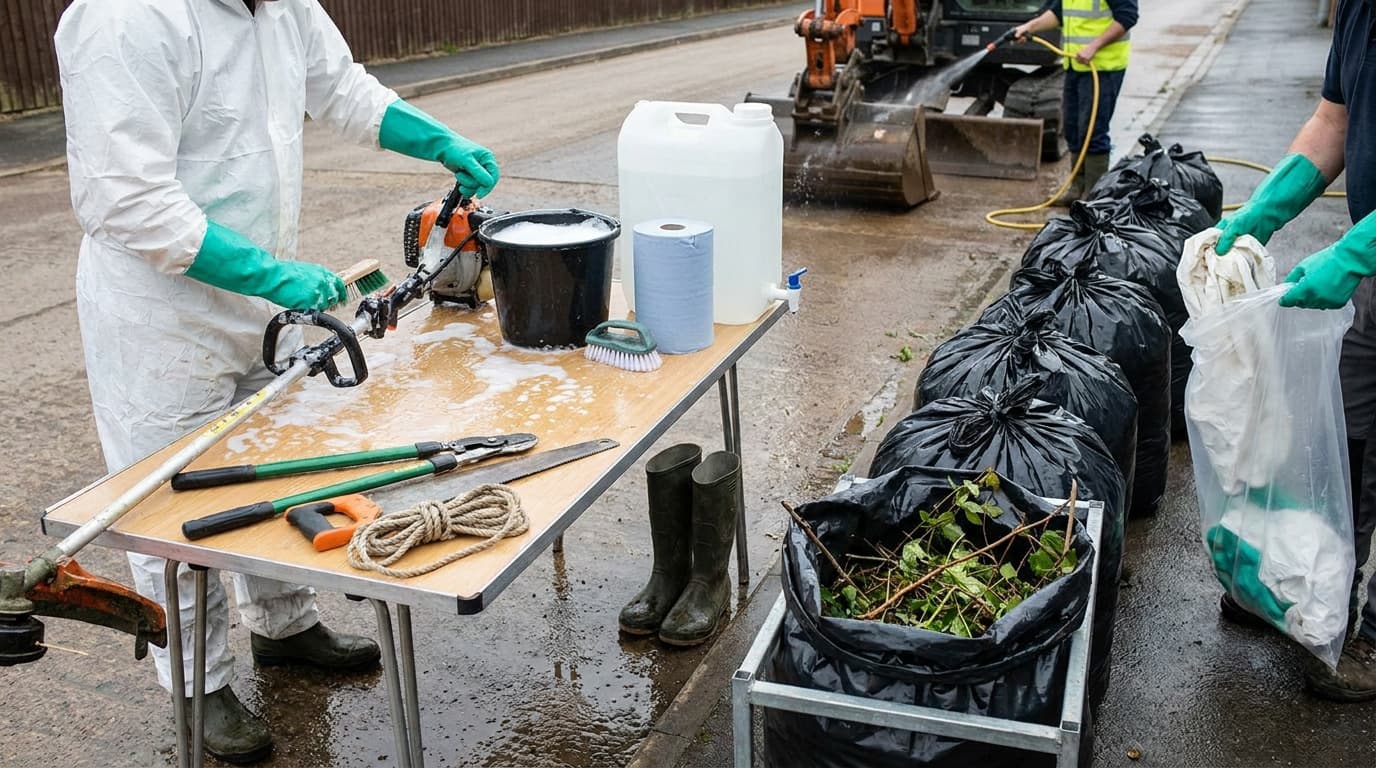
Wash contaminated clothing separately and immediately, and treat boots and leather as either specially cleaned or discarded.
Teach the crew that the rash is not contagious, so effort goes to the objects rather than to the person.
Get medical assessment for any rash on the face or near the eyes, any extensive rash, and immediately for anybody who has inhaled smoke from burning vegetation.
Before you start#
- Confirm the area has been walked and these plants identified, including bare winter vines.
- Confirm nobody is planning to burn any cleared vegetation from this site.
- Confirm non-permeable gloves and coveralls are available, not just leather gloves.
- Confirm washing facilities with cool water and grease-cutting soap are at the work area.
- Confirm the crew knows the wash window is about 10 to 30 minutes.
- Confirm there is a plan and a place to decontaminate tools and machinery at the end.
- Confirm contaminated clothing will be bagged and washed separately, not worn again.
- Confirm everyone knows the rash is not contagious and the objects are the problem.
Talk it over#
- Who cleared this area last, and where did those tools and gloves go?
- Would any of us recognise this plant in February with no leaves on it?
- What is the plan for the brush pile at the end of this job?
- If somebody brushed against it right now, where is the nearest water?
The bottom line#
You do not have to touch the plant, and the plant does not have to be alive. The agent is urushiol, an oily resin rather than a sap, present in every part of the plant year-round — leaves, stems, roots, berries and bare winter vines — so clearance and grubbing in winter is live exposure with nothing to identify by except the hairy aerial rootlets. Because it is an oil it transfers to tools, gloves, boots, machinery, rope and clothing and stays active for years, commonly reported as up to about five years and longer in some sources; it binds tightly to fibres rather than soaking through them, and reactions are triggered by amounts measured in nanograms. So the usual site route is secondary contact with something the plant touched first, which is why the casualty is certain he never went near it. Burning is the worst route: urushiol is heat stable, so fire carries it into the smoke, and inhaling it causes severe airway and lung inflammation — the CDC warns against burning these plants, so cleared vegetation is bagged and removed, never burned, dead or alive. The myth to kill is contagion: the rash is not contagious, and the blister fluid contains no urushiol and spreads nothing — apparent spreading is delayed reaction at different sites plus fresh contact with contaminated objects, so decontaminating the objects is the entire job and isolating the worker achieves nothing. Timing decides the outcome: urushiol binds to skin within roughly 10 to 30 minutes, and washing inside that window may prevent the reaction entirely; after it, washing still prevents transfer. Use cool water, not hot, with grease-cutting soap, and shower rather than bathe. The reaction itself appears 12 to 72 hours after contact and can take one to three weeks after a first-ever exposure — and that first exposure often produces no rash at all because it is sensitising you, so a clean record is not immunity. There is no OSHA standard for poisonous plants: 1926.51(f) washing facilities is the nearest provision, with 1926.50 for medical services and first aid, 1926.95 and 1926.28(a) for PPE — non-permeable gloves, not leather, which absorbs the oil and cannot be decontaminated — 1926.21(b)(2) for instruction, and Section 5(a)(1) behind all of it.
Frequently asked questions about poison ivy, oak and sumac#
How do people get a rash when they never touched the plant?
Because urushiol is an oil, and oils transfer. It moves onto tools, gloves, boots, machinery, rope and clothing, binds tightly to fibres, and stays active for years — commonly reported as up to about five years. A strimmer handle, a pair of gloves from last week or a vine caught on an excavator bucket will all do it. On a construction site the usual exposure is secondary contact with something the plant touched first, not the plant.
Can you get it in winter when there are no leaves?
Yes. Urushiol is present in every part of the plant all year round — stems, roots, berries and bare vines. Winter and early spring clearance is a common way people are exposed, precisely because there are no leaves to identify the plant by. On climbing vines the hairy aerial rootlets on the tree trunk are often the only visible clue.
Why is burning it so much worse than touching it?
Because urushiol is heat stable. Fire does not destroy it; it carries it into the smoke as airborne particles, and inhaling that smoke can cause severe inflammation of the airways and lungs. The CDC warns against burning poison ivy, oak or sumac for this reason, and it is treated as a medical emergency. Never burn cleared vegetation that might contain these plants, dead or alive — bag it and remove it as waste.
Is the rash contagious? Should we keep the person away from the crew?
No, and no. The rash is not contagious, and the fluid in the blisters does not contain urushiol — it cannot spread the reaction to other people or to other parts of the affected person's body. What looks like spreading is delayed reaction at different sites plus fresh contact with contaminated objects. Isolating the worker achieves nothing; decontaminating the tools, gloves and clothing is the entire job.
How long do you have to wash it off?
Roughly 10 to 30 minutes, which is the window in which urushiol binds to skin. Wash inside it and you may avoid the reaction entirely. After it, washing will not stop the rash but still prevents transfer to other parts of the body, to other people and to objects. Use cool water, not hot — heat helps the oil in — with a grease-cutting soap, wash under the nails, and shower rather than bathe, because the oil floats and spreads across bathwater.
Why does the rash appear days later, and in different places at different times?
Because it is a delayed reaction. It usually appears 12 to 72 hours after contact, and after a genuinely first-ever exposure it can take one to three weeks. Different areas appear at different times because thinner skin reacts sooner and thicker skin later, and because of fresh contact with contaminated objects — not because the rash is travelling. That delay is why people are so certain they never touched anything.
I have handled it before and never reacted — am I immune?
No. A first-ever exposure often produces no rash at all, because what it is doing is sensitising your immune system to the oil. The reaction comes on a later exposure. So a clean record with these plants is not immunity — and the same applies across all three, because poison ivy, oak and sumac all produce urushiol, so a reaction to one usually means a reaction to the others.
Download the poison ivy toolbox talk PDF#
Get this poison ivy, oak and sumac toolbox talk as a print-ready PDF — available in English, Spanish, Portuguese, and Turkish. Print it, hand it to the crew, and collect signatures on the included attendance sheet.
Download the PDF — free account required. New members get 3 free downloads.
Related toolbox talks#
Sources#
- American Academy of Dermatology, Poison Ivy, Oak, and Sumac: How to Treat the Rash: https://www.aad.org/
- CDC / NIOSH, Poisonous Plants: https://www.cdc.gov/niosh/topics/plants/
- OSHA, 29 CFR 1926.51 — Sanitation: https://www.osha.gov/laws-regs/regulations/standardnumber/1926/1926.51
This talk is general awareness guidance for training purposes. It is not medical advice and nothing in it is a diagnosis. Anyone with an extensive rash, a rash on the face or near the eyes, or any history of inhaling smoke from burning vegetation should be assessed by a qualified medical professional without delay.
Written by FieldSafetyTalk's safety professional — a CSP, ASP, CHST and OSHA Authorized Outreach Trainer with 14+ years of international construction safety experience across federal, heavy civil, and industrial projects.