Compressed Gas Cylinder
Updated 2026-07-24
In this bundle Fire, Hot Work & Emergency
Print-ready PDF
Download this talk as a print-ready PDF, available in 4 languages.
A gas cylinder is the only thing on this jobsite that can become a rocket. Not a metaphor — a full cylinder holds gas at around 2,000 psi, and if the valve is snapped off, that pressure escapes through a one-inch hole and drives a steel bottle weighing as much as a person through block walls. That is why the small brass cap most crews treat as packaging is, in fact, the entire safety case. This Compressed Gas Cylinder Toolbox Talk (Safety Talk / Tailgate Talk) is about the stored energy nobody sees.
Here is the distinction that carries this whole talk: with almost everything else we control, the hazard exists because of what we are doing with it. A cylinder is dangerous standing still, doing nothing, in the corner where somebody left it. It does not need to be in use, connected, or even switched on. It only needs to fall over.
The question the standard leaves open — and the answer OSHA gave#
29 CFR 1926.350(a)(10) is the rule everybody half-knows:
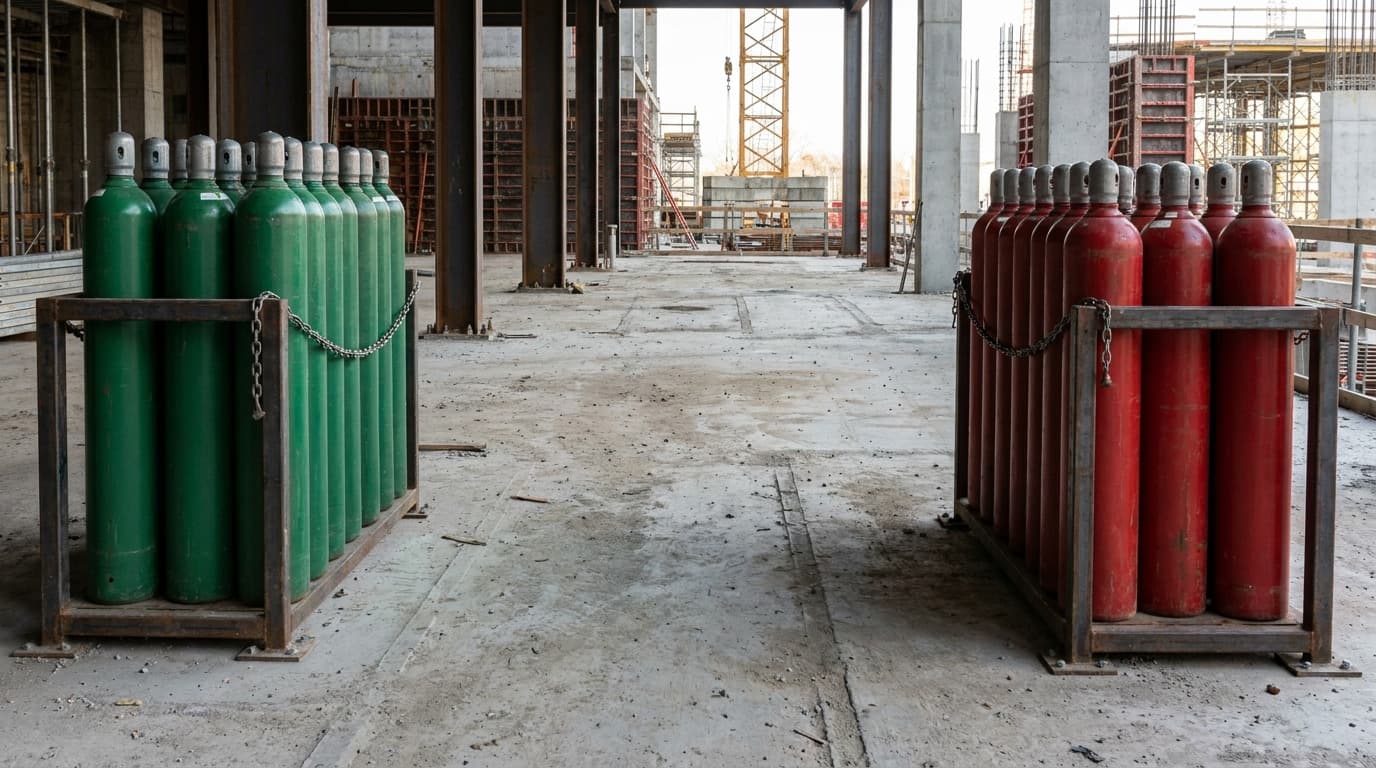
Oxygen cylinders in storage shall be separated from fuel-gas cylinders or combustible materials (especially oil or grease), a minimum distance of 20 feet (6.1 m), or by a noncombustible barrier at least 5 feet (1.5 m) high having a fire-resistance rating of at least one-half hour.
Twenty feet, or a five-foot barrier rated for half an hour. Simple enough — except the standard never says what counts as "in storage." A cylinder parked next to the welding rig at lunchtime: is that storage, or is it in use?
OSHA answered it in a letter of interpretation, and the answer is a clock:
OSHA considers a cylinder to be in storage when it is reasonably anticipated that gas will not be drawn from the cylinder within 24 hours (overnight hours included). At that point the storage requirements must be met.
Twenty-four hours. That single sentence resolves the argument every site has. The oxygen and acetylene sitting together on the cart while the welder works are in use. The same two bottles still standing there at knock-off, with nothing planned until Monday, are in storage — and the 20-foot rule engaged the moment that became reasonably anticipated.
Note also that the barrier is a genuine alternative, not a lesser option. OSHA confirmed in a further interpretation that a wall of 59.06 inches or greater meets the 1.5-metre height requirement — the metric figure governs.
The cap is not packaging#
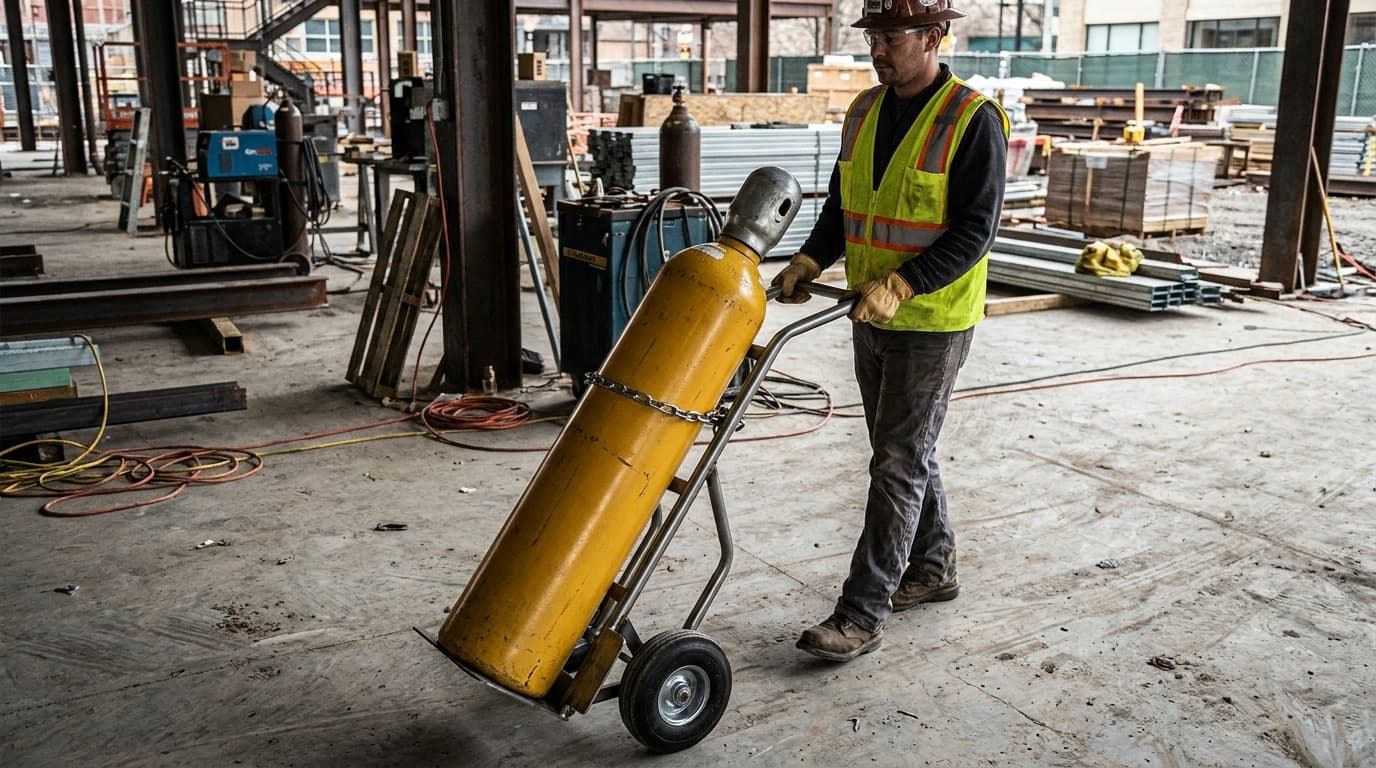
1926.350(a)(1) requires that valve protection caps be in place and secured wherever cylinders are transported, moved, or stored. And (a)(6): unless cylinders are firmly secured on a special carrier intended for the purpose, regulators shall be removed and valve protection caps put in place before cylinders are moved.
The cap exists for exactly one scenario — the cylinder falls and lands on its valve. Without the cap, the valve shears and the cylinder becomes an uncontrolled projectile. With it, the impact goes into the cap.
Two related requirements that get skipped in the same moment:
- (a)(9) — cylinders shall be secured in an upright position at all times, except if necessary for short periods while actually being hoisted or carried.
- (a)(7) — a suitable cylinder truck, chain, or other steadying device shall be used to keep cylinders from being knocked over while in use.
- (a)(8) — when work is finished, when cylinders are empty, or whenever cylinders are moved, the cylinder valve shall be closed. Empty is not exempt; an empty cylinder still has residual pressure and the same projectile mass.
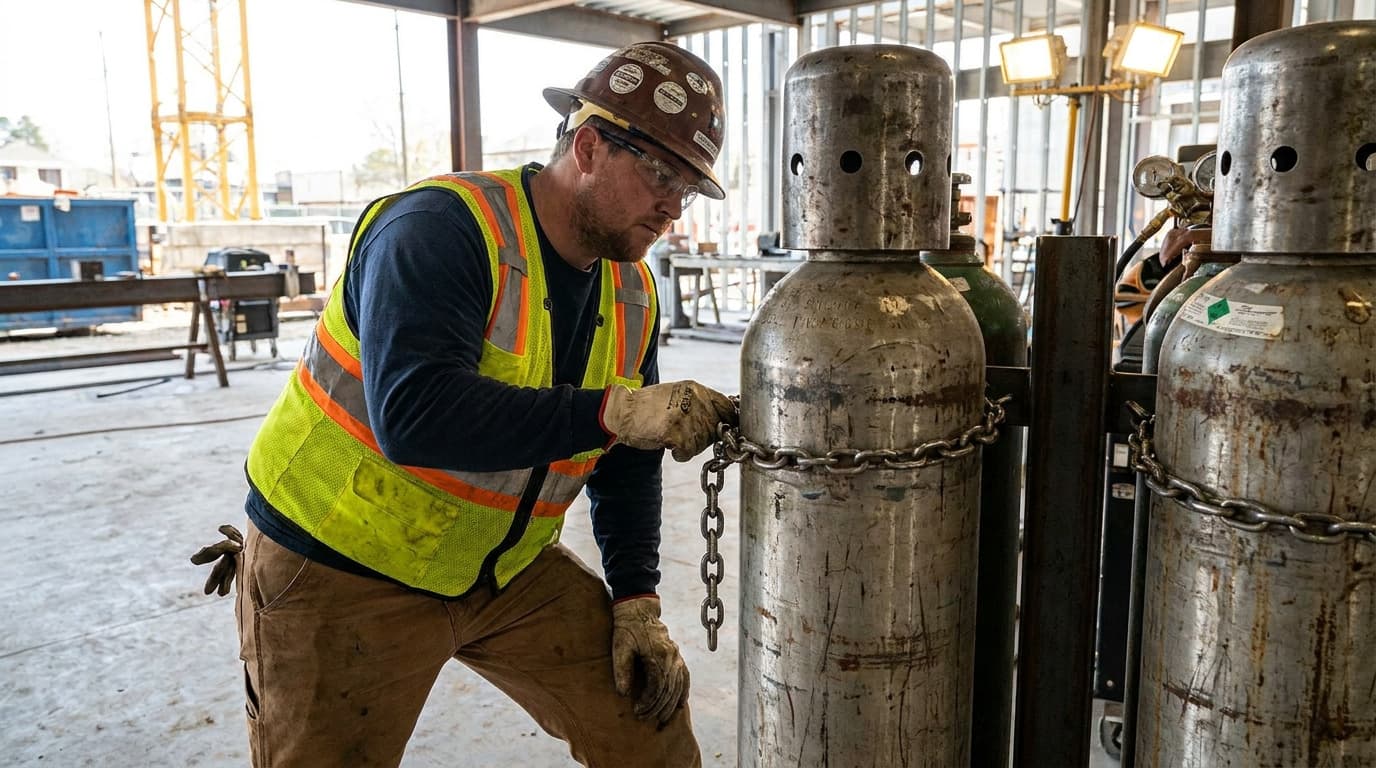
And 1926.350(a)(4): cylinders shall be kept far enough away from the actual welding or cutting operation that sparks, hot slag, or flame will not reach them — or shielded with fire-resistant shields where that is impractical.
Oxygen and oil: the reaction nobody expects#
1926.350(i) states it flatly: oxygen cylinders and fittings shall be kept away from oil or grease, and cylinders, cylinder caps and valves, couplings, regulators, hose and apparatus shall be kept free from oil or greasy substances and shall not be handled with oily hands or gloves.
This is the requirement that surprises people most, because it sounds like housekeeping. It is not. In a high-pressure oxygen atmosphere, hydrocarbons can ignite without any spark or flame at all — the compression of oxygen into an oily fitting is enough. This is why oxygen regulators are never lubricated, why oxygen fittings are never sealed with tape or grease, and why an oily glove on an oxygen valve is genuinely dangerous rather than merely untidy.
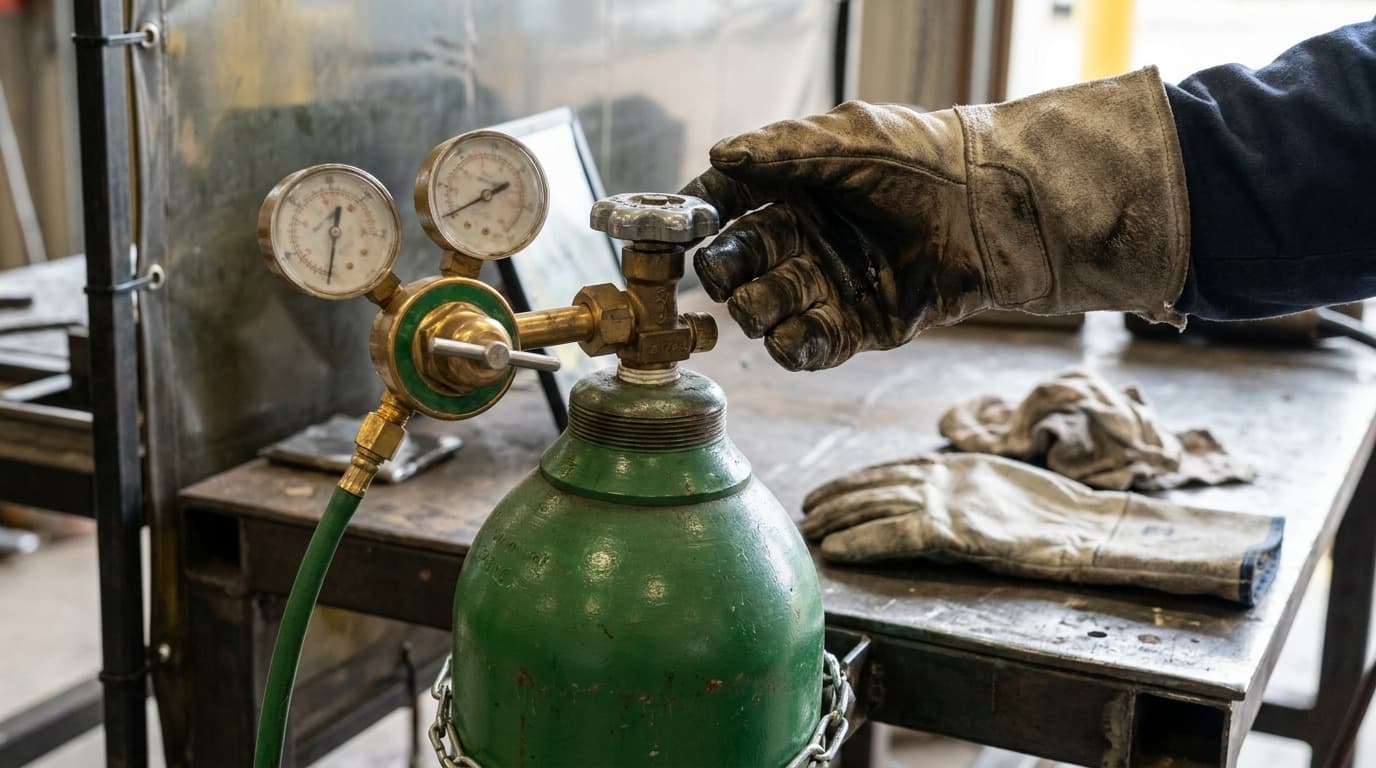
The same logic drives the separation rule in (a)(10): oxygen does not burn, it makes everything else burn violently. A leaking oxygen cylinder near fuel gas or grease turns an ordinary fire into one nothing on site will put out.
Storage inside buildings#
1926.350(a)(11) covers what happens indoors: cylinders shall be stored in a well-protected, well-ventilated, dry location, at least 20 feet (6.1 m) from highly combustible materials such as oil or excelsior. Cylinders should be stored in definitely assigned places away from elevators, stairs, or gangways, and in locations where they will not be knocked over or damaged by passing or falling objects.
Read the second half again. Away from elevators, stairs and gangways — the exact places where cylinders end up on a construction site, because those are the routes people carry them along and the corners where things get parked.
On USACE and NAVFAC projects, EM 385-1-1 applies and is more prescriptive on cylinder storage, separation and securing.
What can go wrong#
Cap off in transit. The single highest-consequence failure, and the most common.
Cylinder standing loose. Not chained, not in a stand, leaning against a wall or a column.
Laid on its side "for a minute." Acetylene in particular must be upright — laying it down lets acetone migrate into the withdrawal line.
Oxygen and acetylene stored together overnight. In use together on a cart is fine; left together past the 24-hour test is not.
Oily hands, oily gloves, oily fittings on oxygen equipment.
Tape or thread sealant on oxygen fittings.
Cylinders in the stairwell or by the hoist — precisely where (a)(11) says not to put them.
Valve left open on an empty cylinder, which then draws back contamination.
Cylinders in the sun or against a heat source, raising internal pressure.
Lifting by the cap, or by a sling around the body, rather than in a proper cradle or basket.
Used as rollers, supports, or props. It happens, and it is exactly what the standard means by not subjecting cylinders to damage.
Damaged, corroded or unlabelled cylinders kept in service because nobody wants to send them back.
How do we control it?#
Cap on whenever it is not connected and in use. Moving, storing, waiting — cap on and secured. That is (a)(1) and (a)(6) in one habit.
Upright and secured, always. Chain, rack, stand or cylinder truck — (a)(9) and (a)(7). "Secured" means it cannot fall if something bumps it.
Apply the 24-hour test at the end of every shift. If gas will not be drawn within 24 hours, the cylinders are in storage and the separation rule applies now, not tomorrow.
Separate oxygen from fuel gas and combustibles by 20 feet, or use a compliant barrier — noncombustible, at least 1.5 m high, half-hour fire resistance.
Keep oil and grease away from oxygen entirely. No lubricant on regulators or fittings, no tape, no oily gloves. Treat that as an ignition control, not housekeeping.
Close the valve when work finishes, when the cylinder is empty, and before moving it.
Assign a storage location away from elevators, stairs, gangways and traffic, protected from being knocked over or struck by falling objects.
Shield cylinders from the work or move them far enough that sparks and slag cannot reach them.
Store empties separately and marked, valves closed and capped — they carry the same projectile risk.
Never lift by the cap. Use a cradle, basket or pallet designed for cylinders.
Check condition on delivery and before use — dents, gouges, corrosion, damaged valve threads, missing labels. Reject rather than adopt.
Before you start#
- Confirm every cylinder is upright and secured against falling.
- Confirm valve protection caps are in place on anything not connected and in use.
- Confirm oxygen is at least 20 feet from fuel gas and combustibles, or behind a compliant barrier.
- Ask whether gas will be drawn within 24 hours — if not, apply storage rules now.
- Check your hands, gloves and fittings for oil or grease before touching oxygen equipment.
- Confirm no tape or sealant has been used on oxygen threads.
- Confirm cylinders are clear of the welding or cutting work, or shielded.
- Confirm the storage location is away from stairs, elevators, gangways and traffic.
- Confirm empties are marked, closed, capped and stored separately.
- Check cylinder condition and reject anything dented, corroded, or unlabelled.
Talk it over#
- Where is the nearest cylinder to you right now, and is it secured?
- Will gas be drawn from these cylinders in the next 24 hours? If not, where should they be?
- What would happen in this area if a cylinder fell and lost its valve?
The bottom line#
29 CFR 1926.350(a)(10) requires oxygen cylinders in storage to be separated from fuel-gas cylinders and combustibles by 20 feet (6.1 m), or by a noncombustible barrier at least 5 feet (1.5 m) high with a half-hour fire-resistance rating — and OSHA has defined in storage as whenever it is reasonably anticipated that gas will not be drawn within 24 hours, overnight included. Caps go on whenever a cylinder is moved or stored under (a)(1) and (a)(6); cylinders stay upright and secured under (a)(9); valves are closed when work ends, when empty, and before moving under (a)(8); and under (i), oxygen equipment must be kept free of oil and grease and never handled with oily hands or gloves — because in high-pressure oxygen, hydrocarbons can ignite with no spark at all.
Frequently asked questions about compressed gas cylinders#
When is a cylinder considered "in storage"?
29 CFR 1926.350(a)(10) sets the separation requirement for cylinders in storage but does not define the term. OSHA answered it in a letter of interpretation: a cylinder is considered to be in storage when it is reasonably anticipated that gas will not be drawn from the cylinder within 24 hours, overnight hours included. At that point the storage requirements must be met.
How far apart must oxygen and fuel gas cylinders be?
Under 1926.350(a)(10), oxygen cylinders in storage must be separated from fuel-gas cylinders or combustible materials — especially oil or grease — by a minimum of 20 feet (6.1 m), or by a noncombustible barrier at least 5 feet (1.5 m) high with a fire-resistance rating of at least one-half hour. OSHA has confirmed that a barrier of 59.06 inches or greater satisfies the 1.5-metre height requirement.
Can oxygen and acetylene be kept together on a welding cart?
While they are in use, yes — the separation rule in (a)(10) applies to cylinders in storage. The point at which it engages is the 24-hour test: once it is reasonably anticipated that gas will not be drawn within 24 hours, including overnight, the cylinders are in storage and must be separated or barriered.
Why must valve protection caps be fitted?
Because the cap is what stands between a dropped cylinder and an uncontrolled release. 1926.350(a)(1) requires caps to be in place and secured wherever cylinders are transported, moved or stored, and (a)(6) requires regulators removed and caps fitted before cylinders are moved unless they are firmly secured on a carrier intended for the purpose. A cylinder that loses its valve becomes a projectile driven by its own stored pressure.
Why is oil so dangerous around oxygen?
1926.350(i) requires oxygen cylinders, caps, valves, couplings, regulators, hose and apparatus to be kept free from oil or greasy substances, and states they shall not be handled with oily hands or gloves. In a high-pressure oxygen atmosphere, hydrocarbons can ignite without any spark or flame. This is why oxygen regulators are never lubricated and why tape or grease is never used on oxygen fittings.
Do empty cylinders need the same precautions?
Yes. Under 1926.350(a)(8), the cylinder valve must be closed when work is finished, when cylinders are empty, and whenever cylinders are moved. An empty cylinder retains residual pressure and has the same mass and projectile potential as a full one, so it still requires caps, securing and an upright position.
Where should cylinders be stored indoors?
Under 1926.350(a)(11), in a well-protected, well-ventilated, dry location at least 20 feet (6.1 m) from highly combustible materials such as oil. Cylinders should be in definitely assigned places away from elevators, stairs, or gangways, and in locations where they will not be knocked over or damaged by passing or falling objects.
Download the compressed gas cylinder toolbox talk PDF#
Get this compressed gas cylinder toolbox talk as a print-ready PDF — available in English, Spanish, Portuguese, and Turkish. Print it, hand it to the crew, and collect signatures on the included attendance sheet.
Download the PDF — free account required. New members get 3 free downloads.
Related toolbox talks#
Sources#
- OSHA, 29 CFR 1926.350 — Gas welding and cutting: https://www.osha.gov/laws-regs/regulations/standardnumber/1926/1926.350
- OSHA, Storage of gas cylinders on construction sites; clarification of "in storage", Letter of Interpretation, July 8, 1999: https://www.osha.gov/laws-regs/standardinterpretations/1999-07-08
- OSHA, Requirement and design of fire-resistant barriers for oxygen and fuel-gas cylinders, Letter of Interpretation, March 4, 2004: https://www.osha.gov/laws-regs/standardinterpretations/2004-03-04-0
Written by FieldSafetyTalk's safety professional — a CSP, ASP, CHST and OSHA Authorized Outreach Trainer with 14+ years of international construction safety experience across federal, heavy civil, and industrial projects.