Fall Protection
Updated 2026-07-23
In this bundle Fall Protection & Heights
Working in California? See the Cal/OSHA edition → California (Cal/OSHA)Working in Washington? See the WA DOSH edition → Washington (WA DOSH)
Print-ready PDF
Download this talk as a print-ready PDF, available in 4 languages.
Falls from height are the number-one killer in construction, and almost every one of them was preventable. This Fall Protection Toolbox Talk (Safety Talk / Tailgate Talk) is about the single thing that separates a near-miss from a fatality: whether you were protected the moment you were exposed to a fall. Not five minutes later, not after you finished "just one thing" — the moment your feet were near an edge, a hole, or six feet of open air.
Here is the distinction that carries this whole talk: fall protection is not about being careful near an edge. Careful is not a system. Fall protection is about having a system in place — guardrails, a hole cover, or a harness tied to a real anchor — before you ever get near the exposure, so that when something goes wrong (and it will, eventually), the system catches you instead of the concrete. Good balance, good boots, and good intentions do not stop a fall. Engineering and equipment do.
How dangerous are falls in construction?#
The numbers are not close. The Bureau of Labor Statistics recorded 1,075 construction fatalities in 2023, and 421 of them — 39.2 percent — were falls, slips, and trips (BLS Census of Fatal Occupational Injuries, 2023). Nationally in 2024, BLS counted 844 fatal falls, slips, and trips across all industries, and 10.8 percent of those involved a fall from more than 30 feet (BLS CFOI, 2024).
Enforcement tells the same story from the other direction. Fall Protection — General Requirements (29 CFR 1926.501) was OSHA's most frequently cited standard in Fiscal Year 2025 for the fifteenth consecutive year, with 5,914 citations — more than double the second-place standard (National Safety Council, preliminary FY2025 data). OSHA has noted this figure is preliminary and may rise when final data publishes.
The pattern behind those numbers matters more than the totals: falls are not killing people because the requirements are unknown. They are killing people because known protection was not in place at the moment of exposure.
OSHA fall protection requirements (29 CFR 1926 Subpart M)#
Fall protection in construction is governed by 29 CFR 1926 Subpart M, sections 1926.500 through 1926.503. Section 1926.501 defines when protection is required. Section 1926.502 defines how the systems must perform. Section 1926.503 covers training.
Trigger heights differ by activity — this is where crews most often get it wrong:
- Construction, general — 6 feet. Each employee on a walking/working surface with an unprotected side or edge 6 feet or more above a lower level must be protected by a guardrail system, safety net system, or personal fall arrest system (1926.501(b)(1)).
- General industry — 4 feet (29 CFR 1910.28).
- Scaffolds — 10 feet (29 CFR 1926.451(g)(1)).
- Steel erection — 15 feet (29 CFR 1926.760).
- Any height when working above dangerous equipment or machinery.
Other key provisions:
- Surface integrity — 1926.501(a)(2). The employer must determine that walking/working surfaces have the strength and structural integrity to support employees safely before anyone works on them.
- Holes — 1926.501(b)(4). Employees must be protected from falling through holes more than 6 feet above a lower level, and from objects falling through holes.
- Wall openings — 1926.501(b)(14). Protection is required where the outside bottom edge is 6 feet or more above a lower level and the inside bottom edge is less than 39 inches above the walking surface.
- Falling objects — 1926.501(c). Where employees are exposed to falling objects, each must wear a hard hat, plus toeboards, screens, guardrail systems, or barricades.
- Body belts prohibited — 1926.502(d). A body belt must not be used for fall arrest. A full-body harness is required. Body belts remain acceptable only for positioning or travel restraint.
- Training — 1926.503. Employees exposed to fall hazards must be trained by a competent person to recognize the hazards and use the systems correctly.
On USACE and NAVFAC projects, EM 385-1-1 also applies and is more restrictive in several places. Where both apply, the stricter requirement governs.
What can go wrong?#
Working at an unprotected edge. Somebody works near a leading edge with nothing between them and the drop, because the guardrail was pulled for a delivery and never replaced.
Falling through an opening. A floor hole covered by a scrap of plywood that was never secured or marked — it flips or slides underfoot.
Anchoring to something that is not an anchor. A lanyard clipped to a handrail, a piece of conduit, or a strap never rated to hold a falling body.
Wearing a harness without connecting it. Workers wear a harness all day but never clip in, because tying off feels like a hassle for "just a second" at the edge.
Equipment that has already failed. A harness with cut webbing, a lanyard with a chemical burn, or a self-retracting lifeline that was dropped and never inspected. These fail exactly when you need them.
Running out of clearance. Even good equipment lets you hit the ground if you did not calculate the distance below. A 6-foot lanyard plus deceleration, harness stretch, and your body length can consume 18 feet or more before you stop. If you only had 12 feet, the system worked and you still died.
Swing fall. An anchor off to one side turns a fall into a pendulum, driving the worker sideways into structure at speed.
Suspension trauma after the arrest. Hanging motionless in a harness restricts blood return from the legs and can cause unconsciousness within minutes. A system that stops your fall is only half the plan.
How do we prevent falls?#
We prevent falls in a specific order, and that order matters. This is the hierarchy, and we work top-down.
1. Eliminate the hazard. Do the work at ground level, prefabricate on the deck, or use equipment that keeps people off the edge entirely. If nobody has to be exposed, nobody can fall.
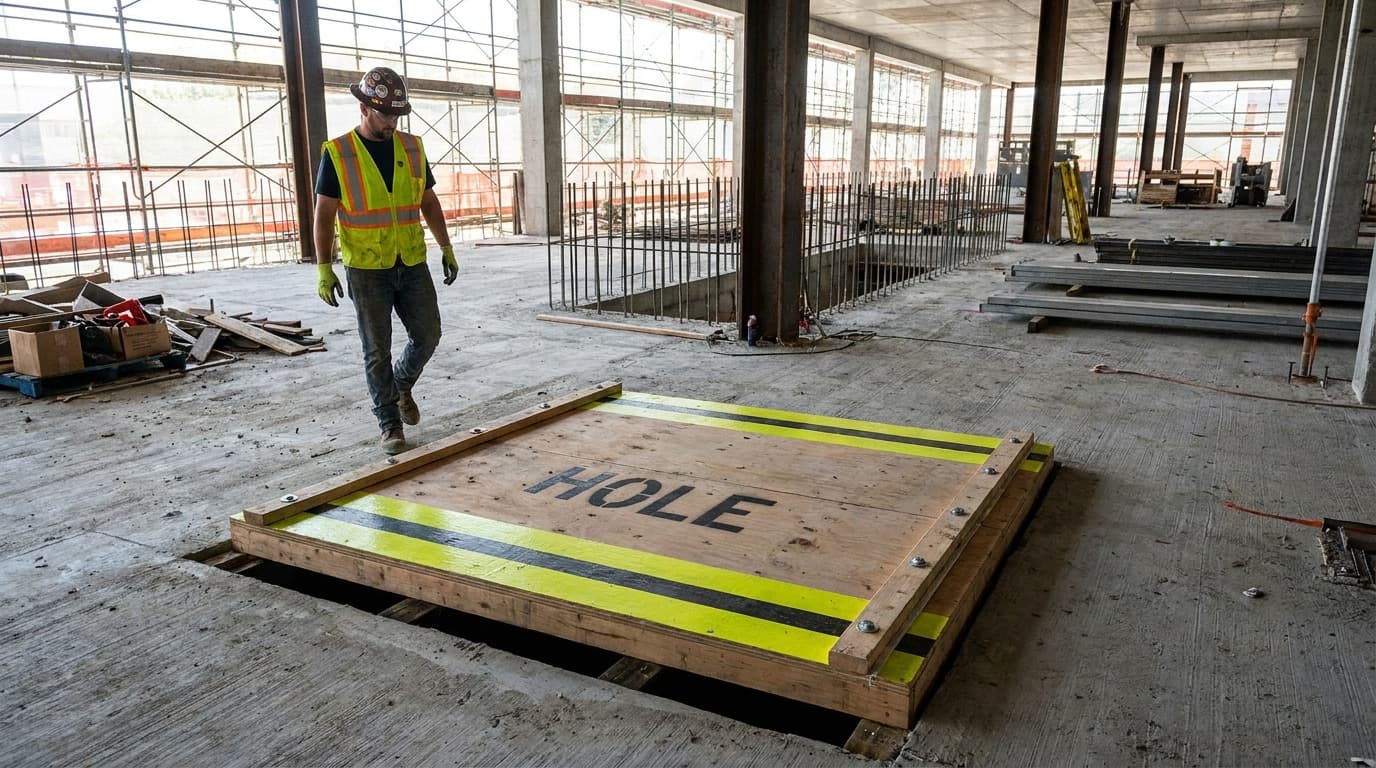
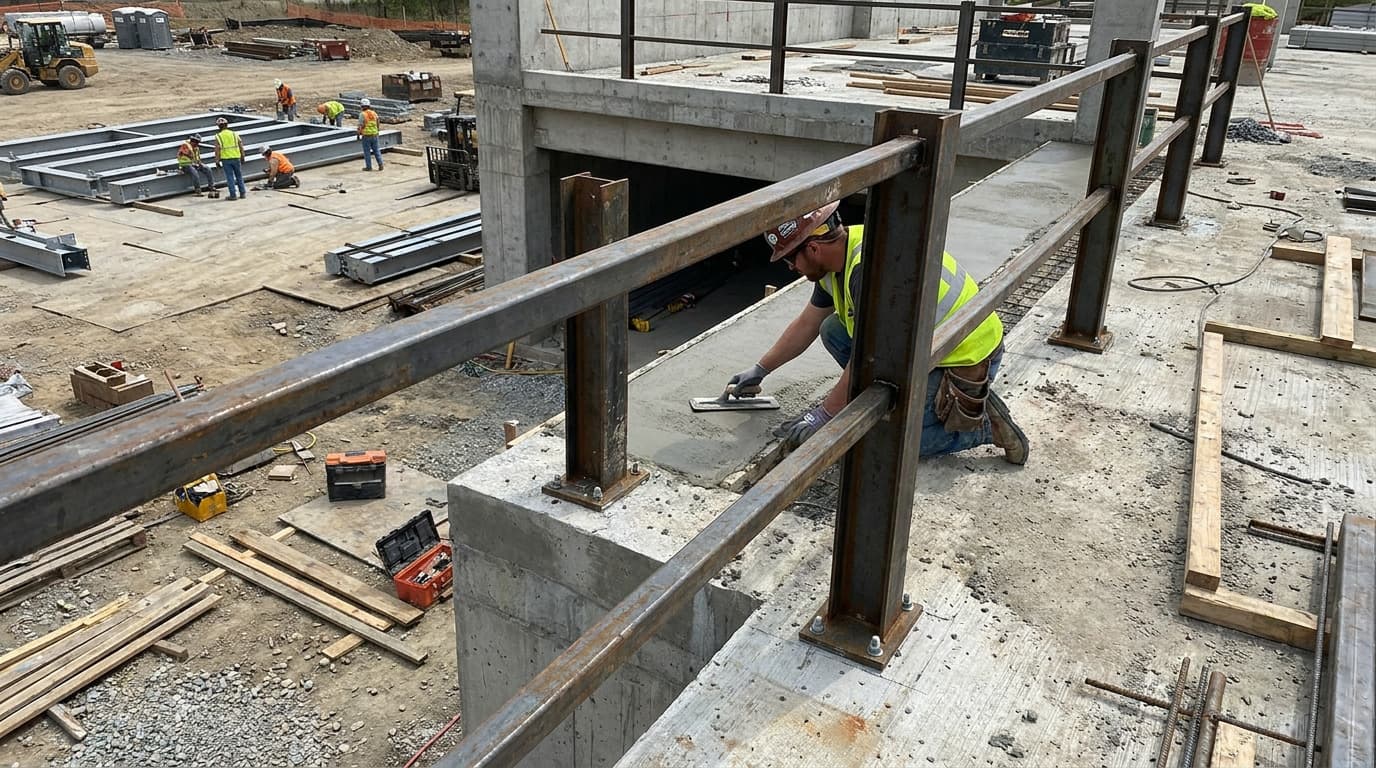
2. Use passive protection. Guardrail systems and covers protect everyone in the area without anyone having to remember to do anything:
- Guardrail top rail at about 42 inches, plus or minus 3, with a midrail
- Capable of withstanding 200 pounds applied downward or outward
- Hole covers secured against displacement, marked "HOLE" or "COVER", and capable of supporting at least twice the weight that could cross them
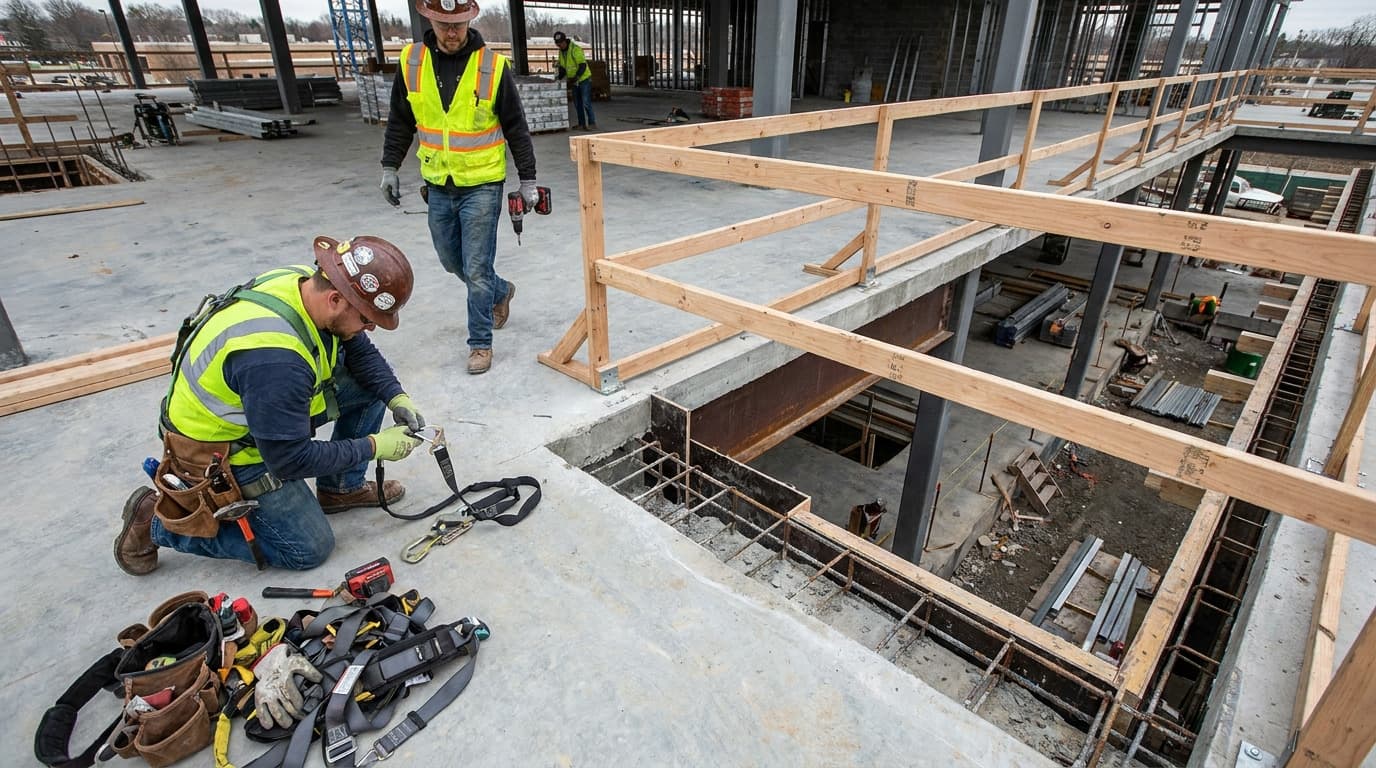
3. Use personal fall arrest where passive protection is not feasible. The harness, connector, and anchor working together:
- The anchor must support 5,000 pounds per worker, or be designed by a qualified person with a safety factor of at least two. Not a handrail. Not conduit.
- The connector must match the situation — a leading-edge-rated SRL at an edge, because a standard lanyard's shock pack can be severed.
- The harness must fit and be worn correctly: chest strap at mid-chest, leg straps snug, dorsal D-ring between the shoulder blades.
- Fall clearance must be calculated: lanyard length + deceleration + harness stretch + your height below the D-ring + a safety margin.
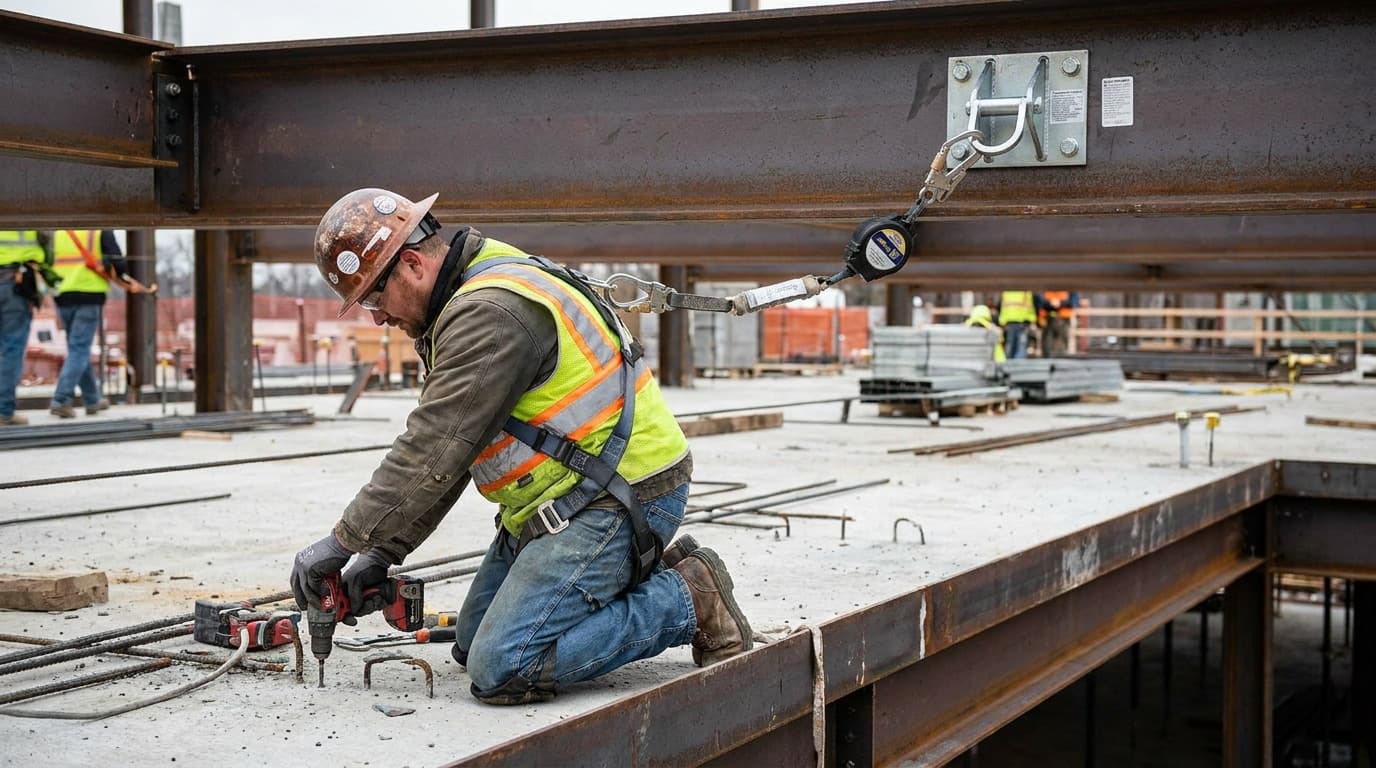
4. Plan the rescue before anyone ties off. Calling emergency services is not a rescue plan for a suspended worker. Know who retrieves them, with what equipment, in minutes.
Inspect your gear every single time. You, the user, inspect the harness, lanyard, and SRL before each use — webbing, stitching, hardware, labels, and the SRL's retraction and lockup. Anything questionable comes out of service.
Before you start#
- Identify every fall exposure in your work area: edges, openings, skylights, floor holes, wall openings, and the path you will walk to get there.
- Confirm the primary protection: are guardrails up and complete, or are covers in place, secured, and marked?
- Inspect the full personal fall arrest setup — harness, connector, SRL — and pull anything with cuts, burns, corrosion, or deployed indicators.
- Verify your anchor is engineered, rated, or approved for fall arrest, and positioned to minimize swing fall.
- Calculate your fall clearance for this location and confirm you have enough distance below you.
- Know the rescue plan for your area: who, how, and how fast.
Talk it over#
- Look around this specific work area right now — where are the fall exposures today, and what is protecting each one?
- Point to the anchor you would tie off to for the task in front of us. Is it actually rated for fall arrest, or does it just look strong?
- If one of us fell and was hanging in a harness right now, walk me through exactly who gets them down and how long it would take.
The bottom line#
Falls kill more construction workers than anything else, and the fix is never "be careful" — it is a system in place before you are exposed: eliminate the hazard, then guardrails and covers, then a harness tied to a real anchor with the clearance to catch you and a rescue plan to get you down. Protection has to be there the moment you are exposed, or it is not protection at all.
Frequently asked questions about fall protection#
At what height is fall protection required?
In construction, 29 CFR 1926.501(b)(1) requires fall protection at 6 feet or more above a lower level. General industry requires it at 4 feet (1910.28), scaffolds at 10 feet (1926.451(g)(1)), and steel erection at 15 feet (1926.760). Protection is required at any height when working above dangerous equipment.
What makes an anchor point acceptable for fall arrest?
It must support 5,000 pounds per attached worker, or be designed by a qualified person as part of a complete system with a safety factor of at least two. Handrails, conduit, ductwork, and scaffold components are not anchors unless specifically engineered as such.
How do I calculate fall clearance?
Add lanyard length, deceleration distance, harness stretch, the distance from your dorsal D-ring to your feet, and a safety margin. If that total exceeds the distance to the level below, the system will not arrest you in time — you need a self-retracting lifeline, a higher anchor, or a different method.
Can I use a body belt instead of a full-body harness?
No. 29 CFR 1926.502(d) prohibits body belts for fall arrest, because arresting forces concentrated at the waist cause severe internal injury. Only a full-body harness distributes those forces across the thighs, pelvis, chest, and shoulders. Body belts remain acceptable only for positioning or travel restraint.
Why is a rescue plan required if the harness already stopped the fall?
Because hanging motionless in a harness restricts blood return from the legs and can cause loss of consciousness within minutes. Arresting the fall is only half the system. The plan must name who retrieves the worker, with what equipment, in minutes — not rely on outside emergency response times.
What are the penalties for a fall protection violation?
As of January 2025, OSHA penalties are $16,550 per serious violation and up to $165,514 for willful or repeated violations. Penalties apply per violation, so multiple unprotected workers multiply the total.
Download the fall protection toolbox talk PDF#
Get this fall protection toolbox talk as a print-ready PDF — available in English, Spanish, Portuguese, and Turkish. Print it, hand it to the crew, and collect signatures on the included attendance sheet.
Download the PDF — free account required. New members get 3 free downloads.
Related toolbox talks#
Sources#
- OSHA, 29 CFR 1926.501 — Duty to have fall protection: https://www.osha.gov/laws-regs/regulations/standardnumber/1926/1926.501
- OSHA, Top 10 Most Frequently Cited Standards: https://www.osha.gov/top10citedstandards
- National Safety Council, OSHA Top 10 Safety Violations, FY2025 preliminary: https://www.nsc.org/newsroom/osha-top-10-safety-violations-show-persistent-risk
- Bureau of Labor Statistics, Census of Fatal Occupational Injuries: https://www.bls.gov/iif/
Written by FieldSafetyTalk's safety professional — a CSP, ASP, CHST and OSHA Authorized Outreach Trainer with 14+ years of international construction safety experience across federal, heavy civil, and industrial projects.