Underground Electrical Hazards
Updated 2026-07-28
In this bundle Electrical Safety
Print-ready PDF
Download this talk as a print-ready PDF, available in 4 languages.
A buried cable gives you none of the warnings an overhead line does. You cannot look up and see it, you cannot judge a clearance to it, and the marks that tell you where it is were painted by someone who was working from records. Then it rains. This Underground Electrical Hazards Toolbox Talk (Safety Talk / Tailgate Talk) is about the four short paragraphs OSHA wrote for exactly this problem — and about the sentence the agency deliberately left out of them.
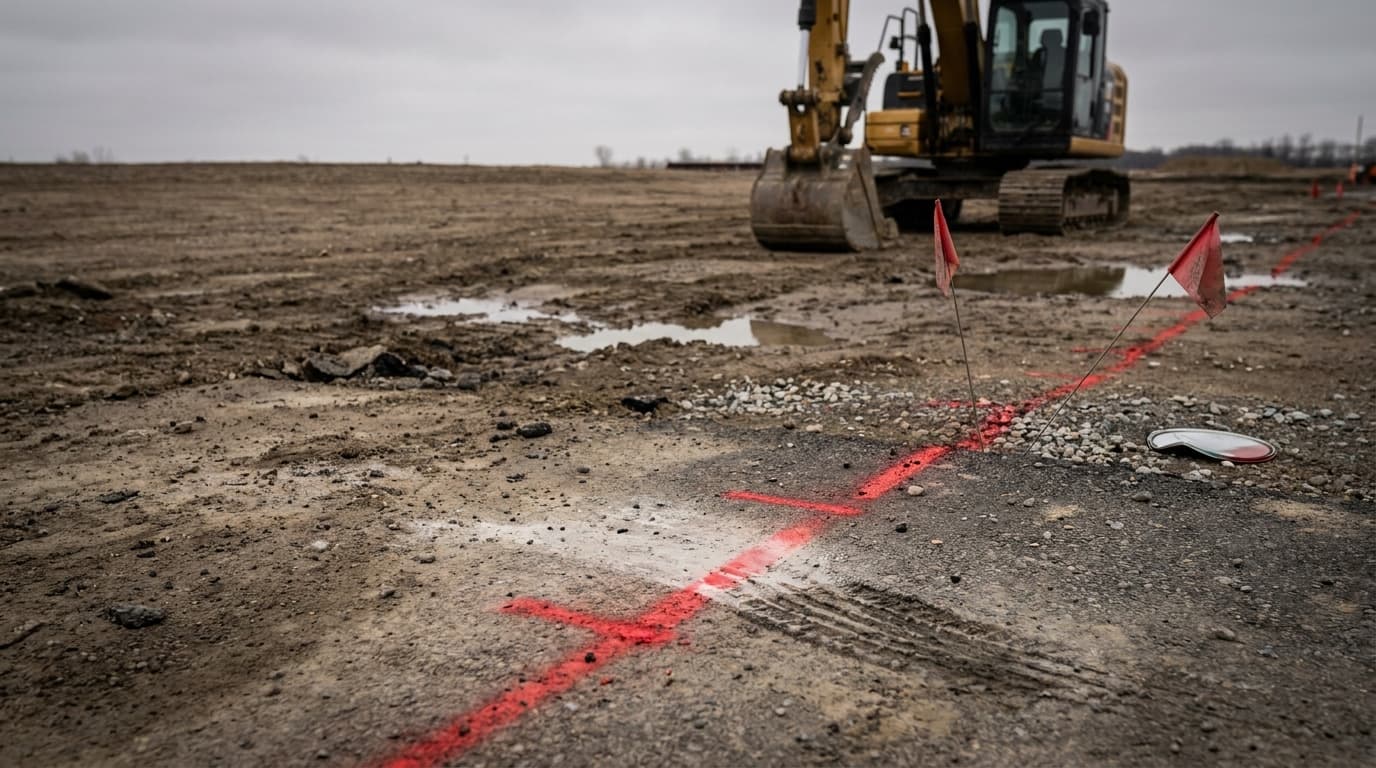
Here is the distinction that carries this whole talk: the standard uses two different words for location, and they carry two different duties. Before you open the ground you need the estimated location. As the excavation approaches that estimate, you need the exact location. Most utility strikes happen in the gap between those two words, where a crew treats a paint line as a fact rather than as an estimate.
Four paragraphs, read in order#
29 CFR 1926.651(b) is short enough to read out loud on site:
- (b)(1) The estimated location of utility installations — sewer, telephone, fuel, electric, water lines, or any other underground installations that may reasonably be expected to be encountered — shall be determined prior to opening an excavation.
- (b)(2) Utility companies or owners shall be contacted within established or customary local response times, advised of the proposed work, and asked to establish the location of the underground installations prior to the start of actual excavation. Where they cannot respond within 24 hours (unless a longer period is required by state or local law), or cannot establish the exact location, the employer may proceed — provided the employer does so with caution, and provided detection equipment or other acceptable means to locate utility installations are used.
- (b)(3) When excavation operations approach the estimated location, the exact location shall be determined by safe and acceptable means.
- (b)(4) While the excavation is open, underground installations shall be protected, supported or removed as necessary to safeguard employees.
Four duties, and every one of them is regularly collapsed into "we called it in."
Notice what (b)(2) actually is. It is not a licence to dig after 24 hours of silence. It is a conditional fallback that replaces one control with two: caution, and detection equipment or other acceptable means. Proceeding without those is proceeding without the standard.
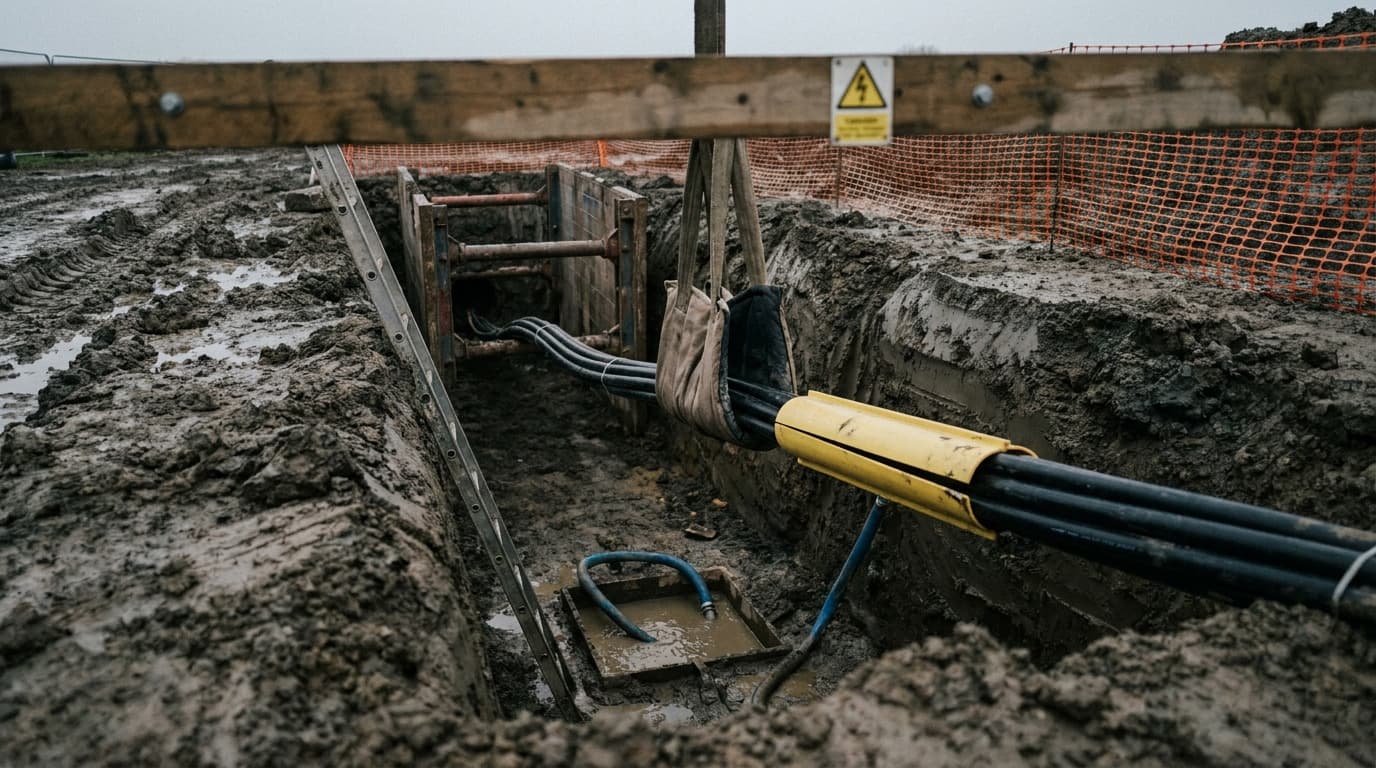
Notice too that (b)(4) runs for the life of the excavation. A cable exposed in the trench wall on Tuesday is still your responsibility on Friday. Supporting it, protecting it from the bucket and from people climbing past it, and keeping it out of water are ongoing duties, not a one-off.
The sentence OSHA took out on purpose#
Ask most crews what "acceptable means" is and they will say hand digging. The rulemaking record says something more interesting.
In Letter of Interpretation 2003-10-23, OSHA set out the history. The preamble to the proposed rule (52 FR 12301, 15 April 1987) noted that a 1972 version of the standard had specified "careful probing or hand digging" as the means of uncovering utilities, and that a later amendment deleted that wording to allow other equally effective means. OSHA then proposed adding "probing with hand-held tools" back into (b)(3) as an example.
It was rejected. In the preamble to the final rule (54 FR 45916, 31 October 1989), OSHA recorded that all commenters — and its own Advisory Committee on Construction Safety and Health — recommended dropping that example, because probing with hand tools could create a hazard to employees by damaging the installation or its insulation. OSHA agreed, and the final rule names no examples at all.
So the standard's silence is not an oversight. The most common site assumption — that a shovel or a bar in careful hands is inherently the safe method — is the assumption OSHA's own rulemaking record examined and declined to endorse.
The same letter then tells you what is acceptable. Because non-conductive hand tools were not on the market when the rule was written, they were never part of the class of equipment the 1989 record treated as unsafe: OSHA concluded that non-conductive or insulated probes and similar non-conductive hand tools, used with appropriate caution, are an acceptable means. For hydro-vacuum excavation, the position is conditional: where the equipment can be adjusted to a minimum of water and suction pressure so that it will not damage underground utilities — electrical lines being specifically named as vulnerable — it is an acceptable means; where it cannot be sufficiently adjusted, it is not. OSHA also made clear these are not the only acceptable technologies. Worth noting: that letter withdrew and replaced an earlier one issued on 7 July 2003, because the earlier version was being misunderstood.
Why a buried cable behaves differently#
An energised underground conductor puts you in a different situation from an overhead line:
There is no clearance to maintain. You are not keeping a distance; you are avoiding a thing you cannot see.
The fault goes into the ground you are standing on. A strike energises soil, water, rebar, the trench box and the machine. Step and touch potential injure people who never touched the cable, including the person watching from the edge.
Water carries it. A trench with standing water and a damaged cable is an energised trench, and the boundary of the hazard is wherever the water goes.
Insulation damage does not announce itself. A bucket tooth or a probe can nick a jacket without tripping anything. The cable fails days or weeks later, often onto somebody else's crew.
Records are the weakest link. As-builts are wrong, services get added, ground gets regraded, and a mark on the surface only ever reflects what somebody believed.
What can go wrong?#
Locates are stale. Marks have a limited life, get washed off, get graded away, or were made for a different phase of the job.
"They didn't come out, so we dug." The 24-hour fallback is used as permission, without detection equipment and without caution.
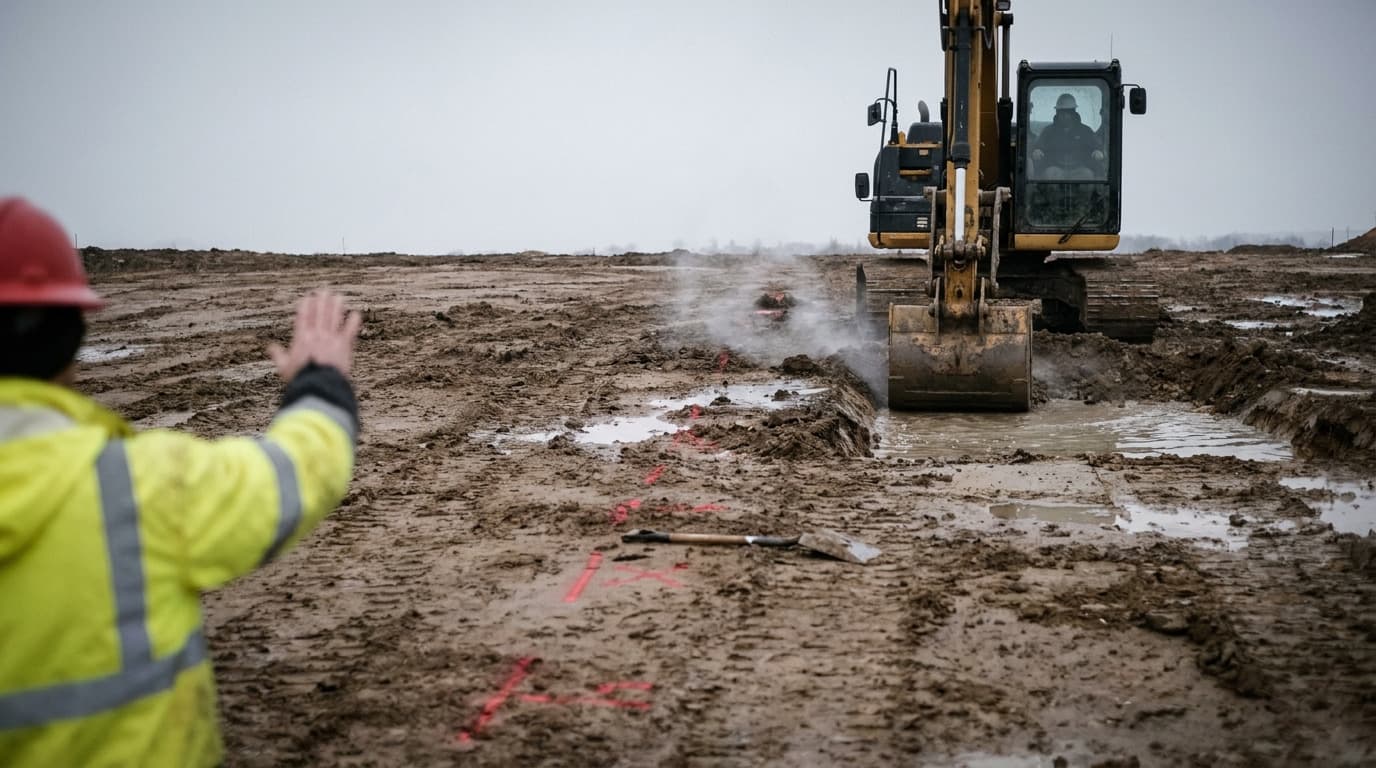
The machine gets to the estimate. Excavation continues on the bucket right up to and past a paint line instead of stopping short and establishing the exact position.
Unmarked and abandoned services. Private site distribution, temporary feeds and old services frequently appear on no drawing at all — and abandoned cables are not reliably dead.
Exposed cable left unsupported. A service spanning an open trench, unsupported, with people climbing under it and a bucket swinging over it.
No one knows what to do at the moment of contact. The instinct to jump down from the machine, or to reach in and pull someone clear, is the instinct that adds a second casualty.
How do we do this properly?#
Treat the paint as an estimate, always. It is what the standard calls it. Stop the machine short of it and establish the exact position by an acceptable means before going deeper.
Book the locate properly and keep the ticket. Contact within established local response times, describe the work, and record what came back. If nobody responds within 24 hours or the exact location cannot be established, that changes the method — it does not remove the duty.
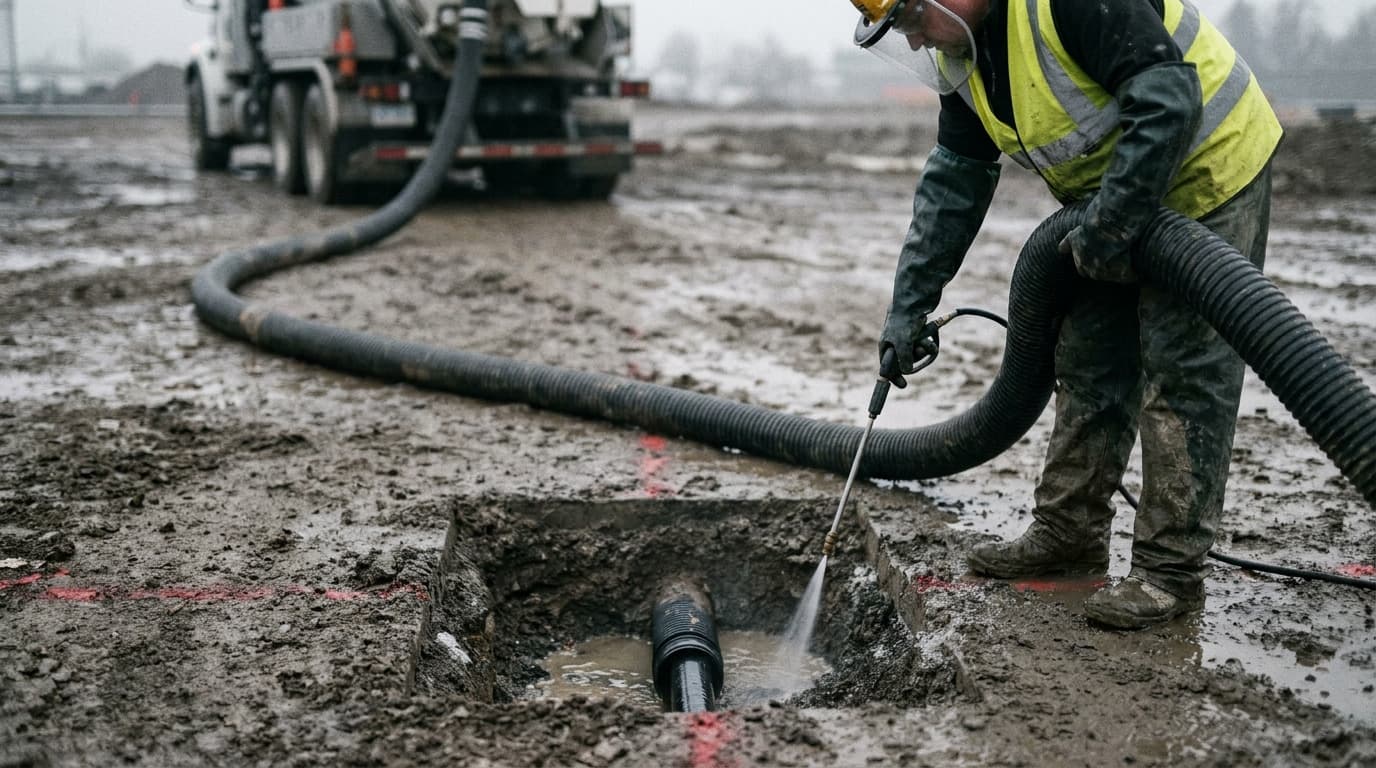
Use detection plus a non-mechanical method to expose. Detection equipment to trace, then non-conductive tools or correctly adjusted hydro-vacuum to expose. If the hydro-vac cannot be turned down enough to be safe against an electrical line, it is not the right tool for that dig.
Protect and support everything you expose, for as long as the excavation is open, and keep water out of the trench.
Brief the contact drill. If the machine strikes a cable: stop, stay on the machine, keep everyone away from the excavation and the machine, and call the utility and emergency services. If you must leave the machine because of fire, jump clear without touching machine and ground together, land with feet together, and shuffle away in small steps.
Never approach to rescue. The ground and the equipment can both be live. Nobody enters until the utility confirms isolation.
Before you start#
- Confirm a current locate exists for this exact dig, and that the marks on the ground match it.
- Confirm who you contacted, when, and what they said about the exact location.
- Confirm the method you will use to expose services — detection equipment plus non-conductive tools or correctly adjusted hydro-vacuum.
- Confirm where the machine has to stop and hand work begins.
- Confirm that everything already exposed is supported and protected, and that the trench is not holding water.
- Confirm every person in the excavation knows what happens if a cable is struck.
Talk it over#
- When were these marks made, and by whom?
- What is on this site that would appear on no drawing at all?
- If the bucket touched a cable right now, what would each of us do?
- Has anyone here ever exposed a service that nobody had marked? What happened next?
The bottom line#
1926.651(b) asks four things in order: determine the estimated location before opening the ground; contact the utilities within customary local response times and ask them to establish the location; determine the exact location by safe and acceptable means as the dig approaches that estimate; and protect, support or remove installations while the excavation is open. The 24-hour clause in (b)(2) is not permission to dig — it substitutes caution plus detection equipment or other acceptable means. And the standard names no acceptable method by design: OSHA proposed "probing with hand-held tools," and dropped it because commenters and its own advisory committee warned it could damage the installation or its insulation. LOI 2003-10-23 confirms non-conductive hand tools and properly adjusted hydro-vacuum excavation as acceptable means. The paint on the ground is an estimate. The cable underneath it is not.
Frequently asked questions about underground electrical hazards#
What does OSHA require before I dig?
Under 29 CFR 1926.651(b)(1), the estimated location of utility installations — sewer, telephone, fuel, electric, water and any other underground installations reasonably expected to be encountered — must be determined prior to opening the excavation. Under (b)(2), the utility companies or owners must be contacted within established or customary local response times, advised of the work, and asked to establish the location before actual excavation starts.
Can I dig if the utility company does not respond?
Only under conditions. 1926.651(b)(2) permits the employer to proceed where utilities cannot respond within 24 hours (unless a longer period is required by state or local law) or cannot establish the exact location — but only if the employer proceeds with caution and detection equipment or other acceptable means to locate the installations are used. Silence from the utility does not remove the duty; it changes the method.
What is the difference between estimated and exact location?
They are two separate duties in the standard. The estimated location must be determined before opening the excavation, under (b)(1). Then, under (b)(3), when excavation operations approach that estimated location, the exact location must be determined by safe and acceptable means. A locate mark on the surface is an estimate.
Does hand digging count as an acceptable means?
The standard names no methods, and that silence was deliberate. In the preamble to the final rule (54 FR 45916, 31 October 1989) OSHA recorded that all commenters and its Advisory Committee on Construction Safety and Health recommended dropping the proposed example of "probing with hand-held tools" because it could create a hazard by damaging the installation or its insulation. LOI 2003-10-23 later concluded that non-conductive or insulated hand tools, used with appropriate caution, are an acceptable means.
Is hydro-vacuum excavation allowed for exposing utilities?
Conditionally. LOI 2003-10-23 states that where hydro-vacuum equipment can be adjusted to use a minimum of water and suction pressure so that it will not damage underground utilities — with electrical lines specifically identified as particularly vulnerable — its use is an acceptable means. Where the equipment cannot be sufficiently adjusted, that method is not acceptable under the standard.
What do I have to do with a cable once it is exposed?
1926.651(b)(4) requires that, while the excavation is open, underground installations be protected, supported or removed as necessary to safeguard employees. That is a duty for the whole life of the excavation — supporting spans, shielding cables from equipment and from people passing, and keeping the exposure out of standing water.
What should we do if equipment strikes a buried cable?
Stop work and treat the excavation, the ground around it and the machine as energised. Stay on the machine if you are on it, keep everyone else back, and call the utility and emergency services. Do not enter the excavation and do not attempt to pull anyone clear — step and touch potential can injure a rescuer. If fire forces you off the machine, jump clear without touching machine and ground at the same time, land with your feet together, and shuffle away in small steps.
Download the underground electrical hazards toolbox talk PDF#
Get this underground electrical hazards toolbox talk as a print-ready PDF — available in English, Spanish, Portuguese, and Turkish. Print it, hand it to the crew, and collect signatures on the included attendance sheet.
Download the PDF — free account required. New members get 3 free downloads.
Related toolbox talks#
Sources#
- OSHA, 29 CFR 1926.651 — Specific excavation requirements: https://www.osha.gov/laws-regs/regulations/standardnumber/1926/1926.651
- OSHA, Letter of Interpretation, 23 October 2003 — Use of hydro-vacuum excavation equipment and other acceptable means to locate underground utility installations: https://www.osha.gov/laws-regs/standardinterpretations/2003-10-23
Written by FieldSafetyTalk's safety professional — a CSP, ASP, CHST and OSHA Authorized Outreach Trainer with 14+ years of international construction safety experience across federal, heavy civil, and industrial projects.