Solvent and Degreaser
Updated 2026-08-06
In this bundle Health & Environmental Exposure
Print-ready PDF
Download this talk as a print-ready PDF, available in 4 languages.
Solvents and degreasers are among the most-used chemicals on any site and among the least respected. They cut grease off parts, clean tools, thin coatings, and wipe down surfaces, and because a rag damp with solvent seems harmless, people use them near heaters, near grinding sparks, in unventilated rooms, and without a second thought about the open container sitting next to the work. This Solvent and Degreaser Toolbox Talk (Safety Talk / Tailgate Talk) is about why that casual treatment is dangerous, and about a single idea that changes how you see every solvent container on the job.
Here is the distinction that carries this whole talk: the vapor is the hazard, not the liquid. A solvent does not burn as a liquid — it gives off vapor, and it is the vapor mixed with air that ignites. That is why a puddle you could not set alight with effort becomes an explosion when its vapor has filled a room and something sparks across the space. The liquid in the can is the source; the invisible cloud above and around it is the hazard. Once you see solvents this way, the whole set of rules — keep it covered, ventilate, control ignition sources, bond and ground — stops being a list to memorize and becomes obvious: you are managing a vapor you cannot see, not a liquid you can.
Where the boundary of this talk sits#
The fire prevention talk owns general fire safety, and the fire extinguisher talk owns fighting a fire once it starts. The fuel storage talk owns fuels specifically, the hot work talks own the permit and controls for cutting and welding as an ignition source, and the chemical spill response talk owns a container that has failed. The hazard communication talk owns the SDS and label system across all chemicals. This talk owns solvents and degreasers as products — the flash-point and vapor mechanism that makes them flammable, the static-spark hazard of transferring them, and their health hazards by inhalation and skin contact. Where general fire safety, a stored fuel, a hot-work permit, or a spill is the question, those talks own it; this one owns the solvent can and the vapor coming off it.
Flash point: is the danger already in the air?#
The number that tells you how dangerous a solvent is sits on the SDS, and it is the flash point — the lowest temperature at which the liquid gives off enough vapor to form an ignitable mixture with the air near its surface. It is the single most useful fact about any flammable liquid, because it answers one question directly: is the ignitable vapor already present at the temperature I am working in?
For many common solvents and degreasers, the flash point is at or below room temperature. That means the vapor is already there, ready to ignite, before you do anything — you are not waiting for the product to heat up. OSHA classifies a flammable liquid as one with a flash point at or below 199.4 °F (93 °C), and the most dangerous category — the line that triggers the strictest handling — is a flash point below 100 °F (37.8 °C), which covers a great many solvents used straight from the can. The practical takeaway is not the number itself but what it means: with a low-flash-point solvent, the room is already full of fuel the moment the container is open, and the only thing missing is an ignition source. Everything else in this talk is about not supplying that source.
The ignition sources you would not think of#
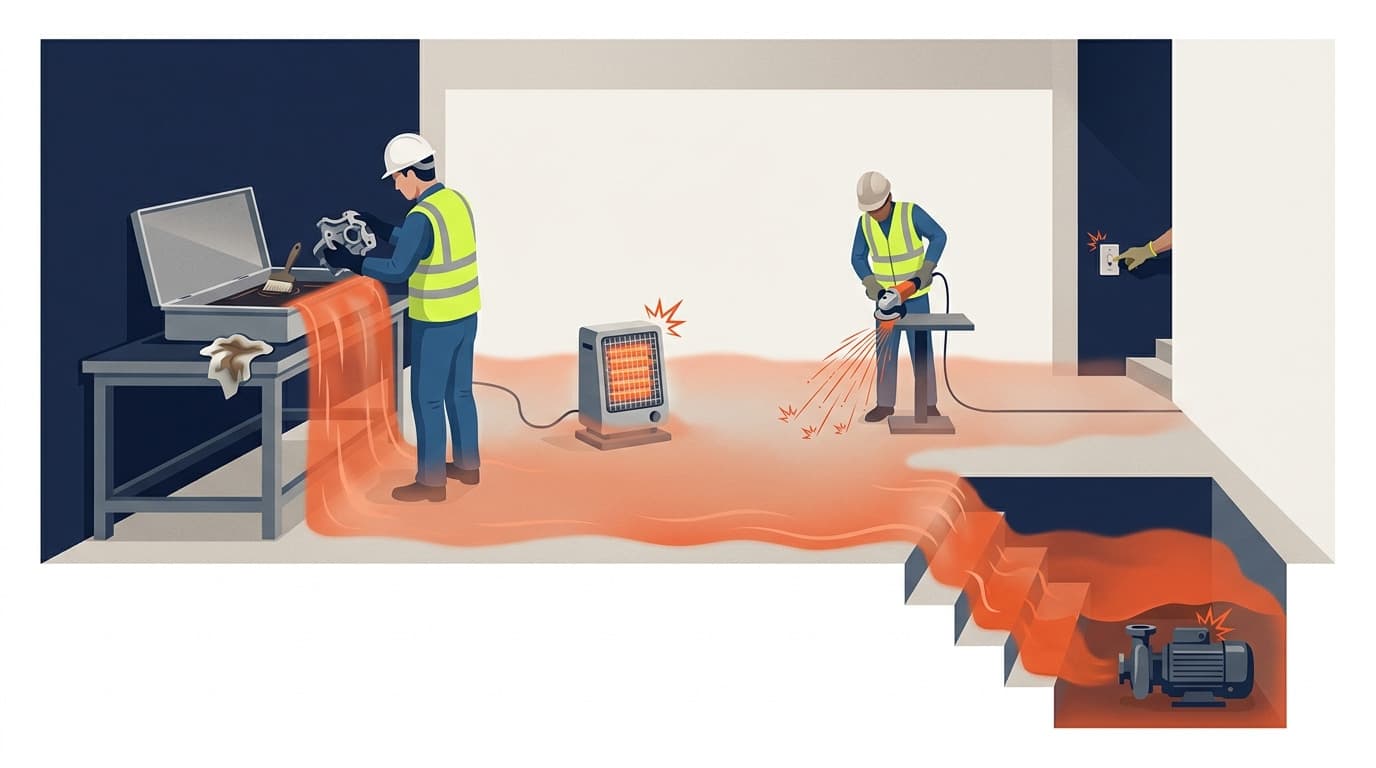
Because the vapor is the fuel and it is already present, the whole game is controlling ignition — and OSHA's own list of ignition sources is longer than most people expect. It includes open flames, lightning, smoking, cutting and welding, hot surfaces, frictional heat, static sparks, electrical sparks, mechanical sparks, spontaneous ignition, and radiant heat. The ones that catch people out are not the open flames — everyone avoids those — but the quiet ones: the hot surface of a work light or a heater, the sparks off a grinder two workstations away, the static charge that builds on a person or a plastic container, the electric motor that is not rated for a flammable atmosphere.
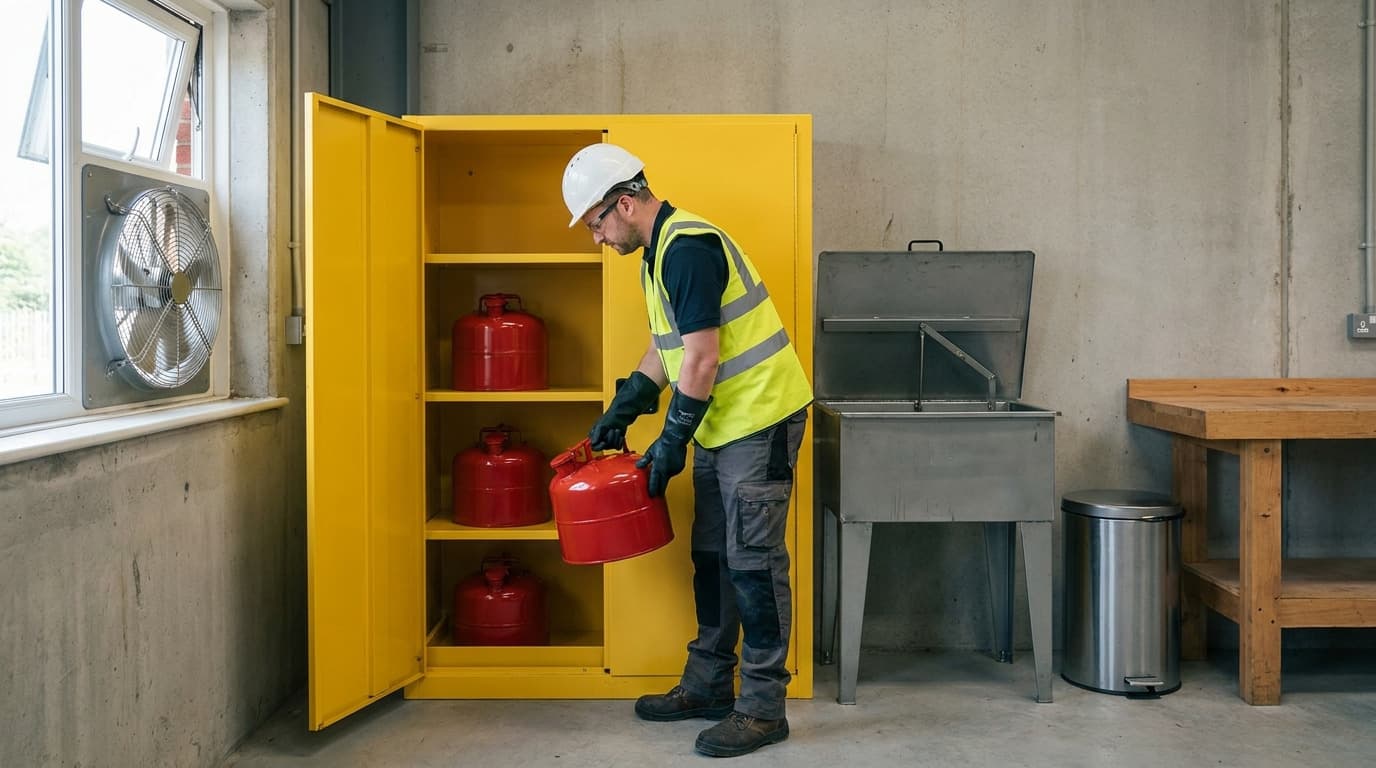
Two properties of solvent vapor make this worse. First, most solvent vapors are heavier than air, so they sink and travel — a vapor cloud can flow along the floor, across a room, down into a pit or a lower level, and reach an ignition source far from the open container. Second, an "empty" solvent container is often more dangerous than a full one, because the empty drum or can is full of vapor in the ignitable range, while the sealed liquid is comparatively contained. A worker doing hot work on or near an "empty" drum is working next to a bomb. The rule that follows is simple: keep solvent containers covered when not in use, keep the work ventilated so vapor cannot accumulate, and keep every ignition source — including the ones you would not think of — away from where the vapor is.
Bonding and grounding: removing the spark the pour creates#
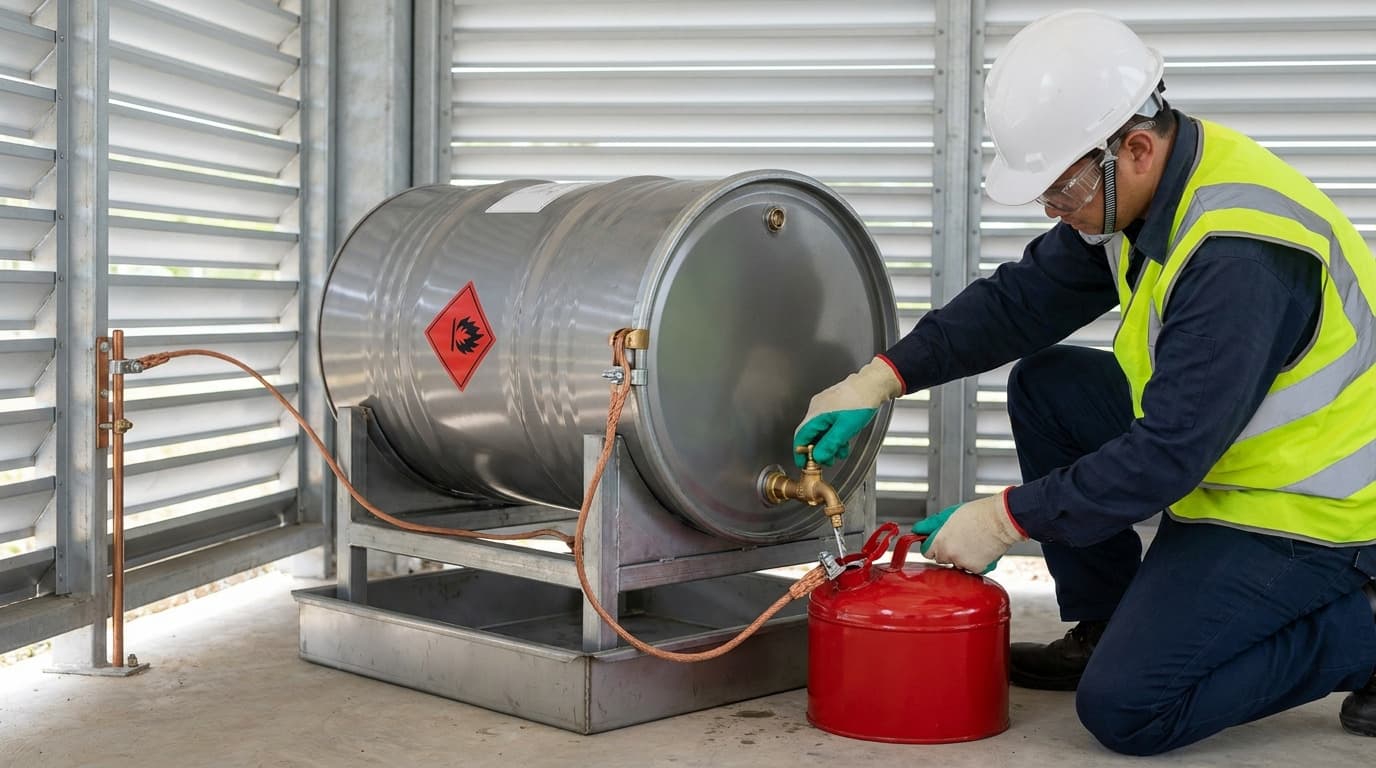
There is one ignition source the work itself manufactures, and it has its own control. When you pour or transfer a solvent from one container to another, the flowing liquid generates static electricity — a charge builds up, and if it discharges as a spark in the presence of the vapor the same pour is releasing, that spark is the ignition source and the vapor is the fuel. The transfer creates both halves of the fire at once.
The control is bonding and grounding. Bonding connects the two containers with a conductive path so there is no voltage difference between them to spark across; grounding connects the system to earth so any accumulated charge dissipates harmlessly. OSHA requires that when transferring the more volatile flammable liquids — those with a flash point below 100 °F — the nozzle and container be electrically interconnected, and that transfers use grounding and bonding to prevent a static spark. This is why the bonding wire and ground clip on a solvent transfer are not bureaucratic clutter: they are what removes the one ignition source you are actively creating by pouring. Transfer flammable solvents only from approved safety cans or DOT-approved containers, keep quantities on the floor small, and store the bulk in an approved flammable cabinet.
The other hazard: what the solvent does to you#
Solvents are not only a fire hazard; they are a health hazard, and the two are easy to separate in your mind and dangerous to separate in practice. The same vapor that can ignite is also being inhaled — solvent vapors cause headaches, dizziness, nausea, and drowsiness, and heavy exposure in a poorly ventilated space can cause loss of coordination and unconsciousness. The same ventilation that keeps the vapor below the ignitable concentration also keeps it out of your lungs, which is why ventilation does double duty here. On the skin, solvents strip the natural oils and cause drying, cracking, and dermatitis, and some are absorbed through the skin into the body — which is the skin hazards talk's ground, invoked here because degreasers are among the worst offenders. The controls overlap with the fire controls by design: ventilate, keep containers closed, wear chemical-resistant gloves and eye protection, and read the SDS for the specific product, because "solvent" covers everything from a mild citrus cleaner to a fast-evaporating, low-flash aromatic.
Where the duty sits#
Solvents and degreasers sit under OSHA's flammable-liquids and hazard-communication rules together, because they are both a fire hazard and a chemical hazard.
The fire side is governed by 1926.152 (flammable liquids in construction) and 1910.106 (general industry): approved containers and safety cans, covered when not in use, quantity limits outside an approved cabinet, bonding and grounding on transfer of the more volatile liquids, ventilation, and control of ignition sources. The chemical side is governed by the Hazard Communication Standard, 1910.1200 (1926.59 in construction), which requires the SDS — where the flash point, health hazards, and PPE for the specific product are stated — to be available and workers trained. The skin and respiratory exposure fall under those respective standards and talks. On federal contract work, EM 385-1-1 carries its own flammable-liquid, ventilation, and fire-prevention requirements, generally at least as strict as the OSHA baseline; where the SDS or the contract sets a tighter limit, that limit governs. And across all of it, the product's SDS is the authority on that specific solvent — the flash point and health hazards vary enormously from one product to the next.
What can go wrong?#
- A low-flash solvent is used in an unventilated room and the vapor fills the space, needing only a spark.
- Hot work — grinding, cutting, welding — is done near an open solvent container or an "empty" drum.
- A solvent is poured between containers with no bonding or grounding, and the static spark ignites the vapor.
- Vapor sinks and travels along the floor to an ignition source across the room or in a lower level.
- A solvent is left in an open container, releasing vapor into the work area all shift.
- A worker inhales solvent vapor in a confined, poorly ventilated space and becomes dizzy or disoriented.
- Bare skin is exposed to a degreaser repeatedly, causing cracking, dermatitis, or absorption.
- Bulk solvent is stored outside an approved cabinet, above the quantity limits.
How do we manage this properly?#
- Treat the vapor as the hazard — assume the ignitable cloud is already present with a low-flash solvent.
- Check the flash point on the SDS and know whether the danger is already in the air at your working temperature.
- Control every ignition source — open flames, hot surfaces, grinding sparks, static, non-rated electrical equipment — near where vapor may be.
- Ventilate the work so vapor cannot accumulate, and keep containers covered when not in use.
- Bond and ground when transferring flammable solvents, and use only approved safety cans or DOT-approved containers.
- Remember an "empty" container is full of vapor — never do hot work on or near one.
- Protect against the health hazard too: ventilate, wear chemical-resistant gloves and eye protection, avoid breathing vapor.
- Store bulk solvent in an approved flammable cabinet and keep floor quantities small.
Before you start#
- Confirm the solvent's flash point and health hazards have been checked on the SDS.
- Confirm the work area is ventilated and vapor cannot accumulate or travel to an ignition source.
- Confirm ignition sources — flames, hot surfaces, grinding, non-rated equipment — are controlled or removed.
- Confirm bonding and grounding are set up if the solvent will be transferred between containers.
- Confirm solvents are in approved safety cans, covered when not in use, and bulk is in an approved cabinet.
- Confirm no hot work will be done near open containers or "empty" drums.
- Confirm chemical-resistant gloves and eye protection are worn for the specific product.
- On federal work, confirm the EM 385-1-1 flammable-liquid and ventilation requirements are met.
Talk it over#
- On this product, what is the flash point — and does that mean the vapor is already ignitable at today's temperature?
- Where could vapor travel from our open container, and what ignition sources are in that path?
- If we are transferring solvent today, where are the bonding and grounding connections?
- Have you ever felt lightheaded or had a headache working with a degreaser? What did the ventilation look like?
The bottom line#
With a solvent or degreaser, the vapor is the hazard, not the liquid. The liquid does not burn — it gives off vapor, and the vapor mixed with air is what ignites, which is why a harmless-looking puddle becomes an explosion once its vapor fills a room and something sparks. The flash point on the SDS tells you the whole story: it is the lowest temperature at which the liquid gives off an ignitable vapor, and for many solvents that is at or below room temperature — so the ignitable cloud is already present the moment the container is open, and the only missing ingredient is an ignition source. OSHA's ignition list is longer than people expect — open flames, hot surfaces, grinding and static and electrical sparks, radiant heat — and two facts make it worse: solvent vapor is usually heavier than air so it sinks and travels to a distant source, and an "empty" container is often more dangerous than a full one because it is full of vapor in the ignitable range. The pour itself creates a spark through static, so bonding and grounding on transfer of the more volatile liquids (flash point below 100 °F) removes the ignition source the work manufactures — governed with the rest of the fire controls by 1926.152 / 1910.106 (approved safety cans, covered containers, quantity limits, ventilation). The same vapor is a health hazard — inhalation causes headaches, dizziness, and worse, and skin contact causes dermatitis and absorption — so ventilation does double duty, and the SDS (under 1910.1200 / 1926.59) is the authority on that specific product's flash point, health hazards, and PPE. The test for any solvent job is one question: is there an ignitable vapor cloud forming here — and have we removed every spark that could reach it, including the one the pour itself would make?
Frequently asked questions about solvents and degreasers#
Why is the vapor more dangerous than the liquid?
Because a solvent does not burn as a liquid — it gives off vapor, and it is the vapor mixed with air that ignites. The liquid in the container is the source, but the invisible cloud above and around it is what actually catches fire or explodes. That is why a puddle you could barely light becomes an explosion when its vapor has filled a room and something sparks across the space. Managing solvents means managing a vapor you cannot see.
What is a flash point and why does it matter?
The flash point is the lowest temperature at which a liquid gives off enough vapor to form an ignitable mixture with the air near its surface. It matters because it answers whether the ignitable vapor is already present at the temperature you are working in. For many solvents the flash point is at or below room temperature, meaning the ignitable cloud is already there before the product is heated at all. You will find it on the SDS.
Why do I have to bond and ground when transferring solvent?
Because pouring or transferring a flammable liquid generates static electricity, and if that charge discharges as a spark in the presence of the vapor the same pour is releasing, it ignites. Bonding connects the two containers so there is no voltage to spark across; grounding lets any charge dissipate to earth. OSHA requires the nozzle and container to be electrically interconnected for the more volatile flammable liquids. Bonding and grounding remove the one ignition source the transfer itself creates.
Is an empty solvent container safe?
No — an "empty" container is often more dangerous than a full one, because it is full of vapor in the ignitable range while the sealed liquid is comparatively contained. Doing hot work on or near an "empty" drum is one of the classic causes of solvent explosions. Treat empty flammable containers as full of vapor until they have been properly cleaned and purged.
Can solvent vapor travel to an ignition source across the room?
Yes. Most solvent vapors are heavier than air, so they sink and flow along the floor, across a room, and down into pits or lower levels, and can reach an ignition source far from the open container. This is why controlling ignition sources only right next to the work is not enough, and why ventilation to prevent the vapor from accumulating and traveling is central.
Are solvents a health hazard as well as a fire hazard?
Yes. The same vapor that can ignite is also inhaled, causing headaches, dizziness, nausea, drowsiness, and in heavy exposure loss of coordination or unconsciousness. On the skin, solvents and degreasers strip natural oils and cause drying, cracking, and dermatitis, and some are absorbed through the skin. Ventilation, chemical-resistant gloves, and eye protection address the health side, and the SDS states the specific hazards for each product.
Download the solvent and degreaser toolbox talk PDF#
Get this solvent and degreaser toolbox talk as a print-ready PDF — available in English, Spanish, Portuguese, and Turkish. Print it, hand it to the crew, and collect signatures on the included attendance sheet.
Download the PDF — free account required. New members get 3 free downloads.
Related toolbox talks#
Sources#
- OSHA, 29 CFR 1926.152 — Flammable liquids (construction: approved containers, storage limits, bonding and grounding, ignition-source control): https://www.osha.gov/laws-regs/regulations/standardnumber/1926/1926.152
- OSHA, 29 CFR 1910.106 — Flammable liquids (flash-point definition and handling): https://www.osha.gov/laws-regs/regulations/standardnumber/1910/1910.106
- OSHA, 29 CFR 1910.1200 — Hazard Communication: https://www.osha.gov/laws-regs/regulations/standardnumber/1910/1910.1200
This talk is general awareness guidance for training purposes. It does not replace your employer's flammable-liquid and hazard-communication program, the product's Safety Data Sheet, the OSHA flammable- liquids or hazard-communication standards, or a competent person's duties, and it is not legal advice. Where the SDS or a contract sets a specific limit, that limit governs.
Written by FieldSafetyTalk's safety professional — a CSP, ASP, CHST and OSHA Authorized Outreach Trainer with 14+ years of international construction safety experience across federal, heavy civil, and industrial projects.