Hand and Power Tools
Updated 2026-07-23
In this bundle Tools & Machinery
Print-ready PDF
Download this talk as a print-ready PDF, available in 4 languages.
You will pick up a tool today without thinking about it. Not carelessly — you have used it a thousand times, you know exactly what it does, and thinking about it would slow you down. That competence is real, and it is also why hand and power tools produce more injuries on construction sites than almost anything else. This hand and power tools talk is about the equipment you stopped making decisions about.
Here is the distinction that carries this whole talk: with unfamiliar hazards, ignorance is the risk and training is the fix. With tools, the opposite happens. Experience builds automatic habits that work extremely well right up until the day the material is different, the tool is worn, the position is awkward, or you are tired — and then the habit executes anyway, because nobody consulted it. The injury does not come from not knowing what you are doing. It comes from knowing so well that the decision stopped happening.
How dangerous are hand and power tools?#
Tool-related injuries dominate the non-fatal picture in construction. According to CPWR, the Center for Construction Research and Training, analyzing BLS data, struck-by injuries — which include being hit by flying fragments, tool pieces, and material — account for 21.5 percent of all non-fatal construction injuries, the single largest category (CPWR Data Bulletin, March 2023, from BLS Survey of Occupational Injuries and Illnesses).
Enforcement reflects the same exposure:
- Eye and Face Protection (29 CFR 1926.102) ranked ninth on OSHA's Top 10 Most Frequently Cited Standards for Fiscal Year 2025 (National Safety Council, preliminary data). The citations cluster in exactly the environments tools create — flying particles, caustic splashes, and high-velocity debris.
- Machine Guarding (29 CFR 1910.212) ranked tenth on the same list.
- OSHA penalties are $16,550 per serious violation and up to $165,514 for willful or repeated violations (effective January 2025).
The pattern behind the numbers is cultural rather than technical. Workers perceive eye protection as unnecessary for "a quick cut" or "just one grind" — and the injuries follow that perception.
OSHA hand and power tool requirements (29 CFR 1926 Subpart I)#
Tools in construction are governed by 29 CFR 1926 Subpart I, sections 1926.300 through 1926.307.
- Condition — 1926.300(a). All hand and power tools, whether furnished by the employer or the employee, must be maintained in a safe condition.
- Guarding — 1926.300(b)(1). When power operated tools are designed to accommodate guards, they must be equipped with such guards when in use.
- Moving parts — 1926.300(b)(2). Belts, gears, shafts, pulleys, sprockets, spindles, drums, flywheels, chains, or other reciprocating, rotating, or moving parts must be guarded if exposed to contact by employees.
- Point of operation guarding — 1926.300(b)(4). The point of operation of machines whose operation exposes an employee to injury must be guarded, and the guarding device must prevent the operator from having any part of the body in the danger zone during the operating cycle.
- Hand tools — 1926.301. Employers must not issue or permit the use of unsafe hand tools. Wrenches with sprung jaws, impact tools with mushroomed heads, and tools with loose, cracked, or splintered handles must not be used.
- Power tool general requirements — 1926.302. Electric power operated tools must be either grounded or double-insulated. Pneumatic power tool hose connections must be secured to prevent accidental disconnection, and a safety clip or retainer installed to prevent attachments from being ejected.
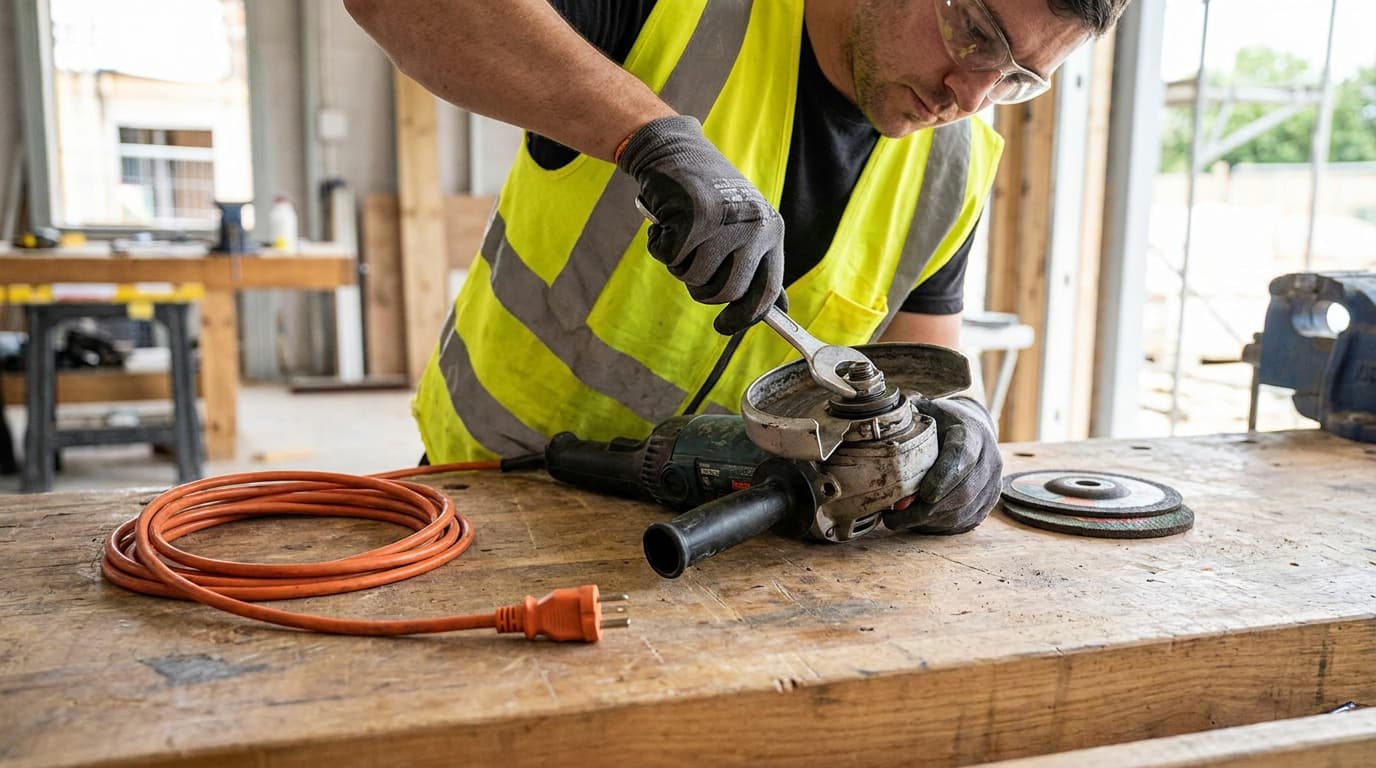
- Abrasive wheels — 1926.303. Abrasive wheels must be used only on machines provided with safety guards, and must be inspected and ring-tested before mounting.
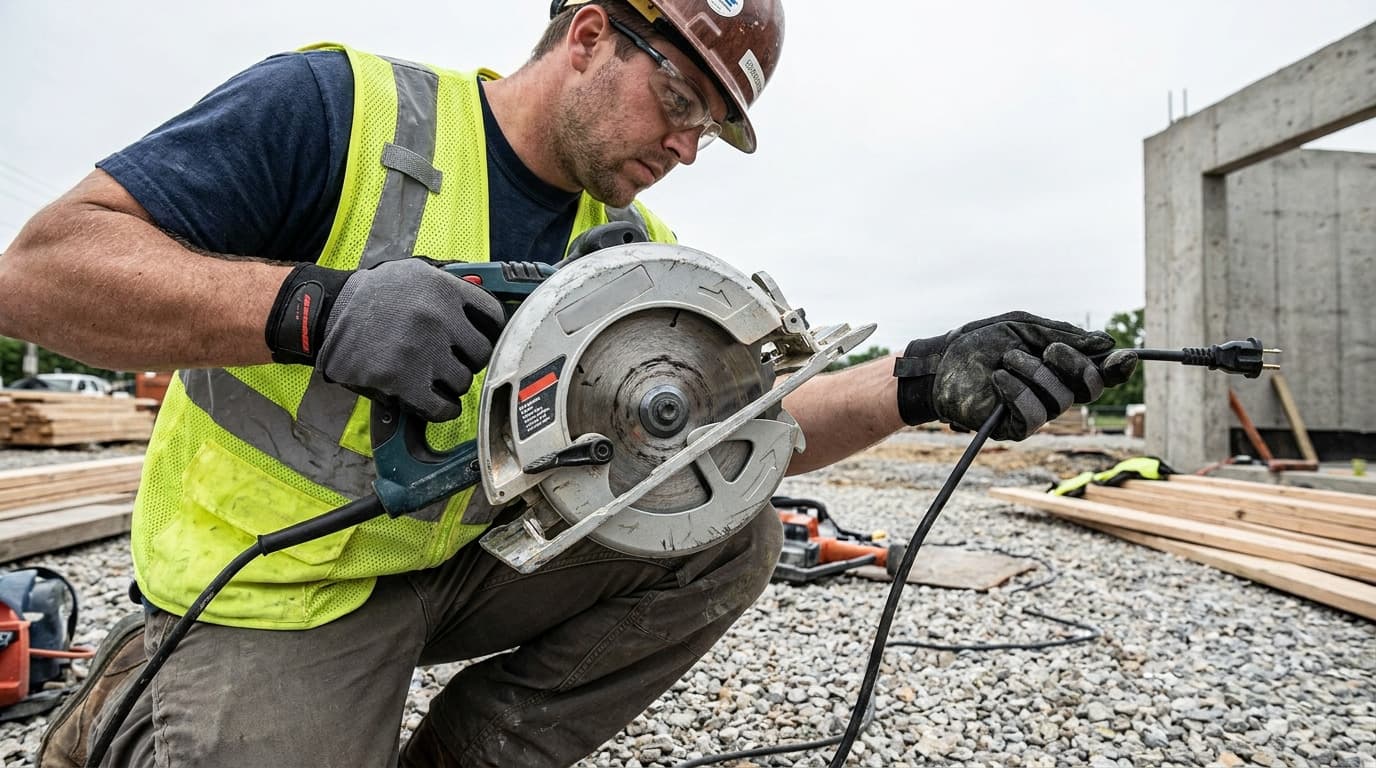
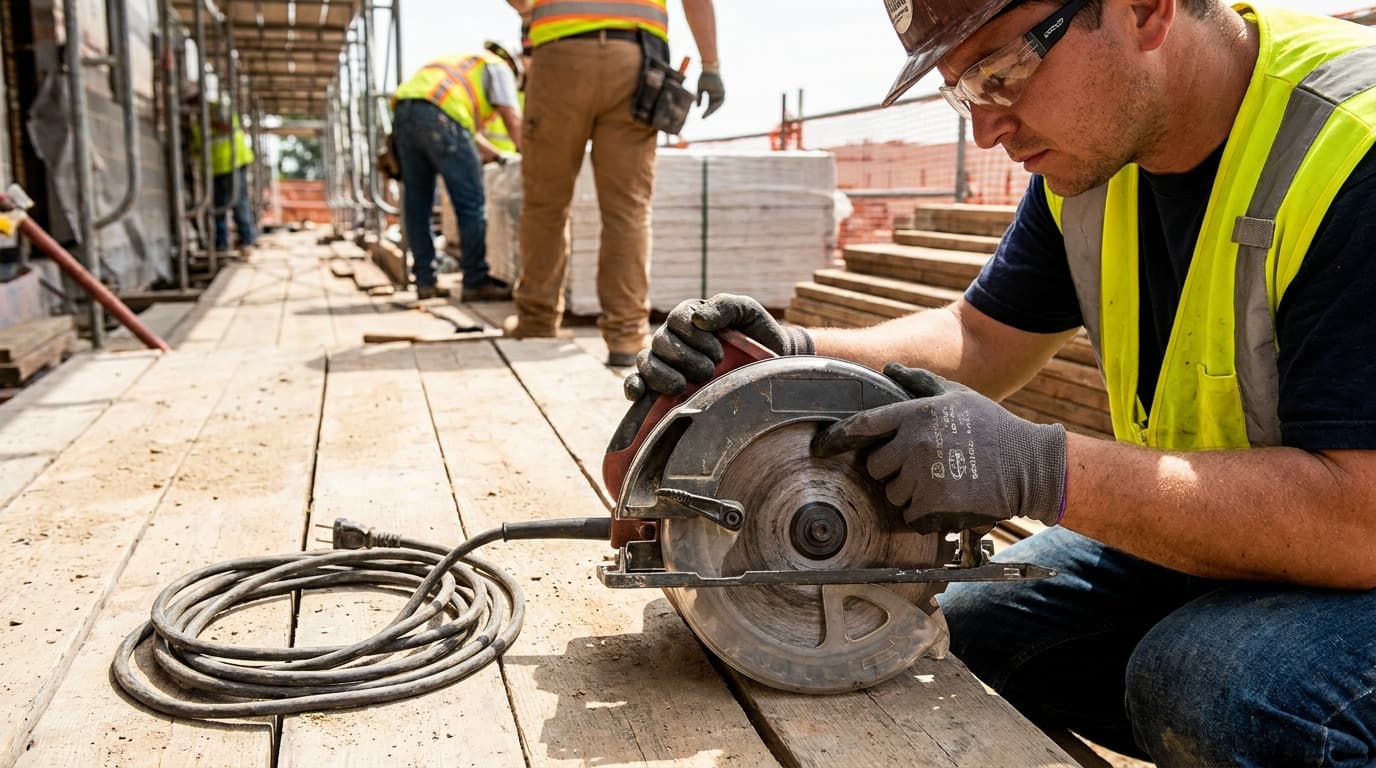
- Woodworking tools — 1926.304. Portable circular saws must be equipped with guards above and below the base plate, and the lower guard must automatically return to covering position when the tool is withdrawn.
On USACE and NAVFAC projects, EM 385-1-1 applies and is more restrictive in several places.
What can go wrong with hand and power tools?#
Using the wrong tool for the task. A screwdriver used as a chisel or pry bar. Pliers used as a wrench. A grinder used to cut when the wheel is rated for grinding. The tool does not fail because it is defective — it fails because it was never designed for what it is doing, and it fails suddenly.
Condition problems that were visible in an inspection nobody performed:
- Mushroomed chisel heads that throw fragments
- Loose or split handles on hammers and axes
- Dull blades that require force, and force is what removes control
- Cracked housings, damaged cords, missing guards, defeated triggers, worn chucks
- Blades and bits installed backwards or not fully seated
Hand placement, where most serious injuries actually happen. The hand steadying the material sits in the blade path. The hand supporting the workpiece is under the drill exit point. The hand guiding the cut is where the tool will go if it binds. Nobody plans this — it happens because the material needs holding and the other hand is the closest thing available.
Loss of control. Overreaching. Working above shoulder height. Standing on something unstable. Unsecured workpieces that move, spin, or rotate into the operator. Working one-handed with a tool that needs two.
Energy source hazards. Electrical tools bring shock, damaged cords, and missing grounds. Pneumatic tools bring whipping hoses when a coupling fails, and compressed air injected into skin. Powder-actuated tools require specific certification and cause fatalities when used by untrained workers or fired into unsuitable base material.
Exposures that accumulate rather than announce themselves. Eye injuries from flying particles, hearing loss from tools used without protection over years, silica and wood dust, hand-arm vibration from prolonged use, and repetitive strain.
How do we prevent tool injuries?#
Select the tool for the job, not for what is closest. The right tool, the right size, the right accessory rated for the operation. If the tool available cannot do the job as designed, get the correct tool rather than forcing the one in your hand.
Inspect before every use. Housing, handle, cord and plug, guard, trigger, chuck, blade or bit condition and seating. Look for cracks, mushrooming, splits, heat damage, and missing components. Under 1926.301, unsafe hand tools must not be issued or used — anything defective is tagged and removed from service, not put back on the rack.
Never remove or defeat a guard. Under 1926.300(b)(1), power tools designed to accommodate guards must be equipped with them when in use. A tool with a guard removed, wedged, or tied back is out of service until it is restored.
Plan hand placement before you start the cut. Decide where both hands go and confirm neither is in the path of the blade, bit, or the direction the tool will travel if it binds. Use clamps, vises, or jigs to hold the work rather than your hand — this single habit prevents a large share of serious tool injuries.
Secure the workpiece. Clamped or fixed, not held. Material that can move, spin, or lift is material that will, at the worst moment.
Manage the energy source correctly:
- Electrical — grounded or double-insulated per 1926.302(a), GFCI protection, cord inspection before every use
- Pneumatic — hose connections secured against accidental disconnection, safety clips or retainers fitted, whip checks on couplings
- Powder-actuated — certified operators only, correct fasteners, base material verified
- Fuel-powered — ventilation, and cool-down before refuelling
Disconnect before you adjust. Unplug or disconnect air before changing a blade, bit, or wheel, clearing a jam, or adjusting a guard. Most accidental starts happen with a hand where the cutting edge is about to be.
Wear the protection the tool requires. Eye protection always, face shield where fragments or splash are likely, hearing protection for the tool's noise level, gloves suited to the task — and never loose gloves, sleeves, jewellery, or long hair near rotating parts, because entanglement is what turns a small tool into an amputation.
Carry and store them properly. Carried by the handle, never by the cord or hose. Never carried with a finger on the trigger. Not raised or lowered by their cords.
Before you start#
- Ask whether this is genuinely the right tool for this task, or just the one in reach.
- Inspect the tool fully: housing, handle, cord, guard, trigger, and blade or bit seating.
- Confirm the guard is present and functional, and that nobody has tied or wedged it back.
- Confirm the accessory is rated for the operation and for the tool's speed.
- Decide where both hands will be during the cut, and confirm neither is in the tool's path.
- Clamp or fix the workpiece rather than holding it.
- Check your footing, your working height, and whether you can maintain full control.
- Confirm the tool is disconnected before you change anything on it.
- Confirm your eye, face, and hearing protection matches what this tool actually produces.
Talk it over#
- Pick up the tool you will use most today. When did you last actually inspect it rather than just use it?
- On the cut you are about to make, where is your other hand — and where does the tool go if it binds?
- What is the tool everybody here uses without thinking? That is the one to talk about.
The bottom line#
Tools injure experienced people far more often than beginners, because familiarity replaces the decision that used to happen every time. The fix is to put a few decisions back: is this the right tool, is it in sound condition, is the guard intact, where are both my hands, and is the work clamped rather than held. Disconnect before you adjust anything, never defeat a guard, and treat the tool you know best as the one most likely to catch you out.
Frequently asked questions about hand and power tool safety#
Does OSHA require guards on power tools?
Yes. Under 29 CFR 1926.300(b)(1), when power operated tools are designed to accommodate guards, they must be equipped with such guards when in use. 1926.300(b)(2) additionally requires guarding of belts, gears, shafts, pulleys, spindles, drums, flywheels, chains, and other moving parts exposed to contact.
Can I use a hand tool with a cracked handle?
No. Under 29 CFR 1926.301, employers must not issue or permit the use of unsafe hand tools. Wrenches with sprung jaws, impact tools with mushroomed heads, and tools with loose, cracked, or splintered handles are specifically prohibited. Defective tools are tagged and removed from service.
Do power tools have to be grounded?
Under 29 CFR 1926.302(a), electric power operated tools must be either grounded or double-insulated. On construction sites this is combined with GFCI protection on temporary power under 1926.404(b)(1), and cord inspection before every use.
What is the most common cause of serious hand tool injuries?
Hand placement. The hand steadying the workpiece frequently sits in the blade path, under the drill exit, or where the tool will travel if it binds. Clamping or fixing the work instead of holding it is the single most effective habit for preventing these injuries.
Should I wear gloves when using power tools?
It depends on the tool. Gloves protect against cuts, abrasion, and vibration for many tasks, but loose gloves near rotating parts — drills, grinders, saws — create an entanglement hazard that converts a minor contact into a severe injury. Match the glove to the task, and keep loose material away from anything that rotates.
Why do experienced workers get injured by tools so often?
Because experience converts tool use into automatic habit, and habit does not re-evaluate. The routine works reliably until conditions change — different material, a worn blade, an awkward position, fatigue — and the habit executes anyway. The injury comes from the decision no longer being made, not from lack of skill.
Download the hand and power tools toolbox talk PDF#
Get this hand and power tools toolbox talk as a print-ready PDF — available in English, Spanish, Portuguese, and Turkish. Print it, hand it to the crew, and collect signatures on the included attendance sheet.
Download the PDF — free account required. New members get 3 free downloads.
Related toolbox talks#
Sources#
- OSHA, 29 CFR 1926 Subpart I — Tools, Hand and Power: https://www.osha.gov/laws-regs/regulations/standardnumber/1926
- OSHA, Top 10 Most Frequently Cited Standards: https://www.osha.gov/top10citedstandards
- CPWR, Fatal and Nonfatal Focus Four Injuries in Construction, Data Bulletin March 2023: https://www.cpwr.com/wp-content/uploads/DataBulletin-March2023.pdf
- Bureau of Labor Statistics, Survey of Occupational Injuries and Illnesses: https://www.bls.gov/iif/