Heat Stress
Updated 2026-07-28
In this bundle Health & Environmental Exposure
Working in California? See the Cal/OSHA edition → California (Cal/OSHA)Working in Washington? See the WA DOSH edition → Washington (WA DOSH)
Print-ready PDF
Download this talk as a print-ready PDF, available in 4 languages.
Heat is the hazard most people treat as weather rather than as an exposure. It is not on a data sheet, nobody hands it out, and the crew's usual answer is to push through. Meanwhile the regulatory picture around it has changed more in the last five years than almost anything else in construction safety — and most of what gets repeated on site about it is now out of date. This heat stress talk sets out where things actually stand.
Here is the distinction that carries this whole talk: heat illness is not a fitness problem, it is an exposure problem. The workers who go down are frequently the fit ones — new starters, returners after a break, people who work hard in the first hours of a hot spell. The body needs days to adapt to working in heat, and nothing about being strong, experienced or determined shortens that. Which is why the control everyone skips, acclimatisation, is the one that matters most.
Where the rules actually stand#
There is still no final federal heat standard. OSHA published a proposed rule, Heat Injury and Illness Prevention in Outdoor and Indoor Work Settings, in August 2024, and as of May 2026 the agency's rulemaking page still described it as proposed rather than final. That proposal would set an initial heat trigger at a heat index of 80 °F (26.7 °C) and a high-heat trigger at 90 °F (32.2 °C), with water, paid rest breaks, shade or cooling, acclimatisation procedures and a written plan attached to them. None of that is in force.
The enforcement programme, however, is very much in force — and it is newer than most people realise. OSHA's National Emphasis Program on outdoor and indoor heat-related hazards, CPL 03-00-024, was originally issued on 8 April 2022 and extended in January 2025. It expired on 8 April 2026. Two days later, on 10 April 2026, OSHA issued an updated NEP under the same number, effective immediately and scheduled to run for five years, built around a target list of 55 high-hazard industries — construction trades among them.
So the position on any site today is this: the citation comes from the General Duty Clause, Section 5(a)(1) of the OSH Act, which requires a workplace free from recognised hazards likely to cause death or serious physical harm — and the inspection comes from a five-year national programme that is specifically looking for heat.
The updated directive also reorganised citation guidance and added a framework inspectors use to evaluate an employer's heat programme. In practice a compliance officer arriving on a hot day is working from a checklist and will ask for: a written heat illness prevention plan, acclimatisation procedures for new and returning workers, documented supervisor and worker training, records showing you actually monitor temperature or heat index, and evidence that water and rest breaks happen in practice, not just on paper.
One requirement is a genuine regulation rather than guidance: 1926.51(a) requires an adequate supply of potable water in all places of employment. That one is citable on its own terms.
Acclimatisation: the control that gets skipped#
The body adapts to working in heat — plasma volume increases, sweating starts earlier and contains less salt, heart rate at a given workload falls. That adaptation takes days of progressive exposure, and it is lost after a break of about a week.
Which means the highest-risk people on any hot site are the predictable ones:
- New starters, in their first days on the job.
- Returners — after holiday, sickness, a rain break or a winter of indoor work.
- Everyone, in the first days of the first hot spell of the year, before the season has done the adapting for you.
An acclimatisation procedure is not complicated: build exposure up over roughly a week, keep new and returning workers under closer supervision, pair them with someone experienced, and accept less output for those days. What it is not is optional — it is one of the specific things the inspection framework asks about.
Reading the day, not the thermometer#
Air temperature alone understates the risk. What matters is the combination of temperature, humidity, radiant heat, air movement, workload and clothing. Two figures are worth using:
Heat index combines temperature and humidity, and it is what the proposed triggers are written against. It is easy to obtain and easy to log.
WBGT — wet bulb globe temperature — accounts for radiant heat and air movement as well, which is why it describes a black roof in still air far better than a weather app does.
And the multipliers that no index captures: direct sun, reflective surfaces, impermeable PPE and coveralls, respirators, heavy physical work, confined or enclosed spaces, and the second or third consecutive hot day, when people arrive already depleted.
What can go wrong?#
A new worker collapses on day two. Unacclimatised, working hard, keeping up with the crew.
Water is available but not drunk. Too far away, no break to get it, or nobody wants to be the one who stops.
Rest breaks are theoretical. In the schedule, not in the day.
Symptoms are misread as a hangover, dehydration or "being soft." Confusion, irritability and stumbling are late signs, not character flaws.
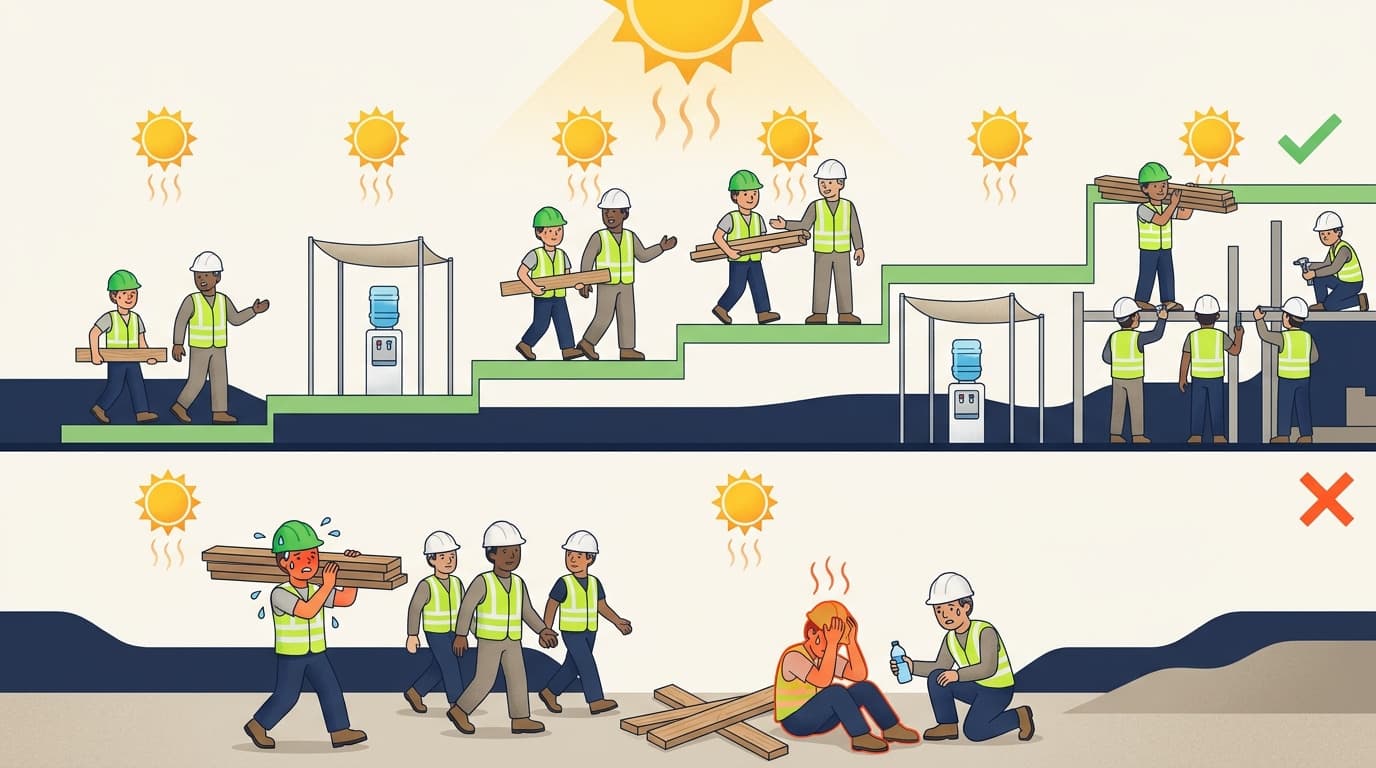
The person is left to recover alone. Sat in a vehicle or a corner, unwatched, while their condition worsens.
Nobody monitors conditions. No temperature or heat index recorded, so nothing triggers anything.
PPE traps the heat. Coveralls, harnesses, respirators and impermeable suits are all heat load, and none of them appear on a weather forecast.
Cooling from the previous night failed. Poor sleep in a hot room means the day starts from behind.
How do we manage this properly?#
Have a written plan and use it. Trigger conditions, water, rest, shade, acclimatisation, training, monitoring and emergency response — it is the first thing an inspection framework asks for.
Acclimatise new and returning workers deliberately, with lighter loads over about a week and closer supervision throughout.
Make water genuinely accessible, in adequate supply as 1926.51(a) requires, close to the work, cool, and drunk in small amounts frequently rather than in bulk at breaks.
Schedule around the heat. Heavy work earlier, rotate tasks, add breaks as conditions worsen rather than as an afterthought.
Provide real shade or cooling, not a patch behind a container — somewhere people will actually go.
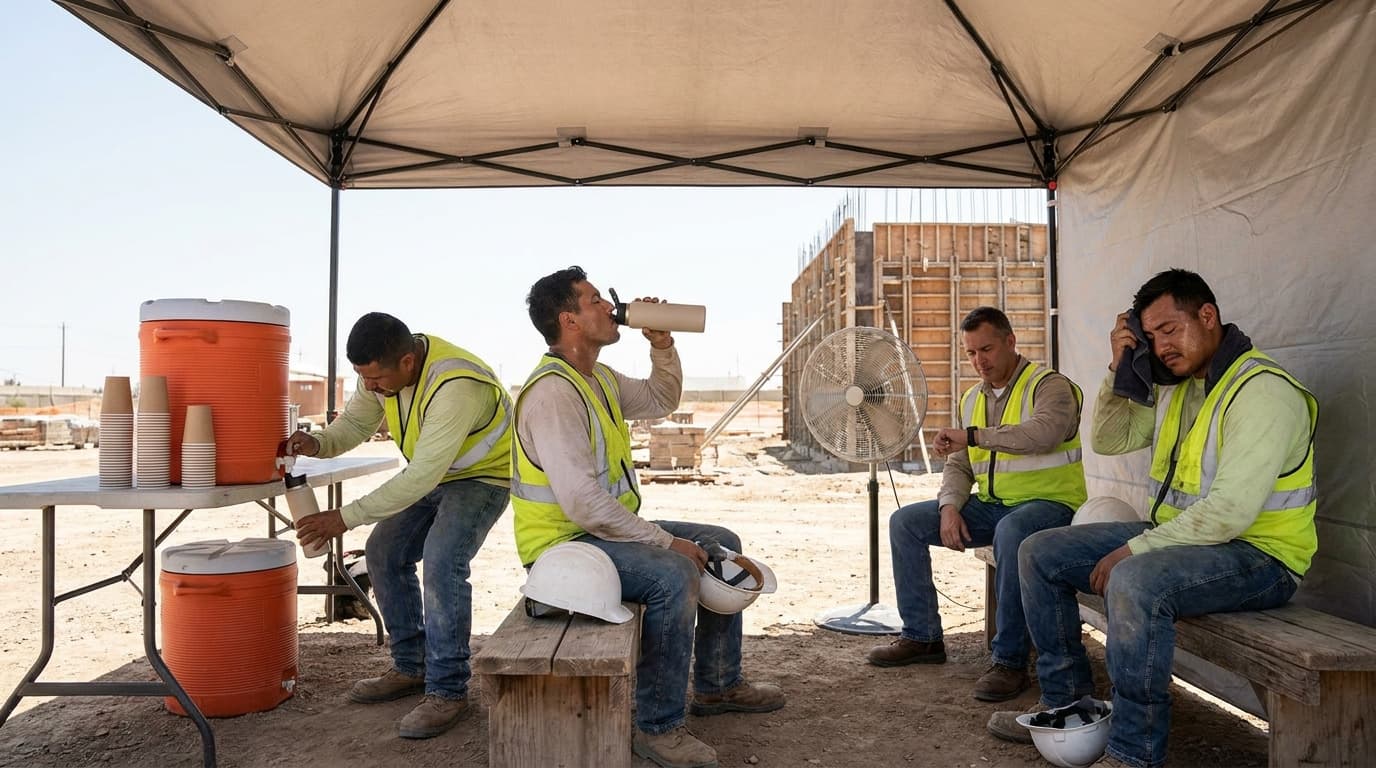
Monitor and record conditions, so decisions are triggered by something measured rather than by how the supervisor feels.
Use a buddy system, because the person losing judgement is the least likely to report it.
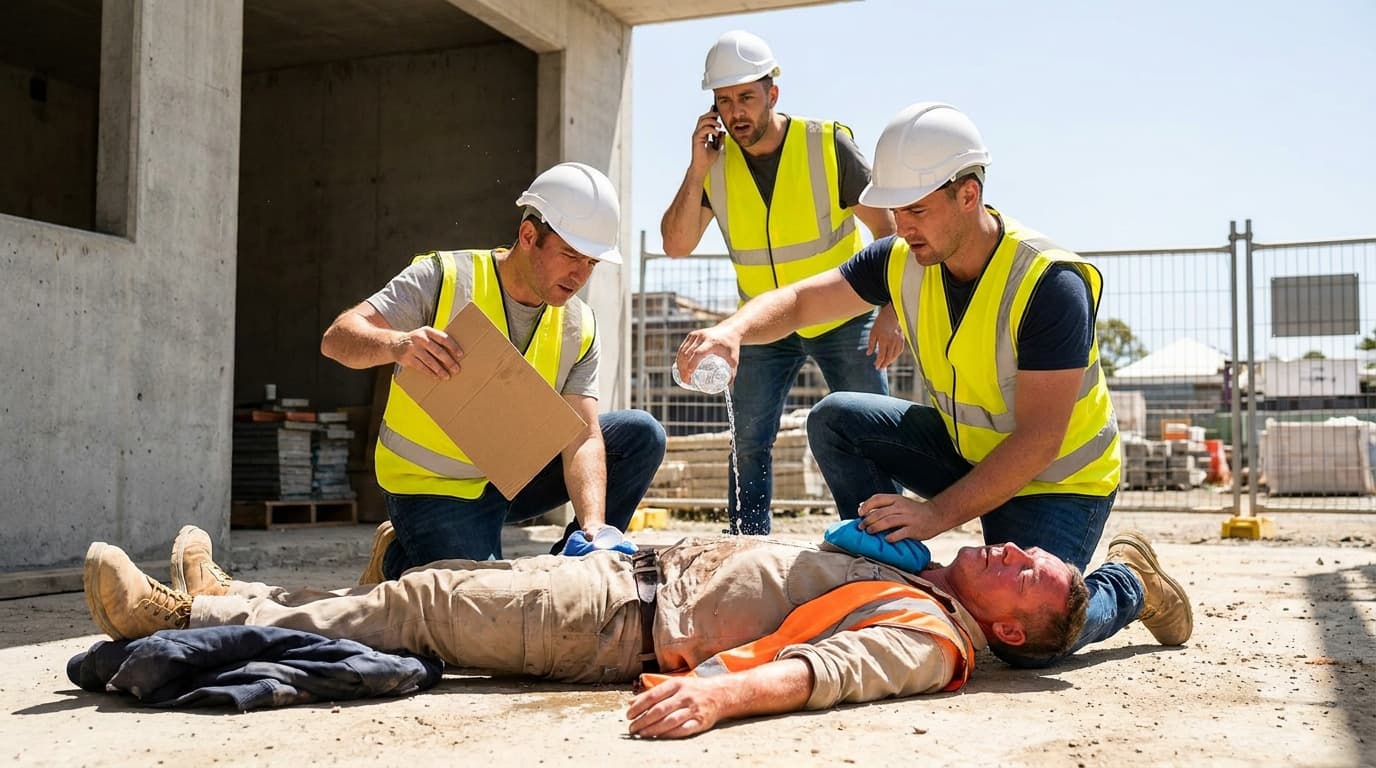
Know the emergency response. Heat stroke is a life-threatening emergency: get the person into shade, start cooling immediately, and call emergency services. Do not send them home alone and do not wait to see if they improve.
Before you start#
- Confirm today's temperature or heat index, and who is recording it.
- Confirm who on the crew is new, returning, or otherwise unacclimatised.
- Confirm where the water is, that it is potable and adequate, and that people can reach it without asking.
- Confirm where shade or cooling is, and that breaks are scheduled rather than hoped for.
- Confirm what PPE is being worn and how much heat load it adds.
- Confirm who is watching whom, and that nobody works alone in the heat.
- Confirm everybody knows the symptoms and that reporting them carries no penalty.
- Confirm the emergency plan: who calls, from where, and how cooling starts before help arrives.
Talk it over#
- Who here started this week, or came back after a break?
- When did you last drink, and how much?
- Has anyone worked through feeling unwell in the heat? What stopped you saying something?
- If somebody went down right now, what would the first two minutes look like?
The bottom line#
As things stand, there is no final federal heat standard — the rule proposed in August 2024 was still described as proposed as of May 2026, and its 80 °F (26.7 °C) initial and 90 °F (32.2 °C) high-heat triggers are not in force. What is in force is enforcement: the heat National Emphasis Program, CPL 03-00-024, expired on 8 April 2026 and was reissued on 10 April 2026 for five years, covering 55 high-hazard industries including construction. Citations run through the General Duty Clause, and 1926.51(a) independently requires an adequate supply of potable water. Inspectors work from a framework that asks for a written plan, acclimatisation procedures for new and returning workers, training, monitoring records and evidence that water and rest actually happen. And the control that saves people is the unglamorous one: acclimatisation, because the body needs days to adapt and being fit does not shorten them.
Frequently asked questions about heat stress#
Does OSHA have a heat standard?
Not a final one. OSHA published a proposed rule, Heat Injury and Illness Prevention in Outdoor and Indoor Work Settings, in August 2024, and as of May 2026 it was still described as proposed rather than final. Heat hazards are therefore cited under the General Duty Clause, Section 5(a)(1) of the OSH Act, which requires a workplace free from recognised hazards likely to cause death or serious physical harm.
If there is no standard, why are inspectors turning up?
Because enforcement does not require a specific standard. OSHA's heat National Emphasis Program (CPL 03-00-024) was first issued on 8 April 2022, expired on 8 April 2026, and was reissued on 10 April 2026 — effective immediately and scheduled to run for five years, with a target list of 55 high-hazard industries that includes construction trades.
What will an inspector ask for?
The updated directive added a framework for evaluating an employer's heat programme. Expect requests for a written heat illness prevention plan, acclimatisation procedures for new and returning workers, documented supervisor and worker training, records showing that temperature or heat index is monitored, and evidence that water and rest breaks happen in practice.
What would the proposed rule require?
As proposed, an initial heat trigger at a heat index of 80 °F (26.7 °C) and a high-heat trigger at 90 °F (32.2 °C), with water access, paid rest breaks, shade or air conditioning, acclimatisation protocols for new workers and written heat illness prevention plans attached. It is a proposal, not a rule — but inspectors are familiar with the framework.
Is there any hard requirement about drinking water?
Yes. 29 CFR 1926.51(a) requires an adequate supply of potable water in all places of employment. That is a construction standard in its own right, independent of the heat rulemaking, and it is citable on its own.
Why does acclimatisation matter so much?
Because adaptation to working in heat takes days of progressive exposure and is lost after roughly a week away. New starters and workers returning from holiday, sickness, a rain break or winter indoor work are unacclimatised, and so is everyone during the first hot spell of the year. Fitness and experience do not substitute for it, which is why acclimatisation procedures are one of the specific items the inspection framework asks about.
What do we do if someone shows signs of heat stroke?
Treat it as a life-threatening emergency. Move the person into shade or a cool area, begin cooling immediately, and call emergency services. Do not leave them alone, do not send them home to recover, and do not wait to see whether they improve — confusion, agitation, slurred speech and collapse are late signs, not early ones.
Download the heat stress toolbox talk PDF#
Get this heat stress toolbox talk as a print-ready PDF — available in English, Spanish, Portuguese, and Turkish. Print it, hand it to the crew, and collect signatures on the included attendance sheet.
Download the PDF — free account required. New members get 3 free downloads.
Related toolbox talks#
Sources#
- OSHA, National Emphasis Program — Outdoor and Indoor Heat-Related Hazards (CPL 03-00-024, 10 April 2026): https://www.osha.gov/enforcement/directives/cpl-03-00-024-0
- OSHA, Extension of CPL 03-00-024 (to 8 April 2026): https://www.osha.gov/enforcement/directives/cpl-03-01-024
- OSHA, 29 CFR 1926.51 — Sanitation: https://www.osha.gov/laws-regs/regulations/standardnumber/1926/1926.51
This talk summarises published regulatory guidance. It is not medical advice. Suspected heat stroke is a medical emergency — begin cooling and call emergency services immediately rather than assessing it on site.