Venomous Snakes & Spiders
Updated 2026-08-01
In this bundle Health & Environmental Exposure
Print-ready PDF
Download this talk as a print-ready PDF, available in 4 languages.
Ask any crew what to do about a snakebite and you will get a confident answer. Cut it and suck it. Get a belt round it above the wound. Pack it in ice. Every one of those was taught seriously at some point, every one of them is still on site in somebody's head, and every one of them now makes the outcome worse. This Venomous Snakes & Spiders Toolbox Talk (Safety Talk / Tailgate Talk) is about replacing that list with a shorter one.
Here is the distinction that carries this whole talk: with a venomous bite, almost everything the crew has been taught to do actively increases the harm — and the single most useful thing anybody on site can do is take out a pen and write down the time. Not because marking the swelling treats anything. Because the hospital needs to know how fast the envenomation is advancing to decide on antivenom, and the only person who can record that is whoever is standing there in the first hour.
What the real risk actually is#
The scale is not what most crews assume, and getting it right changes what you are protecting.
NIOSH's figures: each year 7,000 to 8,000 people are bitten by venomous snakes in the United States, and about 5 of them die. More would die without medical care — but the mortality is not where the story is for working people.
Workers are more likely to suffer long-term injuries than to die from snake bites. For those bitten by rattlesnakes, 10 to 44 percent will have lasting injuries — for example, losing all or part of a finger, or losing the ability to use it.
Read that again, because it reframes the whole talk. This is not primarily a death hazard. It is a hand-and-limb hazard, and hands are what the bites land on. The first aid decisions in the first hour are protecting somebody's ability to keep working, which is exactly why the harmful traditional measures matter so much.
Why the old first aid is the harm#
Each discredited measure fails for its own reason, and the reasons are worth knowing so they stick.
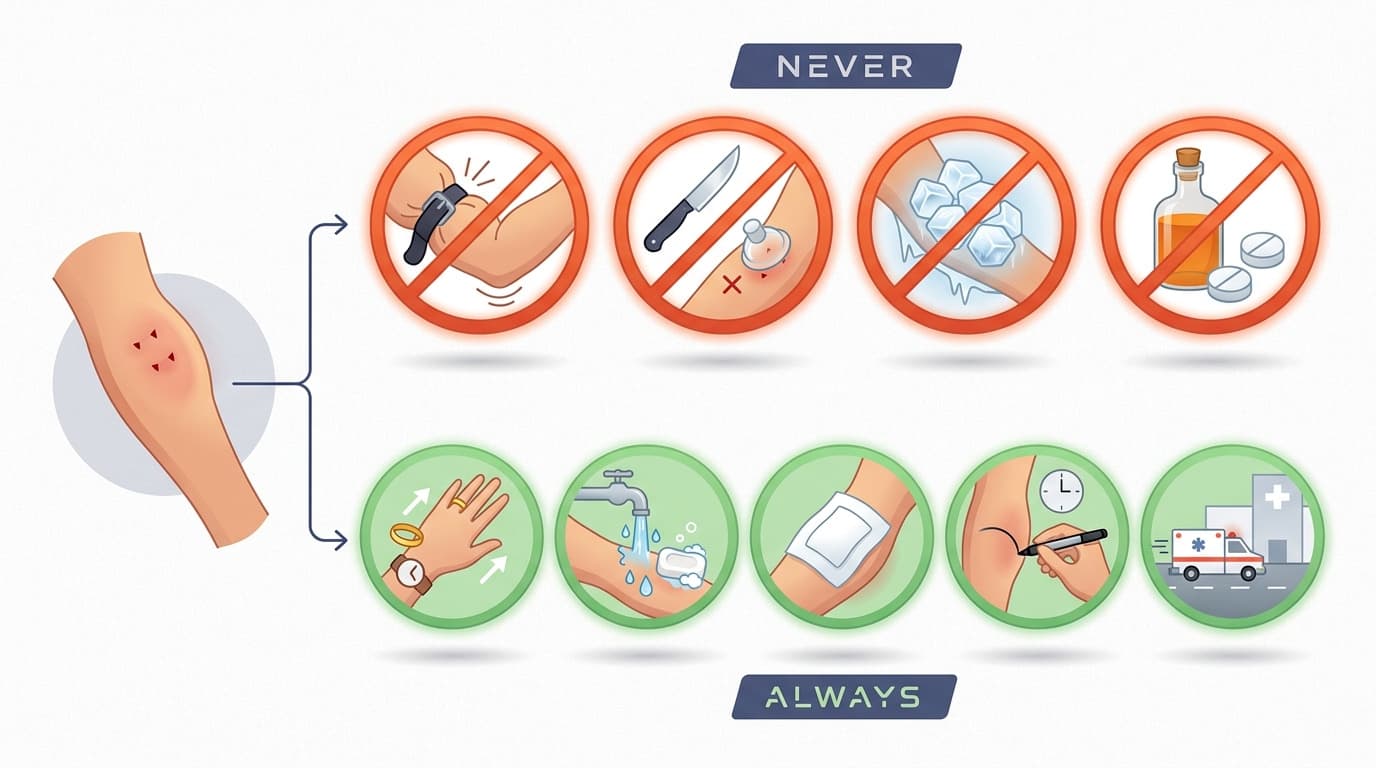
The tourniquet. Restricting blood flow does keep the venom from spreading — and that is precisely the problem. Venom held concentrated at the bite destroys tissue there, while the tourniquet simultaneously cuts off circulation to healthy tissue below it. It converts a serious local injury into a limb-threatening one.
Cutting and suction. Neither removes meaningful venom. The published emergency medicine assessment of commercial suction devices is titled, bluntly, "Snakebite suction devices don't remove venom: They just suck." What they and a knife do reliably is damage tissue and introduce infection at a site already compromised.
Ice and immersion. Cooling does not neutralise venom, and it adds cold injury to a limb whose circulation is already in trouble.
Alcohol and anti-inflammatory painkillers. NIOSH advises against alcohol as a painkiller and against aspirin, ibuprofen and naproxen — those increase bleeding risk in a casualty whose clotting may already be affected.
So the list of things not to do is not caution. It is the treatment.
What NIOSH actually says to do#
Short, and every item is doable by a crew.
Get to hospital — do not wait for symptoms to appear. The only effective treatment is antivenom, and it is not on your site.
Lay or sit the person down with the bite in a neutral position of comfort.
Remove rings and watches before swelling starts. This is the item that saves fingers, and there is a very short window for it.
Wash the bite with soap and water, and cover it with a clean, dry dressing.
Mark the leading edge of tenderness and swelling on the skin, and write the time alongside it. Then do it again as it advances. This is the anchor made practical — a marker pen turns the crew into the hospital's data source on how fast the envenomation is progressing.
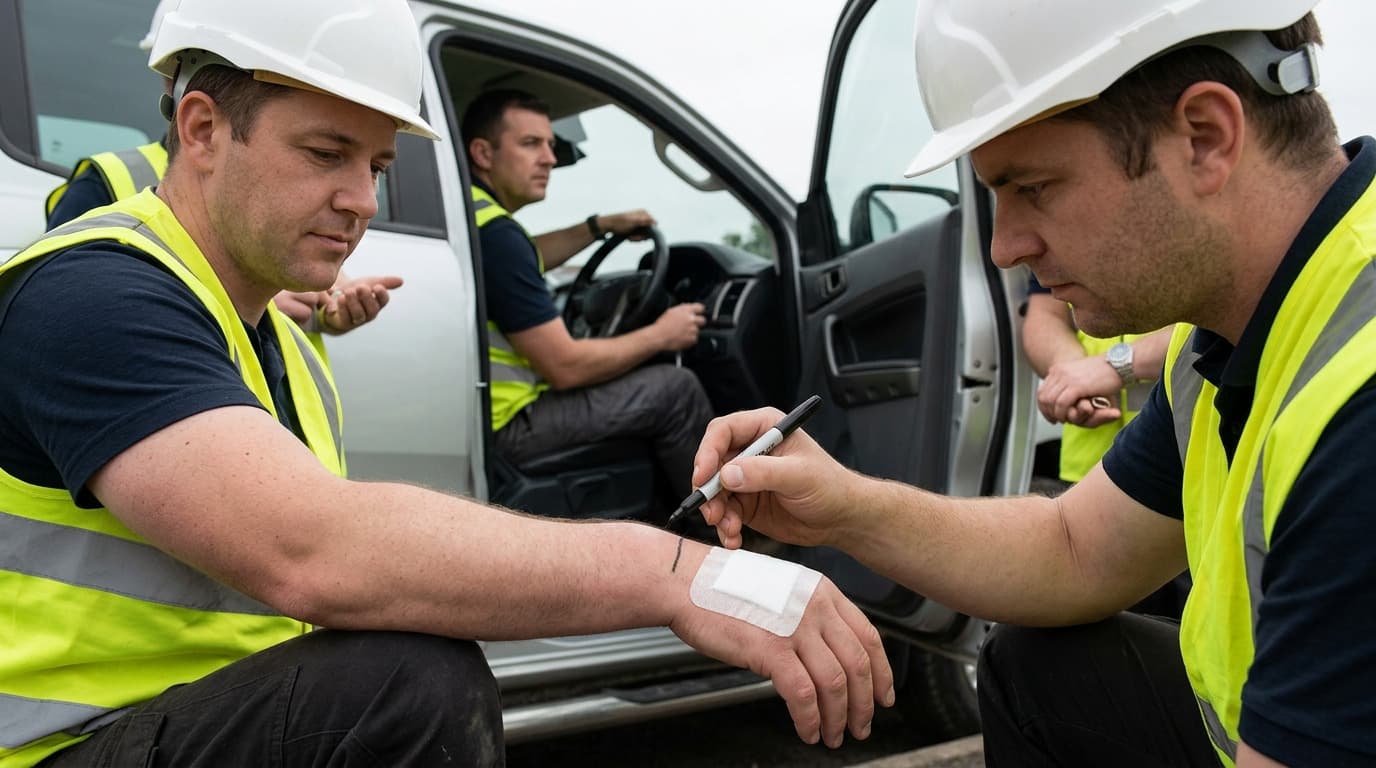
Never handle the snake. NIOSH is explicit: do not pick it up, do not try to trap it, and never handle a venomous snake, not even a dead one or its decapitated head. A photograph from a safe distance is acceptable only if it costs no time; identification is useful but it is not worth a second casualty.
Spiders are the same hazard with the opposite first aid#
This is the part that catches people out, and it is worth stating slowly because the two instructions sit side by side in the same NIOSH guidance.
For a snakebite: do not apply ice. For a spider bite: apply cold.
NIOSH's guidance for spider bites is to stay calm, identify the spider if it can be done safely, wash the bite with soap and water, apply a cloth dampened with cold water or filled with ice to reduce swelling, elevate the bite area if possible, do not attempt to remove venom, notify your supervisor, and seek professional medical attention immediately.
Two bites, two opposite instructions about ice. If a crew has only learned "cold pack for everything," half of that is actively wrong.
Black widow. Red colouring on the underside of the abdomen; builds webs between objects, so bites often happen on contact with a web; the bite leaves two puncture marks; the venom is a neurotoxin producing pain at the bite that then spreads to the chest, abdomen or the whole body. Found throughout North America, most common in the southern and western US.
Brown recluse. Violin-shaped marking; the bite site can develop into a small white blister and then a severe lesion needing medical attention, which heals slowly and may scar.
And the general rule for both: spiders are not aggressive. Most bites happen because a spider is trapped or touched — which tells you exactly where the control is.
Note also that spider bites can become infected, and tetanus status becomes a question. How that is treated for recording purposes sits in the reporting minor injuries talk.
Where they are on a construction site#
Not in the wild. In the things the crew handles.
Stacked and stored materials — pipe, block, timber, formwork, anything that has sat for a week. Spoil heaps and rubble. Crawl spaces, culverts, voids and manholes. Plant and equipment left standing. Site cabins, stores and welfare units. And the one that produces the hand and foot bites: gloves, boots and PPE left out overnight, which are a warm dark cavity to a spider and an obvious shelter to a snake.
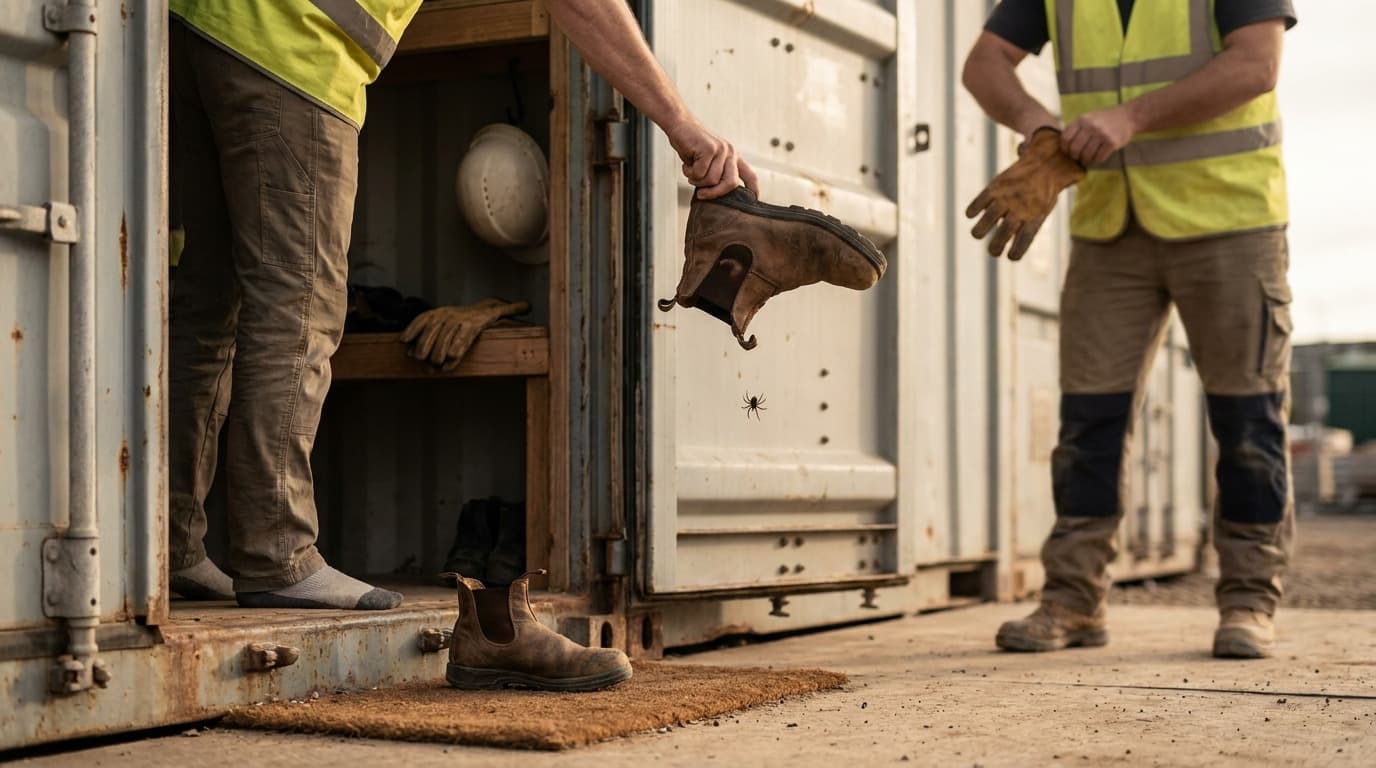
The controls follow directly. Shake out gloves and boots before putting them on. Look before reaching into anything you cannot see the bottom of. Move stored material with a tool or a machine, not bare hands. Wear boots and long trousers for vegetation and spoil work. And give a snake room to leave — most bites happen to people who approached, handled or tried to kill one.
Where the duty sits#
There is no OSHA standard for snakes or spiders, but there is a construction training provision written for exactly this situation and most crews have never seen it.
1926.21(b)(4): "In job site areas where harmful plants or animals are present, employees who may be exposed shall be instructed regarding the potential hazards, and how to avoid injury, and the first aid procedures to be used in the event of injury."
Note what it demands: instruction in avoidance and in the first aid procedures. Given that the correct first aid here is mostly a list of things not to do, this provision is the reason a talk like this is a compliance activity rather than a nice extra.
Alongside it: 1926.50 covers medical services and first aid, including arrangements for transport to a physician or hospital — which for this hazard is the whole treatment. 1926.95 and 1926.28(a) cover PPE, which here means boots, long trousers and, where the risk justifies it, snake gaiters. And Section 5(a)(1) applies where nothing specific does.
What can go wrong?#
Applying a tourniquet, concentrating venom at the bite and starving healthy tissue below it.
Cutting or sucking the wound, which removes no meaningful venom and damages tissue.
Packing the limb in ice, adding cold injury to a compromised limb.
Giving ibuprofen or alcohol, increasing bleeding risk.
Waiting to see whether symptoms develop instead of moving to hospital.
Leaving rings and a watch on until the hand has swollen.
Trying to kill, catch or photograph the snake, including handling a dead one.
Putting on gloves or boots that have been left out overnight, without shaking them out.
How do we manage this properly?#
Teach the "do not" list as the treatment, not as a caveat — no tourniquet, no cutting, no suction, no ice on a snakebite, no alcohol, no aspirin or ibuprofen.
Get a marker pen into the first aid kit and make sure the crew knows what it is for: mark the leading edge of swelling and write the time.
Remove rings and watches immediately, before swelling starts.
Move to hospital without waiting for symptoms — antivenom is the treatment and it is not on site.
Know in advance which hospital stocks antivenom and how long it takes to get there. On a remote site that is the single most important number in this talk.
Never handle the snake, alive or dead, and do not delay transport for identification.
Remember the ice rule runs opposite for spiders — cold is correct for a spider bite, wrong for a snakebite.
Shake out gloves, boots and PPE before use, every time.
Look before reaching, and move stored material with a tool.
Before you start#
- Confirm what venomous species are present in this region and season.
- Confirm the crew knows the "do not" list for snakebite first aid.
- Confirm there is a marker pen in the kit and people know why.
- Confirm which hospital stocks antivenom and how long transport takes.
- Confirm boots and long trousers are being worn for spoil and vegetation work.
- Confirm gloves, boots and PPE have not been left out overnight, or will be shaken out.
- Confirm stored materials will be moved with a tool rather than bare hands.
- Confirm everyone knows not to handle a snake, including a dead one.
Talk it over#
- If somebody was bitten on the hand right now, what would each of us reach for first?
- How long would it take to get from here to a hospital with antivenom?
- Where on this site has material been sitting undisturbed longest?
- Who left their gloves out overnight?
The bottom line#
With a venomous bite, almost everything the crew has been taught to do actively increases the harm — and the most useful thing anybody on site can do is take out a pen and write down the time. The scale reframes the risk: NIOSH reports 7,000 to 8,000 venomous snakebites a year in the US with about 5 deaths, but workers are more likely to suffer long-term injuries than to die, and 10 to 44 percent of rattlesnake bites leave lasting injury such as losing all or part of a finger or the use of it — this is a hand-and-limb hazard, not primarily a death hazard. The discredited measures each fail for a reason: a tourniquet holds venom concentrated where it destroys tissue while starving healthy tissue below; cutting and suction remove no meaningful venom and damage tissue, the published assessment of suction devices being titled "Snakebite suction devices don't remove venom: They just suck"; ice adds cold injury to a compromised limb; and alcohol, aspirin, ibuprofen and naproxen raise bleeding risk. What NIOSH says to do instead: get to hospital without waiting for symptoms, lay or sit the person with the bite in a neutral position of comfort, remove rings and watches before swelling starts, wash with soap and water, cover with a clean dry dressing, and mark the leading edge of tenderness and swelling on the skin with the time alongside it. Never handle the snake — not even a dead one or its decapitated head. For spiders the guidance inverts on one point that catches crews out: do not ice a snakebite, but do apply cold to a spider bite, along with washing, elevating, not attempting to remove venom, notifying a supervisor and seeking medical attention. Black widow — red marking under the abdomen, webs between objects, two puncture marks, a neurotoxin causing pain that spreads to chest, abdomen or the whole body; brown recluse — violin marking, a blister developing into a severe slow-healing lesion. Spiders are not aggressive; most bites happen because one is trapped or touched, which is why the controls are shaking out gloves and boots, looking before reaching, and moving stored material with a tool. On duties, there is no OSHA standard for snakes or spiders, but 1926.21(b)(4) requires that where "harmful plants or animals are present, employees who may be exposed shall be instructed regarding the potential hazards, and how to avoid injury, and the first aid procedures to be used in the event of injury" — with 1926.50 for medical services and transport, 1926.95 and 1926.28(a) for PPE, and 5(a)(1) behind them.
Frequently asked questions about venomous snakes and spiders#
Should we use a tourniquet, or cut and suck the bite?
No to all of it. A tourniquet keeps the venom concentrated at the bite, which is exactly where it destroys tissue, while cutting off circulation to healthy tissue below — turning a serious local injury into a limb-threatening one. Cutting and suction remove no meaningful venom; the published emergency medicine assessment of suction devices is titled "Snakebite suction devices don't remove venom: They just suck." Both reliably damage tissue and introduce infection.
What should we actually do while waiting for transport?
NIOSH's list is short. Lay or sit the person down with the bite in a neutral position of comfort. Remove rings and watches before swelling starts. Wash the bite with soap and water. Cover it with a clean, dry dressing. Mark the leading edge of tenderness and swelling on the skin and write the time alongside it. And do not wait for symptoms to appear — get medical help right away, because the only effective treatment is antivenom.
Why does marking the swelling matter so much?
Because it is the only record of how fast the envenomation is advancing, and that is what the hospital uses to judge severity and antivenom decisions. Nobody at the hospital saw the limb an hour ago; the crew did. A marker line at the leading edge of tenderness and swelling, with the time written beside it and repeated as it advances, converts the people standing there into the most useful diagnostic instrument available.
Is a snakebite likely to kill somebody?
Usually not, and that is not the right thing to be protecting against. NIOSH reports 7,000 to 8,000 venomous snakebites a year in the US and about 5 deaths — but states that workers are more likely to suffer long-term injuries than to die, with 10 to 44 percent of rattlesnake bites causing lasting injury, such as losing all or part of a finger or the ability to use it. The first hour is protecting somebody's hand, which is why the harmful traditional measures matter.
Do we ice a spider bite or not?
Yes for spiders, no for snakes — and this is the detail that catches crews out. NIOSH's spider bite guidance is to wash the bite with soap and water, apply a cloth dampened with cold water or filled with ice to reduce swelling, elevate the area, not attempt to remove venom, notify your supervisor and seek medical attention immediately. For a snakebite, ice is explicitly on the do-not list. A crew that has learned "cold pack for everything" has half of it wrong.
Where on a construction site do these actually turn up?
In handled things, not in the wild. Stacked and stored materials that have sat a while, spoil heaps and rubble, crawl spaces, culverts, voids and manholes, plant left standing, cabins and stores — and most reliably, gloves, boots and PPE left out overnight, which are a warm dark cavity to a spider and shelter to a snake. Spiders are not aggressive; most bites happen because one is trapped or touched, so shaking out gloves and boots is a real control.
Is there an OSHA standard for this?
There is no OSHA standard for snakes or spiders, but 1926.21(b)(4) covers it directly: "In job site areas where harmful plants or animals are present, employees who may be exposed shall be instructed regarding the potential hazards, and how to avoid injury, and the first aid procedures to be used in the event of injury." That requires instruction in avoidance and first aid procedures, not just awareness. 1926.50 covers medical services and transport arrangements, 1926.95 and 1926.28(a) cover PPE, and Section 5(a)(1) applies behind them.
Download the venomous snakes and spiders toolbox talk PDF#
Get this venomous snakes and spiders toolbox talk as a print-ready PDF — available in English, Spanish, Portuguese, and Turkish. Print it, hand it to the crew, and collect signatures on the included attendance sheet.
Download the PDF — free account required. New members get 3 free downloads.
Related toolbox talks#
Sources#
- NIOSH / CDC, Venomous Snakes at Work: https://www.cdc.gov/niosh/outdoor-workers/about/venomous-snakes.html
- NIOSH / CDC, Venomous Spiders at Work: https://www.cdc.gov/niosh/outdoor-workers/about/venomous-spiders.html
- OSHA, 29 CFR 1926.21 — Safety training and education: https://www.osha.gov/laws-regs/regulations/standardnumber/1926/1926.21
This talk is general awareness guidance for training purposes. It is not medical advice and nothing in it is a diagnosis. All bites should be treated as potentially venomous until assessed. Anyone bitten by a snake or spider should be moved to medical care without waiting for symptoms and assessed by a qualified medical professional.
Written by FieldSafetyTalk's safety professional — a CSP, ASP, CHST and OSHA Authorized Outreach Trainer with 14+ years of international construction safety experience across federal, heavy civil, and industrial projects.