Static Electricity Hazards
Updated 2026-07-28
In this bundle Electrical Safety
Print-ready PDF
Download this talk as a print-ready PDF, available in 4 languages.
Static is the hazard nobody logs. It leaves no damaged component, no tripped breaker and no burnt insulation to point at afterwards — just a fire that started at a moment when nothing appeared to be happening. This Static Electricity Hazards Toolbox Talk (Safety Talk / Tailgate Talk) is about where the charge comes from on a construction site, and about the two words people use as though they meant the same thing.
Here is the distinction that carries this whole talk: bonding connects two objects to each other; grounding connects an object to earth. Bonding removes the difference in potential between two things, so no spark can jump between them. Grounding gives an accumulated charge somewhere to drain. You can bond two drums together and still have both floating at the same high potential — and you can ground a metal frame while an insulated part sitting on it keeps charging. Static control usually needs both, and saying "it's grounded" answers only half the question.
The only place OSHA puts a number on static#
Search Part 1926 for a general static-electricity standard and there is none. What exists are provisions attached to specific operations — and one of them contains the only numerical specification for static control in the whole construction part.
1926.905(u) requires that when loading blasting agents pneumatically over electric blasting caps, semiconductive delivery hose shall be used and the equipment shall be bonded and grounded.
Then 1926.914(aa) defines the hose:
Semiconductive hose — a hose with an electrical resistance high enough to limit flow of stray electric currents to safe levels, yet not so high as to prevent drainage of static electric charges to ground; hose of not more than 2 megohms resistance over its entire length and not less than 5,000 ohms per foot meets the requirement.
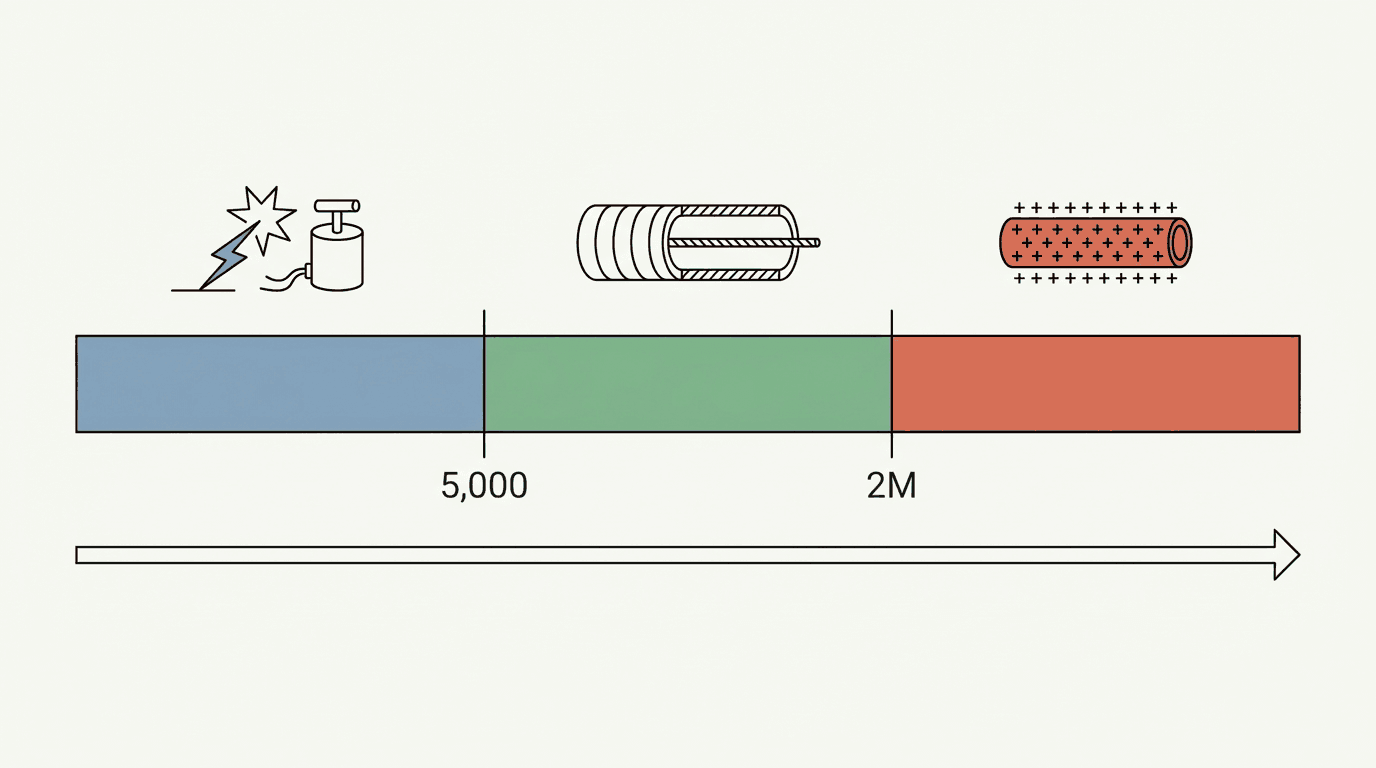
Read the shape of that definition rather than the numbers. It is a window with a ceiling and a floor, and it exists because both extremes are lethal in that operation. Too conductive, and stray current can reach an electric blasting cap. Too insulating, and the charge generated by ammonium nitrate prills blowing down a hose at speed has nowhere to go, and it will find somewhere.
That is static in one paragraph: it is a hazard of materials moving against each other, and the control is a path for the charge to leave that is neither absent nor excessive.
Where the charge actually comes from#
Charge separates whenever two materials in contact are pulled apart, and the drier and more insulating they are, the more of it stays behind. On a construction site that means:
- Pouring, blowing or conveying powders — cement, silica flour, plaster, fillers, grain, ammonium nitrate. Flow through a hose or chute generates charge continuously.
- Liquid transfer — fuel and solvent moving through a hose or splashing into a container. That case is governed by 1926.152(e)(2), which requires transfer only when the containers are electrically interconnected, and it is covered in the fuel storage talk.
- Plastic sheeting — polythene being unrolled, pulled off a stack, flapping in the wind, or dragged over a surface. Sheeting is one of the strongest charge generators on a site, and it cannot be bonded or grounded.
- Belts and moving machinery — drive belts running on pulleys, conveyors, dust extraction ducting.
- Spraying and blasting — paint, coatings and abrasive media leaving a nozzle at velocity.
- People — walking on an insulating floor, getting out of a vehicle seat, peeling off a synthetic layer. A person wearing insulating footwear is an ungrounded conductor, and can accumulate enough charge to produce a spark you can feel.
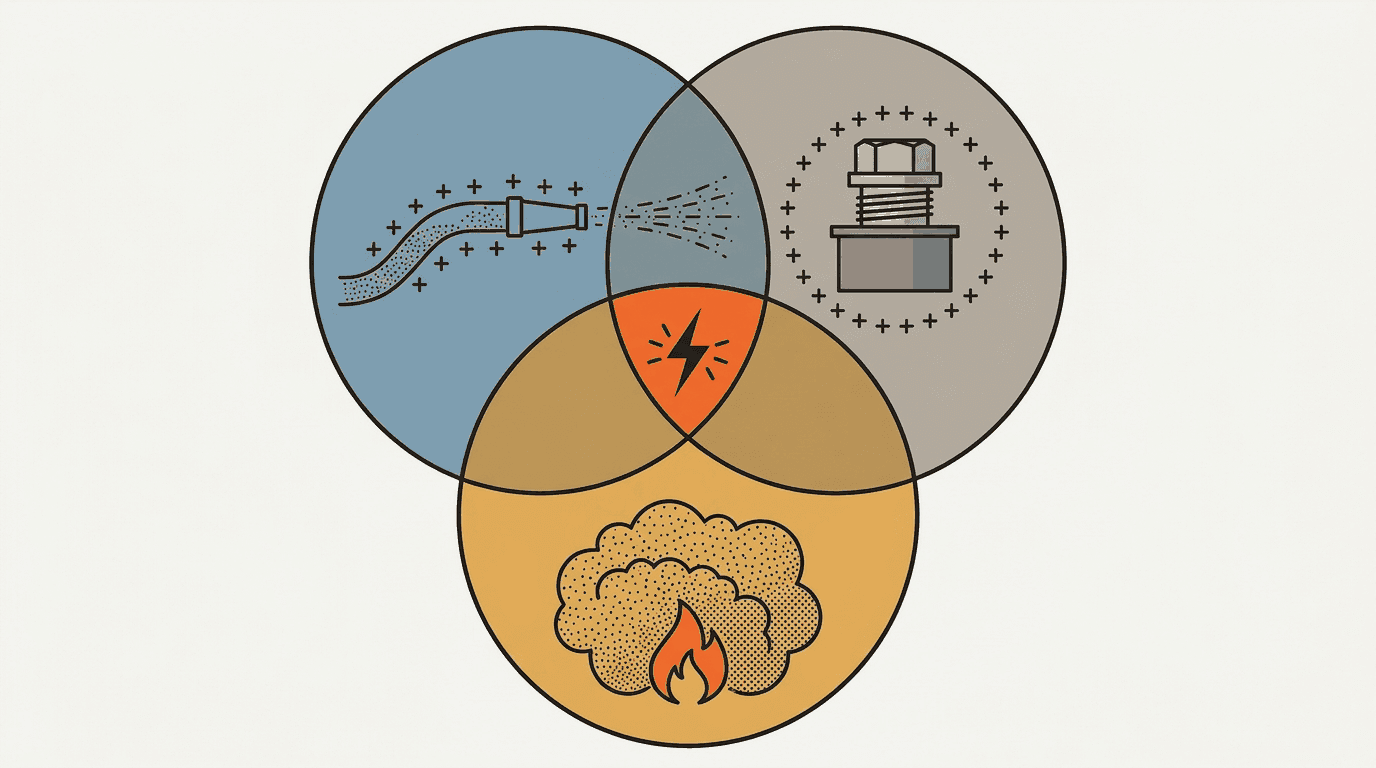
Charge is not the hazard by itself. Three things have to line up: a way to generate it, something insulated enough to hold it, and a flammable atmosphere in the discharge gap. Take away any one and there is no event. Removing the third — the atmosphere — is usually the strongest control available, which is why static and ventilation are the same conversation.
The things that can be neither bonded nor grounded#
Bonding and grounding work on conductors. A metal drum, a metal chute, a pump body, a machine frame — all of these can be tied together and to earth, and the charge leaves.
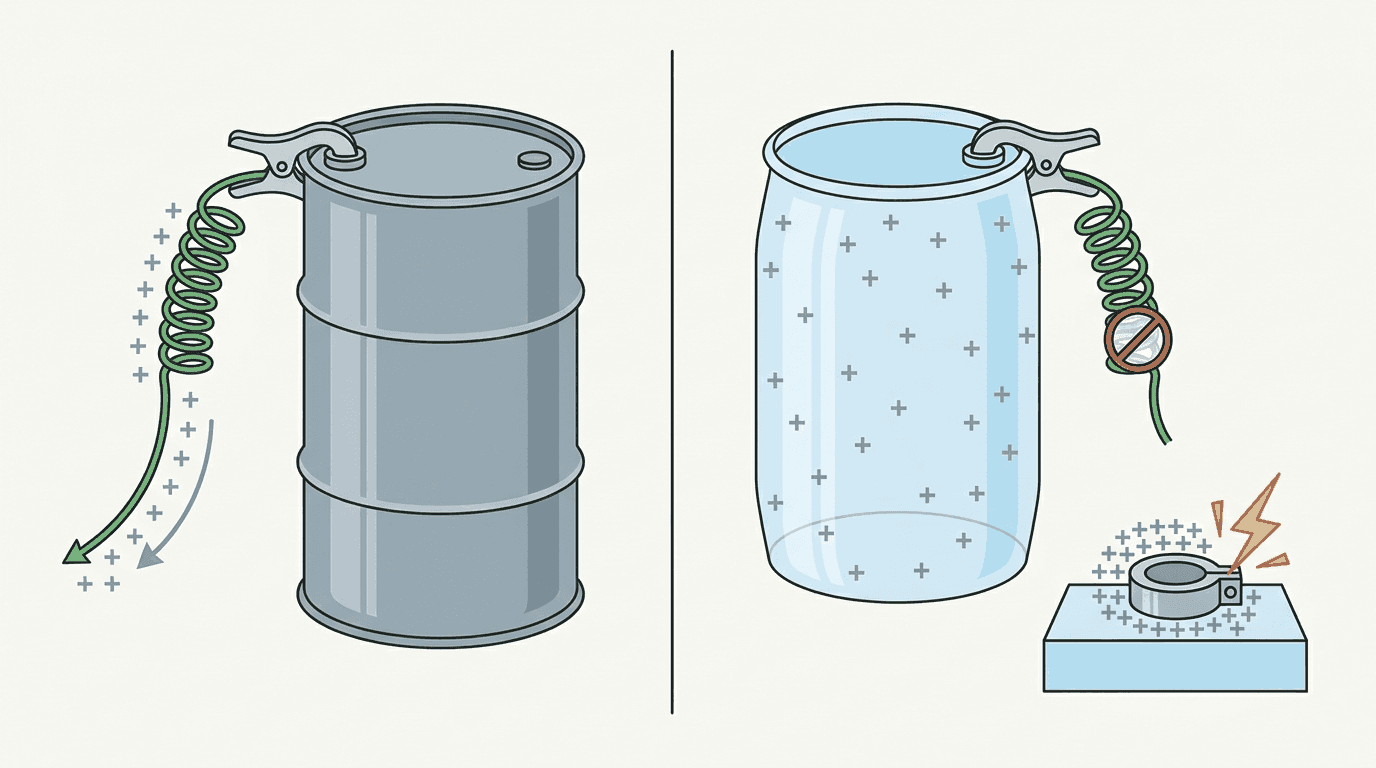
The problem items on a modern site are the ones that cannot:
- Plastic containers and non-conductive vessels. A clamp on a plastic can bonds nothing. The material cannot conduct the charge to the clamp in the first place.
- Plastic sheeting, liners and bagging. Charge sits on the surface and stays there.
- Insulating hoses and non-conductive ducting — which is precisely the failure mode the semiconductive hose definition was written to prevent.
- An isolated conductor sitting on an insulator. A metal flange on a plastic pipe, a metal fitting on a hose, a drum on a pallet, a scaffold clip on a sheet. These are the dangerous ones: they conduct well enough to accumulate a charge across their whole surface, then release it in one spark rather than leaking away slowly.
Two more practical points. Humidity matters — dry air, dry seasons and heated enclosures all raise the accumulated charge, so the same operation that has been uneventful for six months can behave differently in a dry spell. And you will usually not feel the discharge that matters: the spark energy that ignites a solvent vapour or a fine dust cloud can be well below the level at which a person notices a shock.
What can go wrong?#
Transfer into an ungrounded or non-conductive container. The classic ignition event, and the reason the fuel rules are written the way they are.
Sheeting near solvent work. Polythene enclosure, coating or adhesive vapours inside it, and a large charged plastic surface a few feet away.
Dust in an enclosed space. Cutting, grinding, bagging or blowing fine material inside a container or a partly enclosed floor, with an isolated metal fitting in the middle of it.
A bonding cable that connects nothing. Clamped over paint, over rust, onto a plastic handle, or with a broken conductor inside the lead.
Grounding assumed from the equipment ground. An equipment grounding conductor exists to clear faults. It may or may not provide a static drain path for the particular part that is charging.
The wrong hose. Non-conductive hose used where a semiconductive one is specified — or, in blasting work, a wire-reinforced hose which introduces a stray-current path of its own.
Dry weather. The change nobody records: the operation did not change, the humidity did.
How do we control it?#
Bond first, then ground. Connect the two objects that will exchange charge to each other, then provide a path to earth. Metal-to-metal, on clean bare metal, before the transfer starts and until it finishes.
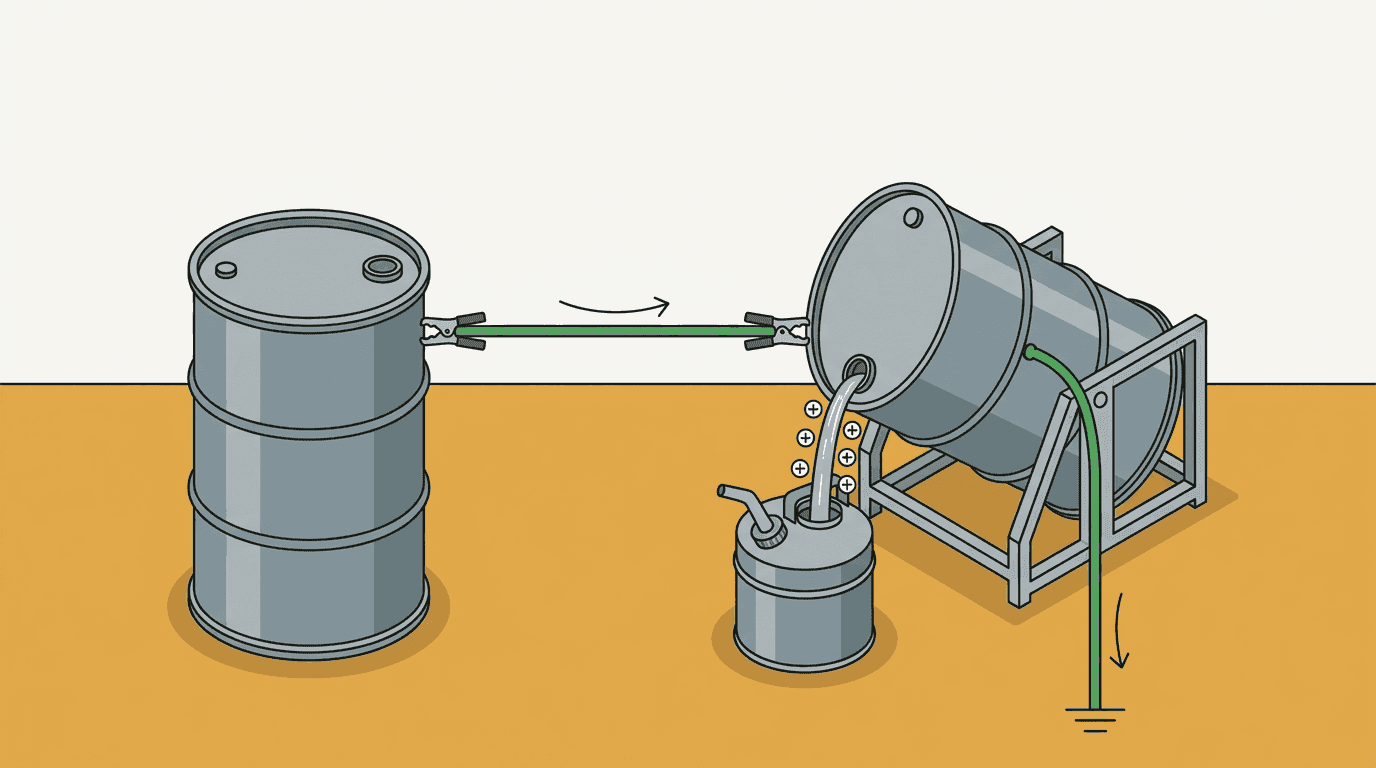
Check the connection, not the cable. Bare metal to bare metal, clamps biting through paint and rust, leads continuous, connections made before flow begins.
Use conductive or semiconductive equipment where the standard or the manufacturer specifies it — including semiconductive delivery hose where 1926.905(u) requires it, with the equipment bonded and grounded.
Slow the process down. Charge generation rises with velocity and turbulence. Reduce flow rates, avoid free-fall splashing, use dip pipes and bottom fill where they are available.
Remove the atmosphere. Ventilate, keep vapour and dust concentrations down, and do not create an enclosure that traps them around a charging operation.
Keep plastic away from flammable atmospheres. Sheeting, liners and non-conductive containers do not belong close to solvent, fuel or fine-dust work.
Watch the weather. In dry conditions, increase the caution on the same tasks rather than assuming the last six months are evidence.
Ground yourself deliberately where the work warrants it — touch a grounded metal surface away from the opening before you begin, and be aware that insulating footwear on a dry surface leaves you charged.
Before you start#
- Confirm what in this task will generate charge: powder, liquid, sheeting, spraying, or a belt.
- Confirm whether a flammable atmosphere can exist in the same place at the same time.
- Confirm every metal item involved is bonded to the others and grounded, on bare metal.
- Confirm no plastic or non-conductive container is being used where charge will be generated.
- Confirm the hose or ducting is the type specified for the operation.
- Confirm ventilation is adequate to keep vapour and dust out of the flammable range.
- Confirm there is no isolated metal fitting sitting on an insulator in the middle of the operation.
Talk it over#
- What are we moving, pouring or unrolling today that could generate a charge?
- Where on this site is there plastic sheeting close to solvent or fuel work?
- Has anyone here been shocked by touching a machine, a frame or a vehicle? Where was that?
- Has the weather been dry this week — and does that change anything we are about to do?
The bottom line#
Bonding equalises potential between two objects; grounding drains charge to earth, and most static controls need both. Part 1926 has no general static standard — its provisions attach to specific operations, and the only numerical one is 1926.914(aa), which defines semiconductive hose as not more than 2 megohms over its length and not less than 5,000 ohms per foot: a deliberate window, because too conductive and stray current reaches an electric blasting cap, too insulating and the static has nowhere to drain. 1926.905(u) requires that hose, bonded and grounded, for pneumatic loading over electric caps, and 1926.152(e)(2) governs the flammable-liquid transfer case in the fuel storage talk. Everything else is the same three-part problem: generation, accumulation on something insulated, and a flammable atmosphere in the gap. Break any one of the three.
Frequently asked questions about static electricity on construction sites#
What is the difference between bonding and grounding?
Bonding connects two or more objects together so there is no difference in potential between them and no spark can jump between them. Grounding connects an object to earth so accumulated charge can drain away. They do different jobs, and static control commonly requires both — bonding the containers to each other, and grounding the assembly.
Does OSHA have a static electricity standard for construction?
There is no general one. Static requirements in Part 1926 are attached to particular operations — for example 1926.152(e)(2) for transferring flammable liquids between containers, and 1926.905(u) for pneumatic loading of blasting agents over electric blasting caps, which requires semiconductive delivery hose with the equipment bonded and grounded. NFPA 77, the recommended practice on static electricity, is the consensus document contracts commonly point to.
What is semiconductive hose, and why is there a range?
1926.914(aa) defines it as a hose with resistance high enough to limit flow of stray electric currents to safe levels, yet not so high as to prevent drainage of static electric charges to ground — met by hose of not more than 2 megohms over its entire length and not less than 5,000 ohms per foot. The range exists because both extremes are dangerous: too conductive risks stray current reaching an electric blasting cap, too insulating traps the static charge.
Can you bond a plastic container?
No. Bonding and grounding move charge through a conductor, and a plastic or otherwise non-conductive container cannot carry the charge to the clamp. This is why non-conductive containers are the wrong choice wherever charge will be generated, and it is the point developed further in the fuel storage talk.
Why is plastic sheeting a static hazard?
Because unrolling, dragging or peeling it separates surfaces on a large scale, and the material holds the resulting charge instead of letting it drain. A charged sheet near a flammable vapour or a fine dust cloud is a discharge waiting for a nearby conductor — and unlike a drum, there is no way to bond it.
Do I have to feel a shock for static to be dangerous?
No, and this is the part that misleads people. The spark energy that will ignite a solvent vapour or a fine airborne dust can be well below the level at which a person feels a discharge. A process that has never given anyone a shock is not evidence that the charge is not accumulating.
Does dry weather really make a difference?
Yes. Lower humidity means less surface conductivity, so charge that would otherwise leak away slowly is retained instead. The same task in the same place can behave differently in a dry spell — which is why "we have always done it this way" is a weak answer to a static question.
Download the static electricity toolbox talk PDF#
Get this static electricity hazards toolbox talk as a print-ready PDF — available in English, Spanish, Portuguese, and Turkish. Print it, hand it to the crew, and collect signatures on the included attendance sheet.
Download the PDF — free account required. New members get 3 free downloads.
Related toolbox talks#
Sources#
- OSHA, 29 CFR 1926.914 — Definitions applicable to this subpart: https://www.osha.gov/laws-regs/regulations/standardnumber/1926/1926.914
- OSHA, 29 CFR 1926.905 — Loading of explosives or blasting agents: https://www.osha.gov/laws-regs/regulations/standardnumber/1926/1926.905
- OSHA, 29 CFR 1926.152 — Flammable liquids: https://www.osha.gov/laws-regs/regulations/standardnumber/1926/1926.152
Written by FieldSafetyTalk's safety professional — a CSP, ASP, CHST and OSHA Authorized Outreach Trainer with 14+ years of international construction safety experience across federal, heavy civil, and industrial projects.