Reporting Minor Injuries
Updated 2026-07-28
In this bundle Jobsite Fundamentals & Compliance
Print-ready PDF
Download this talk as a print-ready PDF, available in 4 languages.
The injuries that end careers are rarely the ones that looked serious at the time. A cut that gets infected. A knee that was "fine" for three weeks. An eye that was rinsed out and forgotten. Every one of those started as something the person decided was too small to mention — and the decision not to mention it is what turned a minor injury into a problem. This Reporting Minor Injuries Toolbox Talk (Safety Talk / Tailgate Talk) is about why that decision gets made and what the rules actually say.
Here is the distinction that carries this whole talk: reporting and recording are two different things, and workers are being asked to do the first. Whether a case ends up on a log is a recordkeeping question with precise legal criteria, and it is the employer's problem. Whether an injury gets mentioned at all is the worker's decision — and people routinely suppress that decision because they think they are saving somebody paperwork or protecting a record. They are not. They are removing the only chance to treat something early.
First aid or medical treatment — the line that decides recordability#
1904.7(b)(5)(ii) defines first aid for recordkeeping purposes as the following, and nothing else:
- Using a non-prescription medication at non-prescription strength — a recommendation to use it at prescription strength is medical treatment
- Administering tetanus immunisations — other immunisations such as hepatitis B or rabies vaccine are medical treatment
- Cleaning, flushing or soaking wounds on the surface of the skin
- Wound coverings such as bandages, gauze pads, butterfly bandages or Steri-Strips — sutures and staples are medical treatment
- Hot or cold therapy
- Non-rigid means of support such as elastic bandages, wraps and non-rigid back belts — devices with rigid stays designed to immobilise are medical treatment
- Temporary immobilisation devices used while transporting an accident victim
- Drilling of a fingernail or toenail to relieve pressure, or draining fluid from a blister
- Eye patches
- Removing foreign bodies from the eye using only irrigation or a cotton swab
- Removing splinters or foreign material from areas other than the eye by irrigation, tweezers, cotton swabs or other simple means
- Finger guards
- Massages — physical therapy or chiropractic treatment are medical treatment
- Drinking fluids for relief of heat stress
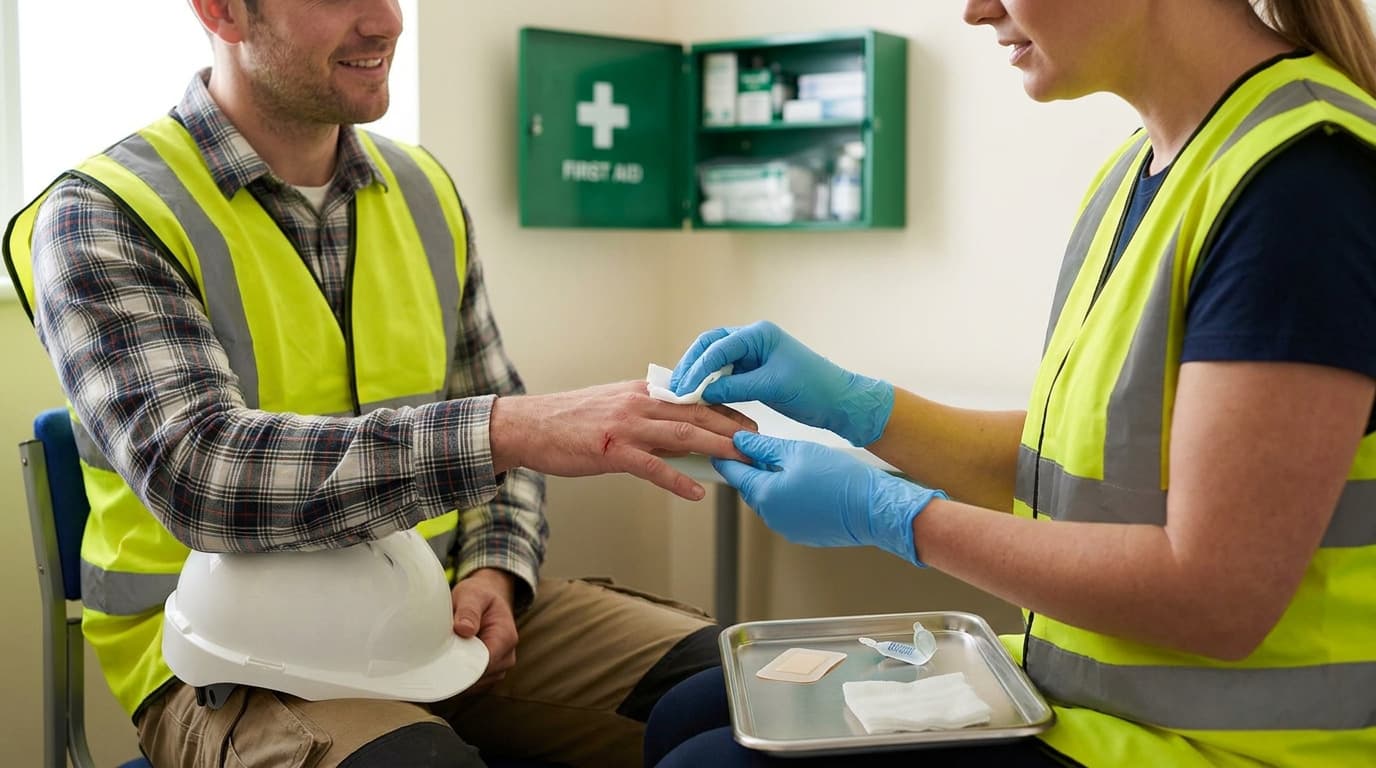
And then the sentence that settles every argument, at (iii): "No, this is a complete list of all treatments considered first aid for part 1904 purposes." It is a closed list. If a treatment is not on it, it is not first aid.
The second rule is the one people get wrong, and it is at (iv): the professional status of the person providing the treatment has no effect. OSHA considers the listed treatments to be first aid regardless of who provides them — even when provided by a physician or other licensed health care professional.
So the intuitions everyone brings are both wrong. Going to hospital does not make it recordable, if all they did was clean the wound and apply a dressing. And being treated on site does not make it first aid, if somebody gave prescription-strength medication. It is the treatment that decides, not the treater and not the location.
Two related points: diagnostic procedures such as x-rays and blood tests are not medical treatment, and a visit to a physician solely for observation or counselling is not either. But if a physician recommends medical treatment, the case is recordable even if the employee does not follow the recommendation.
The reporting clocks — 1904.39#
Separate from the log, four events must be reported to OSHA:
A work-related fatality — within 8 hours.
A work-related in-patient hospitalisation, amputation, or loss of an eye — within 24 hours.
These are notification duties with a running clock, and the clock starts when the employer learns of the event. They are not discretionary and they are not satisfied by entering the case on the log.
Deterring reports is itself a violation#
1904.35 requires the employer to establish a reasonable procedure for employees to report work-related injuries and illnesses promptly and accurately — and a procedure is not reasonable if it would deter or discourage a reasonable employee from reporting.
That is worth sitting with, because it makes several common practices into problems rather than policies. A safety bonus that disappears when someone reports. A programme that awards prizes for days without a recordable. Automatic drug testing after any injury regardless of circumstance. Making the reporter explain themselves in front of the crew. None of those forbid reporting outright — they simply make it expensive, which is exactly what the provision addresses.
And separately, 1904.36 applies Section 11(c) of the OSH Act: employees are protected from discrimination for reporting.
Why people stay quiet#
They think it is not worth the fuss. A graze, a knock, a bit of grit — and mentioning it feels disproportionate.
They do not want to break a run. Boards counting days since the last recordable turn every injury into a personal decision about the whole crew's number.
They fear consequences. Being seen as careless, losing hours, losing a placement, or being tested.
They intend to see how it goes. Which is reasonable-sounding and is exactly how a small injury becomes a late diagnosis.
Nobody knows how. No obvious route, or a route that requires finding a specific person who is not there on nights.
It happened at the end of the shift and mentioning it means staying late.

What can go wrong?#
An infected cut that was never cleaned properly or watched.
An eye injury rinsed and forgotten, with a fragment still present.
A strain that becomes chronic because it was worked through for a fortnight.
A late report questioned for legitimacy, because the delay itself now looks suspicious — which punishes exactly the behaviour you were trying to encourage.
A hazard left in place. The injury was the signal, and nobody received it.
A reporting deterrent operating as policy — bonuses, boards, blanket testing.
Recordability decided by guesswork, with cases misclassified in both directions.
Nobody at hospital knows what caused it, because the mechanism was never captured.
How do we do this properly?#
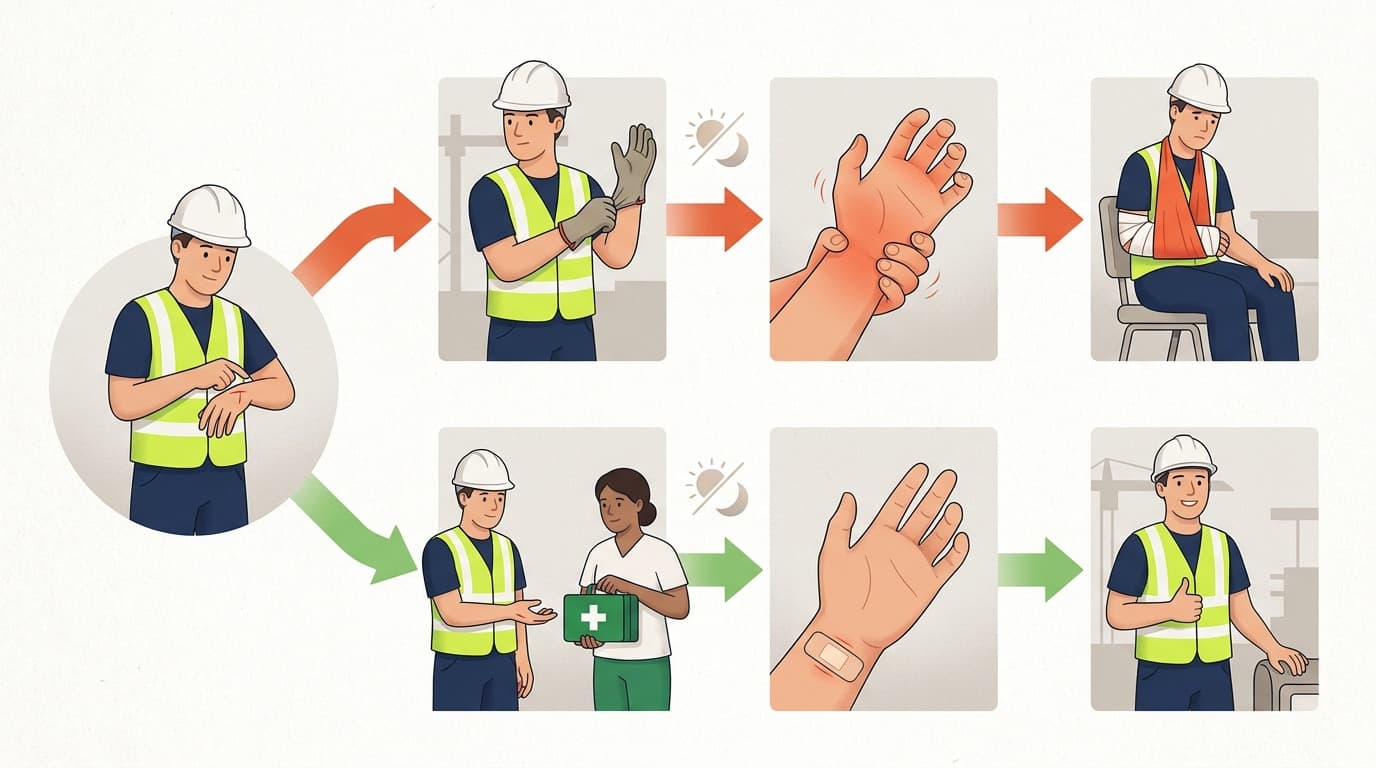
Report everything, including what looks trivial. Reporting costs a minute. Not reporting costs the option to treat it early.
Separate reporting from recording in how you talk about it. Workers report; the employer determines recordability against 1904.7. Confusing the two is what makes people feel they are making a legal decision.
Make the route obvious and available on every shift — a named person, and a fallback when that person is absent.
Never let the response punish the reporter. No interrogation in front of the crew, no automatic assumption of fault, no testing without a reason connected to the incident.
Remove reporting deterrents. Look hard at bonus schemes, day counters and prize programmes, because 1904.35 treats a procedure that discourages reporting as unreasonable.
Apply the first aid list precisely. Check the treatment against 1904.7(b)(5)(ii), not against how bad it looked.
Watch the clocks. 8 hours for a fatality, 24 hours for in-patient hospitalisation, amputation or loss of an eye.
Close the loop. Tell the person what happened as a result of their report — it is the single strongest predictor of whether they report the next one.
Before you start#
- Confirm you know who to report an injury to today, including on this shift.
- Confirm you know the fallback if that person is unavailable.
- Confirm the crew understands that reporting is not the same as being recorded.
- Confirm nothing in the site's incentives makes reporting costly.
- Confirm anyone with an untreated cut, strain or eye irritation from a previous shift has raised it.
- Confirm first aid supplies are stocked and someone is trained to use them.
- Confirm the person recording knows the first aid list is a closed list.
- Confirm everyone knows the 8-hour and 24-hour reporting duties exist and who discharges them.
Talk it over#
- Has anyone here had an injury this month that they did not mention?
- What would put you off reporting something small?
- Does anything on this site count days since the last recordable — and what does that do to us?
- When you last reported something, did anyone tell you what came of it?
The bottom line#
1904.7(b)(5)(ii) lists what counts as first aid, and (iii) confirms it is a complete list — nothing else qualifies. (iv) settles the argument people actually have: the professional status of the person providing the treatment has no effect, so listed treatments are first aid even when a physician provides them. It is the treatment that decides recordability, not the treater and not the location. Separately, 1904.39 requires reporting a fatality within 8 hours and an in-patient hospitalisation, amputation or loss of an eye within 24 hours. And 1904.35 requires a reasonable procedure for reporting promptly and accurately — one that would deter or discourage a reasonable employee from reporting is not reasonable, which puts day-counters, injury-linked bonuses and blanket post-injury testing squarely in scope. The worker's job is simple: report it, even if it looks like nothing.
Frequently asked questions about reporting minor injuries#
What counts as first aid rather than medical treatment?
1904.7(b)(5)(ii) gives the list — non-prescription medication at non-prescription strength, tetanus immunisations, cleaning or flushing surface wounds, wound coverings including butterfly bandages, hot or cold therapy, non-rigid supports, temporary immobilisation for transport, draining a blister or drilling a nail, eye patches, removing foreign bodies from the eye by irrigation or swab, removing splinters from other areas by simple means, finger guards, massages, and drinking fluids for heat stress. Paragraph (iii) confirms this is a complete list.
Does it become recordable if a doctor treats it?
No — not by itself. 1904.7(b)(5)(iv) provides that the professional status of the person providing the treatment has no effect: the listed treatments are first aid even when provided by a physician or other licensed health care professional. What makes a case recordable is the treatment given, not who gave it or where.
Are x-rays and blood tests medical treatment?
No. Diagnostic procedures such as x-rays and blood tests — including prescription medications used solely for diagnostic purposes — are not medical treatment for Part 1904, and neither is a visit to a physician solely for observation or counselling.
What if the doctor recommends treatment and the worker declines?
The case is still recordable. If a physician or other licensed health care professional recommends medical treatment, you must record the case even if the injured employee does not follow the recommendation — though you should encourage them to follow it.
What has to be reported to OSHA, and how quickly?
Four events. A work-related fatality within 8 hours, and a work-related in-patient hospitalisation, amputation or loss of an eye within 24 hours. These are notification duties separate from entering the case on the log.
Can we run a safety bonus based on injury numbers?
Be careful. 1904.35 requires a reasonable procedure for reporting work-related injuries and illnesses promptly and accurately, and provides that a procedure is not reasonable if it would deter or discourage a reasonable employee from reporting. Incentives tied to injury counts, day-counter boards and blanket post-injury testing all risk operating as exactly that kind of deterrent.
Why report something that will heal on its own?
Because you cannot tell at the time which ones will. A cut that gets infected, an eye with a fragment still in it and a strain worked through for two weeks all looked minor on the day. Reporting also captures the mechanism while it is still known, which is what lets the hazard be fixed before it reaches somebody else.
Download the reporting minor injuries toolbox talk PDF#
Get this reporting minor injuries toolbox talk as a print-ready PDF — available in English, Spanish, Portuguese, and Turkish. Print it, hand it to the crew, and collect signatures on the included attendance sheet.
Download the PDF — free account required. New members get 3 free downloads.
Related toolbox talks#
Sources#
- OSHA, 29 CFR 1904.7 — General recording criteria: https://www.osha.gov/laws-regs/regulations/standardnumber/1904/1904.7
- OSHA, 29 CFR 1904.39 — Reporting fatalities, hospitalizations, amputations, and losses of an eye as a result of work-related incidents: https://www.osha.gov/laws-regs/regulations/standardnumber/1904/1904.39
- OSHA, 29 CFR 1904.35 — Employee involvement: https://www.osha.gov/laws-regs/regulations/standardnumber/1904/1904.35
This talk summarises published regulatory guidance. It is not medical advice. Any injury that is painful, worsening, infected or affecting the eye should be assessed by a qualified health professional regardless of how minor it first appeared.
Written by FieldSafetyTalk's safety professional — a CSP, ASP, CHST and OSHA Authorized Outreach Trainer with 14+ years of international construction safety experience across federal, heavy civil, and industrial projects.